Table of Contents


KEY TAKEAWAYS
- Oracle has announced a planned AI Services Practice that pairs OpenAI models with Oracle applications, data and cloud. Oracle Customer Success Services (CSS) will lead delivery.
- It covers AI agents in Fusion, AI app development on OCI, enterprise data, and security. For enterprises, it signals that AI has moved from experiments to production, and that the delivery partner you choose now matters as much as the model.
What did Oracle just announce?
Oracle is putting a dedicated AI consulting practice on the table, and it is a big move. Oracle CSS will lead customer engagements. OpenAI will help train the Oracle teams, so the people delivering the work will know the technology deeply.
The practice is built around four areas:
| Focus area | What it covers |
|---|---|
| AI in Oracle Fusion Cloud Applications | Agents built with Oracle AI Agent Studio, plus complex, long-running work in Oracle Fusion Agentic Applications and Oracle Fusion Claw |
| AI application development on OCI | OpenAI Codex and APIs working with OCI Enterprise AI to build, test and run solutions |
| Enterprise data with AI | Oracle AI Data Platform, Oracle AI Database and Autonomous AI Lakehouse feeding agents and apps |
| Security with frontier AI | Oracle AI Security Mesh, a managed service using OpenAI cyber models to find and fix vulnerabilities |
Oracle also plans to train and certify one million developers and professionals, including consultants, customers and partners, through Oracle University.
Why is this such a big deal for enterprise AI?
Because the era of AI demos is over. When a platform leader of Oracle’s size builds a practice around getting AI live inside finance, supply chain and HR processes, it tells the market where the real demand sits: production.
Production is the hard part. A proof of concept can impress a boardroom in a week. Making that same AI accurate, secure, affordable and trusted across thousands of daily transactions is what separates winners from stalled pilots. Oracle just put its weight behind solving that problem. That is a gift to every enterprise that has been waiting for AI to get serious.
What changes for enterprise buyers?
More choice, more speed, and a lot more noise. The buying question shifts from “which model?” to four sharper ones:
- Who owns the AI solution after go-live?
- How are accuracy and cost tracked as usage grows?
- Can we use different models for different jobs?
- What happens to the systems that are not Oracle?
That last one is critical. Real enterprises run mixed estates: Oracle Fusion or E-Business Suite, SAP, NetSuite, industry platforms and legacy systems. AI that stops at one platform’s edge fixes only part of the process.
How should you choose between a single-stack and a multi-platform approach?
A single-stack approach works well when your core processes live in Fusion and your teams are comfortable with Oracle plus OpenAI. Oracle has also noted bring-your-own-model options for supported connections, so flexibility is on the roadmap.
A multi-platform approach fits organizations that need agents, data and governance to work across Oracle and non-Oracle systems, and want to pick the right model for each use case. In that case, a delivery partner adds a connected layer on top of the platforms.
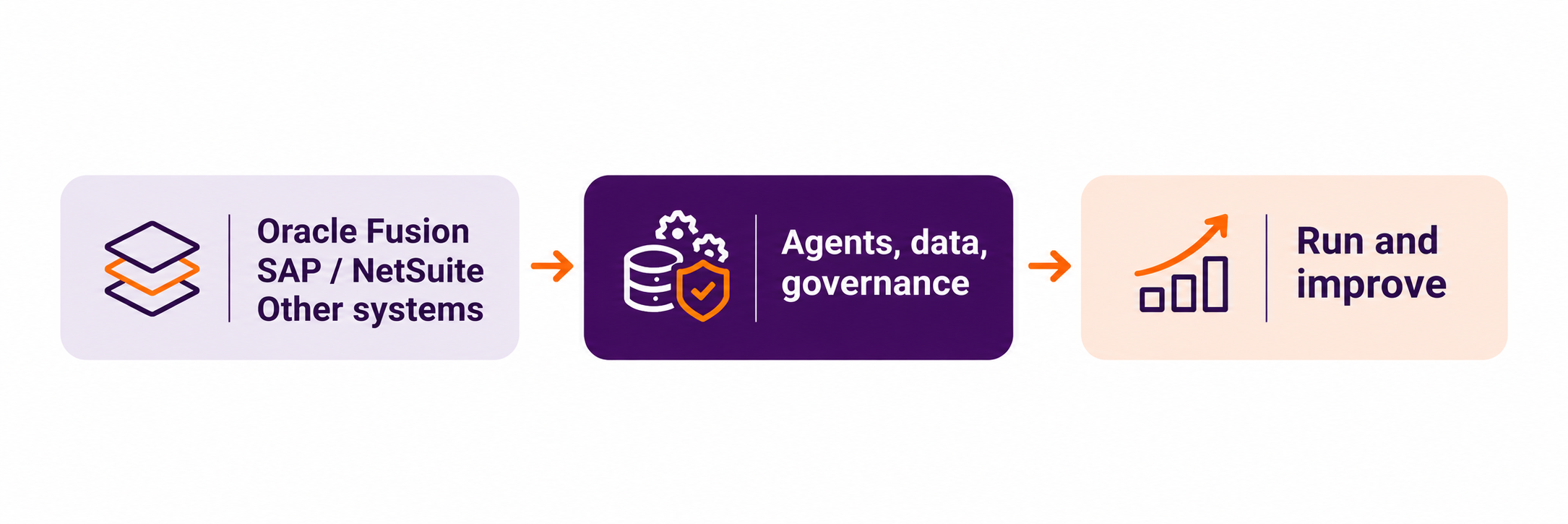
The real value sits in that middle layer and in the run-and-improve loop that follows go-live.
Where does AppsTek fit?
AppsTek has been an Oracle partner since 2011, and we are fired up about this announcement. It brings AI budgets, executive attention and certified talent into the Oracle ecosystem, and that lifts every customer program.
We focus on the parts of the journey where customers ask for the most help:
- Oracle implementation and operationalizing AI: getting agents live inside Fusion processes, including activation of Oracle Fusion Claw and its growing catalog of agents.
- Enterprise agentic engineering: building custom AI that plugs into the systems you already run.
- Agentic Managed Services: running, monitoring and improving AI and applications after go-live, across Oracle and other platforms.
- Model choice: the right model for each use case, not a business designed around one.
We work alongside Oracle and its teams, bringing speed, platform neutrality and hands-on delivery for customers whose needs reach beyond a single stack.
What should you ask before choosing an AI delivery partner?
Use this checklist, whether you work with Oracle, a partner, or both:
- Can the solution use more than one model, and who decides which one fits each job?
- How are accuracy, reliability and cost tested before and after go-live?
- Who owns operations once the solution is live?
- Does the scope include systems outside Oracle that your processes depend on?
- How are security, access control and governance built in from day one?
- Is there proof of real workloads in production, not only demos?
Clear answers here tell you more than any announcement.
The bottom line
Oracle’s OpenAI-powered AI Services Practice proves that enterprise AI has entered its production phase. The winners will ask sharper questions, connect AI across their whole estate, and pick partners who stay accountable after launch.
Planning your next move with AI on Oracle? Book a conversation with our team to see where you stand.
Frequently Asked Questions
It is a planned Oracle consulting practice that combines OpenAI models with Oracle applications, data and cloud infrastructure. Oracle Customer Success Services leads delivery.
Oracle CSS leads customer engagements and delivery. OpenAI contributes expertise to train the Oracle teams.
AI in Oracle Fusion Cloud Applications, AI application development on OCI, enterprise data with AI, and security through Oracle AI Security Mesh.
The practice is powered by OpenAI technology. Oracle also describes bring-your-own-model options for supported OpenAI connections, and its data offerings work with a choice of foundation models.
Oracle plans to train and certify one million developers and professionals, including consultants, customers and partners, on OpenAI technology through Oracle University.
Choose a delivery approach that covers the full estate. Ask any provider how agents, data and governance extend beyond Oracle applications.