• ISO Certified ISO/IEC 27001:2022
Summarize the article now ChatGPT Perplexity Claude

Fusion now executes specialist work

At Oracle AI World in Las Vegas on October 26, 2026, Oracle put Fusion Claw at the centre of its applications strategy. Claw is a governed runtime that carries out the specialist work usually done by financial analysts, supply chain planners and workforce schedulers. It then commits the results to Fusion, inside limits the business sets. 

Oracle first introduced Claw on September 29, 2026. The AI World release widens its reach across the suite, and Oracle says all of it is available now in the current Fusion release. The decision for executives is how much execution to delegate, and under which controls. 

What Oracle announced

Oracle’s agentic applications are built around a business outcome, such as shipping orders on time within cost and capacity limits. They run around the clock and recommend actions. When a task needs deep analysis across millions of records, the application hands it to Claw. 

  • Scope of work spanning Reconciliation, analysis, planning, simulation and optimization. Runs can last hours. 
  • 75 packaged agentic applications, ready to deploy across ERP, HCM, SCM and CX. 
  • 25 of them are Claw-enabled, including Ledger (financial close), Workforce Orchestration, Supply Planning Allocation, Procurement Spend, Service Health Check and Strategic Field Demand Planning. 
  • Build your own extensions for customers with no-code tools in AI Agent Studio, or in VS Code and a command-line interface. 
  • Models spread Google Gemini and OpenAI models handle reasoning at launch. 
  • Access from anywhere. Fusion Companion routes a plain-language request to a transaction, an agent, an agentic application or Claw. It runs in Fusion Agentic Home, on iOS and Android, and as a ChatGPT plug-in. 

Oracle reports 5.7 million agent runs a quarter across its customer base. 

How a Claw run works

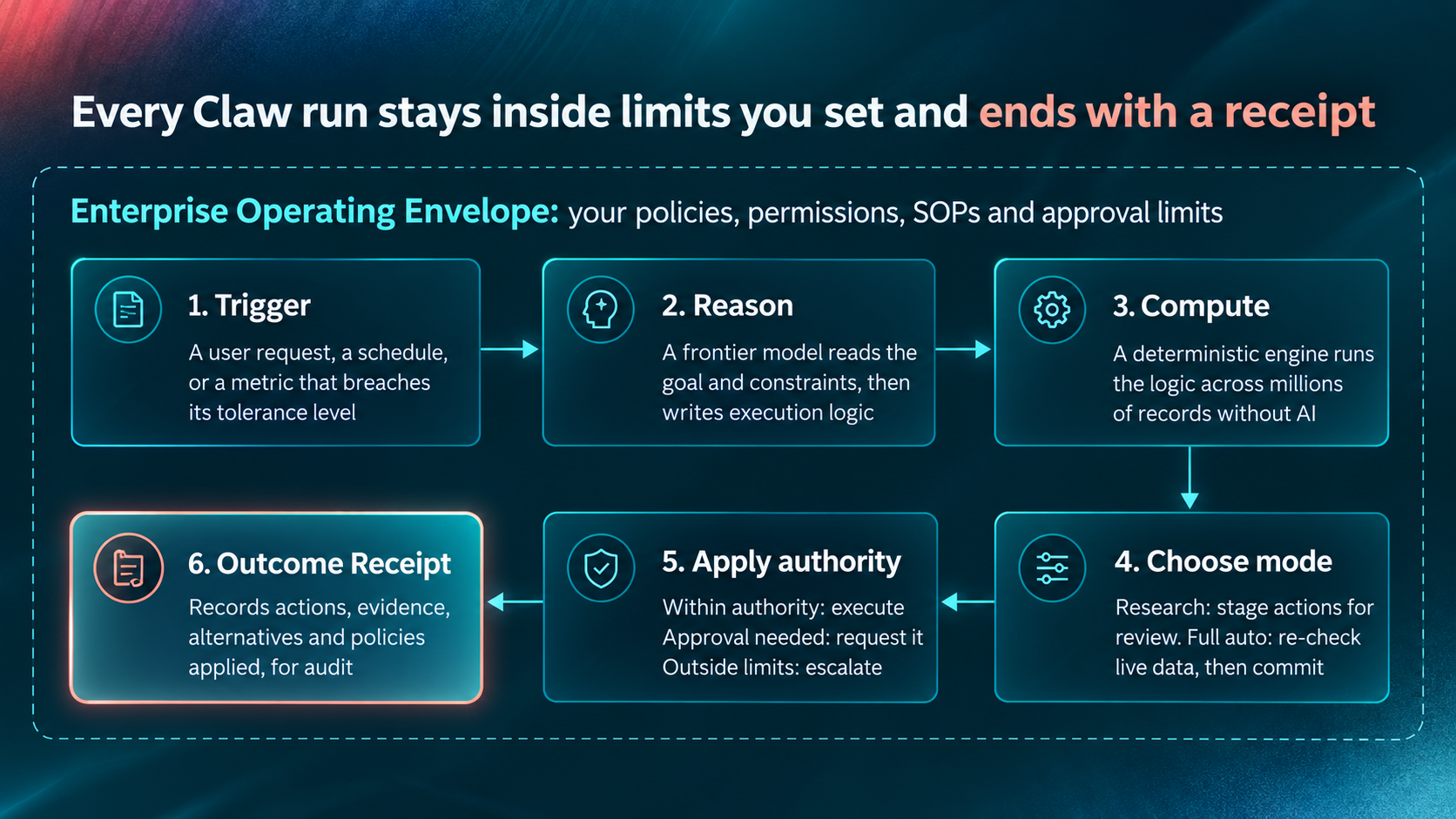
How a Fusion Claw run works · 6 steps inside the Operating Envelope

The model plans once and deterministic code handles the volume. Oracle says this keeps results consistent across millions of records and limits token spend to the planning step. Two operating modes matter for risk owners. Research mode does all the analysis and stages the actions, which can number in the hundreds, for a person to accept, edit or reject. Full-auto mode re-checks the live state of Fusion before it commits anything, so it never acts on a stale plan. Leone set a “5pm test”: AI that stops pursuing an outcome when staff go home is not owning it. 

What the demos showed

Oracle ran three Claw scenarios on stage. These are vendor demonstrations, not audited customer results, but they show the scale of change Oracle is claiming. 

Scenario Starting point Claw result
Shipment load planning 61% truck utilization against a 70% target 88% utilization, 16 fewer load moves, 117 orders pulled in, $58,000 saved. 5 of 154 loads sent to a planner; 149 processed.
Hospital workforce scheduling Telemetry unit coverage at 70% against a 95% target 70 of 72 open shifts filled, coverage at 99%, relative cost up 5%. Two alternatives rejected: one needed union approval, one cost more.
Financial close Controller needs a close readiness pack Balances, cutoff and timing explanations, and intercompany findings assembled into a sign-off pack in minutes.

Oracle also says Claw records the path each run takes, so similar runs reason faster. Internal testing showed up to 50% less reasoning time on repeat runs. Oracle has not published benchmarks.

What executives should do now

  • Pilot one Claw-enabled application: Chris Leone, who leads Fusion development, asked customers to take one of the 75 applications off the shelf and run it with a pilot group. Pick a process with a clear financial measure, such as close duration or freight cost. 
  • Define the operating envelope first: Decide which actions Claw may commit alone, which need approval and which must escalate. Finance, risk and audit should sign this off before full-auto mode is switched on. 
  • Start in research mode: Let Claw stage actions for review until results match what your planners would have done. 
  • Ask for the receipts: Make the Outcome Receipt part of internal audit evidence from day one. 
  • Check the data first: Claw acts on the live system of record. Gaps in master data, approval hierarchies or policy set-up will show up in its results, so fix them before the pilot starts. 
  • Plan for wider rollout: Leone suggested trialling Agentic Home now and extending it to a broad user base by January or February 2027. 

Conclusion

Fusion Claw is ready to pilot, but the results will depend on the groundwork: clear limits, clean data and a measured move from research mode to full auto. Companies that settle those questions early will be the first to turn Oracle’s demo numbers into results of their own. 

If you are weighing where Fusion Claw fits in your Oracle roadmap, AppsTek can help you find the right starting point. Connect with our experts today.  

About The Author

Rahul Sudeep, Senior Director of Marketing at AppsTek Corp, is a results-driven, AI-first B2B marketing leader with 15 years of experience scaling global enterprise SaaS companies. His expertise, honed at IIM-K, spans architecting high-impact go-to-market strategies, driving new market identification and positioning, and embedding Generative AI, LLMs, and predictive analytics into the core marketing function. Rahul unifies Technology, Sales, and Support teams around a single strategic hub, while also managing key Partner and Investor Relations. He leverages AI-driven insights to craft powerful brand narratives and hyper-personalized demand generation campaigns that drive measurable revenue growth and deepen customer engagement.
  • ISO Certified ISO/IEC 27001:2022