
Operationalize Intelligent
Integration Across the Enterprise Stack
Intelligent Integration engineered for enterprises that operate in real time
Intelligent Integration engineered for enterprises that operate in real time
Intelligent integration connects systems, data, workflows, and AI into a coordinated enterprise execution layer.
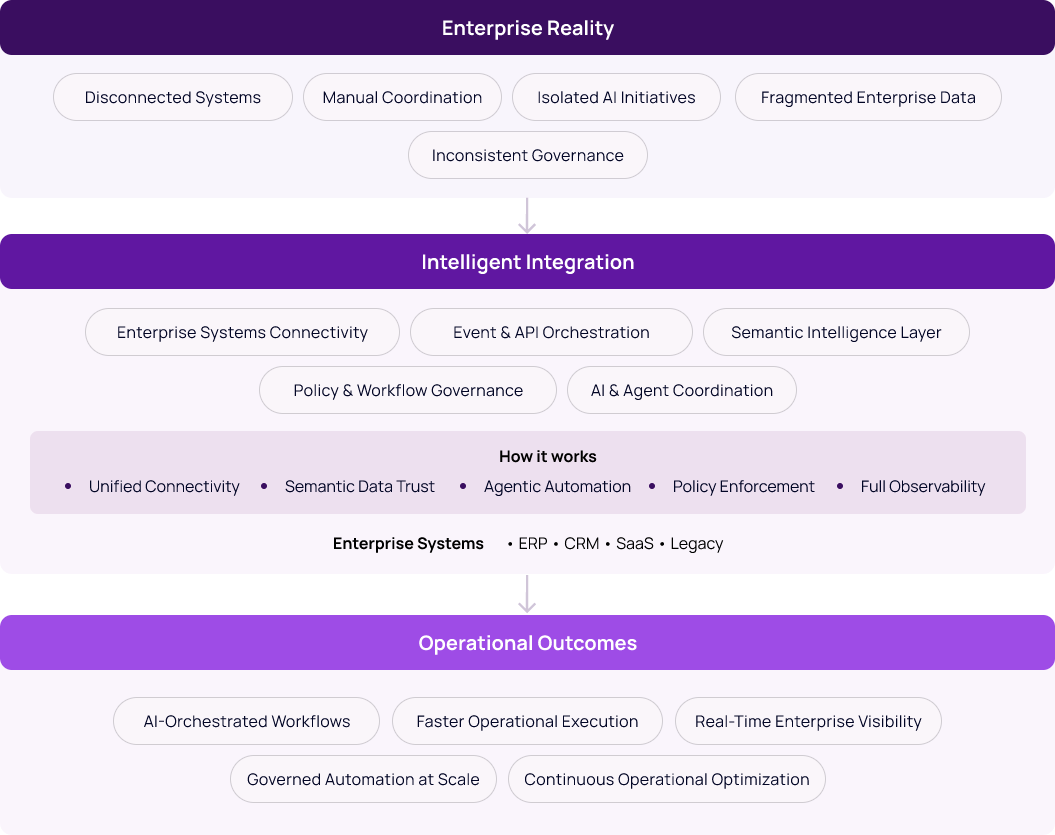
Assess APIs, workflows, and data flow latency
Enterprise Integration Services anchored on Intelligent Orchestration deliver the real-time coordination legacy approaches struggle to match
Siloed Systems
Business processes span dozens of disconnected apps, data moves manually, creating costly delays
Integration Debt
Point-to-point integrations multiply with every new tool, teams maintain pipelines instead of outcomes
Latent Operations
Batch synchronization delivers data hours after the moment of decision, capping operational responsiveness
Manual Bottlenecks
Exception handling and approvals depend on human intervention, holding back scale and AI deployment velocity
Compliance Gaps
Audit trails, policy enforcement, and governance controls remain inconsistent across systems
No AI Readiness
Disconnected and unstructured data prevents reliable AI deployment and agent-driven workflows
Enterprise Integration Services move from connectivity to coordination through Intelligent Integration engineered for the agentic enterprise
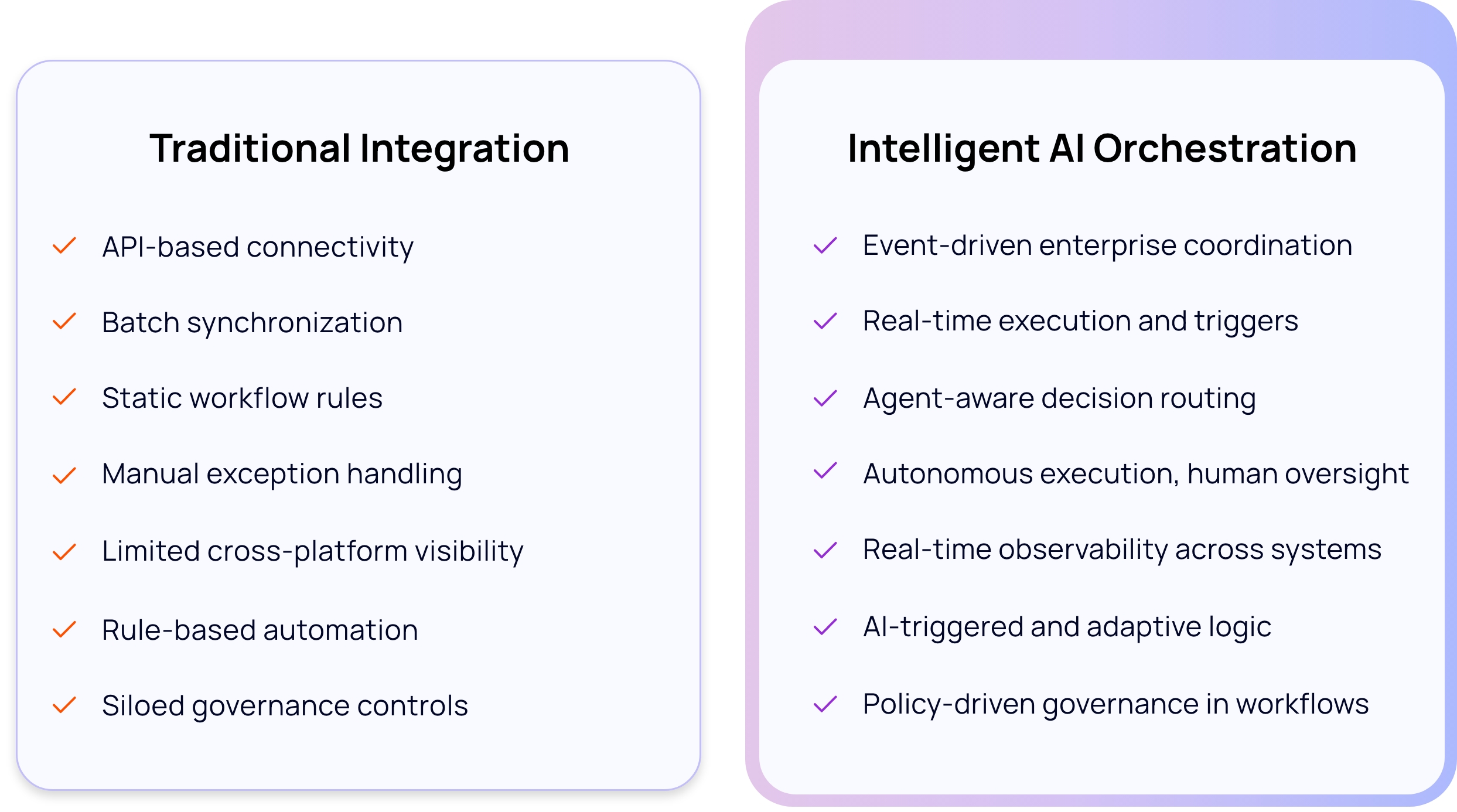
Enterprise Integration Services powering agent-aware execution, adaptive workflows, and intelligent operations at scale.
Oracle Fusion, SAP S/4HANA, CRM, SaaS, and legacy systems unified as governed systems of record across transactions, financials, and operational data
API gateways, service mesh, event streaming, and Pub/Sub for secure real-time communication across distributed environments
Canonical models, schema transforms, PII masking, and data lineage delivering an AI-ready foundation aligned with governance policy
Workflow engines, decision rules, and human-in-the-loop policy coordination across enterprise platforms and ERP flows
Agent lifecycle, LLM integration, and Agentic Process Automation embedded into autonomous coordination across enterprise operations
IAM, Policy-as-Code, audit trails, and AI decision traceability for enterprise-grade control, compliance, and performance monitoring
A GenAI-powered accelerator built for integration platform migration, modernization, and greenfield implementation at speed.
The platform discovers integrations and dependencies, generates migration mappings and deployment-ready assets, validates against enterprise standards, and supports ANY → ANY migration across integration ecosystems.
Enterprise Outcomes
Connect ERP, SaaS, data pipelines, workflows, and AI agents through an Intelligent Integration layer built for real-time orchestration, governance, and enterprise-scale execution.
Enterprise application integration services connect ERP, CRM, SaaS, and legacy platforms through APIs, event streams, and service layers. Data and process signals move in real time across systems without point-to-point complexity.
A consistent, event-driven integration backbone replaces fragmented connections and reduces integration overhead.
Data is standardized using canonical models, schema mapping, and governance policies. Business context is preserved across systems, enabling reliable data exchange and AI readiness.
Workflows and AI models operate on consistent, governed data rather than conflicting system outputs.
Intelligent orchestration coordinates workflows using AI agents, decision engines, and event triggers. Processes adapt dynamically based on context, system signals, and business rules.
Execution shifts from static automation to adaptive, AI-driven workflow coordination across enterprise environments.
Governance frameworks apply policy-as-code, access controls, and audit mechanisms directly within integration workflows. Every transaction and decision aligns with enterprise compliance requirements.
Compliance, security, and governance operate as embedded controls across all integration activities.
End-to-end observability tracks workflows, system interactions, and AI-driven decisions in real time. Telemetry, logging, and audit trails provide visibility into performance and execution.
Teams monitor, analyze, and optimize integration performance continuously across systems and workflows.
Intelligent integration across industries, built for speed, control, and measurable outcomes.
Disconnected KYC, compliance, and core banking systems create operational delays and high manual exception handling.
Faster customer onboarding, stronger compliance posture, and improved operational coordination.
OSS/BSS fragmentation and provisioning complexity limit real-time service coordination and billing synchronization.
Reduced activation time, improved operational responsiveness, and higher customer retention.
Disconnected ERP, POS, inventory, and supply chain systems limit real-time operational visibility.
Improved inventory turnover, reduced stockouts, and faster operational decision-making.
ERP systems disconnected from shop-floor operations create reactive maintenance cycles and delayed production visibility.
Reduced downtime, improved quality control, and greater operational efficiency.
SCADA fragmentation, remote asset complexity, and legacy-heavy infrastructure slow operational coordination.
Improved infrastructure reliability, faster incident response, and stronger operational governance.
Business-critical metrics improved through coordinated execution and reduced operational friction.
Case proof of how Enterprise Application Integration Services moved the metrics that mattered most
The differentiators that separate true Intelligent Integration from connectivity-first platforms.
Workflows that sense, adapt, and respond in real time
Full control over AI agents across the deployment lifecycle
Built around ERP, CRM, and industry-specific data models
Regulatory alignment embedded into the design, not bolted on after
Bridges legacy systems with cloud-native intelligence
Measured against business results, not just platform uptime
Intelligent integration is a modern approach to connecting applications, data, and systems using AI, automation, and intelligent orchestration. Unlike traditional methods, it goes beyond simple connectivity to enable smart, self-optimizing workflows across the enterprise.
Today's businesses run on dozens of disconnected applications, leading to data silos and inefficiencies. Intelligent integration, powered by enterprise integration services, unifies these systems to enable faster decisions, smoother operations, and scalable growth.
Intelligent integration delivers end-to-end automation, real-time data flow, and smarter decision-making through business intelligence integration. It also reduces costs, improves agility, and enhances customer experiences across every touchpoint.
By using intelligent orchestration, it automates repetitive tasks and streamlines complex workflows across systems. This reduces manual effort, accelerates processes, and frees teams to focus on strategic priorities.
It eliminates costly custom-coded connections through reusable enterprise application integration services and automates manual data handling. Combined with business intelligence integration, it helps leaders make smarter, cost-saving decisions.
It connects ERP, CRM, finance, and other systems into unified data pipelines for real-time access. Through AI Integration Services, teams gain a single, trusted view of enterprise data to drive better collaboration and decisions.
No, traditional system integration simply connects applications, while AI Integration Services adds AI, automation, and intelligent orchestration. This makes it proactive, adaptive, and capable of optimizing itself without manual intervention.
It acts as the backbone of digital transformation by seamlessly connecting cloud, legacy, and modern systems through enterprise integration services. With business intelligence integration, it ensures every digital initiative delivers measurable value.
It bridges legacy systems with modern, cloud-native applications using enterprise application integration services and intelligent orchestration. This enables agility, scalability, and a future-ready foundation for continuous innovation.
.
Partner with experts in enterprise application engineering