Table of Contents
Why the latest AI in Oracle EPM releases matter to bank CFOs
Where Oracle EPM AI earns its place in bank finance
Board pack commentary shows GenAI’s value for executive reporting
How should banks govern Oracle EPM AI under SR 26-2?
A phased path from prediction to action
Find the Oracle EPM AI value already in your subscription
Every month, bank finance teams rebuild deposit and loan forecasts, chase variances, and rewrite commentary for the Asset-Liability Committee (ALCO) and the board. Much of that work is repetitive, and it ties up the analysts banks most need for forward-looking decisions.
Oracle EPM AI is now built to absorb a meaningful share of that effort. Inside Oracle Cloud Enterprise Performance Management (EPM) and Cloud Enterprise Data Management (EDM), AI works on three layers: predictive models that forecast and flag anomalies, generative AI (GenAI) that drafts commentary, and AI agents that answer plain-language questions and prepare actions for review. Oracle has embedded AI in Cloud EPM since 2015, but most of these capabilities arrived after April 2024. For bank leaders, the question has shifted from what the technology can do to how to capture the gains without creating new model risk.
Why the latest AI in Oracle EPM releases matter to bank CFOs
For nearly a decade, AI in Oracle EPM meant statistical forecasting. The 2024 to 2026 releases move AI into everyday finance workflows, so a planner can ask a question in plain language, receive a drafted explanation, and move from insight to action without leaving the platform.
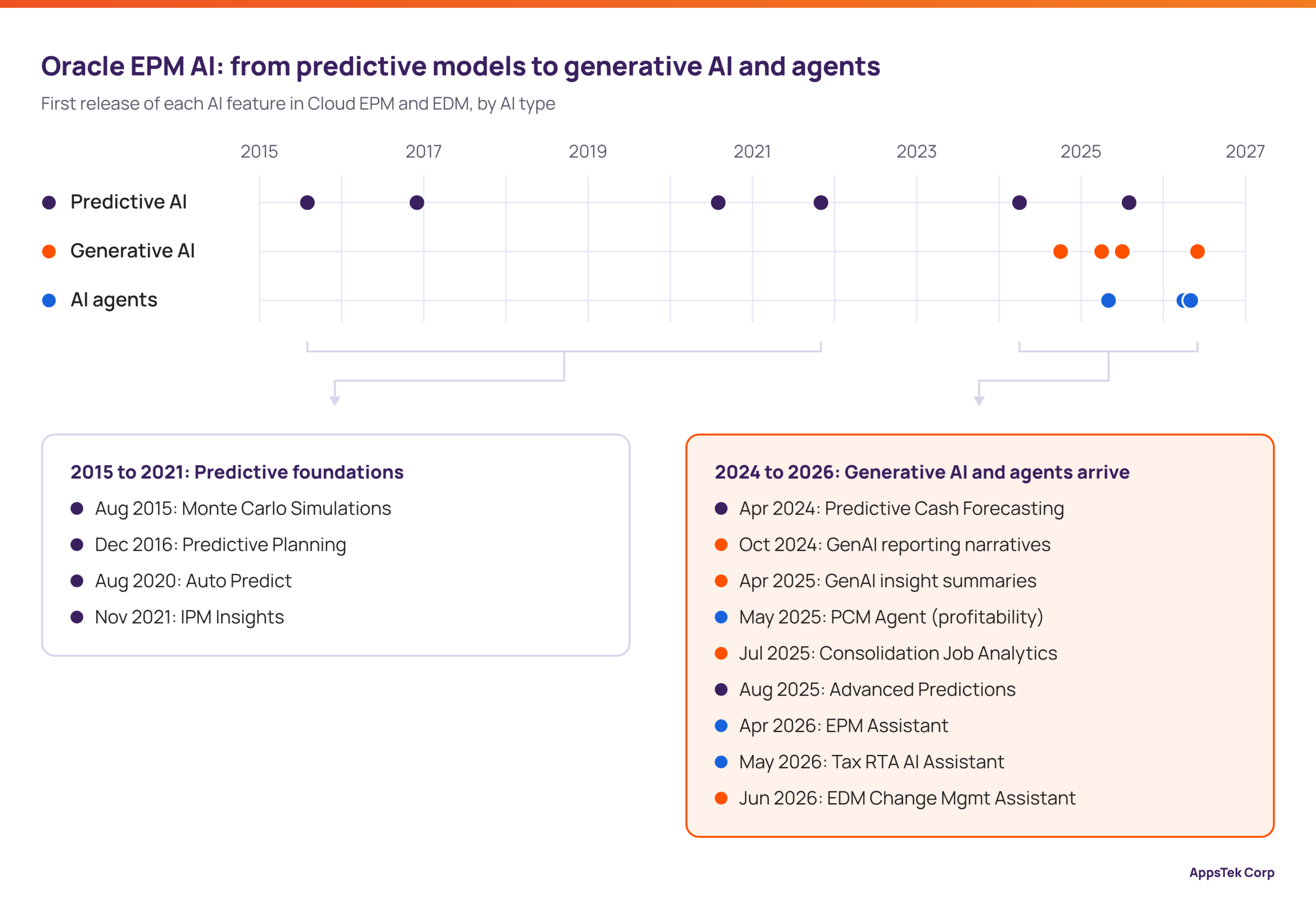
With EPM updates shipping monthly, new AI features deserve a standing place on the finance technology agenda rather than an annual upgrade review.
Where Oracle EPM AI earns its place in bank finance
The strongest returns sit in recurring cycles where skilled people spend hours on repeatable work. Forecasting is the clearest starting point: Predictive Planning gives planners a statistical baseline for deposit, loan, and fee income by product or region, which they refine with judgment before it feeds the net interest income (NII) plan. Predictive Cash Forecasting adds a predicted cash view for treasury, while regulatory liquidity metrics still come from risk systems.
Cost oversight benefits next. Intelligent Performance Management (IPM) Insights flags anomalies and forecast bias in branch and cost-center spending, and GenAI summarizes them in plain language, so reviewers spend their time on decisions instead of investigation. During a multi-entity close, Consolidation Job Analytics uses GenAI to help teams diagnose consolidation runs within a tight window. These pairings map documented Oracle features to typical bank tasks rather than reported customer results.
Access routes deserve equal attention, because they shape licensing, setup effort, and control ownership. Predictive features and in-product GenAI run inside EPM, while EPM Assistants require a Fusion environment with AI Agent Studio. Banks that connect in-house AI platforms through REST APIs own model choice, security, and audit themselves.
Board pack commentary shows GenAI’s value for executive reporting
Few finance deliverables carry more scrutiny than ALCO and board commentary. GenAI in Oracle Narrative Reporting drafts that commentary directly inside the report. The financial reporting team sets a condition, such as a variance threshold on NII by business line. When a figure crosses it, GenAI can describe the exception, name the top 3 contributors along one dimension, or compare the result with prior periods.
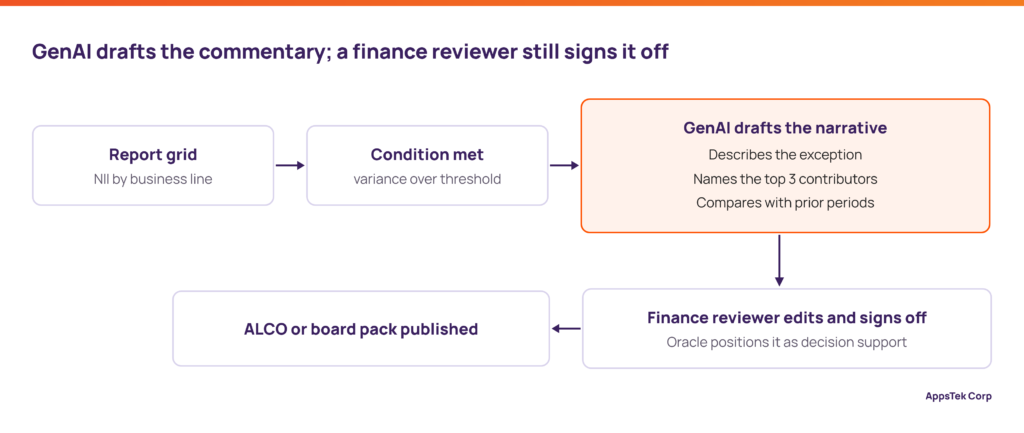
Control stays with finance. The team customizes the prompt templates behind each narrative, and Oracle positions the feature as decision support, so a named reviewer edits and signs off every draft. Leaders should confirm licensing early, because GenAI narratives run only in Enterprise Narrative Reporting and not in Standard, Platform, or legacy Enterprise Performance Reporting Cloud Service (EPRCS) deployments.
How should banks govern Oracle EPM AI under SR 26-2?
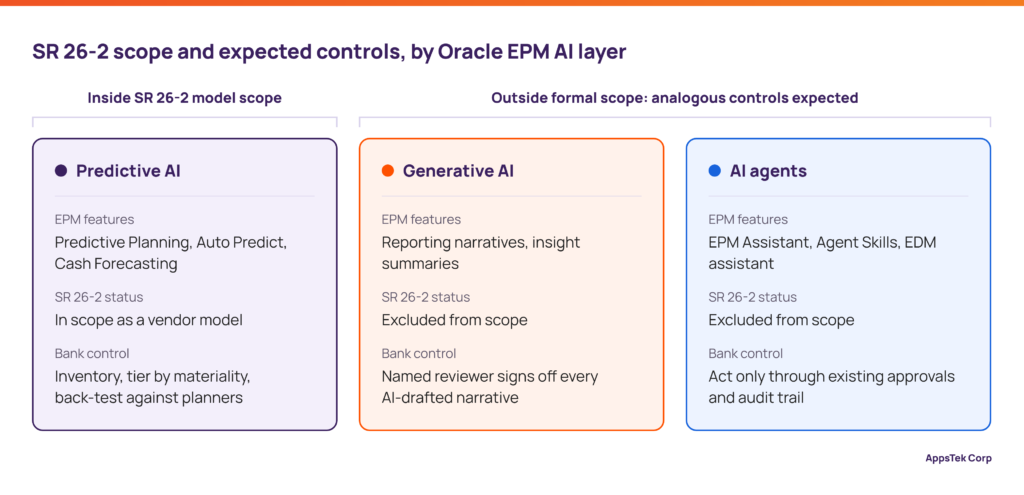
Governance is where AI ambition in banking usually slows, and 2026 brought welcome clarity. On April 17, 2026, the Federal Reserve, the Office of the Comptroller of the Currency (OCC), and the Federal Deposit Insurance Corporation (FDIC) replaced most of SR 11-7 with SR 26-2, revised guidance on model risk management (MRM). SR 26-2 keeps statistical and non-generative AI models in scope, excludes generative and agentic AI, and raises expectations for understanding vendor models.
Each layer of Oracle EPM AI therefore calls for a different control. Predictive features that drive a material NII or capital plan should be inventoried, tiered by materiality, and back-tested against planner forecasts like any vendor model. GenAI and agents fall outside formal scope, yet supervisors still expect analogous controls. A named reviewer for every AI-drafted narrative, and agent actions routed through existing approvals and audit trails, form a sensible minimum.
Data residency also needs an early check, since GenAI availability varies by Oracle Cloud Infrastructure (OCI) region. Banks supervised in the UK or Canada face broader model definitions under SS1/23 and OSFI E-23.
A phased path from prediction to action
A practical sequence begins with predictive features on high-volume forecast lines, since they need no additional platform and fit the model risk processes banks already run. Generative features follow once a review policy for AI-drafted text is live, and agents follow once approval controls are proven.
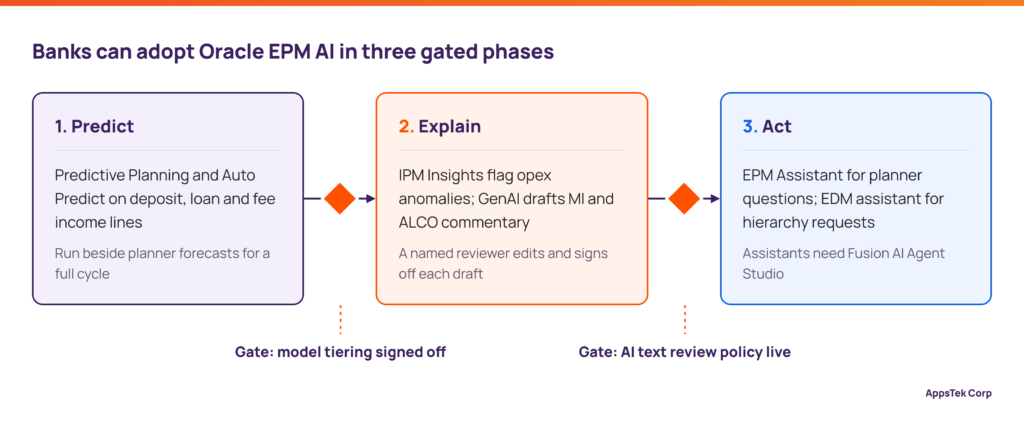
Each gate opens once its controls are in place, so MRM capacity sets the pace more than technology readiness. Banks that sequence adoption this way capture early forecast efficiency while earning the confidence of regulators and boards.
Find the Oracle EPM AI value already in your subscription
Some of these capabilities may already sit inside your current Cloud EPM subscription. AppsTek Corp’s Oracle EPM consultants can review it, map each AI feature to your forecasting, close, and board reporting calendar, and help establish the review controls your risk teams expect.
Frequently Asked Questions
Oracle EPM AI is the set of AI capabilities built into Oracle Cloud EPM and Cloud EDM. It works on three layers: predictive models that forecast and flag anomalies, generative AI that drafts commentary, and AI agents that answer plain-language questions and prepare actions for review. Oracle has embedded AI in Cloud EPM since 2015, but most of these capabilities arrived after April 2024.
Predictive Planning gives planners a statistical baseline for deposit, loan and fee income by product or region. Planners then refine it with their own judgment before it feeds the net interest income (NII) plan. Predictive Cash Forecasting adds a predicted cash view for treasury, while regulatory liquidity metrics still come from risk systems.
Some may be. Predictive features and in-product GenAI run inside EPM. GenAI reporting narratives need Enterprise Narrative Reporting and are not available in the Standard, Platform or legacy EPRCS deployments. EPM Assistants need a Fusion environment with AI Agent Studio. A subscription review shows which features you can use today.
The reporting team sets a condition, such as a variance threshold on NII by business line. When a figure crosses that threshold, GenAI drafts commentary inside the report. It can describe the exception, name the top three contributors or compare the result with prior periods. A named finance reviewer edits and signs off every draft before the pack is published.
Partly. SR 26-2, issued on April 17, 2026, keeps statistical and non-generative AI models in scope. That means predictive EPM features that drive a material plan should be inventoried, tiered by materiality and back-tested. Generative and agentic AI are excluded from scope, but supervisors still expect similar controls, such as named reviewers and approval workflows.
No. GenAI availability varies by Oracle Cloud Infrastructure (OCI) region, so banks should check data residency early in planning. Banks supervised in the UK or Canada should also review SS1/23 and OSFI E-23. Both use broader model definitions than SR 26-2.
Start with predictive features on high-volume forecast lines. They need no additional platform and fit the model risk processes banks already run. Add generative features once a review policy for AI-drafted text is live, then move to agents once approval controls are proven.
AppsTek Corp’s Oracle EPM consultants can review your current Cloud EPM subscription and match each AI feature to your forecasting, close and board reporting calendar. They can also help set up the review controls your risk teams expect.

About The Author
Myrlysa I. H. Kharkongor is Senior Content Marketer at AppsTek Corp, driving content strategy for the company’s digital engineering services to enhance brand presence and credibility. With experience in media, publishing, and technology, she applies a structured, insight-driven approach to storytelling. She distills AppsTek’s cloud, data, AI, and application capabilities into clear, accessible communications that support positioning and grow the brand’s digital footprint.