Table of Contents
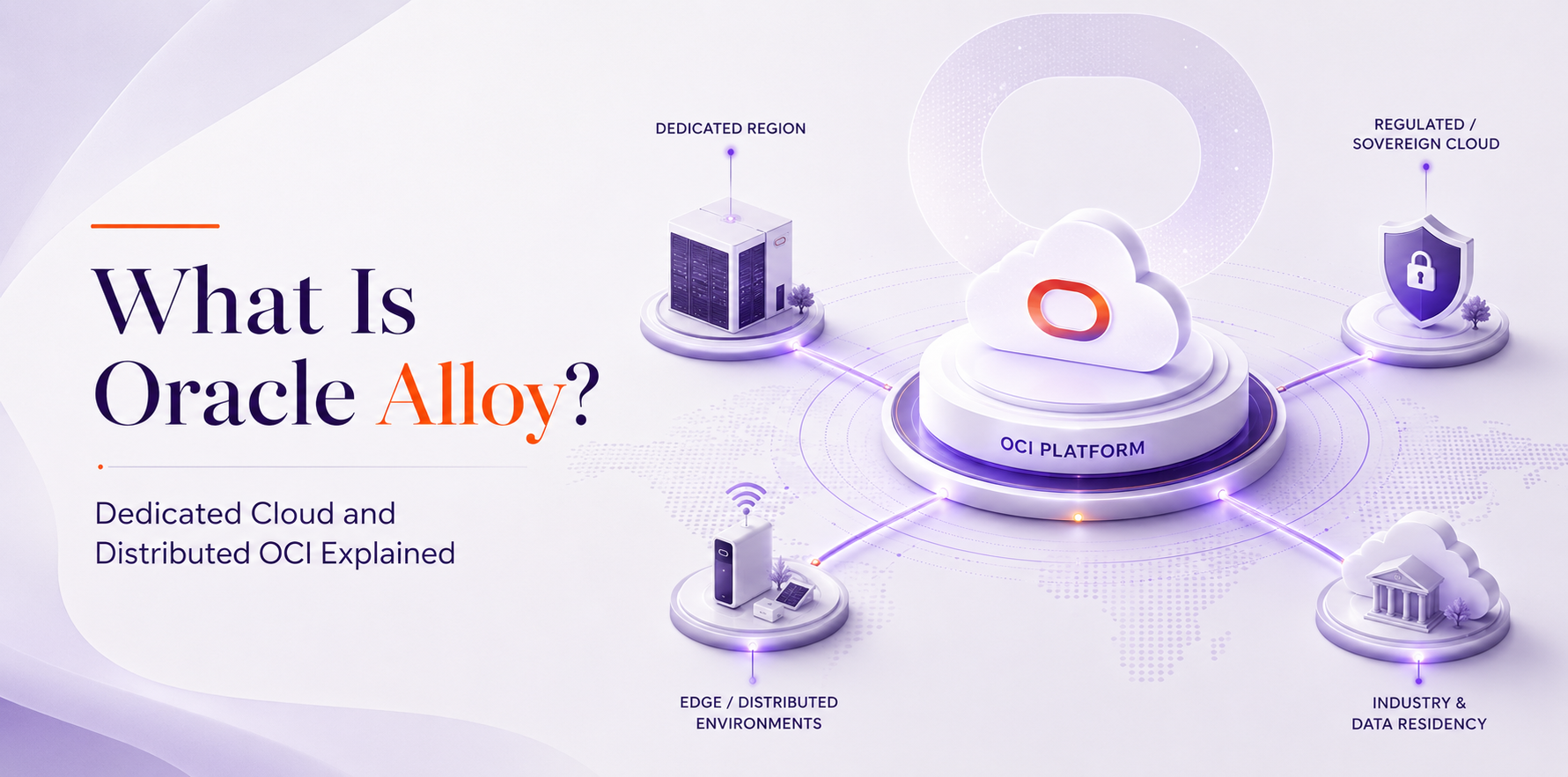
How Oracle Alloy Makes Distributed OCI Practical
Oracle Alloy Creates a Branded Cloud Business
OCI Dedicated Region Keeps The Full Control Plane Local
Sovereign Cloud For Enterrpsie
Isolated Regions and Roving Edge Extend The Spectrum
A Practical decision Framework For Distributed OCI



The enterprise technology landscape is undergoing a fundamental and rapid shift. We are moving away from passive generative AI systems like basic chatbots that merely summarize text. Instead, organizations are transitioning toward Agentic AI. These are autonomous systems capable of reasoning, planning, and executing complex business operations across highly fragmented cloud ecosystems.
At the center of this transformation within the enterprise ecosystem is Oracle AI Agent Studio. For chief information officers, cloud architects, and enterprise governance leaders, understanding how to construct, secure, and integrate these agents is no longer optional. It has become the foundational prerequisite for scaling artificial intelligence effectively securely.
Organizations must adopt sovereign agentic AI architectures that respect data residency laws while simultaneously connecting to disparate data lakes hosted on different cloud providers. This article explores the architecture of Oracle AI Agent Studio and details exactly how it bridges the gap between Oracle Fusion applications and external multi-cloud environments.
What is Oracle AI Agent Studio?
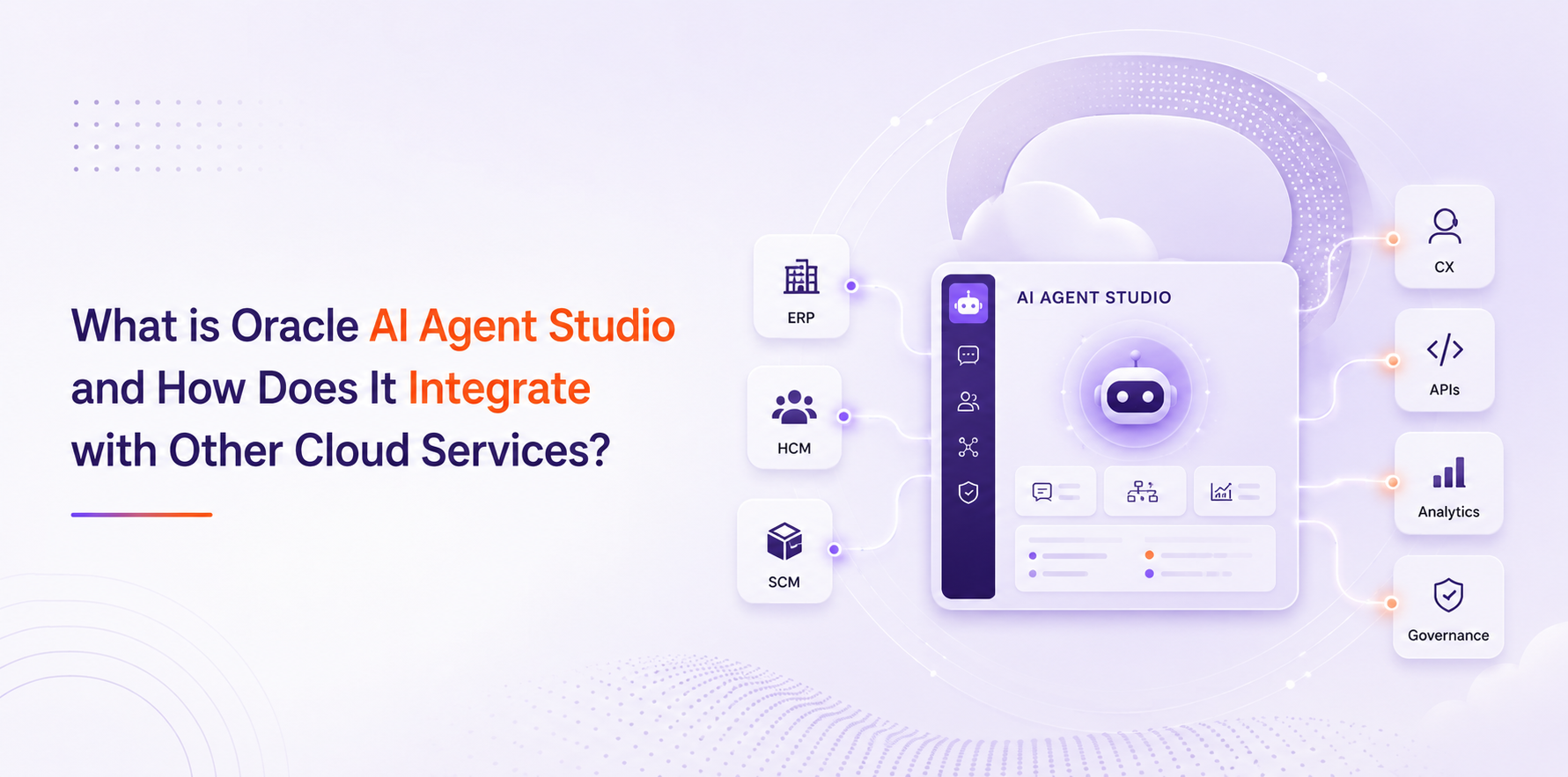
Oracle AI Agent Studio is a low-code orchestration environment embedded natively within Oracle Fusion Cloud Applications. It allows enterprises to build, configure, and deploy autonomous AI agents. These agents can reason over corporate data, automate complex multi-step workflows, and securely integrate with third-party cloud services like AWS, Azure, or Salesforce using strict identity propagation and role-based access controls.
The Anatomy of Oracle AI Agent Studio
Traditional artificial intelligence integrations often suffer from the “bolted-on” dilemma. They exist outside the core Enterprise Resource Planning or Human Capital Management system. This approach requires fragile API bridges, redundant security protocols, and constant maintenance. Oracle AI Agent Studio avoids this structural flaw by operating on a “built-in” philosophy. It acts as the intelligent orchestration layer residing directly within the native Oracle Fusion application architecture.
Architecturally, the Studio divides the agent lifecycle into two distinct and highly secure surfaces:
- The Design-Time Surface: This is a natural-language workspace where developers and business analysts configure agent behaviors. Here, they can attach specific knowledge sources, define complex orchestration rules, select the appropriate Large Language Model, and establish guardrails for compliance.
- The Run-Time Surface: This is the live execution layer where agents operate against real-time enterprise data. Crucially, the agent is strictly bound by the invoking user’s existing security permissions, ensuring that the AI cannot bypass human authorization layers.
Core Capabilities Driving Agentic Applications
Oracle has expanded the Studio to support robust enterprise-grade deployment. The platform moves beyond simple text generation by incorporating several advanced capabilities.
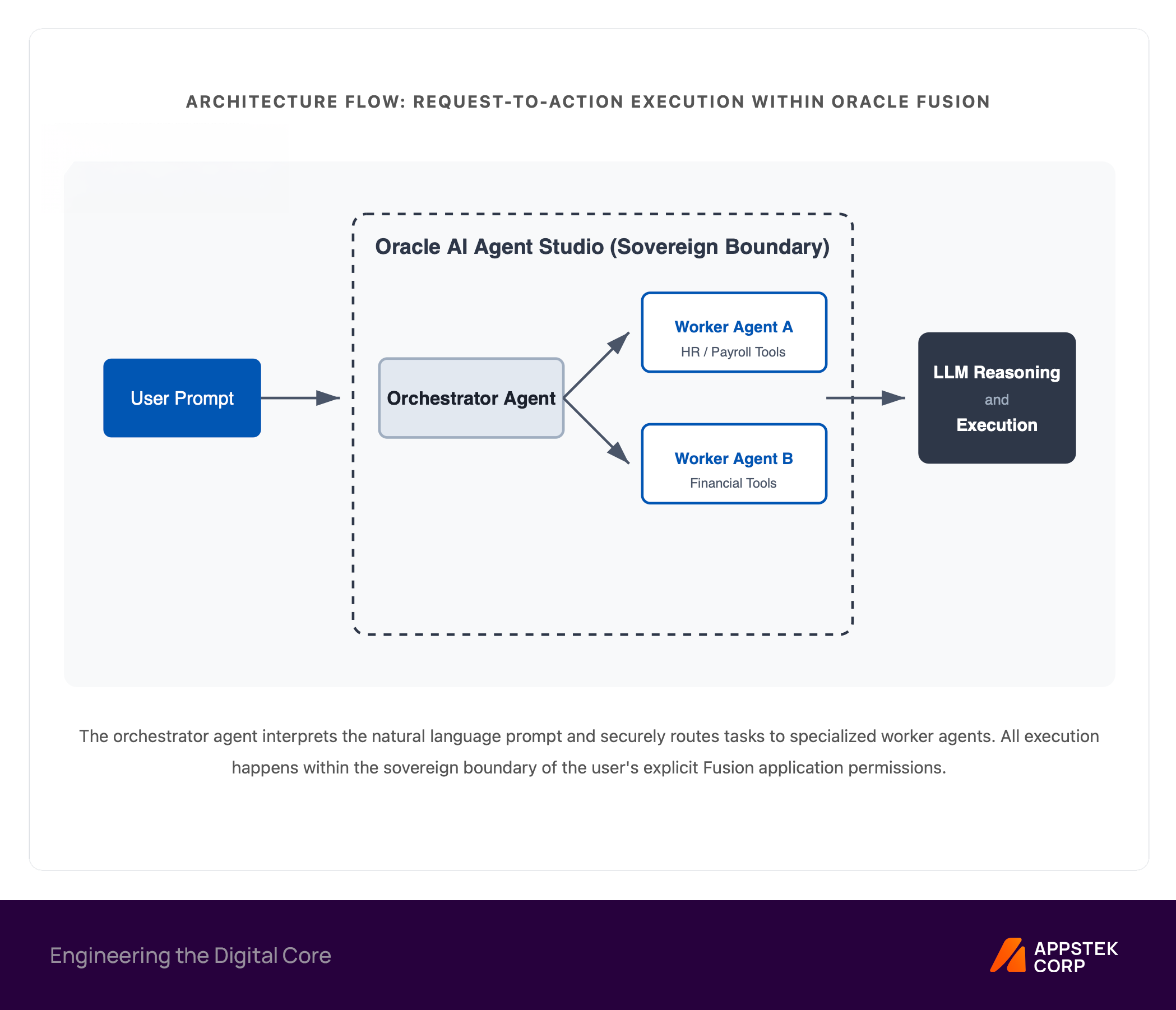
Agent Teams and Workflow Orchestration: Complex corporate tasks are rarely handled by a single entity. The Studio allows for the creation of structured “Teams.” In this model, a supervisor agent routes sub-tasks to specialized worker agents based on deterministic logic. For example, a supervisor might route a compensation query to an HR agent and a tax implication query to a Finance agent, aggregating the results before presenting them to the user.
Contextual Memory and State Management: Rather than treating every single interaction as a blank slate, agents retain contextual memory across workflows and collaborations. This reduces user friction and allows the system to learn from ongoing user behavior, maintaining the thread of a conversation even if a task takes several days to complete.
LLM Agnosticism and Multimodal Processing: Organizations are not locked into a single proprietary model. The Studio supports multimodal capabilities and allows enterprises to route specific tasks to different models optimized for different workloads. Users can utilize Oracle-hosted models like Cohere or Meta Llama, or securely integrate their own custom LLMs.
Software and hardware extensibility
Operators can extend the platform with custom services built through the same developer, user experience, DevOps, and security capabilities used across OCI. Specialized hardware can also become part of the environment, including industry appliances or established enterprise systems. This creates room for differentiated services around data residency, sector workflows, managed operations, and regional compliance.
Enterprise AI Governance and Sovereign Architectures
The orchestrator agent interprets the natural language prompt and securely routes tasks to specialized worker agents. All execution happens within the sovereign boundary of the user’s explicit Fusion application permissions.
How Oracle AI Agents Integrate Across Multi-Cloud Ecosystems
Modern enterprises operate in highly diversified cloud environments. A typical global corporation might use Oracle for their core financial systems, Salesforce for customer relationship management, and AWS for custom logistical data lakes. A critical strength of Oracle AI Agent Studio is its deep extensibility. It is engineered specifically to orchestrate workflows that span this multi-cloud reality without compromising identity verification or network security.
The Studio manages external multi-cloud integration through four primary pathways.
- Oracle Integration Cloud (OIC) and Identity Propagation
This is arguably the most powerful mechanism for secure multi-cloud orchestration. When an Oracle AI agent needs to trigger a complex external workflow, it routes the request directly through Oracle Integration Cloud. For instance, an agent might need to update a Salesforce client record while simultaneously adjusting an inventory database hosted on AWS.
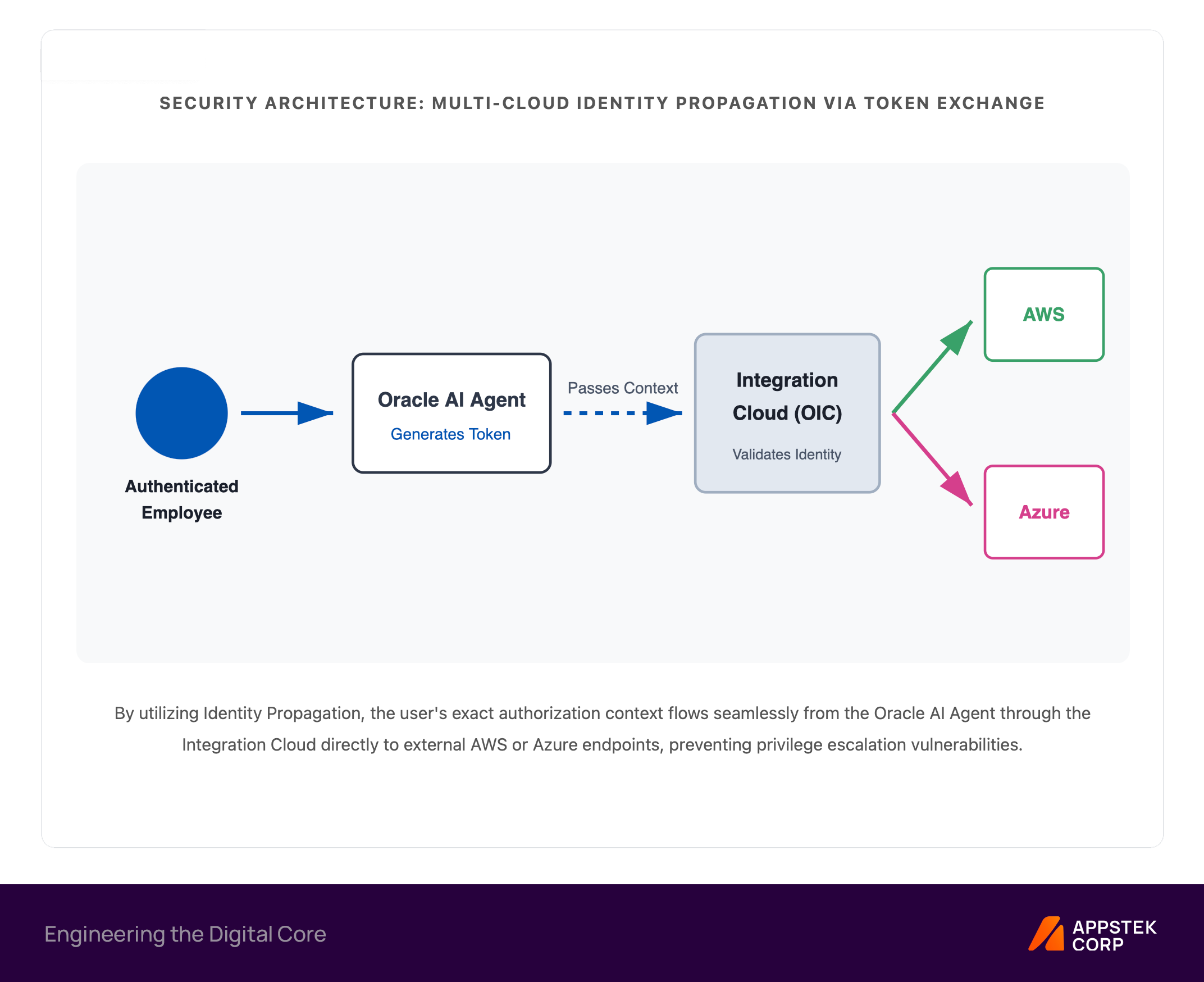
To maintain absolute security across these boundaries, the Studio utilizes Identity Propagation. During runtime, the AI agent generates a JSON Web Token assertion based precisely on the authenticated human user initiating the request. This token is passed securely to OIC. OIC then validates the token and carries the user’s exact identity into the downstream third-party cloud. The external system processes the request as if the human user initiated it manually. This maintains flawless audit logs and adheres to zero-trust security postures perfectly.
- The Model Context Protocol (MCP)
Oracle supports the open-source Model Context Protocol. This protocol acts as a universal standardization bridge. It allows AI agents to expose and connect to custom external tools, internal microservices, or proprietary databases easily. If an enterprise developer can wrap a service with an MCP server, the Oracle AI Agent can invoke it just like a native Fusion business object. This is highly useful for connecting agents to legacy on-premises databases securely.
- External REST APIs with Human Oversight
Agents can also be configured to interact directly with external systems via standard REST API endpoints using GET, POST, or PATCH methods. Because API calls can trigger external computing costs or permanently alter external data, Oracle allows enterprise architects to enforce mandatory “Human in the Loop” checkpoints. Before the agent executes a POST request to an external cloud, a designated human supervisor receives an automated notification to approve or reject the action.
By utilizing Identity Propagation, the user’s exact authorization context flows seamlessly from the Oracle AI Agent through the Integration Cloud directly to external AWS or Azure endpoints, preventing privilege escalation vulnerabilities.
- The Agent to Agent (A2A) Protocol
In highly advanced multi-cloud architectures, an Oracle AI Agent may not just invoke a static API. It may need to converse directly with a specialized AI agent residing natively in another cloud platform. The emerging A2A protocol allows distinct AI systems to collaborate on complex problems, share contextual data securely, and negotiate optimal outcomes before presenting a unified solution back to the human user.
“The true value of Agentic AI is not localized text generation. It is the seamless orchestration of multi-step, multi-cloud business processes executed securely within a rigid, sovereign governance framework.”
Detailed Workflow: Cross-Cloud Supply Chain Resolution
To understand the practical impact of this technology, consider this automated workflow involving a global logistics disruption.
Step 1: The Trigger Event
A logistics manager in Oracle Fusion asks the AI Agent Studio, “Analyze the impact of the port strike in Seattle on our Q3 hardware deliveries and suggest alternatives.”
Step 2: Internal Oracle Data Retrieval
The orchestrator agent activates the Supply Chain Worker Agent. This agent queries Oracle Fusion securely to identify all active purchase orders routed through the Port of Seattle. It successfully identifies 45 delayed shipments.
Step 3: Multi-Cloud API Execution
Realizing it needs external shipping schedules, the orchestrator agent securely passes the user’s identity token to Oracle Integration Cloud. OIC securely calls a third-party logistics API hosted on Microsoft Azure to fetch real-time freight availability at alternative ports in Vancouver and Los Angeles.
Step 4: LLM Reasoning and Human Approval
The AI Agent compiles the data, calculates that routing through Vancouver adds 2 days but saves $15,000 compared to Los Angeles, and presents this recommendation to the manager. The manager clicks “Approve.” The agent then automatically updates the shipping routes in Oracle Fusion and sends an API update back through OIC to alert the external vendors via their respective cloud platforms.
Industry Use Cases and Applications
Oracle AI Agent Studio fundamentally alters how daily operations are conducted across historically siloed enterprise departments. Consider these specialized applications.
| Enterprise Domain | Specialized Agent Capability | Multi-Cloud Impact and Integration |
|---|---|---|
| Supply Chain Management | Predictive Inventory Advisor | Detects shortages in Fusion, checks approved vendor services through OIC, and prepares a purchase order for review |
| Corporate Finance | Automated Invoice Processor | Extracts invoice data, validates amounts against Oracle records, and routes approved payments through connected services |
| Human Capital Management | Internal Mobility and Skills Advisor | Matches internal skills with role requirements and checks external learning platforms for relevant courses |
| Customer Experience | Contract Compliance Monitor | Reviews service obligations, compares delivery performance, and flags accounts that require intervention |
Best Practices for Implementing Agentic Workflows
To maximize return on investment while strictly minimizing operational risk, organizations implementing Oracle AI Agent Studio should adhere closely to several architectural best practices.
- Adopt a Supervisor and Worker Topology: Avoid creating monolithic agents that attempt to do everything at once. Build highly specialized worker agents. Dedicate one agent for database query generation, one for API execution, and one for final data validation. Oversee them all with a master orchestrator agent.
- Enforce Strict Topic Scoping: Define absolutely clear boundaries for what an agent is allowed to handle. An agent designed to check external inventory levels should explicitly be instructed to refuse inquiries about internal payroll data, regardless of the user’s prompt.
- Validate Grounding Sources Constantly: For agents utilizing Retrieval-Augmented Generation to reference enterprise documents, ensure the underlying data repository is meticulously curated. Stale, outdated, or contradictory documents will severely degrade agent reasoning and produce corporate hallucinations.
- Leverage Built-In Return on Investment Dashboards: Utilize the Studio’s native monitoring and observability tools. Track token usage costs, system latency, and actual business hours saved per workflow. This data is absolutely crucial for justifying ongoing AI infrastructure investments to executive stakeholders.
Conclusion
Oracle AI Agent Studio represents a major maturation point for enterprise artificial intelligence. By moving completely away from disjointed chatbots, Oracle has successfully delivered a cohesive and highly secure orchestration fabric.
This platform empowers organizations to build intelligent digital workers that operate natively within their core ERP and HCM systems. Crucially, these agents possess the robust integration tooling necessary to execute complex actions across the broader multi-cloud universe securely. Tools like the Model Context Protocol and Oracle Integration Cloud ensure that data flows seamlessly while identity propagation maintains absolute security.
Oracle AI Agent Studio moves enterprise AI from conversational assistance into governed execution, but realizing that shift requires the right Fusion architecture, integration design, and governance model to support agents in production. AppsTek Corp brings deep experience across Oracle Fusion Cloud implementation, AI activation within Oracle, and integration services that connect agent workflows to a wider cloud estate securely. Whether you are evaluating your first agentic pilot or scaling agent teams across finance, supply chain, and HCM, explore our full Oracle services or talk to our Oracle and AI specialists to map the right starting point.
Frequently Asked Questions About Oracle AI Agent Studio
Oracle AI Agent Studio is a low-code orchestration platform embedded in Oracle Fusion Cloud Applications. It supports the design, configuration, deployment, and management of autonomous AI agents and agent teams that reason over enterprise data, coordinate multi-step workflows, and connect with external services through governed integration paths.
Agents inherit Fusion role-based access controls, so each action is scoped to the permissions of the invoking identity. The platform also supports topic boundaries, approved grounding sources, human approval checkpoints, and detailed monitoring. Each agent can be limited to a defined business domain and a specific set of tools, keeping data access aligned with enterprise policy.
The Studio connects to external services through four paths: Oracle Integration Cloud with JWT-based identity propagation, Model Context Protocol for standardized tool connectivity, REST endpoints for direct API operations, and the A2A (Agent-to-Agent) protocol for cross-platform agent collaboration. Each path preserves identity context and supports audit continuity across cloud boundaries.
Yes. Through Oracle Integration Cloud and MCP, agents can reach services hosted on Azure, AWS, Salesforce, and private environments. Identity propagation ensures that external requests carry the authenticated context of the person and role that initiated the process, rather than defaulting to a generic service account.
AI Agent Studio is the builder platform for creating, extending, and managing agents and agent teams. Fusion Agentic Applications are pre-built, outcome-driven applications powered by coordinated agent teams that Oracle ships natively within Fusion Cloud. The Studio provides the foundation on which both custom and pre-built agentic applications operate.

About The Author
Rahul Sudeep, Senior Director of Marketing at AppsTek Corp, is a results-driven, AI-first B2B marketing leader with 15 years of experience scaling global enterprise SaaS companies. His expertise, honed at IIM-K, spans architecting high-impact go-to-market strategies, driving new market identification and positioning, and embedding Generative AI, LLMs, and predictive analytics into the core marketing function. Rahul unifies Technology, Sales, and Support teams around a single strategic hub, while also managing key Partner and Investor Relations. He leverages AI-driven insights to craft powerful brand narratives and hyper-personalized demand generation campaigns that drive measurable revenue growth and deepen customer engagement.