

KEY TAKEAWAYS
- The Mortgage Compliance Dataset (MCD) is the standard loan data format lenders provide regulators for origination exams. Version 2.0 is built on the MISMO v3.6.0 reference model and is designed to replace the Loan Examination File some states require.
- Each regulator decides if and when to mandate it, so readiness is a set of conversations, not a deadline you can look up.
- MISMO’s own advice is to ask your regulator, your LOS provider and your compliance technology provider how prepared they are.
- Seven questions cover version, scope, delivery, validation, data gaps, change and proof. Score each answer from 0 to 2.
When a regulator asks for loan data in the MISMO Mortgage Compliance Dataset (MCD) format, the ability to produce it will depend heavily on the systems supporting your lending operations.
For state-licensed lenders, that puts the loan origination system (LOS) provider under scrutiny. And a simple assurance that the platform supports MCD is hardly enough to establish readiness.
MISMO’s May 2026 FAQ makes the next step clear: lenders should engage their regulator, LOS provider, and compliance technology provider to understand where each stands.
So, what should lenders actually be asking? These seven questions will help assess LOS readiness, uncover potential gaps, and put provider claims to the test. A scoring framework is included to make those answers easier to evaluate.
1 What is the MCD, and why does your LOS provider matter?
The MISMO Mortgage Compliance Dataset (MCD) changes how lenders prepare and submit loan-level data for regulatory examinations. It establishes a standard set of loan data fields and a common file format that regulators can use to review lending activity.
According to MISMO’s FAQ, the MCD is designed to replace the Loan Examination File (LEF) that some state regulators currently require. Version 2.0 is the current release, built on the MISMO v3.6.0 reference model. Its scope prioritizes federal requirements applicable across states, while leaving out investor overlays and data elements unrelated to regulatory requirements. MISMO maintains the standard in collaboration with the Conference of State Bank Supervisors (CSBS), regulators, and industry participants (MISMO).
The implications for lenders go beyond adopting a new file format.
Individual state regulators determine whether and when to require the MCD, and new state legislation is unnecessary for its adoption. That makes regulatory readiness a moving target, with requirements potentially emerging at different times across jurisdictions.
The loan origination system (LOS) is central to meeting that expectation. It holds much of the underlying loan data that feeds the MCD export, making the provider’s ability to map, validate, and generate the required dataset a critical part of lender readiness.
The ecosystem is already responding. MISMO reports that several LOS providers are developing MCD-compliant export capabilities, while compliance technology providers are building tools to evaluate those exports. The momentum is also reaching the wider mortgage industry. In July 2026, the Mortgage Bankers Association highlighted growing state regulator preparation for the MCD in its coverage of an upcoming industry session.
For lenders, the priority is clear: understand what the MCD requires, establish where the LOS provider stands, and identify any gaps before a regulator makes the dataset part of an examination.
2 What does an MCD readiness workflow look like?
Three conversations with external stakeholders, followed by internal readiness work. Blue marks external discussions, teal represents actions for the team, and lavender highlights the final decision.
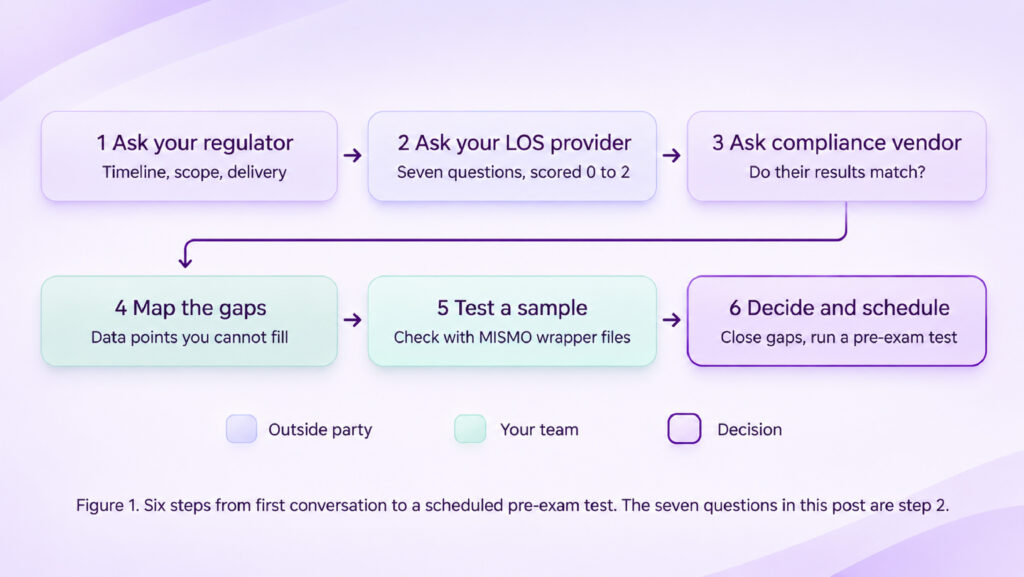
- Start with your regulator: Establish which states and examinations are moving to the MCD, the expected timelines, accepted delivery formats, and the loans covered. Each regulator sets its own adoption schedule.
- Put your LOS provider to the test: Send the seven questions below in writing. Ask for technical documentation, sample exports, and validation evidence that demonstrate actual readiness.
- Bring in your compliance vendor: Since they will evaluate the MCD file, ask how their validation process works and whether their results align with those of your LOS provider when both assess the same sample files.
- Build a data gap inventory: Identify every required data element your LOS cannot populate, document its current source, and assign ownership for closing each gap.
- Run a sample export: Generate an MCD file for a representative loan and validate it against MISMO’s wrapper files. Use the results to identify mapping errors and missing data before submitting anything for regulatory review.
- Set the readiness plan: Prioritize outstanding gaps, assign owners and deadlines, and schedule a pre-examination test using actual loan files. Make sure the LOS and compliance teams are aligned before the first regulatory submission.
3 What are the seven questions to ask your LOS provider about the MCD?
Print the table and take it into the meeting. For each question it gives the reason to ask, what a strong answer sounds like and the warning sign.
| Ask this | Why it matters | A strong answer | A warning sign |
|---|---|---|---|
| 1. Which MCD version can your LOS export today, and when does the next one ship? | Version 2.0, built on MISMO v3.6.0, is current. A file built to an older draft may not match what regulators and vendors test. | Names the version and the LOS release that exports it, with a date for updates | “We support the MCD” with no version |
| 2. Which loans does your export cover, and what happens to the rest? | Version 2.0 leaves out several loan types, including HELOCs, reverse mortgages and business purpose loans. | Lists in-scope and out-of-scope products and says how out-of-scope loans are flagged | Silence on products |
| 3. Can I export one loan on demand and a whole portfolio in bulk? | The MCD supports both, but what you get depends on the vendor and on what your regulator asks for. | Demonstrates both and explains how a bulk run is requested and checked | Single loan only, or bulk “on request” with no process |
| 4. How do you validate the file, and how do you handle the three known v2.0 issues? | MISMO provides wrapper files for validation and has listed three corrections to come. | Validates against the wrapper files and can explain each issue and its workaround | Has not heard of the wrapper files or the issues |
| 5. Which data points can you not fill from the LOS, and where will they come from? | Some data lives in title, closing or third-party systems, not the LOS. | Shares a field-by-field map with gaps marked and a source named for each | A “fully mapped” claim with no map to show |
| 6. How will you keep up with spec updates and state requirements? | State-specific requirements and DSCR loans are on the roadmap, and each state sets its own timeline for retiring the Loan Examination File. | Has a named owner, a release process and a plan to run the old and new formats side by side | No owner and no cadence |
| 7. Have you tested your export against compliance vendors on the same samples? | A key goal of the MCD is that different vendors reach the same results on the same files. | Names the vendors and shows matching pass and fail results | Internal testing only |
4 Which three questions deserve a closer look?
Question 2: Scope: According to MISMO, version 2.0 excludes payment option ARMs, reverse mortgages, negative amortization loans, non-TRID loans and lines, HELOCs, business purpose loans, chattel, and loans outside the scope of Regulation Z. DSCR loans are also excluded, although they are on the roadmap. Ask how your provider identifies and handles these loan types to prevent them from entering an export unintentionally.
Question 4: Validation: MISMO identifies three known issues in version 2.0, all scheduled for correction in a future release. The specification lists the reference model identifier as “3.6.0036620230418” instead of the correct “3.6.036620230418.” It also identifies the parent container for the Owned Property Lien UPB Amount as OWNED_PROPERTY_PROPERTY_DETAIL, when the correct name is OWNED_PROPERTY_DETAIL. Finally, the service provider disclosure type applies only to loans with mortgage insurance, for which NonShoppableService is the only valid option.
The sample XML files already contain the correct identifier and container name. A build based solely on the specification text could carry forward the first two errors. Ask your provider which source they used to build the export.
Question 5: Data gaps: This is where implementation readiness is often determined. While the LOS serves as the system of record, an examination file also relies on information from title, closing, and third-party sources. Ask your provider for a complete data map showing where each required field originates. A provider that can account for every data point and its source can demonstrate how the export is assembled. If that mapping is unavailable, there is still work to do.
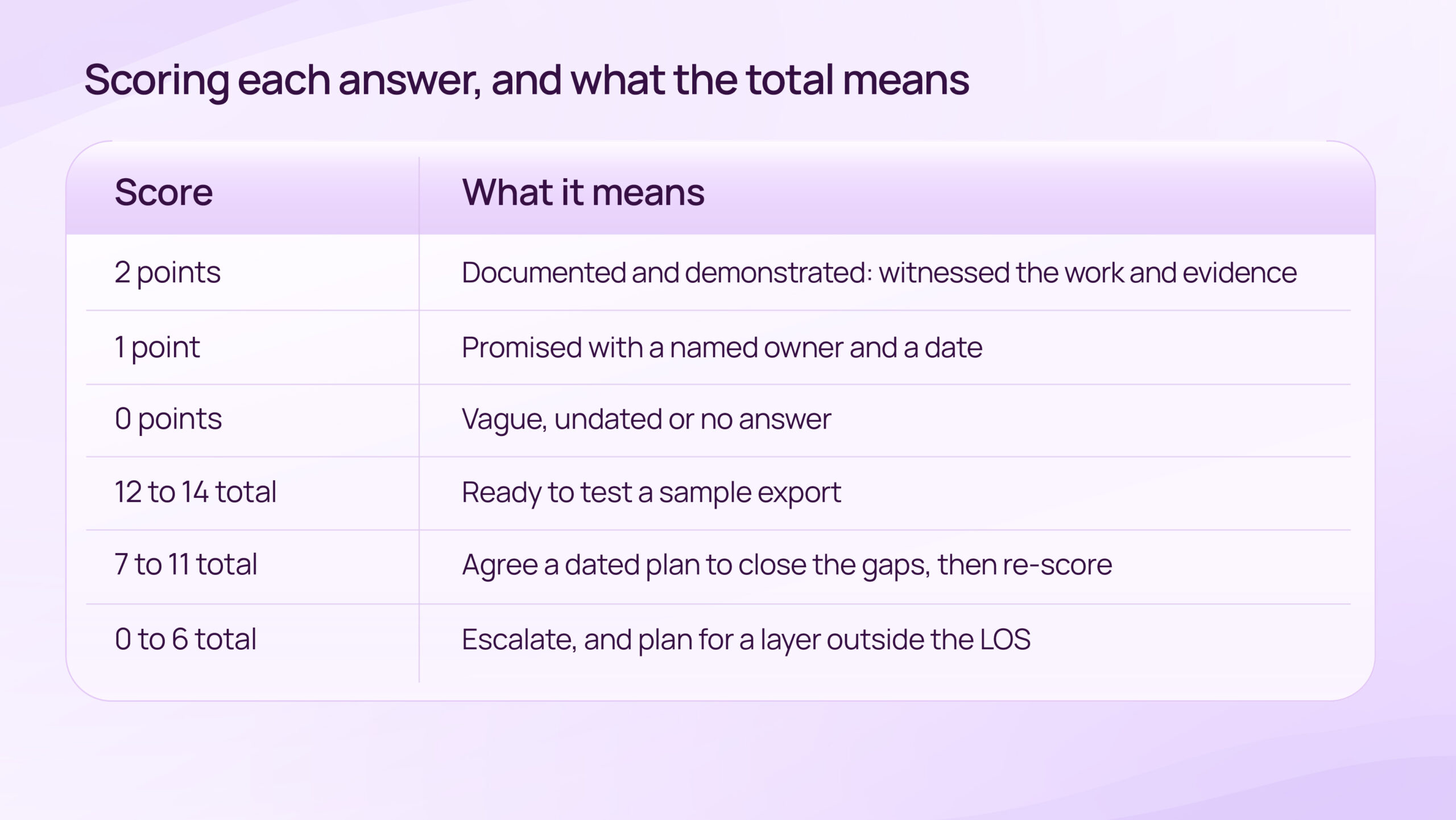
5 How do you score the answers?
Score each answer on a 0–2 scale, then calculate the total. Use the bands as practical guidance rather than a formal standard.
6 What if the answers show gaps?
There are three ways to move forward, and they can work together. Ask the current LOS provider for a dated delivery roadmap and establish clear accountability for each milestone. Consider adding an export layer outside the LOS to bring together LOS, title, and closing data, map them to the MCD, validate the resulting file, and retain evidence for every validation result. If a requirement is missing from the standard itself, raise it with the relevant working group. MISMO allows organizations to participate in MCD development through its workgroup, which meets on the first and third Thursday of each month, from 3:00 to 4:00 pm Eastern.
Whichever approach is adopted, put it through testing with real loan files before an examiner requests the dataset. MISMO reports that multi-state testing by regulators is already under way, with a focus on data consistency, pass and fail scenarios, and alignment across vendors. Aligning internal tests with these evaluation areas can help identify gaps early and reduce surprises during an examination.
7 How do you start an MCD readiness check?
Treat readiness as a 30-day exercise. In the first week, assess which loans fall within the MCD’s scope and evaluate data completeness. In the second week, map LOS and title fields to the relevant MCD data points and agree on the export design. During the third week, generate a sample single-loan export, validate it against the wrapper files, and apply the published corrections. Use the final week to review the findings and establish a clear plan for bulk delivery and pre-examination testing.
That is the MCD readiness start AppsTek AI Services and AppsTek Custom Software offer, and the compliance and MCD agent described in our ebook runs the same checks continuously once it is in place.
Frequently asked questions
It is designed to replace the Loan Examination File that some state regulators require licensed lenders to provide to their compliance vendor. Each state regulator sets its own timeline for the change, so ask yours.
Not by itself. Individual regulators decide whether and when to mandate it, and states do not need new legislation to do so. Readiness depends on the regulator, the LOS provider and compliance technology provider.
Payment option ARMs, reverse mortgages, negative amortization loans, non-TRID loans and lines, HELOCs, business purpose loans, chattel and loans not subject to Regulation Z. DSCR loans are not covered yet but are on the roadmap.
Yes. It supports delivery as a single loan or in bulk, though what you can do in practice depends on your regulator’s requirements and your vendors’ capabilities.
MISMO lists three items to correct in a future version: the reference model identifier in the specification, a parent container name for the Owned Property Lien UPB Amount, and an implementation note that only the NonShoppableService option applies to the service provider disclosure type on loans with mortgage insurance. The sample XML files already carry the correct identifier and container name.

About The Author
Rahul Sudeep, Senior Director of Marketing at AppsTek Corp, is a results-driven, AI-first B2B marketing leader with 15 years of experience scaling global enterprise SaaS companies. His expertise, honed at IIM-K, spans architecting high-impact go-to-market strategies, driving new market identification and positioning, and embedding Generative AI, LLMs, and predictive analytics into the core marketing function. Rahul unifies Technology, Sales, and Support teams around a single strategic hub, while also managing key Partner and Investor Relations. He leverages AI-driven insights to craft powerful brand narratives and hyper-personalized demand generation campaigns that drive measurable revenue growth and deepen customer engagement.