Table of Contents
Why Does Oracle Fusion 26D Demand a New Approach to Testing
The Business Case for Agentic Oracle Test Automation
How Does Agentic Quality Engineering Transform Oracle Regression Testing?
How Can Specialized AI Agents Improve Oracle Fusion Testing
WHere Can Agentic QE Deliver Business Value Across Oracle ERP, HCM, and SCM?
How Qspeak Accelerates Oracle Test Automation with Specialized AI Agents
Preparing Oracle Application Testing for 2027
Accelerate Yur Oracle Application Testing with Appstek’s Agentic QE Servivces


Oracle applications are becoming more autonomous. The bigger question for enterprise leaders is whether their Quality Engineering can keep pace without increasing testing costs.
With Oracle Fusion 26D introducing expanded agentic capabilities, enterprises are entering a new phase of application modernization. AI agents are becoming part of business workflows across finance, supply chain, and enterprise operations.
For CIOs and Oracle application leaders, this creates a clear business priority: accelerating Oracle application testing while protecting critical operations and controlling Quality Engineering costs.
Agentic testing offers a way forward. By using specialized AI agents for test generation, automation development, and self-healing maintenance, enterprises can reduce repetitive testing effort and improve release confidence.
Why Does Oracle Fusion 26D Demand a New Approach to Agentic Testing?

Oracle Fusion 26D reflects a significant shift toward intelligent enterprise applications. With Fusion Claw and expanded agentic capabilities, Oracle is introducing more sophisticated ways for enterprise applications to coordinate and execute business activities within governed environments.
This changes what organizations need to validate.
Consider an Oracle Financials workflow that processes invoices, evaluates exceptions, and routes approvals. Successful transaction execution alone does not establish whether the correct approval policies were applied, permissions were respected, or connected financial systems received accurate information.
As enterprise workflows become increasingly autonomous, testing must validate complete business outcomes, including exception handling, system interactions, and authorization controls. Agentic testing helps connect application requirements, test scenarios, automated execution, and validation evidence within a coordinated quality engineering process.
The Business Case for Agentic Oracle Test Automation
Oracle Fusion Cloud Applications operate on a quarterly update schedule, requiring enterprises to validate important business workflows before production changes.
Organizations managing ERP, HCM, SCM, and connected applications must repeatedly verify configurations, integrations, permissions, and critical transactions.
Agentic Oracle test automation creates opportunities to make this process more efficient.
| Business priority | Potential Agentic QE value |
|---|---|
| Reduce testing expenditure | Decrease repetitive test creation and eligible maintenance effort |
| Improve release confidence | Increase visibility into critical business-process coverage |
| Protect business continuity | Prioritize high-impact workflows and exception scenarios |
| Improve engineering capacity | Redirect QE resources toward complex validation |
| Strengthen governance | Preserve traceability and human approval controls |
For enterprise leaders, the business case extends beyond faster test execution. The real opportunity is to improve the economics of recurring Oracle releases without compromising quality.
How Does Agentic Quality Engineering Transform Oracle Regression Testing?
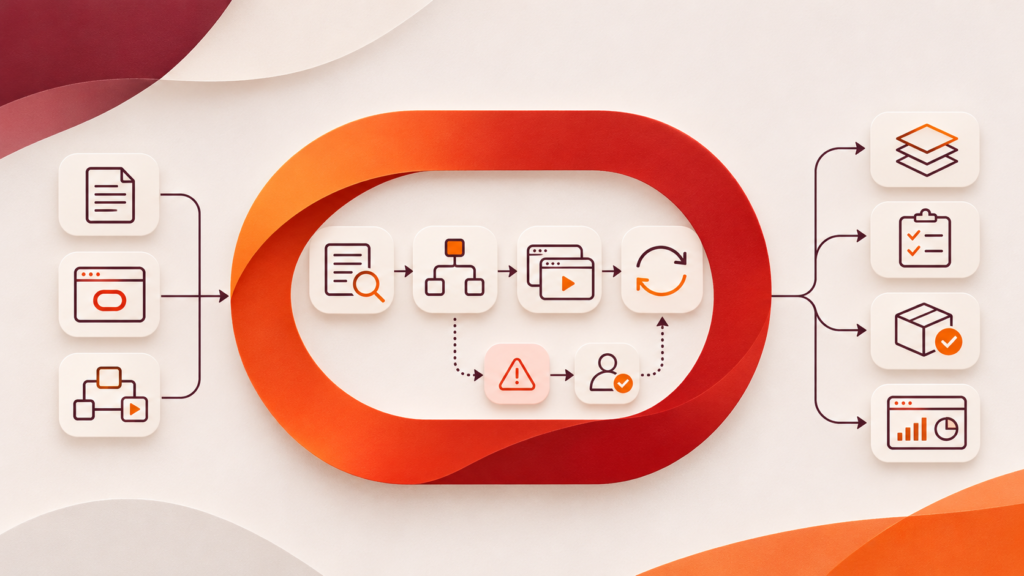
Agentic Quality Engineering uses specialized AI agents to support activities across the testing lifecycle. Instead of relying entirely on manually created test scenarios and repeatedly maintained automation scripts, agents help engineers interpret requirements, generate tests, map workflows, and maintain automation.
For Oracle regression testing, this introduces five capabilities:
- Requirement intelligence: Analyze approved business requirements, application changes, and acceptance criteria to identify validation needs.
- Intelligent scenario generation: Create test scenarios covering transactions, business rules, approval workflows, and exceptions.
- Application mapping: Connect scenarios to accessible Oracle interfaces, elements, APIs, and supported workflows.
- Automated test development: Generate executable tests using compatible automation frameworks.
- Self-healing maintenance: Identify eligible interface changes and repair affected test interactions while preserving functional validation.
Human oversight remains essential for ambiguous requirements, material automation changes, and genuine application defects.
The objective is to reduce repetitive engineering effort while improving the maintainability and reliability of automated testing.
How Can Specialized AI Agents Improve Oracle Fusion Testing?
Oracle Fusion testing frequently spans several connected business processes.
A Procure-to-Pay workflow, for example, may involve supplier information, invoice validation, approval hierarchies, accounting entries, and external integrations.
Testing individual screens cannot confirm that the complete workflow produces the intended business outcome. Specialized AI agents can help engineers establish stronger connections between business requirements, testing scenarios, application workflows, and results.
For an invoice approval process, Agentic QE can support validation of standard approvals, threshold exceptions, rejected invoices, and downstream financial updates.
This enables teams to focus on business-process coverage rather than simply increasing the number of automated scripts. The result is an opportunity to identify coverage gaps earlier and provide stronger evidence for release-readiness decisions.
Where Can Agentic QE Deliver Business Value Across Oracle ERP, HCM, and SCM?
The strongest opportunities for Agentic QE exist in workflows where application failures can directly affect business operations.
| Oracle application | Testing focus | Business value |
|---|---|---|
| Oracle ERP and Financials | Invoice approvals, financial close, reconciliation | Protect financial accuracy and reduce operational disruption |
| Oracle HCM | Payroll inputs, employee workflows, permissions | Improve confidence in HR and payroll processes |
| Oracle SCM | Procurement, inventory, fulfillment, integrations | Support supply chain continuity |
| Oracle-connected applications | API transactions, data synchronization, exception handling | Reduce cross-system processing risk |
Aligning automation with these business outcomes helps enterprise leaders measure the operational value of Oracle application testing.
How AI Agents Accelerates Oracle Test Automation
AppsTek combines its Oracle application expertise with Agentic Quality Engineering capabilities through, Agentic AI Software Testing Accelerator.
It uses specialized AI agents to support requirements analysis, test scenario generation, application mapping, automation creation, and self-healing maintenance.
Consider an enterprise preparing for an Oracle Fusion quarterly update. Its testing team must validate invoice approvals, financial workflows, and integrations while maintaining existing automation.
Accelerator can help engineers translate approved requirements into test scenarios, create automation using compatible frameworks, and maintain eligible test interactions as application interfaces evolve.
Human engineers continue to validate critical business assertions, investigate uncertain failures, and approve material changes. The intended business value is faster test preparation, reduced repetitive maintenance, and clearer visibility into workflow coverage.
Deployment for a particular Oracle environment depends on application access, compatibility, integrations, and governance requirements.
Preparing Oracle Application Testing for 2027
Oracle’s expansion of agentic applications is creating new expectations for enterprise software quality.
As business workflows become more autonomous, organizations will increasingly need to validate AI-driven decisions, permissions, exceptions, and downstream transaction outcomes.
Agentic Quality Engineering offers a foundation for evolving testing processes alongside these applications.
For organizations investing in Oracle modernization, the priority is to build a quality engineering capability that can adapt to application changes while controlling operational costs.
Accelerate Your Oracle Application Testing with AppsTek's Agentic QE Services
Oracle quarterly updates should not require enterprises to repeatedly rebuild their testing effort.
AppsTek helps organizations evaluate how specialized AI agents and QSpeak can improve test development, automation maintenance, and critical business-process validation.
Start with a 2-week QSpeak Proof of Concept.
Select a business-critical Oracle workflow, establish your current testing baseline, and measure opportunities for improving automation efficiency, coverage, and release confidence.
Explore AppsTek’s Agentic Quality Engineering Services
Frequently Asked Questions
Agentic Quality Engineering uses specialized AI agents to support requirements analysis, scenario generation, test automation, and eligible self-healing maintenance across Oracle application workflows.
It can help reduce repetitive test creation and automation maintenance. Actual savings depend on application complexity, existing testing processes, and implementation results.
Self-healing can identify and repair eligible changes affecting automated test interactions, reducing maintenance effort while preserving engineering review of functional defects.
As Oracle applications introduce more autonomous workflows, enterprises need to validate business rules, permissions, exception handling, and downstream transaction outcomes alongside conventional application functionality.
Related Reading

About The Author
Myrlysa I. H. Kharkongor is Senior Content Marketer at AppsTek Corp, driving content strategy for the company’s digital engineering services to enhance brand presence and credibility. With experience in media, publishing, and technology, she applies a structured, insight-driven approach to storytelling. She distills AppsTek’s cloud, data, AI, and application capabilities into clear, accessible communications that support positioning and grow the brand’s digital footprint.