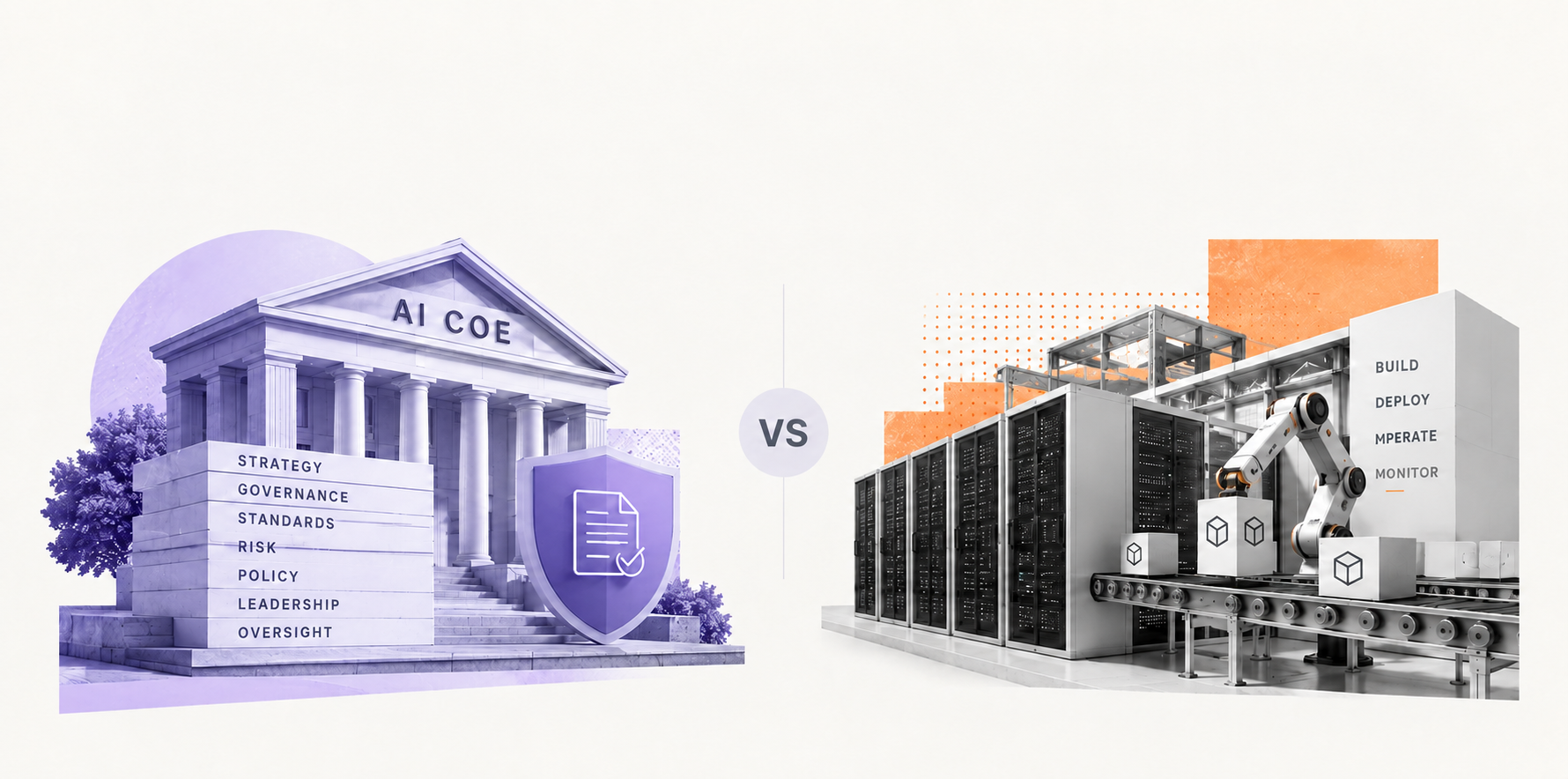



An AI adoption framework is the operating model an enterprise uses to move AI from pilot to production at scale. The most effective frameworks combine two functions: an AI Center of Excellence, which sets strategy, governance, and standards, and an AI Factory, which builds, deploys, and monitors AI systems on a repeatable, industrial basis.
Most enterprise AI initiatives never get that far. According to Gartner, roughly 50% of generative AI proof-of-concept projects will be scrapped before reaching production. The reason is rarely the model itself, it’s usually unclear ownership, inconsistent governance, fragmented data, and no repeatable path from prototype to deployed system. A well-designed AI adoption framework closes that gap by giving strategy and execution separate, clearly defined owners that work in a continuous loop.
This guide breaks down what an AI Center of Excellence is, how it differs from an AI Factory, and how to structure an AI adoption framework that actually gets AI projects into production.
What is an AI Center of Excellence?
An AI Center of Excellence (AI CoE) is the centralized team responsible for enterprise-wide AI strategy, governance, standards, and skill-building. It does not build software. Its job is to decide how AI should be adopted across the organization, which platforms are approved, what data and privacy rules apply, how risk and bias are evaluated, and which projects are worth funding.
Who staffs an AI Center of Excellence:
- Chief AI Officer or equivalent executive sponsor
- Data governance and privacy leads
- Legal and compliance analysts
- Enterprise business strategists and risk officers
What an AI Center of Excellence owns:
- Approved cloud platforms and vendor selection
- Data privacy, security, and compliance standards
- Bias, transparency, and responsible-AI review criteria
- Enterprise-wide AI training and upskilling programs
How AI Center of Excellence success is measured: policy adoption rate, percentage of projects following approved standards, reduction in unsanctioned “shadow AI” tool usage, and regulatory compliance scores.
What is an AI Factory?
An AI Factory is the delivery engine that transforms an approved AI concept into a reliable, monitored production system. While the Center of Excellence determines what to build and the rules to follow, the AI Factory focuses on building, deploying, and operating it reliably, at scale, and cost-effectively.
Who staffs an AI Factory:
- Machine learning engineers and data scientists
- MLOps engineers
- Software engineers
- Product managers who translate business needs into technical requirements
What an AI Factory owns:
- CI/CD pipelines for model deployment
- Feature stores and centralized model registries
- Containerized, scalable compute infrastructure
- Continuous monitoring for model drift, data degradation, and latency
How AI Factory success is measured: time to deployment, model uptime, inference latency, deployment frequency, and return on investment.
AI Center of Excellence vs. AI Factory: Key Differences
| Area | AI Center of Excellence | AI Factory Model |
|---|---|---|
| Primary objective | Strategy, governance, standards, enterprise skills | Build, test, deploy, and operate AI systems |
| Team composition | Strategists, legal, compliance, governance leads | ML engineers, data scientists, MLOps, developers |
| Core output | Policies, frameworks, training programs, vendor decisions | Code, model registries, pipelines, live production models |
| Success metrics | Compliance rate, risk mitigation, training completion | Time to market, uptime, deployment cost, ROI |
Why You Need Both to Build a Working AI Adoption Framework
Neither function works well alone. A Center of Excellence without an AI Factory model produces policy documents and no shipped software. An AI Factory without a Center of Excellence ships fast but accumulates compliance risk, technical debt, and inconsistent standards.
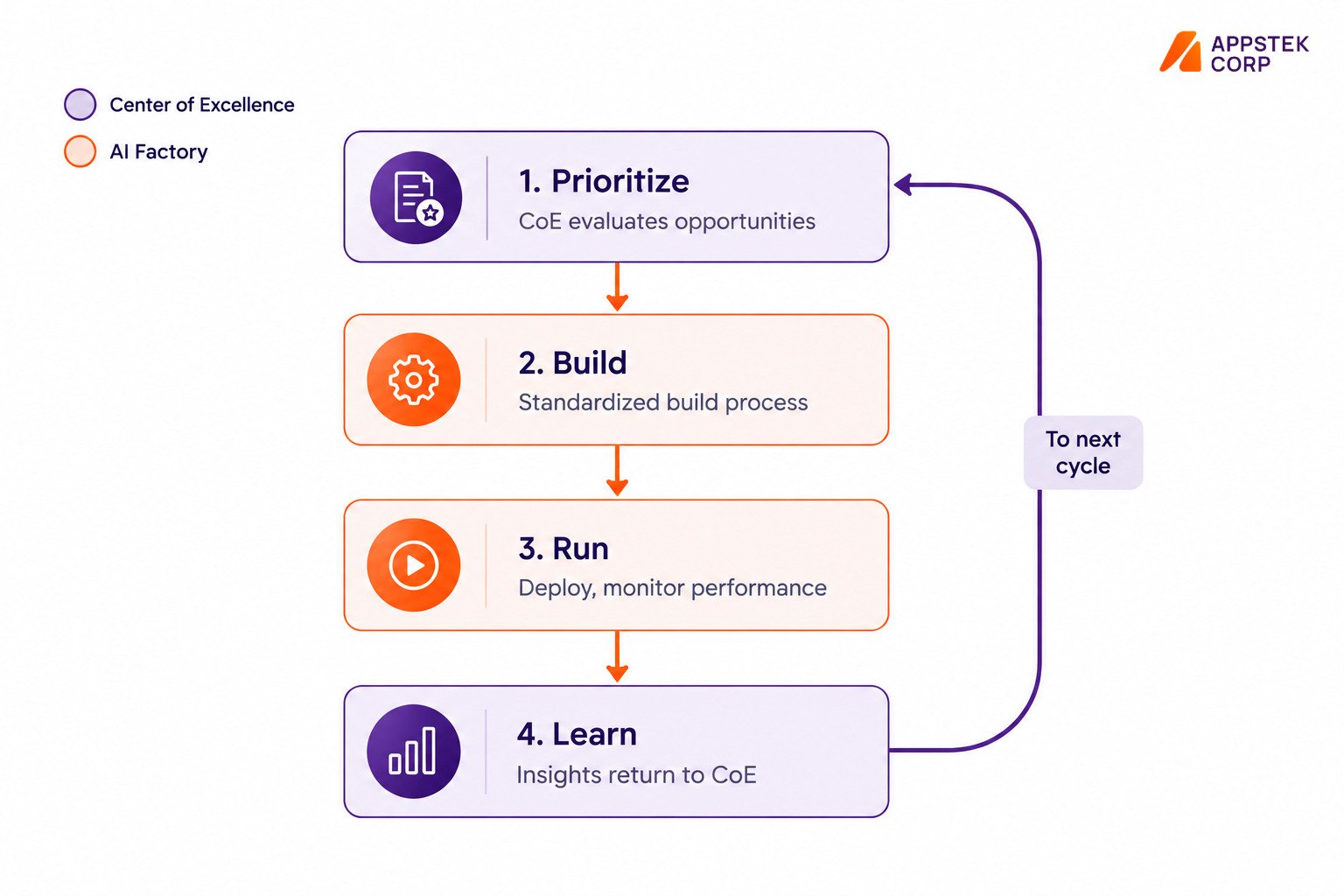
An effective AI adoption framework creates a continuous handoff between governance and delivery. The Center of Excellence determines what should move forward and under what conditions. The AI Factory turns those decisions into production-ready systems. The cycle works like this:
- Prioritize
The Center of Excellence evaluates AI opportunities against business value, strategic priorities, risk, and feasibility. - Build
Approved use cases move to the AI Factory, where teams develop them using standardized architecture, tools, workflows, and delivery practices. - Run
The Factory deploys the solution into production and continuously tracks performance, cost, reliability, and risk. - Learn
Production data flows back to the Center of Excellence, giving governance teams the evidence needed to refine standards, policies, and future investment decisions.
The result is a closed delivery loop that keeps AI moving. Ideas are evaluated, built, deployed, measured, and fed back into the next decision cycle.
That is what prevents pilot stall: a working proof of concept sitting in a sandbox with no clear path to production, funding, governance, or ongoing ownership.
How to Build an AI Adoption Framework in Four Phases
Phase 1: Assess readiness and align leadership
Audit current data infrastructure, technical talent, security posture, and the overarching organizational appetite for change. Define governance ground rules before any technological project starts.
Phase 2: Staff up the execution engine
Hire or reassign specialized talent directly into the AI Factory. Invest heavily in MLOps tooling, scalable cloud infrastructure, automated testing pipelines, and centralized model registries ensuring delivery remains fully repeatable.
Phase 3: Scale cross-functionally
Run the AI Center of Excellence and the AI Factory in parallel across multiple global business units. Invest strategically in enterprise-wide digital literacy ensuring technological adoption spreads across every single department.
Phase 4: Measure outcomes and refine
Track financial ROI, algorithm latency, deployment speed, and system uptime on the AI Factory side. Track compliance rates alongside specific risk metrics on the governance side. Use both data streams to refine the overarching framework continuously.
Conclusion
AI adoption needs more than a strong strategy or a capable engineering team. It needs an operating model that connects the two. The AI Center of Excellence sets the direction, standards, and governance, while the AI Factory turns approved use cases into production systems and feeds real-world results back into the next round of decisions.
That connection is what moves AI beyond pilots. The goal is to create a repeatable way to build, govern, operate, and improve AI solutions that deliver measurable business value.
If your enterprise is ready to move AI from strategy to production, AppsTek helps enterprises build the operating models and engineering foundations needed to take AI from pilot to production. Talk to our AI experts today.
Frequently Asked Questions
An AI adoption framework is a structured operating model, typically combining a governance function (AI Center of Excellence) and a delivery function (AI Factory), that enterprises use to move AI projects from prototype to sustained production use.
An AI Center of Excellence sets strategy, governance, and standards for AI across the organization. An AI Factory builds, deploys, and operates the AI systems themselves. One defines the rules; the other does the engineering.
A high failure rate for generative AI proofs of concept is driven less by model quality and more by unclear governance, fragmented data strategy, and the absence of a repeatable deployment process, exactly the gap an AI adoption framework is designed to close.
The formal team structure can scale down. A smaller organization may combine governance and delivery responsibilities in fewer roles, but the underlying functions, approval criteria, standards, and a repeatable build-and-deploy process, still need an owner.
On the governance side: policy adoption rate, reduced shadow-AI usage, compliance scores. On the delivery side: time to production, deployment frequency, system uptime, and ROI. A healthy framework shows improvement on both sets simultaneously.

About The Author
Myrlysa I. H. Kharkongor is Senior Content Marketer at AppsTek Corp, driving content strategy for the company’s digital engineering services to enhance brand presence and credibility. With experience in media, publishing, and technology, she applies a structured, insight-driven approach to storytelling. She distills AppsTek’s cloud, data, AI, and application capabilities into clear, accessible communications that support positioning and grow the brand’s digital footprint.