
Table of Contents
How Deployment Strategy Shapes Enterprise AI Success
What Happens During an AI Pilot After Approval
How an AI Factory Model Prepares AI for Production
AI Pilot vs AI Factory Across Every Stage of Deployment
Why Production Success Starts Before Model Development
How Enterprise AI Production Challenges Repeat Across Industries



A successful AI pilot often creates confidence across the business. Accuracy targets are met, leadership approves the investment, and the next step appears straightforward. Then production begins.
Production introduces challenges that rarely appear during a proof of concept. Enterprise data arrives from multiple systems, governance reviews become mandatory, integration requests enter change management queues, and operational ownership shifts between teams. Progress slows even though the underlying AI model performs exactly as expected.
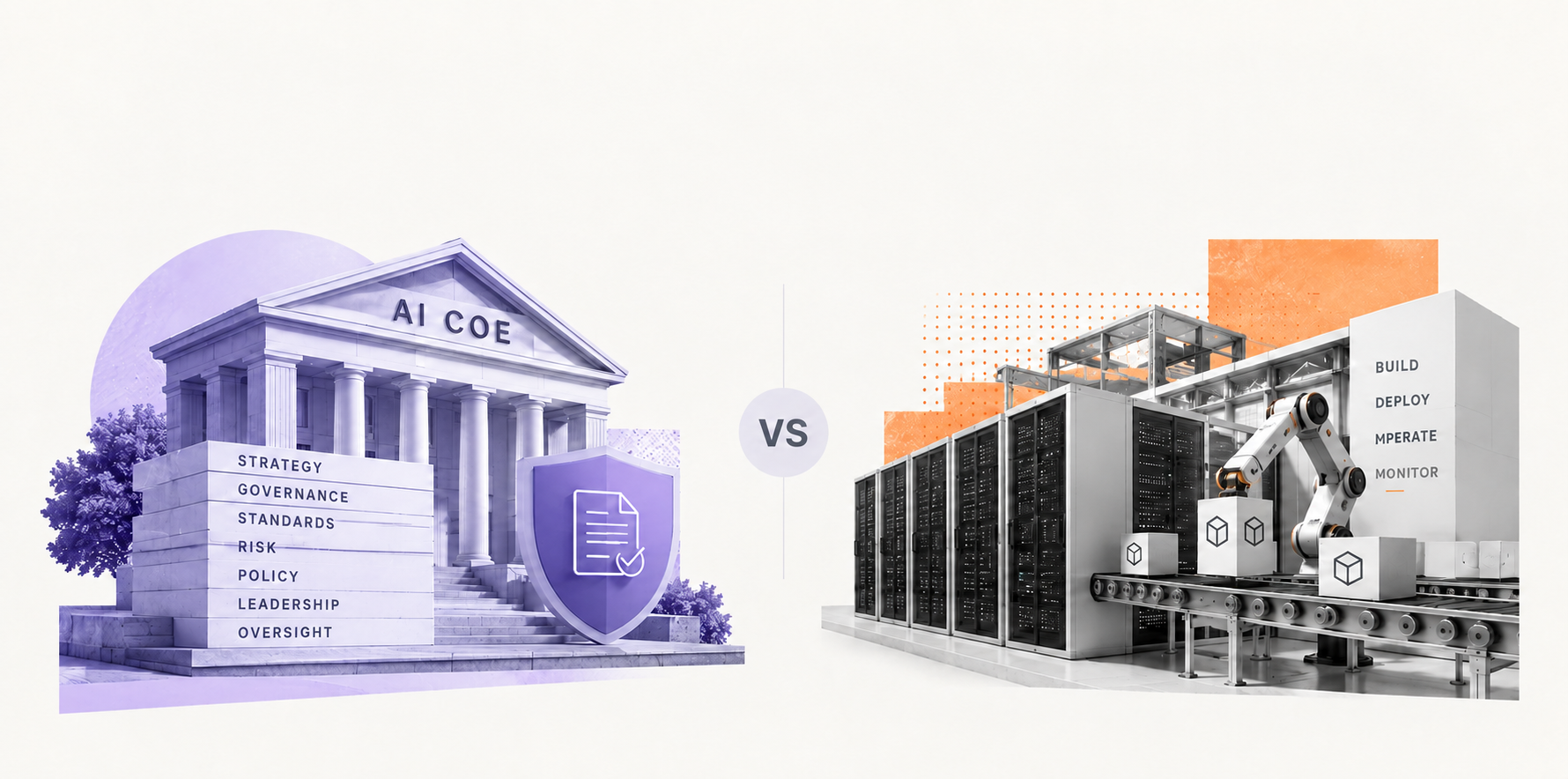
This is where the conversation around AI Pilot vs AI Factory becomes important. The difference is rarely the model itself. The difference lies in the operating model behind it.
An AI Factory Model prepares the enterprise for production before development begins. Data architecture, governance, integrations, deployment, and continuous monitoring are planned as shared capabilities rather than project-specific tasks. Every deployment strengthens the foundation for the next initiative instead of restarting the journey.
The following example illustrates how two organizations deploy the same AI capability using the same technology and budget. Six months later, the results look entirely different.
How Deployment Strategy Shapes Enterprise AI Success
Consider a financial institution introducing AI-powered document intelligence for loan processing. The objective is identical in both organizations. Reduce manual effort, accelerate application processing, and maintain regulatory compliance without compromising decision quality.
The technology is identical as well. Both organizations deploy the same natural language processing model to extract information from loan documents, validate data against compliance policies, and identify exceptions for human review.
Investment, business objectives, and technical capability remain unchanged. Only one decision differs. The first organization approaches the initiative as an AI pilot. The second adopts an AI Factory Model designed for long-term production. That single architectural decision shapes every outcome that follows.
What Happens During an AI Pilot After Approval
The pilot begins with carefully prepared data collected from a single loan origination system. Training, testing, and validation produce impressive accuracy, giving leadership confidence to approve production deployment.
The production environment immediately reveals a different reality. Applications originate from multiple platforms, document structures vary significantly, and data quality differs across business units. The original data pipeline requires redesign before the model can process production workloads consistently.
Integration becomes the next obstacle. Connecting multiple enterprise systems introduces formal change management processes, extended approval cycles, and dependencies that were outside the original project scope. Governance questions arrive shortly afterward.
Legal and compliance teams require explainability, audit trails, decision ownership, and operational controls before approving broader deployment. Documentation is created after these questions emerge, extending delivery timelines while introducing additional operational work.
The solution eventually reaches production, although only within a limited business group. Human reviewers continue validating nearly every AI recommendation because governance policies evolved after deployment rather than before it.
Six months after launch, only a small percentage of the intended workload is processed through the new system. Return on investment remains limited, additional integrations are still pending, and future AI initiatives begin with another round of planning rather than building upon existing capabilities. The AI model performs well. The production architecture never reached the same level of readiness.
How an AI Factory Model Prepares AI for Production
The second organization begins with a different objective. Instead of preparing a single AI project, the organization prepares a production environment capable of supporting multiple AI initiatives.
The first phase focuses on architecture rather than model development. Every production data source is identified, document formats are standardised through a governed data layer, integration requests are submitted at the beginning of the project, and governance requirements receive approval before deployment planning moves forward.
Development begins only after those production foundations are established. The AI model is trained using production data collected across every relevant source system instead of a curated sample. Initial accuracy is slightly lower because real production data contains inconsistencies. Those issues are addressed within the governed data layer, allowing improvements to benefit every future deployment rather than a single project.
This approach also simplifies AI Factory infrastructure deployment. Audit logging, monitoring, security controls, integration patterns, and operational governance already exist before production rollout begins.
When the solution enters production, every connected business system becomes available simultaneously. Performance monitoring continues after deployment, automatically identifying data drift, document changes, and operational anomalies. Model improvements become part of continuous operations rather than emergency projects.
By the sixth month, the platform processes the complete production workload while reducing processing time across the organization. More importantly, the same infrastructure already supports the next AI initiative, dramatically reducing planning effort and implementation time.
The first deployment becomes the foundation for every deployment that follows.
AI Pilot vs AI Factory Across Every Stage of Deployment
The first six months tell the real story of enterprise AI adoption. A pilot demonstrates technical capability. A factory demonstrates operational capability.
| Dimension | AI Pilot | AI Factory |
|---|---|---|
| Data preparation | Production data is addressed after the pilot | Governed data layer designed before development begins |
| Integration | Enterprise integrations are discovered during implementation | Integration planning begins before model development |
| Governance | Compliance reviews arrive during deployment | Governance framework approved before production |
| Auditability | Audit evidence is created after requests emerge | Audit trails are generated automatically from day one |
| Production scale | Limited rollout across selected workloads | Enterprise-wide deployment planned from the start |
| Monitoring | Performance reviews rely on manual observation | Automated monitoring identifies drift and operational issues continuously |
| Future initiatives | Every deployment begins as a separate project | Existing infrastructure accelerates every new AI initiative |
| Business value | ROI depends on extending the pilot | Production value begins immediately after deployment |
The comparison highlights a simple principle. An AI pilot proves that a model works. An AI Factory Model proves that an organization is prepared to operate AI at enterprise scale.
Why Production Success Starts Before Model Development
Technology alone did not create different results. Four architectural decisions made before development determined how quickly each organization reached production.
1. Data Architecture Before Model Development
The AI pilot focused on preparing a single dataset. The factory designed a governed data layer capable of supporting every production system from the beginning.
As additional use cases appeared, the same foundation supported them without rebuilding data pipelines. This decision reduced future implementation effort while improving consistency across deployments.
2. Governance Before Deployment
Governance became a production obstacle for the pilot because compliance discussions started after development. The factory established decision boundaries, audit requirements, approval workflows, and operational ownership before development began.
Legal, compliance, security, and technology teams aligned around one governance framework that supported production deployment from the first release. That preparation shortened delivery timelines while reducing operational uncertainty.
3. Integration Planned at Project Start
Enterprise AI depends on enterprise systems. Applications, APIs, business platforms, document repositories, and operational workflows all become part of the deployment.
The pilot addressed integrations after model development. The factory treated integration planning as part of the initial architecture.
Change requests entered approval queues early, allowing technical work and enterprise approvals to progress together instead of sequentially. This approach became a key advantage during AI Factory infrastructure deployment, where operational readiness matters as much as model performance.
4. Continuous Operations Instead of Project Completion
A pilot typically concludes once predefined success metrics are achieved. Production introduces a different objective. Models require continuous monitoring, governance reviews, retraining, security validation, and performance measurement as business conditions evolve.
The AI Factory Model includes operational monitoring as part of the architecture itself. Data drift, document changes, and system anomalies are detected continuously, allowing improvements to become routine operational activities rather than reactive projects. Each deployment strengthens the platform instead of creating another isolated solution.
How Enterprise AI Production Challenges Repeat Across Industries
The example focuses on financial services, although the pattern extends far beyond one industry. A manufacturer may achieve excellent predictive maintenance results during a pilot before discovering that production facilities operate with different sensor standards and data structures.
A healthcare provider may validate clinical documentation successfully within one department before encountering governance requirements across multiple regions and regulatory environments.
A real estate organization may automate lease analysis for one portfolio before expansion introduces additional document formats, approval processes, and integration requirements.
Different industries create different business challenges. Production follows the same pattern. Success depends less on the intelligence of the model and more on the production environment surrounding it. An AI Pilot vs AI Factory discussion ultimately becomes a conversation about enterprise readiness rather than artificial intelligence itself.
AI Pilot vs AI Factory Is Ultimately an Enterprise Decision
Enterprise AI succeeds through preparation rather than experimentation alone.
A high-performing model delivers value only when production data, governance, integration, monitoring, and operational ownership evolve together. Treating every initiative as a standalone pilot creates repeated planning cycles, duplicated infrastructure, and slower adoption across the organization.
The AI Pilot vs AI Factory conversation highlights a broader shift in enterprise AI strategy. Sustainable value comes from building a production ecosystem where each deployment strengthens the next. That is the purpose of an AI Factory Model. Shared infrastructure, governed operations, and repeatable delivery transform individual AI projects into an enterprise capability.
A structured approach to AI Factory infrastructure deployment enables organizations to move beyond isolated successes and establish an environment where AI can scale confidently across business functions.
AppsTek helps enterprises design AI Factory operating models that align data, governance, infrastructure, and deployment into a production-ready foundation, enabling every AI initiative to deliver measurable business value while accelerating the path to the next deployment.
Ready to build an AI Factory? Explore our services or speak with an AI expert to identify the right operating model for the enterprise.
Frequently Asked Questions About AI Pilot vs AI Factory
An AI pilot validates whether a model can solve a specific business problem under controlled conditions. An AI Factory Model prepares AI for enterprise operations by establishing governed data, production integrations, security controls, monitoring, and compliance before deployment. The pilot proves technical feasibility. The factory creates a repeatable operating model that supports long-term growth.
Pilots are typically designed around limited datasets, defined success metrics, and isolated environments. Production introduces multiple data sources, governance reviews, operational ownership, infrastructure dependencies, and enterprise integrations. These requirements extend implementation timelines when they are addressed after model development instead of during solution design.
AI Factory infrastructure deployment establishes the production foundation required to support AI workloads across the enterprise. It includes governed data architecture, integration frameworks, security policies, audit capabilities, monitoring, deployment pipelines, and operational controls. Once this foundation is available, every new AI initiative can build on existing capabilities rather than creating infrastructure independently.
The first deployment creates reusable capabilities that support future projects. Governed data layers, integration patterns, compliance frameworks, monitoring services, and deployment processes remain available across multiple AI use cases. Development teams spend less time rebuilding shared capabilities and more time delivering business outcomes, allowing new initiatives to move into production with greater speed and consistency.

About The Author
Wanpherlin M. Shangpliang is a Marketing Manager at AppsTek Corp, driving strategic marketing initiatives across digital, content, and brand communications. She focuses on positioning AppsTek’s AI offerings and comprehensive digital engineering services while supporting market outreach across key industries. With expertise in campaign management, content strategy, and audience engagement, Wanpherlin builds effective marketing programs that drive measurable growth and strengthen AppsTek’s overall presence.