
Table of Contents
What Does AI Agent Testing Actually Validate
Why Testing Only the Final Answer Creates a Blind Spot
The Four-Layer AI Agent Testing Framework
How to Test AI Agents Step by Step
AI Agent Evaluation Metrics That Matter
Common AI Agent Testing Mistakes
How AI Agent Testing Fits Into the Development Lifecycle



How to Test AI Agents: A Practical AI Agent Testing Framework
AI agents create a different quality problem. They do more than generate an answer. An enterprise AI agent may retrieve data, select a tool, call an API, hand a task to another agent, retry a failed action, update a system or request approval before moving ahead.
A correct final response tells you only part of the story. The real question is whether the agent reached that outcome through an execution path the enterprise can trust.
That is where AI agent testing changes the Quality Engineering model. Testing has to evaluate the outcome, observable execution path, tool behavior, controls, stability and recovery behavior together.
What Does AI Agent Testing Actually Validate
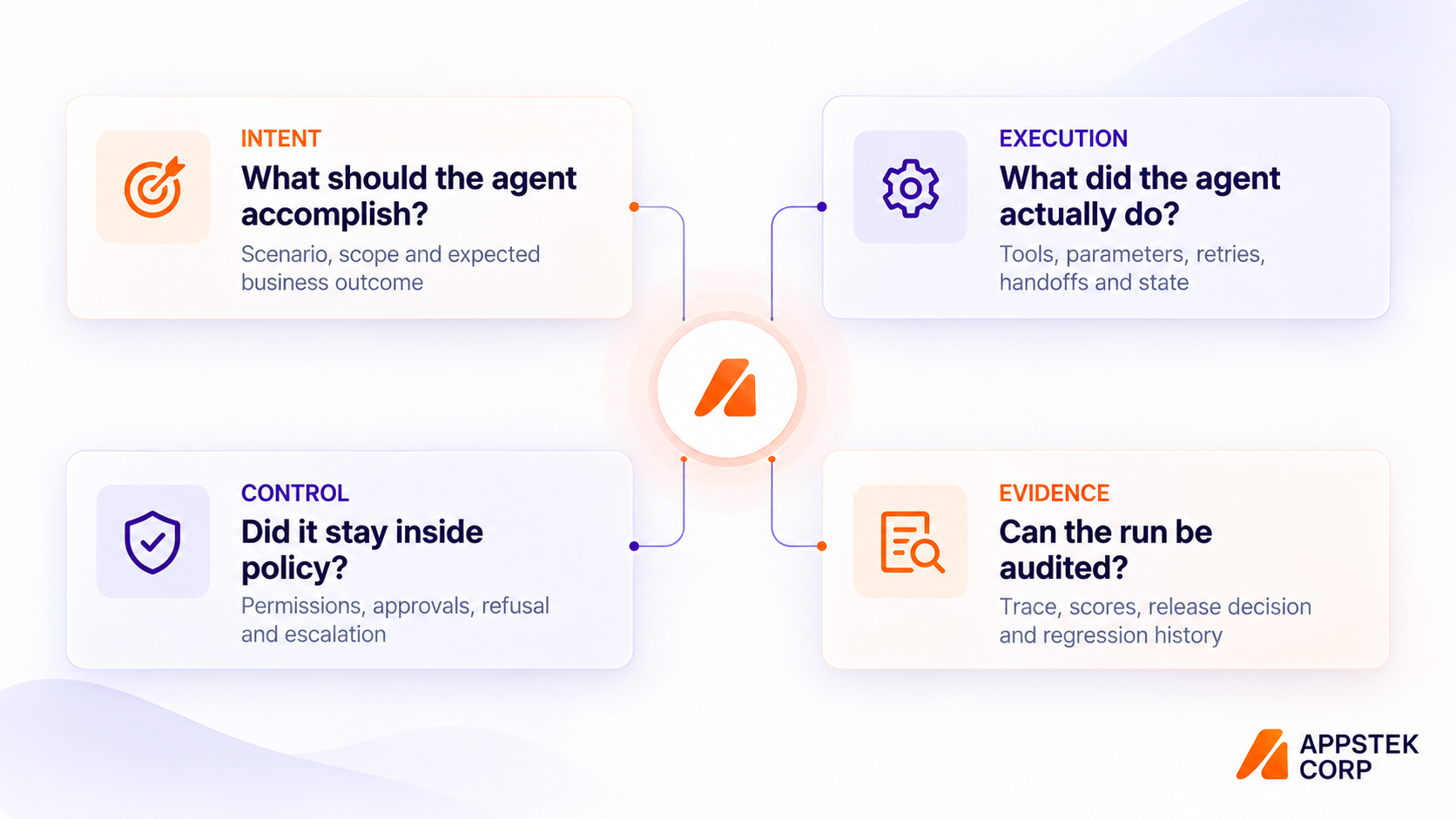
AI agent testing evaluates whether an agent completes the intended task while using the right tools, following defined business rules, respecting its authority and producing enough evidence to explain its behavior
This is broader than checking whether the answer looks correct. Consider an agent that needs to retrieve an account balance and summarize it for a user. The response could be accurate while the agent first queries an unnecessary privileged system, encounters an authorization error, retries twice and eventually reaches the approved source. The user sees success, while Quality Engineering sees unnecessary risk.
A robust AI agent evaluation asks questions such as:
- Did the agent accomplish the intended business goal?
- Which tools did it select and were those tools permitted for the task?
- Were parameters and authorization scopes correct?
- Did required validation or approval steps occur?
- How did the agent behave when a tool failed?
- Did execution remain inside defined cost and latency boundaries?
- Can the observable sequence of events be reconstructed afterward?
In this framework, reasoning path validation refers to the agent’s observable execution trajectory: tool calls, state transitions, routing, retries, handoffs and control decisions. The focus is execution evidence rather than private model chain-of-thought.
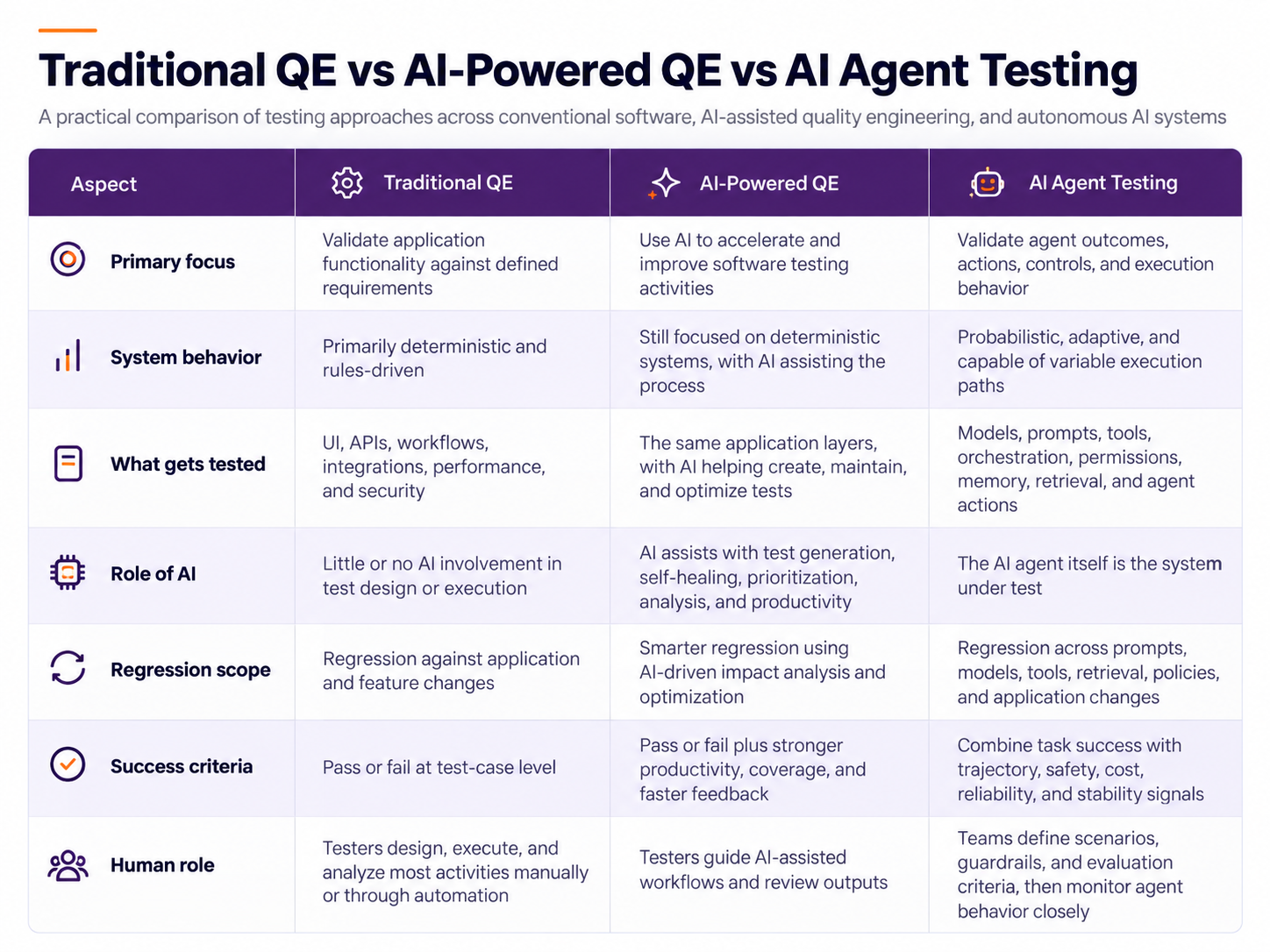
Traditional QE remains essential for validating UI, APIs, integrations, performance and security. AI-powered QE builds on this foundation by using AI to accelerate test creation, maintenance, prioritization and analysis. AI agent testing extends assurance further by validating the agent’s decisions, tool use, execution paths, controls and runtime behavior.
Why Testing Only the Final Answer Creates a Blind Spot
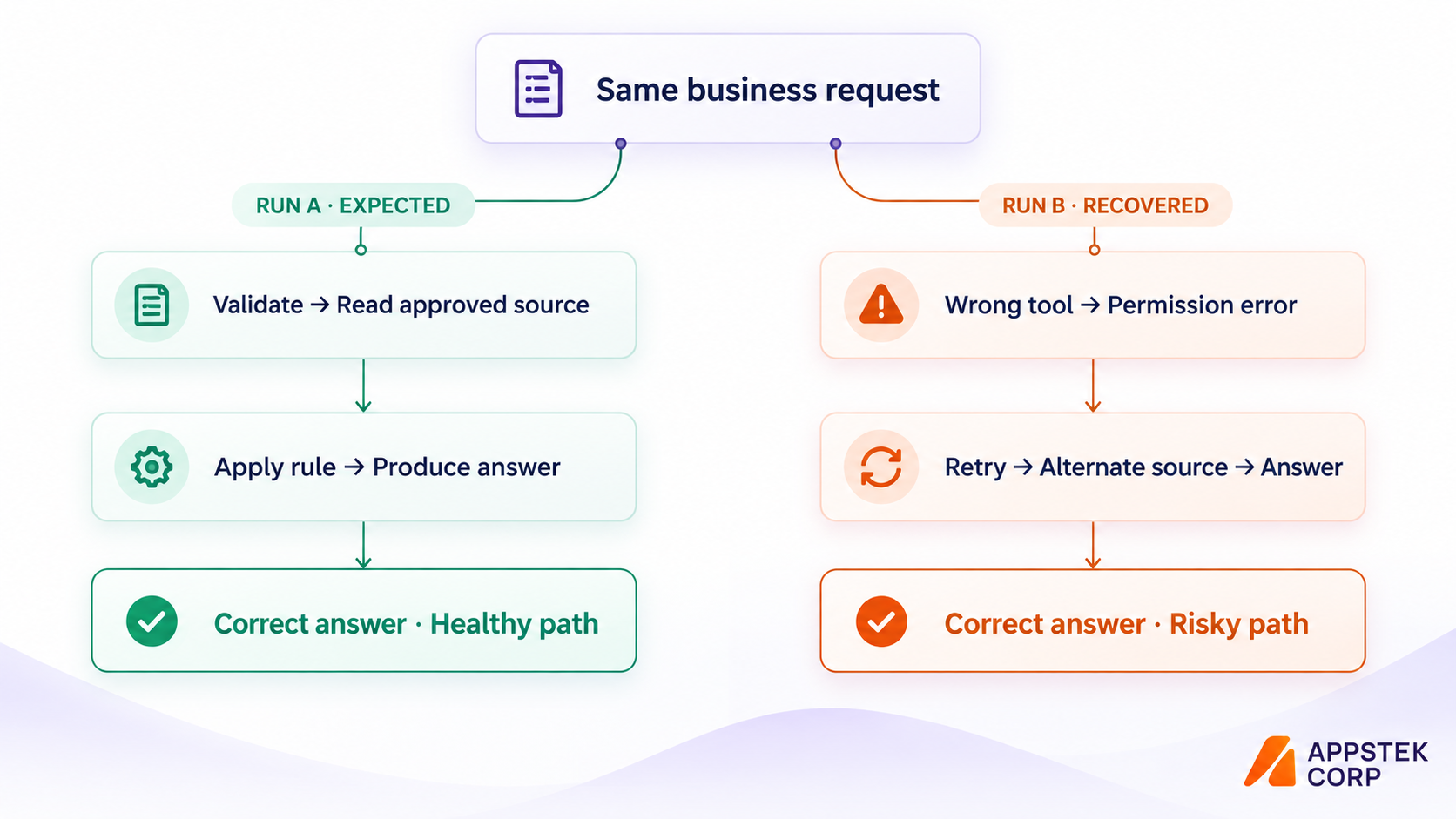
Two AI agent runs can end with exactly the same answer and still carry very different operational risk. One run may use the approved source and follow the expected validation sequence. Another may call the wrong tool, hit a permission error, retry and recover through an alternate source.
An output-level assertion could mark both runs as successful. A trace-level evaluation can identify the recovered run as degraded because the agent selected the wrong tool, generated an avoidable failure and needed recovery before completing the task.
This becomes increasingly important as agents gain access to enterprise systems. OWASP identifies risks such as tool abuse, privilege escalation, excessive autonomy, memory poisoning, approval bypass and runaway tool loops. Its guidance also recommends structured adversarial testing before production and after material changes to tools, memory, retrieval, policies or model providers. OWASP AI Agent Security Cheat Sheet
The implication for enterprise QE is clear: agent quality depends on the integrity of the execution as well as the quality of the answer
The Four-Layer AI Agent Testing Framework
A practical AI agent testing framework needs to evaluate four connected layers: observability, tool behavior, consistency and guardrails. Together, these layers turn dynamic agent behavior into testable enterprise quality criteria.
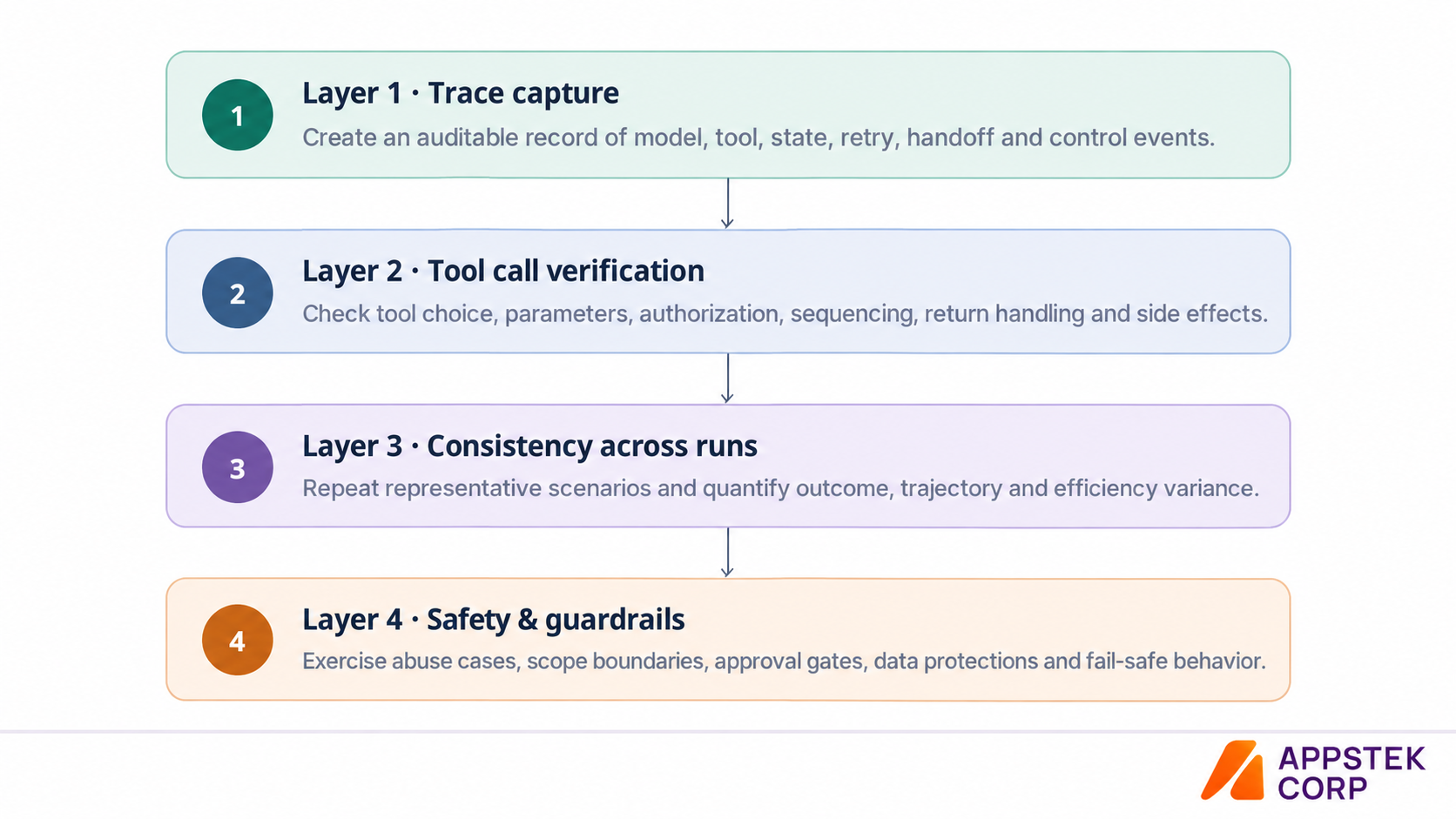
Layer 1: Capture the execution trace
Testing begins with observability. Each test run should create a structured record of what happened across the workflow. Useful evidence includes scenario and model versions, tool requests and responses, state transitions, routing events, retries, approvals, errors, latency, resource usage and the final business outcome. The goal is to reconstruct the run accurately enough to locate the point where behavior diverged.
Layer 2: Verify tool calls and actions
Tool use moves agent testing beyond response quality. Validate tool selection, parameters, authorization scope, return handling, sequencing and intended side effects. Instead of forcing every successful run into one rigid route, define trajectory invariants: required actions, forbidden actions, approval checkpoints, allowed tool sets and retry boundaries.
Layer 3: Test consistency across repeated runs
An AI agent may make slightly different decisions each time a scenario runs. Variation is expected. The important question is whether it stays inside the acceptable operating envelope. Compare task outcomes, tool choices, critical trajectory events, control compliance, retry behavior, latency and cost across repeated runs. Sampling depth should follow business risk.
Layer 4: Test guardrails and boundary behavior
Routine scenarios show how the agent behaves when conditions are clean. Enterprise assurance also needs difficult conditions such as conflicting instructions, prompt injection through retrieved content, invalid tool responses, approval bypass attempts, privilege escalation and excessive retry loops. Success may mean asking for clarification, requesting approval, using a safe fallback or escalating to a human.
How to Test AI Agents Step by Step
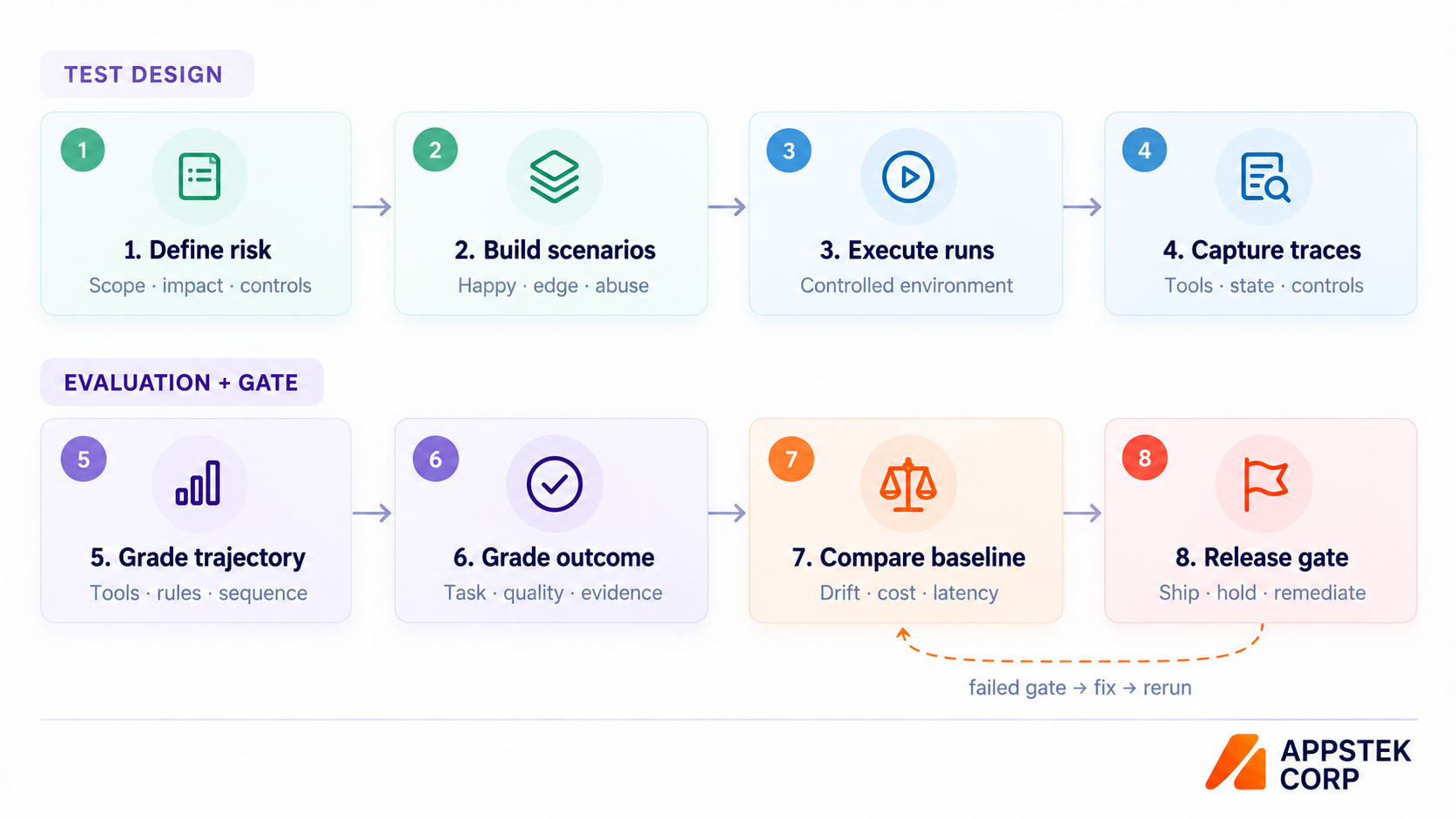
A repeatable process makes AI agent evaluation easier to operationalize across releases and gives teams a consistent evidence trail for release decisions.
1. Define the business outcome and authority boundary Document what the agent is expected to accomplish, which data and systems it can access, what actions it can execute directly and where approval becomes mandatory.
2. Build a representative scenario set Cover routine workflows, edge conditions, tool failures, ambiguous requests, hostile inputs and previously observed production incidents.
3. Define outcome criteria and trajectory invariants Specify the business result plus the execution requirements that must remain true across valid routes.
4. Execute in a controlled environment and capture traces Version prompts, tools, model configuration, policies and test data so release differences can be diagnosed accurately.
5. Grade the outcome and execution separately Score task success independently from trajectory compliance so recovered failures stay visible.
6. Repeat runs and compare against a baseline Measure stability across representative scenarios and flag material changes in tool use, quality, controls, latency or cost.
7. Turn evaluation into a release gate Connect critical failures to CI/CD gates and feed production findings back into the regression suite.
AI Agent Evaluation Metrics That Matter
A single pass rate hides important information. A stronger AI agent evaluation scorecard combines measures that reflect the type of agent and the risk created by its actions.
| Metric | What it tells you |
|---|---|
| Task success rate | Percentage of runs that achieve the intended business outcome |
| Trajectory compliance rate | Percentage of runs that stay within defined execution invariants |
| Tool call accuracy | Percentage of evaluated tool interactions using approved tools, parameters and authorization |
| Guardrail activation accuracy | Whether controls trigger when required while legitimate activity continues |
| Behavioral drift rate | Frequency of material deviations against the approved baseline |
| Recovery success rate | Ability to handle tool, API or workflow failures safely |
| Cost per successful run | Resources consumed to deliver a valid outcome |
| Time to detect regression | Time between a material behavioral change and its detection |
Thresholds should reflect business impact. A read-only knowledge agent and an autonomous operational agent need different release requirements because the consequences of failure differ significantly.
Common AI Agent Testing Mistakes
Testing the answer while ignoring the execution
A correct response can hide an incorrect data source, excessive privilege, unnecessary retries or an approval gap. Evaluate both the outcome and the execution evidence.
Requiring one exact execution path
Agent workflows can have several acceptable routes. Test the conditions that must remain true across those routes.
Declaring success after one clean run
Probabilistic systems need repeated execution. Variation becomes measurable only after representative scenarios are exercised across enough runs to establish a useful baseline.
Ignoring retries, loops and efficiency
Functional success can still become operationally expensive. Track retries, tool calls, latency and resource consumption before scale magnifies inefficient behavior.
Treating production launch as the end of testing
Agent behavior can shift when models, prompts, retrieval sources, permissions, tools or user behavior change. Production evidence should feed the next regression cycle.
How AI Agent Testing Fits Into the Development Lifecycle
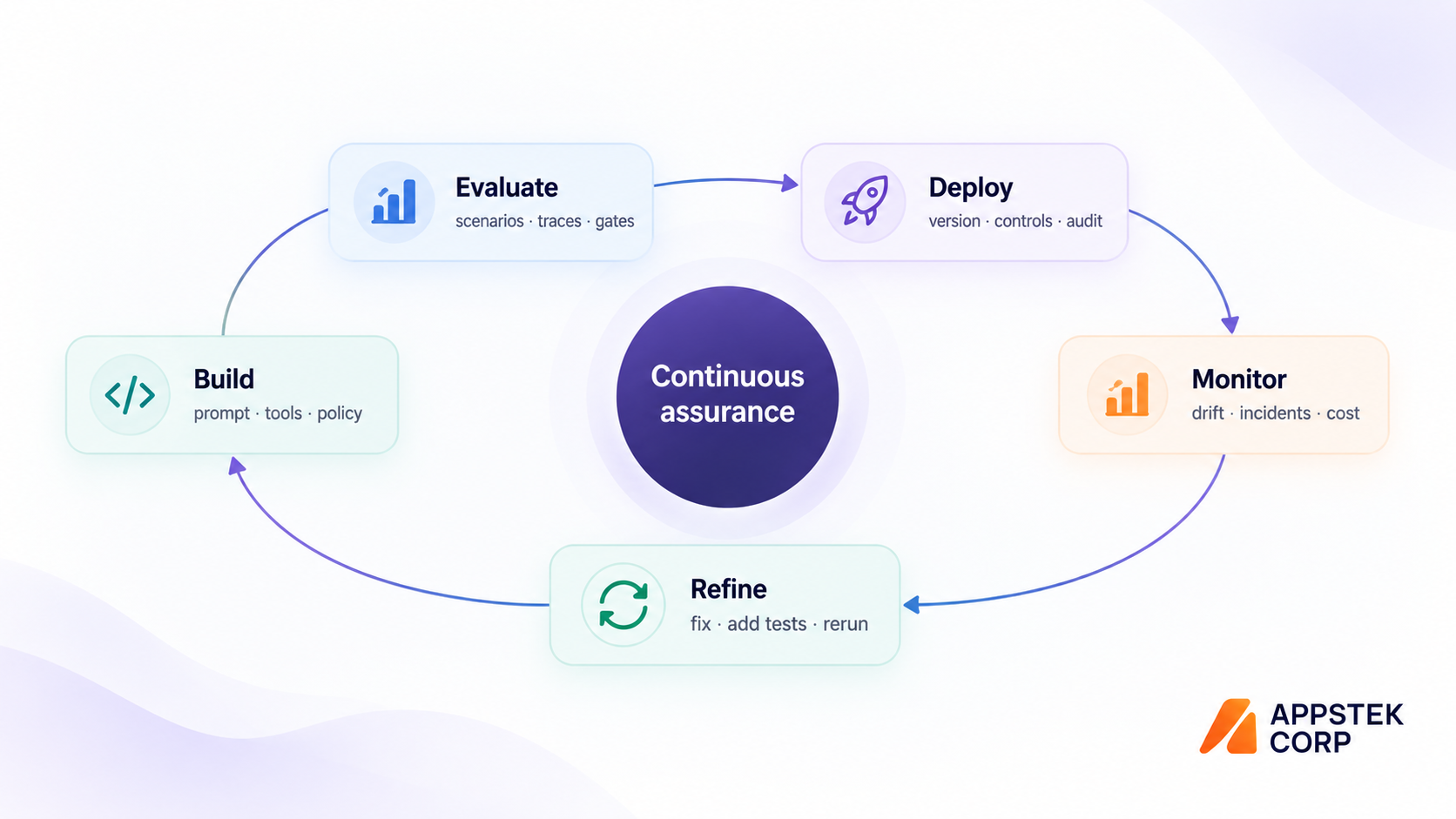
AI agent assurance works best as a continuous loop: Build → Evaluate → Deploy → Monitor → Refine → Re-evaluate
Pre-release testing establishes the approved baseline. Production monitoring then surfaces behavior that controlled test environments may miss. Incidents, near misses, unusual execution paths and new user patterns become inputs for the regression suite.
Material changes to the agent’s model, prompts, tools, retrieval layer, permissions, orchestration or governance policies should trigger targeted re-evaluation. This creates a feedback loop where production experience steadily improves test coverage.
How AppsTek Approaches AI Agent Testing
AppsTek treats AI agent assurance as a Quality Engineering problem with agent-specific evaluation layers. The objective is to make agent behavior measurable, governable and diagnosable while preserving enough flexibility for dynamic enterprise workflows.
1. Model the risk Define the systems, data, actions, approval requirements and potential business impact attached to the agent.
2. Design the test oracle Establish outcome expectations, trajectory invariants, forbidden actions, authority boundaries and escalation behavior.
3. Instrument the workflow Capture observable evidence across model interactions, tools, state changes, approvals, retries and handoffs.
4. Exercise real operating conditions Run representative business scenarios alongside edge cases, tool failures, hostile inputs and recovery conditions.
5. Measure agent behavior Evaluate task success, execution integrity, stability, control compliance, latency and resource consumption.
6. Govern release and regression Connect evaluation results with release gates and turn meaningful production findings into new regression scenarios.
This capability complements AppsTek’s broader Agentic Quality Engineering services, where AI agents support testing across requirements, application workflows, test creation, automation and governed enterprise delivery.
The Right Answer Is Only Half the Test
Enterprise AI agents increasingly sit between human intent and real business action. That makes output accuracy essential, while enterprise trust also depends on tool behavior, authority boundaries, recovery, stability and evidence across every release.
Teams need to see which tools the agent used, how it handled failure, whether it respected controls, how stable its behavior remains and whether the same quality survives the next model, prompt or application change.
Put Your AI Agents Through a Real Quality Gate
Evaluate execution paths, tool behavior, guardrails and production readiness with AppsTek Agentic Quality Engineering
Frequently Asked Questions
AI agent testing evaluates whether an AI agent completes a task correctly while following approved execution, tool, security and governance rules. It can include outcome evaluation, execution-trace analysis, repeated-run testing, adversarial scenarios, drift detection and production regression.
Start by defining the business outcome and authority boundary. Build representative scenarios, establish trajectory invariants, capture execution traces, evaluate outcome and execution independently, repeat scenarios to measure stability and connect material failures to release gates.
An AI agent testing framework is a structured approach for evaluating agent behavior across outcomes, tool interactions, execution traces, stability and guardrails. It helps teams convert dynamic agent behavior into measurable Quality Engineering criteria.
AI agent evaluation measures how effectively and reliably an agent performs its intended tasks. Enterprise evaluation can cover task success, trajectory compliance, tool accuracy, control behavior, recovery, drift, latency and resource consumption.
LLM testing primarily evaluates model responses and model behavior. AI agent testing extends evaluation to the surrounding system, including tools, permissions, retrieved context, orchestration, state changes, handoffs and actions executed against enterprise applications.
Testing should occur before release and after material changes to the agent's model, prompts, tools, retrieval sources, permissions or policies. Production incidents and newly observed behaviors should also feed the regression suite so coverage evolves with the system.
Approval requirements should follow the impact and reversibility of the action. High-impact financial, administrative, security-sensitive or externally visible operations benefit from clearly defined human or independent authorization controls before execution.

About The Author
Rahul Sudeep, Senior Director of Marketing at AppsTek Corp, is a results-driven, AI-first B2B marketing leader with 15 years of experience scaling global enterprise SaaS companies. His expertise, honed at IIM-K, spans architecting high-impact go-to-market strategies, driving new market identification and positioning, and embedding Generative AI, LLMs, and predictive analytics into the core marketing function. Rahul unifies Technology, Sales, and Support teams around a single strategic hub, while also managing key Partner and Investor Relations. He leverages AI-driven insights to craft powerful brand narratives and hyper-personalized demand generation campaigns that drive measurable revenue growth and deepen customer engagement.