


1
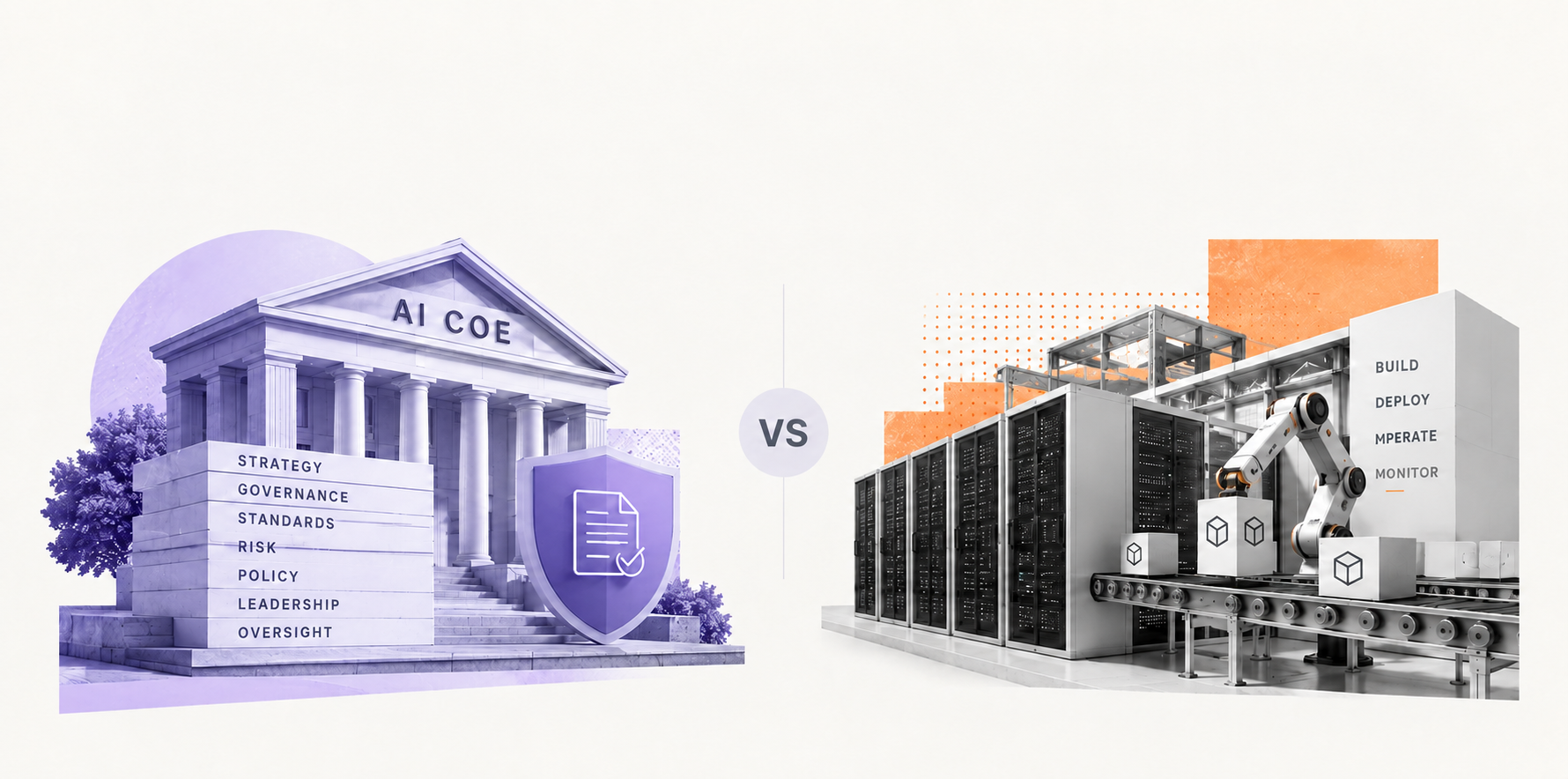
The unit of scale is a governed AI product integrated into a business workflow, not a standalone model.
2
Shared platforms create leverage only when ownership, funding, governance and operations are equally clear.
3
The strongest AI Factory model standardizes delivery and control while allowing domains to adapt solutions to real operating context.
Enterprise AI has entered an uncomfortable middle stage. Models are more capable, development tools are easier to access, and business demand is expanding. Yet the operating conditions required to deploy AI reliably remain fragmented. Data teams build one pipeline, application teams create another integration, risk teams review late, and business units launch copilots that have no clear production owner.
This is why the conversation must move beyond an AI platform or a collection of use cases. A platform can provide infrastructure, models, tooling and deployment services. It cannot decide which problems deserve investment, who owns the result, how controls enter the delivery path, how human work changes, or how the enterprise learns after release.
The AI Factory ecosystem addresses that wider problem. It is the structure that connects strategy, architecture, engineering, governance and operations so that AI becomes repeatable without becoming generic.
The factory metaphor is useful only when applied to the path of delivery. Enterprises should standardize how AI is selected, evidenced, secured, deployed, monitored and improved. They should not standardize away the business context that makes each AI product valuable.
What is an AI Factory ecosystem?
An AI Factory ecosystem is a coordinated network of business teams, data assets, engineering capabilities, control functions, platforms and partners that produces and operates AI as an enterprise capability. It covers the complete lifecycle: value discovery, product definition, data and context preparation, model or agent engineering, validation, deployment, workflow integration, observation, governance and continuous improvement.
The word ecosystem matters. No single platform, team or vendor can provide all the context and control needed for enterprise AI. The capability depends on interactions across business domains, application estates, data platforms, security systems, model providers, infrastructure environments, regulators and specialist partners.
A useful definition for CIOs is:
The AI Factory ecosystem is the enterprise operating system for producing, governing and improving intelligence inside real workflows.
This definition separates the enterprise view from the infrastructure-only meaning of an AI factory. Accelerated computing, storage, networking, Kubernetes, model services and observability are essential production foundations. Current enterprise design guidance also treats the ecosystem as a combination of infrastructure, AI platforms, data connectors, security, observability, developer tooling and partner integrations.1 The enterprise operating model must extend above those layers to include value, accountability and process change.
| Dimension | AI Platform | AI Factory Ecosystem |
|---|---|---|
| Primary purpose | Provide shared tools, models and infrastructure | Create a repeatable enterprise capability for AI outcomes |
| Unit of delivery | Model, notebook, API or deployment endpoint | Governed AI product embedded in a workflow |
| Ownership | Platform or engineering team | Shared across domain, product, platform and control owners |
| Governance | Tooling and policy controls | Decision rights, risk tiers, evidence, runtime controls and accountability |
| Success measure | Usage, capacity, deployment volume | Business value, adoption, trust, economics and resilience |
| Learning model | Technical monitoring and model iteration | Business, human, operational and technical feedback loops |
Why enterprises need an ecosystem, not another AI stack
Most scaling barriers do not sit inside the model. They appear at the boundaries between functions and systems. A promising use case slows down because the data owner was not involved early. A well-performing agent cannot access a system of record. A compliance review changes the architecture after development. A production service has no owner for exceptions. An inference bill grows without a clear link to business value.
These are ecosystem failures. They happen when each part of the enterprise optimizes its own task but no one owns the complete path to an outcome.
Workflow before model
Start with the decision or unit of work that must improve. Select models and agents only after the operating context, constraints and handoffs are understood.
Context before scale
Enterprise data, process rules, permissions and institutional knowledge create differentiation. Generic intelligence without context produces generic value.
Reuse before reinvention
Standardize connectors, evaluation harnesses, policy controls, prompt and agent patterns, observability and release paths so each initiative starts at a higher level.
Controls inside the path
Governance should operate as code, workflow and evidence during delivery and runtime, rather than as a separate approval exercise near release.
Economics at outcome level
Track the cost of completing a useful business outcome, not only tokens, GPU hours or API calls. Cost must remain visible beside quality and value.
Federation with standards
Central teams should provide shared foundations and guardrails. Domain teams should retain accountability for business design, adoption and performance.
The reference architecture of an AI Factory ecosystem
A practical AI Factory architecture can be understood as six production layers supported by two horizontal control planes. Each layer has a distinct purpose, but value appears only when the layers operate as one system.
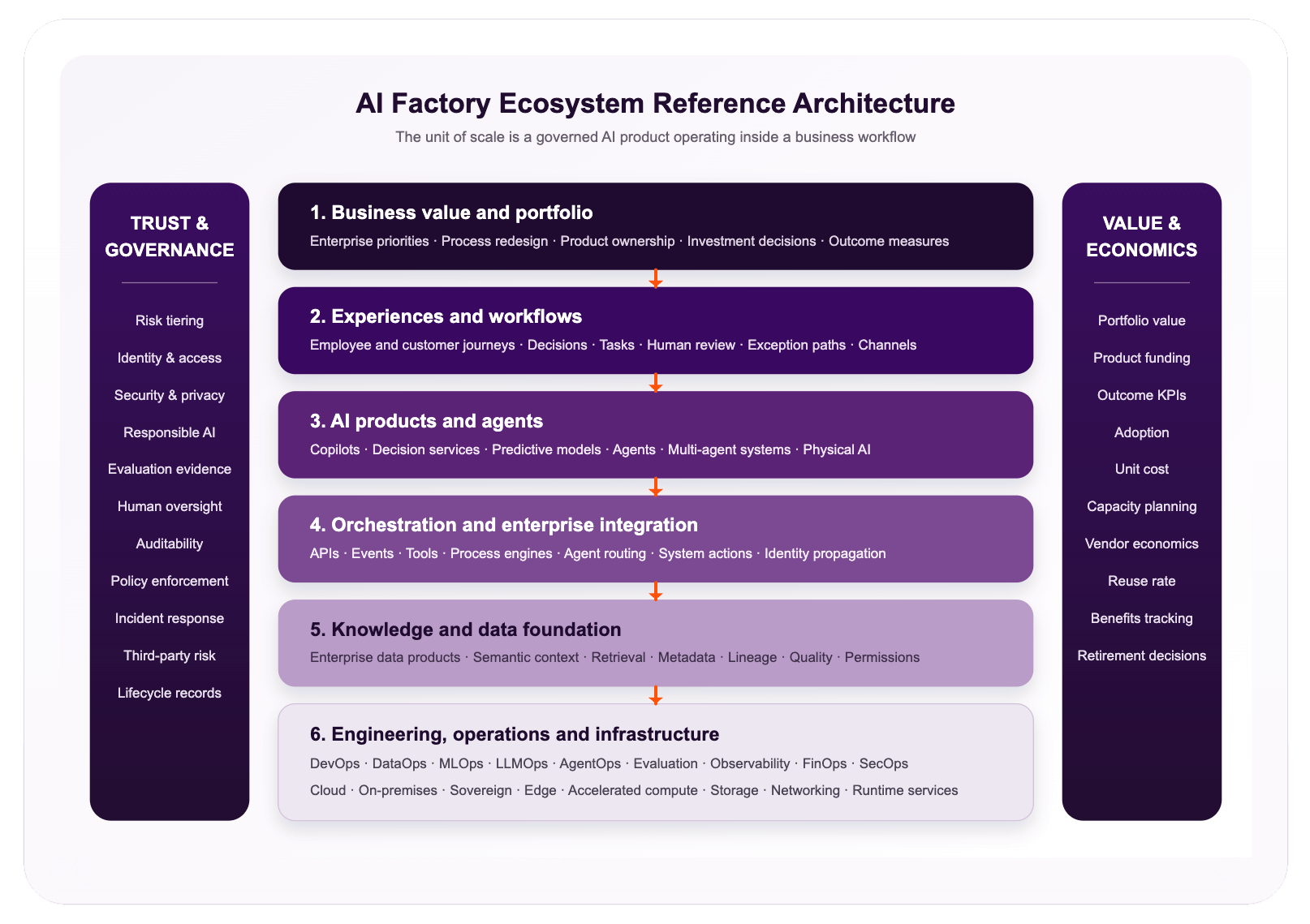
Figure 1. The ecosystem connects six production layers with two control planes. Trust, governance, value and economics must remain active across the full lifecycle, rather than appearing as late-stage reviews.
1. Business value and portfolio
This layer translates enterprise priorities into a managed portfolio of AI products. It defines the problem, product owner, expected outcome, funding model, process change, adoption path and retirement criteria.
- Use-case discovery based on business constraints, not model novelty
- Portfolio balancing across value, feasibility, risk and reuse potential
- Named product ownership with measurable post-release accountability
2. Experiences and workflows
AI creates value when it changes how a decision is made or how work is completed. This layer maps the user journey, task sequence, human handoffs, exceptions and system touchpoints.
- Role-specific interfaces, copilots and embedded decision support
- Human review points based on confidence, materiality and risk
- Fallback and exception pathways when AI cannot act safely
3. AI products and agents
This is the portfolio of production capabilities: predictive models, language applications, computer vision services, decision engines, copilots, agents and multi-agent workflows.
- Product contracts covering purpose, boundaries, inputs, outputs and service levels
- Reusable skills, tools, prompts, policies and evaluation assets
- Versioned agents and models with clear lifecycle states
4. Orchestration and enterprise integration
Enterprise AI must retrieve context, call tools, coordinate agents and take action across the application estate. The orchestration layer manages these interactions while preserving identity, permissions and audit context.
- API, event, workflow and process integration patterns
- Agent registry, tool registry and routing policies
- State, memory, transaction boundaries and compensation logic
5. Knowledge and data foundation
AI products need governed access to enterprise context. This layer combines data products, semantic models, metadata, retrieval, knowledge graphs, vector stores, content services and real-time signals.
- Permission-aware retrieval and policy-filtered context
- Quality, lineage, provenance and freshness controls
- Shared semantic definitions that reduce conflicting answers across domains
6. Engineering, operations and infrastructure
This layer provides the delivery pipelines, runtime environments and operational disciplines required to build and run AI across cloud, on-premises, sovereign and edge environments.
- Development environments, automated tests, release pipelines and artifact management
- MLOps, LLMOps and AgentOps for different classes of AI systems
- Observability, security, capacity, reliability and cost management
Compound AI architectures increasingly rely on registries, planners and coordinated flows across agents, enterprise data and APIs rather than a single monolithic model.2 The implication for the CIO is significant: model selection is only one architectural decision among many. Integration, context, identity, evaluation and control often determine production viability.
The operating model: four loops that must run together
An AI Factory should not be managed as a linear project pipeline. Production AI behaves as a set of connected loops. Business priorities change, models change, data changes, user behavior changes and regulation changes. The operating model must keep sensing and responding.
LOOP 01
Value loop
Continuously identifies high-value decisions and workflows, measures realized outcomes, reallocates investment and retires products that no longer justify their cost or risk.
LOOP 02
Delivery loop
Turns a prioritized problem into a production AI product through reusable patterns, automated evidence, integration, validation and controlled release.
LOOP 03
Control loop
Applies risk classification, identity, security, privacy, evaluation, human oversight, policy enforcement and incident response across delivery and runtime.
LOOP 04
Learning loop
Uses technical signals, user feedback, overrides, exceptions and business outcomes to improve prompts, tools, models, policies, workflows and training.
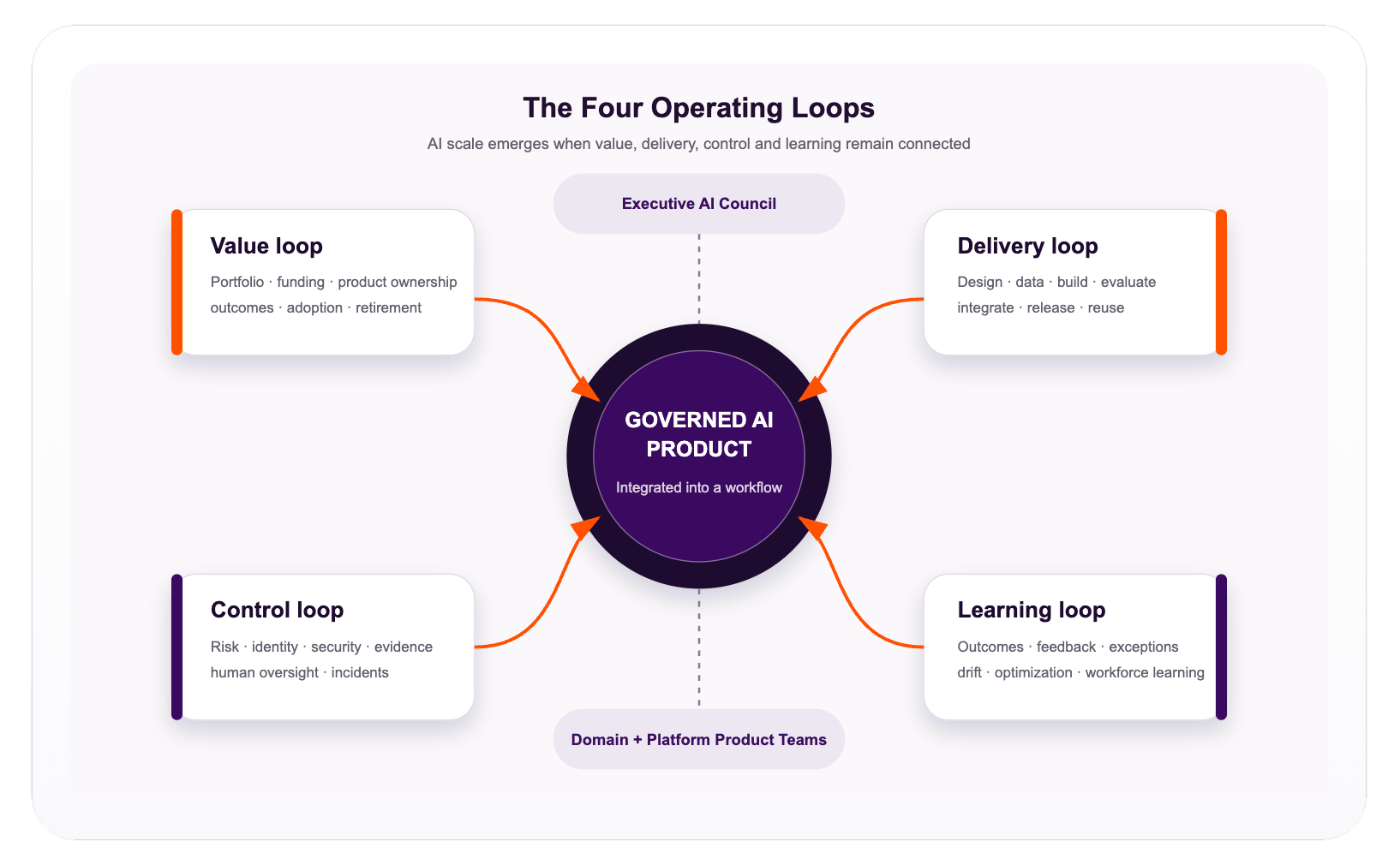
Figure 2. The four loops create a living operating model. The product is governed centrally where standards matter and owned by the domain where outcomes matter.
Why a federated model usually works best
A highly centralized model can create standards but may become a delivery bottleneck. A fully decentralized model can move quickly but often produces duplicate platforms, inconsistent controls and hidden cost. A federated model separates enterprise responsibilities from domain responsibilities.
| Decision area | Enterprise AI function | Business domain | Control functions |
|---|---|---|---|
| Portfolio | Cross-enterprise prioritization criteria and shared funding | Business case, process ownership and value realization | Risk appetite and mandatory review thresholds |
| Architecture | Reference patterns, platform services and interoperability | Domain integration and workflow-specific design | Security, privacy, resilience and compliance requirements |
| Engineering | Reusable components, pipelines, evaluation harnesses and environments | Product backlog, domain logic, acceptance tests and adoption | Evidence requirements and independent challenge for higher-risk systems |
| Operations | Shared observability, incident tooling, capacity and vendor management | Business service levels, exceptions and product performance | Control monitoring, incident escalation and audit support |
CIO design test
For every production AI product, the organization should be able to answer five questions without ambiguity: Who owns the outcome? Who can change the system? Who approves material risk? Who responds when it fails? Who decides when it should be retired?
The end-to-end AI Factory workflow
The workflow should create evidence and reusable assets as a normal consequence of delivery. Each stage produces a clear artifact, applies the right control and creates an explicit decision.
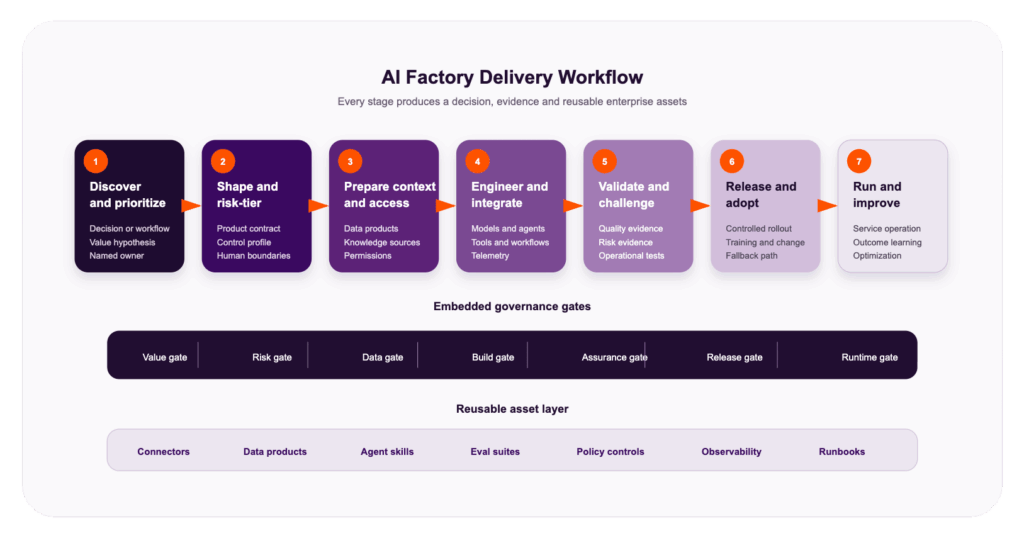
Figure 3. A production pathway should be explicit and risk-adjusted. Lower-risk products can move through automated gates, while high-impact systems receive deeper challenge and human approval.
Stage 1: Discover and prioritize
Begin with a decision, workflow or customer outcome that has a named owner. Evaluate value, feasibility, data readiness, integration complexity, risk, adoption effort and reuse potential. The output is a portfolio decision, not a vague innovation theme.
Stage 2: Shape and risk-tier
Define the product contract: intended users, decisions supported, actions allowed, prohibited behavior, human oversight, service expectations and success measures. Assign a risk tier that determines required evidence and approval depth.
Stage 3: Prepare context and access
Build the governed context layer. Identify data products, knowledge sources, business rules, permissions, retention requirements and freshness needs. The product should retrieve only what the user and the AI service are permitted to access.
Stage 4: Engineer and integrate
Choose the simplest reliable pattern. A deterministic rule or retrieval service may be more suitable than an autonomous agent. Where agents are required, define skills, tools, state, memory, routing, transaction behavior and human checkpoints. Instrument the system before production.
Stage 5: Validate and challenge
Test the complete system, not only the model. Evaluation should cover business correctness, groundedness, robustness, safety, privacy, permissions, bias, latency, cost, failure behavior and operational recovery. Evidence must reflect realistic tasks and adversarial conditions.
Stage 6: Release and adopt
Use progressive release patterns, clear fallback paths and workforce enablement. Adoption is part of product engineering. Users need to understand what the system can do, when judgment remains necessary and how to report an exception.
Stage 7: Run and improve
Operate the AI product as a business service. Observe technical behavior, user behavior, model and agent traces, data quality, human overrides, outcome quality, cost and policy events. Feed that evidence back into product, process and workforce decisions.
What the AI Factory ecosystem produces
The ecosystem should not be organized around one model family. It should support a portfolio of solution patterns that share production foundations while serving different business needs.
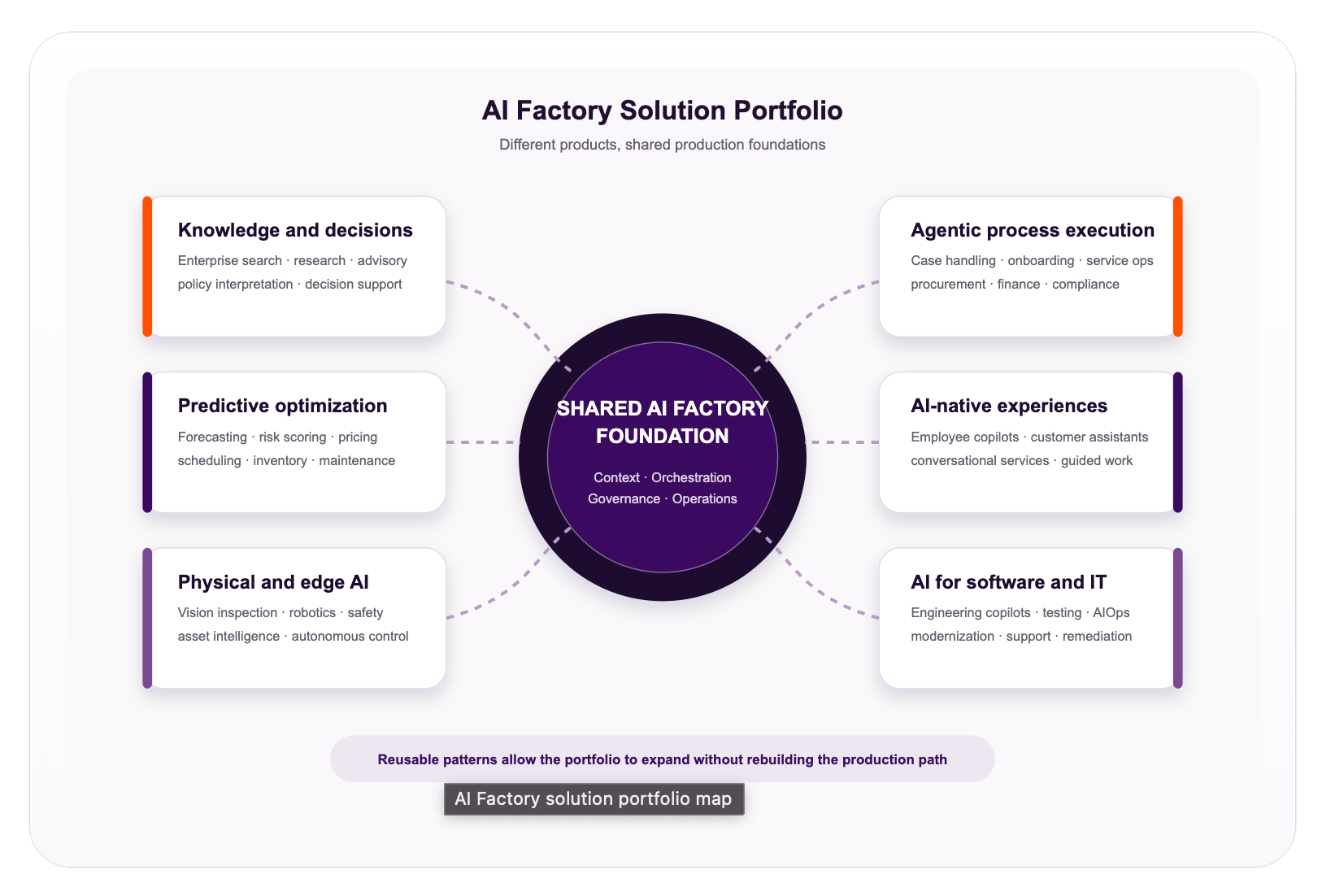
Figure 4. The solution portfolio spans probabilistic, generative, agentic and physical AI. Shared controls and platform services reduce duplication while domain-specific products preserve business context.
Knowledge and decision systems
Combine enterprise retrieval, semantic context, evidence and reasoning to support research, policy interpretation, planning and high-value decisions.
Agentic process execution
Coordinate specialized agents, business rules, APIs and human approvals to execute multistep work across enterprise systems.
Predictive optimization
Use forecasting, classification, anomaly detection and optimization to improve risk, planning, pricing, maintenance and resource decisions.
AI-native experiences
Embed conversational and multimodal assistance inside employee and customer journeys while preserving permissions, context and handoffs.
Physical and edge AI
Connect vision, sensor data, robotics and edge inference to real-world operations that require low latency, resilience and safety boundaries.
AI for software and IT
Accelerate engineering, testing, modernization and operations through code intelligence, autonomous remediation and service-management agents.
How MLOps, LLMOps and AgentOps fit together
The AI Factory needs a common operational backbone, but not every AI product requires the same controls. Traditional machine-learning systems, language-model applications and autonomous agents have different failure modes and observation needs.
| Operational discipline | Primary object | Critical controls | Production signals |
|---|---|---|---|
| MLOps | Predictive or statistical model | Data lineage, feature quality, model versioning, validation, drift, retraining | Accuracy, calibration, drift, bias, latency, model availability |
| LLMOps | Language or multimodal AI application | Prompt and retrieval versions, grounding, evaluation sets, content safety, model routing | Answer quality, groundedness, retrieval quality, token use, latency, refusal behavior |
| AgentOps | Agent or multi-agent workflow | Identity, tool permissions, plans, traces, memory, action policy, transaction boundaries, kill controls | Task completion, action accuracy, tool failures, loops, escalation, cost per outcome, policy events |
AgentOps is not simply MLOps with more dashboards. Agents can choose tools, create plans, maintain state and affect live systems. Operational design must therefore observe the full reasoning and action trace, enforce least-privilege access, control side effects and preserve a reliable path for human intervention.
Operational principle
Observe the decision path, not only the final answer. For an agentic workflow, the enterprise needs to know what context was retrieved, which tools were called, what permissions were applied, where a human intervened, what action reached the system of record and what outcome followed.
Governance must become an executable system
Policies written in a document cannot keep pace with production AI. The AI Factory must translate governance into decision rules, automated tests, policy checks, runtime controls, evidence records and escalation workflows.
NIST frames AI risk management across the design, development, use and evaluation of AI systems, while its generative AI profile adds considerations specific to generative systems.3 ISO/IEC 42001 takes a management-system view, covering policies, objectives, processes and continual improvement for organizations that develop, provide or use AI.4 An enterprise AI Factory can operationalize these principles through the delivery and control loops.
A practical control model has five parts
- Risk classification: Categorize the product based on decision materiality, autonomy, data sensitivity, affected stakeholders and regulatory exposure.
- Control profile: Map the risk tier to required controls, evidence, human oversight, testing depth and approval authority.
- Policy-as-code: Enforce access, data handling, allowed tools, model routes, content boundaries and action permissions automatically.
- Runtime assurance: Monitor policy events, anomalous behavior, drift, quality degradation, human overrides and incidents.
- Lifecycle accountability: Maintain product records, ownership, evidence, versions, incidents, material changes and retirement decisions.
Governance should be proportional. A low-risk internal summarization tool should not face the same review path as an agent that can approve a payment or alter a customer account. Risk-tiered pathways make control stronger because attention is concentrated where the potential impact is highest.
The ecosystem partner model
Enterprise AI is inherently multi-provider. Most organizations will combine hyperscalers, model providers, data platforms, application vendors, infrastructure partners, open-source components and specialist engineering services. The AI Factory should make this diversity manageable without allowing the architecture to fragment.
Partners should enter through defined roles
- Infrastructure partners provide compute, storage, networking, edge environments and validated deployment patterns.
- Platform partners provide data, model, orchestration, observability, security and developer capabilities.
- Application partners expose business processes, APIs, events and embedded AI features inside systems of record.
- Model providers supply foundation models, specialist models, embeddings and inference services.
- Engineering and transformation partners connect business design, architecture, integration, product delivery, governance and managed operations.
- Academic and industry ecosystems contribute research, standards, domain benchmarks and workforce development.
The enterprise should retain architectural control even when delivery is distributed. Vendor selection should evaluate interoperability, data and model portability, identity integration, evidence access, pricing transparency, operational support and exit pathways.
| Assessment area | Questions for the CIO and architecture team |
|---|---|
| Interoperability | Can the service integrate through open APIs, events and standard identity patterns? Can components be replaced without redesigning the product? |
| Control and evidence | Can the enterprise access model, agent and tool traces? Are policy events, versions and audit records exportable? |
| Data boundaries | Where is data processed and retained? How are tenant isolation, residency, encryption and training-use restrictions handled? |
| Economics | Can cost be attributed to product and outcome? What changes with volume, latency, context size, model choice or dedicated capacity? |
| Portability and exit | Can prompts, evaluations, data assets, agent definitions, telemetry and artifacts move to another environment? |
| Operational fit | Does the service align with enterprise incident, change, vulnerability, support and resilience processes? |
How to measure whether the AI Factory is working
AI factory measured only by the number of models or agents deployed will optimize for output volume. The scorecard should show whether the enterprise is becoming faster, more reliable, more reusable and more economically disciplined.
Business value
- Value realized after release
- Cycle-time improvement
- Error or loss reduction
- Revenue or capacity enabled
Delivery flow
- Time to first production release
- Lead time for material change
- Percentage of automated evidence
- Reuse across products
Quality and trust
- Task success rate
- Groundedness and action accuracy
- Human override rate
- Policy and safety events
Adoption
- Active eligible users
- Workflow penetration
- Repeat use
- User confidence and exception reporting
Economics
- Cost per completed outcome
- Cost by product and model route
- Capacity utilization
- Vendor and infrastructure variance
Resilience
- Availability and latency
- Mean time to detect and recover
- Fallback success
- Dependency and concentration risk
The scorecard should connect these categories. A lower model cost is not an improvement if task success declines and human rework rises. Higher adoption is not automatically positive if users are bypassing controls. Strong AI economics depends on the complete outcome.
A practical maturity path for the AI Factory ecosystem
Enterprises do not need to build every layer before releasing value. They need a coherent sequence that strengthens the foundation while real products move into operation.
HORIZON 01
Foundation
Define ambition, portfolio rules, reference architecture, risk tiers, product ownership and the first governed data and model pathways.
HORIZON 02
Engineering
Establish reusable delivery patterns, context services, evaluation, integration, CI/CD and the initial agent and model registries.
HORIZON 03
Control and observability
Industrialize policy enforcement, identity, evidence, quality monitoring, AgentOps, incident management and outcome telemetry.
HORIZON 04
Operating and scale
Federate delivery across domains, manage unit economics, expand reuse, reshape work and operate the portfolio as a continuous enterprise capability.
These horizons are cumulative rather than strictly sequential. A domain can begin product engineering while the enterprise foundation is being completed, provided minimum controls and ownership are explicit. The objective is to avoid two extremes: building a large platform before value is proven, or launching many products before the operating foundation exists.
The CIO's first 90 days
The first 90 days should establish a minimum viable ecosystem around a deliberately small portfolio. The goal is to prove the operating model, not to announce an enterprise-wide factory before the delivery path works.
Days 1 to 30: Set direction and decision rights
- Choose three to five candidate workflows with named executive and product owners.
- Define portfolio criteria based on value, feasibility, risk, adoption and reuse.
- Publish the initial reference architecture and approved deployment environments.
- Agree risk tiers, mandatory controls and approval authorities.
- Assign ownership across domain, platform, data, security, risk and operations.
Days 31 to 60: Build the minimum production pathway
- Create reusable templates for product contracts, architecture decisions and evidence.
- Establish a governed context pattern for enterprise data and knowledge access.
- Implement baseline model, prompt, retrieval and agent evaluation.
- Connect identity, secrets, logging, telemetry and incident workflows.
- Define cost attribution by product and environment.
Days 61 to 90: Release, learn and standardize
- Release one or two products through controlled rollout and visible human oversight.
- Measure business outcome, task quality, adoption, exceptions and unit economics.
- Turn the first delivery assets into reusable platform services and playbooks.
- Review control effectiveness and remove manual steps that can be automated safely.
- Approve the next portfolio based on evidence from the first production cycle.
What good looks like after 90 days
The enterprise has a working production pathway, clear decision rights, one shared scorecard, reusable architecture patterns, baseline governance and at least one AI product measured against a business outcome. It does not need a fully completed platform or a large catalog of pilots.
Common failure modes
1. Treating infrastructure as the complete factory
Accelerated infrastructure can solve performance and capacity constraints. It cannot establish product ownership, adoption, value measurement or governance. Infrastructure is the production floor, not the operating model.
2. Building a platform before defining products
A large platform program can spend heavily on capabilities that no priority workflow needs. Use the first product portfolio to shape shared services, then expand the platform through evidence.
3. Centralizing every AI decision
Central teams should own standards and leverage, not every backlog decision. Excessive centralization reduces domain accountability and slows iteration.
4. Allowing every domain to choose its own stack
Local autonomy without interoperability creates duplicated tools, inconsistent identity, incomplete evidence and hidden vendor concentration. Federation requires a bounded set of patterns.
5. Measuring deployment instead of outcomes
Deployment counts reward activity. A production scorecard should track completed work, decision quality, adoption, risk, cost and resilience.
6. Adding governance after the demonstration succeeds
Late governance often forces rework because data access, model choice, agent permissions or human oversight were designed incorrectly. Risk shaping should begin before engineering.
7. Ignoring the operating workforce
AI changes roles, decision authority, exception handling and accountability. Without process redesign and workforce preparation, an accurate system can still fail to create value.
Ten questions every CIO should ask
- Which enterprise decisions or workflows deserve an AI product rather than another experiment?
- Who owns business performance after the product enters production?
- Which data, knowledge and permissions create the context the product needs?
- What should remain deterministic, and where is probabilistic or agentic behavior justified?
- Which components can be reused across domains without weakening local context?
- How does identity follow an agent when it calls tools or acts in a system of record?
- What evidence is required before release, and how does that requirement change by risk tier?
- Can the enterprise observe the full path between user request, context, reasoning, action and outcome?
- Can cost be attributed to a business product and completed outcome?
- How will the organization stop, degrade, replace or retire the product safely?
The next enterprise capability is not AI access. It is AI production.
Access to capable models is becoming widely available. Durable advantage will come from the enterprise context, architecture and operating discipline that turns those models into trusted products and better workflows.
The AI Factory ecosystem provides that discipline. It connects value, workflow design, data, engineering, integration, governance, operations and partners. It creates shared leverage without reducing every business problem to the same template. Most importantly, it makes accountability visible after AI begins influencing real decisions and actions.
For CIOs, the strategic question is no longer whether the organization can build an AI demonstration. It is whether the enterprise can repeatedly produce, govern and improve intelligence as part of how the business operates.
Frequently asked questions
An AI Factory ecosystem is the connected operating system that turns business priorities, enterprise data and reusable engineering into governed AI products, agents and decisions. It includes architecture, delivery, controls, people, partners and operational feedback loops.
An AI platform supplies shared tools and infrastructure. The ecosystem also defines portfolio decisions, ownership, governance, delivery workflows, funding, adoption, operational metrics and continuous improvement. The platform is one layer of the ecosystem.
A practical architecture includes business value and portfolio management, workflow experiences, AI products and agents, orchestration and integration, knowledge and data, engineering and operations, trust and governance, and scalable infrastructure.
Ownership should be federated. A central AI function owns shared platforms, standards and controls. Business domains own outcomes, process redesign, adoption and product performance. Executive leadership aligns risk appetite and investment.
AgentOps manages the production lifecycle of agents and multi-agent systems. It covers identity, permissions, plans, tool calls, traces, memory, quality, cost, exceptions, policy events, human intervention and safe shutdown.
Use a balanced scorecard covering business value, delivery flow, quality and trust, adoption, unit economics and resilience. Key measures include time to production, reuse rate, task success, human override, cost per outcome, policy events and recovery performance.
Most enterprises benefit from a federated model. Central teams provide standards, platforms, controls and shared services. Domain teams own workflow design, product backlogs, adoption and outcomes.
A minimum viable operating model can be established in about 90 days around a small product portfolio. Broader industrialization, federation and workforce redesign continue as an enterprise capability program.
Key terms
A repeatable enterprise capability for producing, deploying, governing and improving AI products.
AI product
A production service with named users, an owner, defined outcomes, boundaries, controls and lifecycle accountability.
AI systems that can reason, plan, use tools, maintain state and take actions within defined permissions.
AgentOps
Practices and platforms for observing, controlling and improving agents and multi-agent systems in production.
LLMOps
Operational practices for language-model applications, including prompts, retrieval, evaluation, routing and safety.
MLOps
Practices that automate and govern the lifecycle of machine-learning models and their data dependencies.
AI governance
Decision rights, policies, controls and evidence used to manage AI value, risk and accountability.
AI operating model
The roles, processes, funding, governance and delivery structures used to run AI as an enterprise capability.
Related AppsTek insights
Build an AI Factory that works beyond the pilot
AppsTek helps enterprises connect AI strategy, architecture, agentic engineering, governance and production operations into one scalable delivery model.

About The Author
Rahul Sudeep, Senior Director of Marketing at AppsTek Corp, is a results-driven, AI-first B2B marketing leader with 15 years of experience scaling global enterprise SaaS companies. His expertise, honed at IIM-K, spans architecting high-impact go-to-market strategies, driving new market identification and positioning, and embedding Generative AI, LLMs, and predictive analytics into the core marketing function. Rahul unifies Technology, Sales, and Support teams around a single strategic hub, while also managing key Partner and Investor Relations. He leverages AI-driven insights to craft powerful brand narratives and hyper-personalized demand generation campaigns that drive measurable revenue growth and deepen customer engagement.