


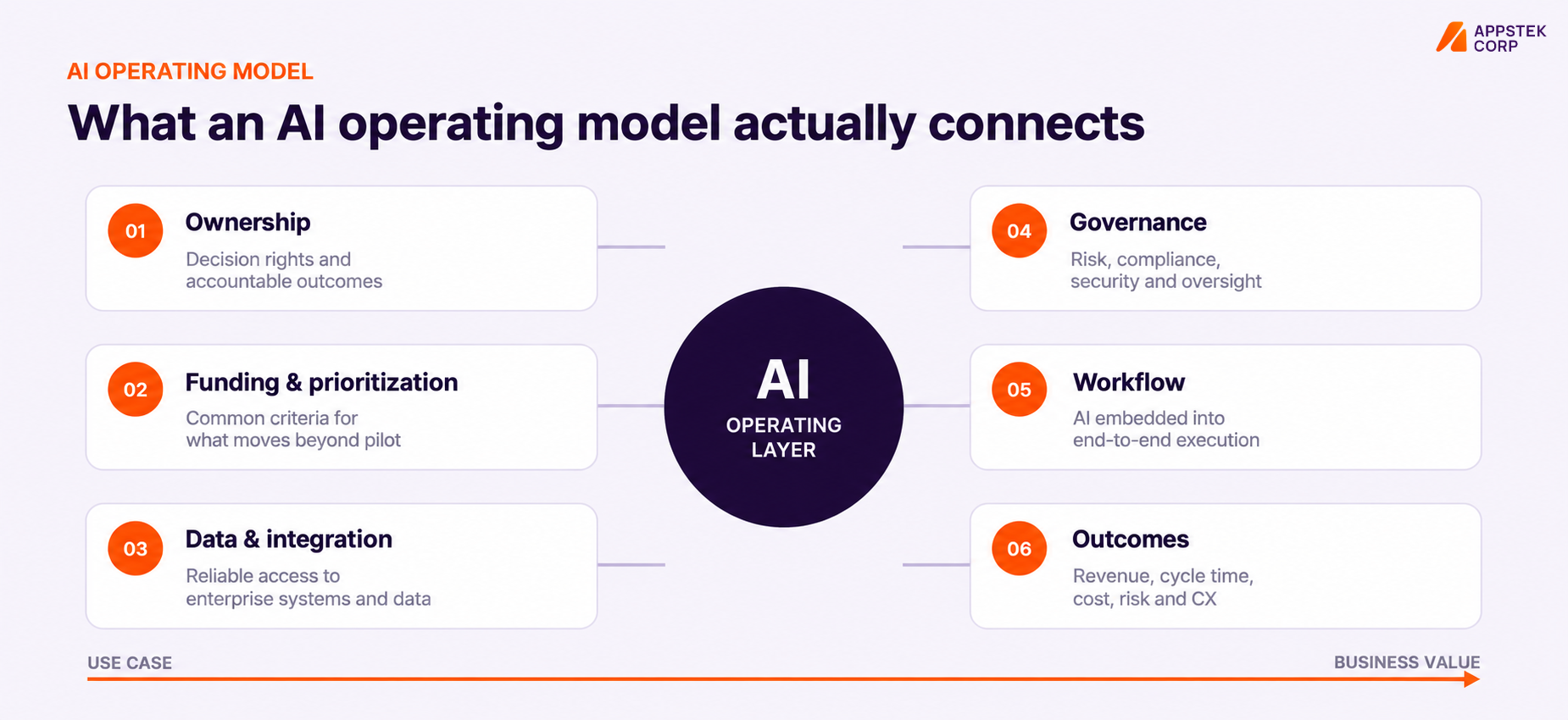
Three years into the enterprise AI buildout, the numbers should concern every leadership team that has signed off on the investment. Deloitte’s 2026 State of AI in Enterprise study found that only 25% of respondents had moved 40% or more of their AI experiments into production, while 54% expected it to reach that level within the next three to six months. MIT’s Project NANDA found that 95% of enterprise generative AI pilots deliver no measurable profit and loss impact, and S&P Global Market Intelligence reports that 42% of companies abandoned most of their AI initiatives in 2025, up from 17% a year earlier. The ambition is clearly there. The conversion into production value is not.
That gap is often framed as a technology problem. I believe that diagnosis is increasingly wrong.
Across client conversations, I see a remarkably consistent pattern. An enterprise runs a strong pilot. The pilot works. It gets a case study, a demonstration, perhaps even executive visibility. Then momentum slows because the surrounding business has not changed with it. The workflow is still designed for human handoffs. Decision rights remain fragmented. Incentives still reward the old way of working. Governance arrives after the solution has already been built.
The AI works. The organization around it is not yet structured to operate it.
A year later, the enterprise may have twelve more pilots, several more platforms, and a much larger AI budget. Yet the number of scaled, production-grade use cases has barely moved.
The next phase of enterprise AI will not be won by the companies that accumulate the most models, copilots, or agents. It will be won by the companies that redesign how work, accountability, governance, and economics come together around them.
What Is an AI Operating Model?
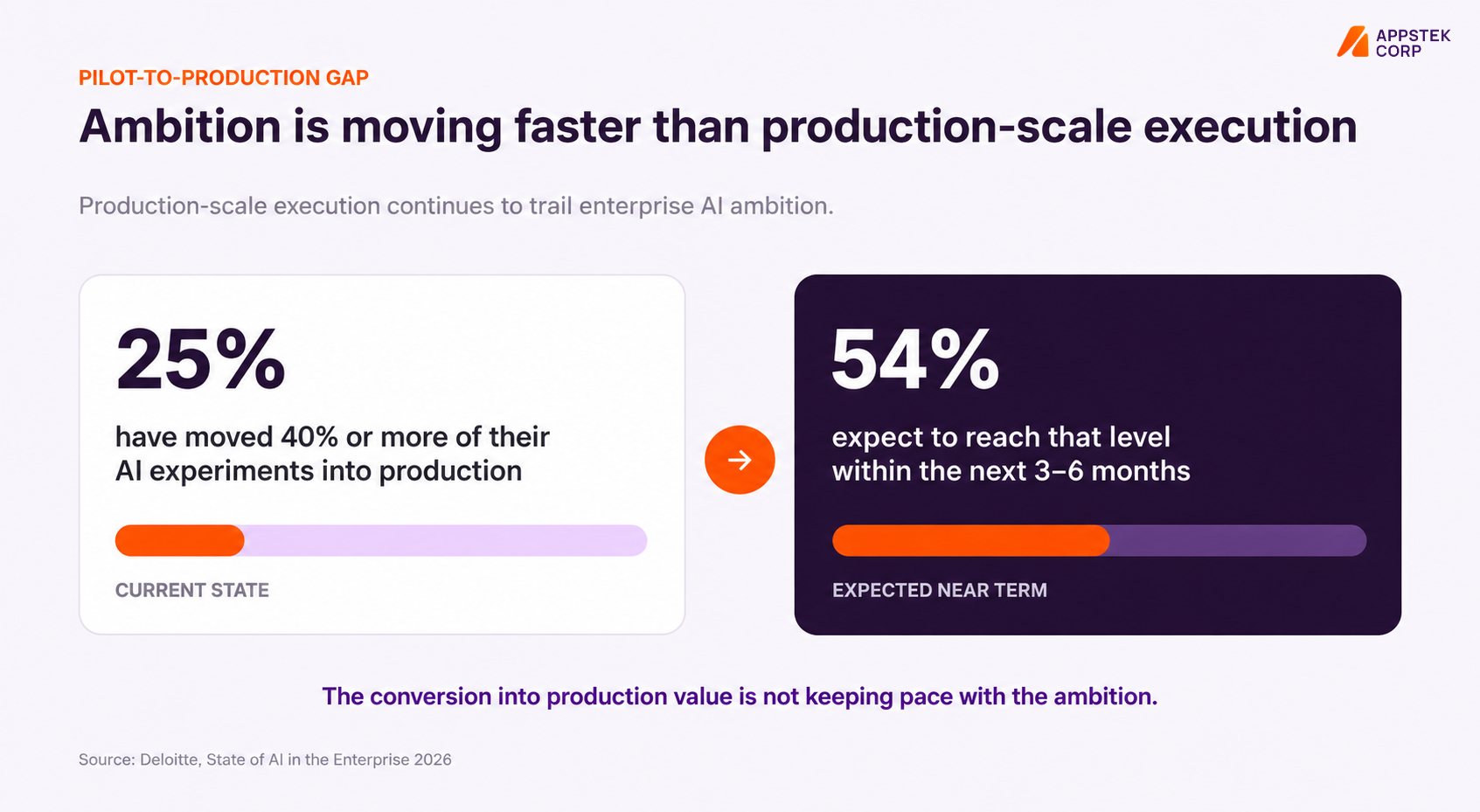
An AI operating model is the connective structure that determines how AI actually functions inside a business. It defines who owns AI outcomes, how initiatives are funded and prioritized, how risk is governed, how data is made available, how systems are integrated, and how AI output becomes part of a business process rather than an additional layer beside it.
IBM has framed its own AI operating model around four connected systems: agents, data, automation, and hybrid infrastructure. The terminology will differ across enterprises, but the underlying principle is more important than the framework itself. AI has to move from being something the enterprise deploys to something the enterprise knows how to operate with rigor, accountability, and repeatability.
That distinction matters because many organizations have scaled access to AI faster than they have scaled the mechanisms needed to convert that access into value.
IBM’s CEO research offers a useful signal. Only 25% of AI initiatives surveyed had delivered their expected ROI, while just 16% had scaled enterprise-wide. Its 2026 CEO Study goes further, arguing that leaders making the most progress are rethinking decision rights, cross-functional collaboration, incentives, operating models, and end-to-end workflows around AI.
These are not simply adoption metrics. They are symptoms of a deeper operating problem.
The technology is advancing quickly. The organizational machinery required to absorb it is moving much more slowly.
Why Does Enterprise AI Adoption Stall?
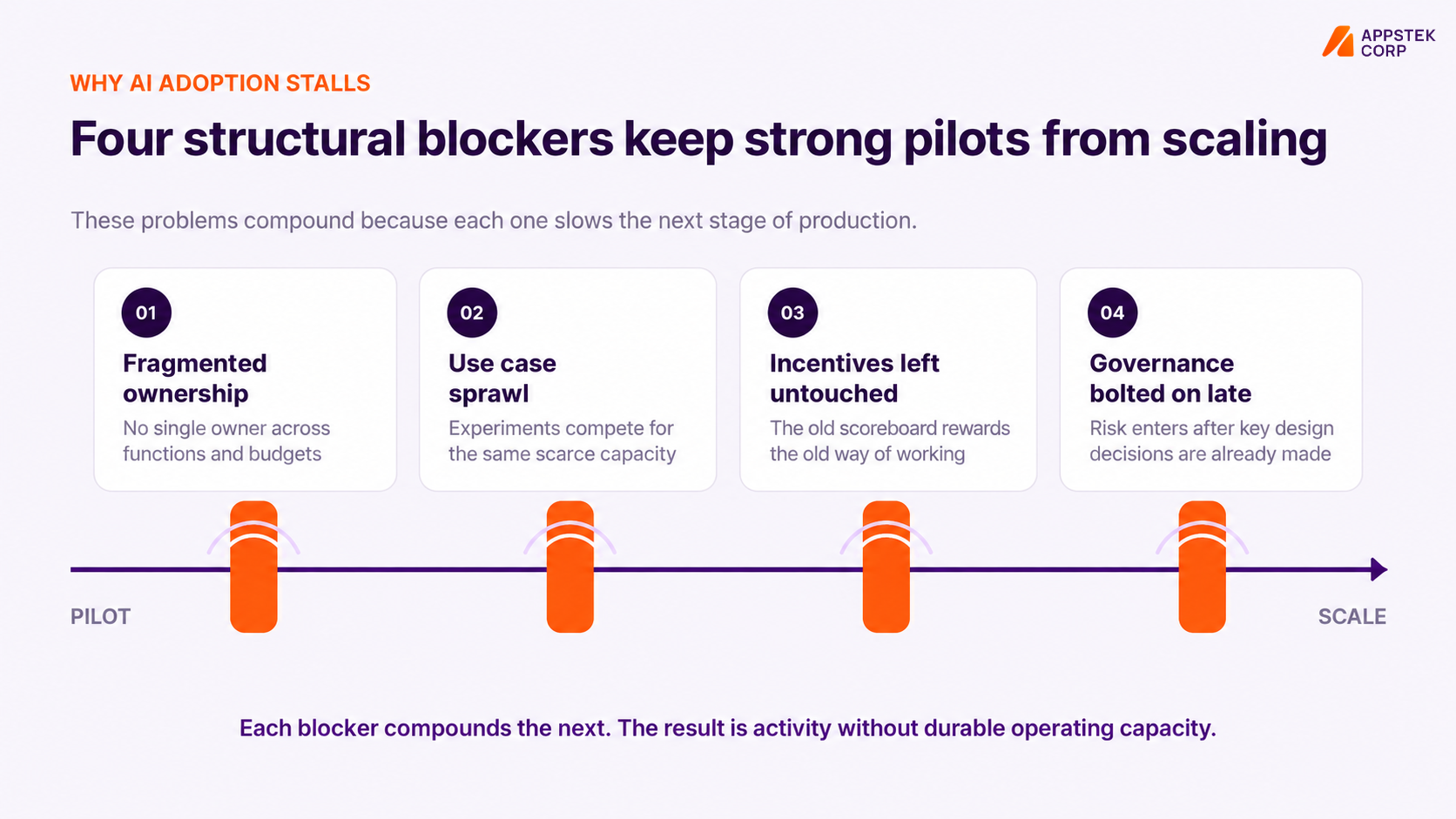
Four reasons show up repeatedly, and each one reinforces the others.
An oft-cited RAND Corporation analysis puts the failure rate at more than 80%, roughly twice that of conventional IT projects, and Gartner’s 2026 research finds that only 28% of AI use cases fully meet their ROI expectations.
Fragmented ownership. AI often sits across several budgets at once: IT, operations, marketing, finance, innovation, legal, and individual business units. That may be manageable while teams are experimenting. It becomes a serious constraint when AI begins crossing functions and changing core processes.
The most valuable use cases rarely respect organizational boundaries. They move through systems, data domains, approval structures, and business units. If nobody owns the outcome end to end, accountability becomes diluted. Everyone can sponsor a pilot. Very few people have the authority to take a cross-functional use case all the way into production.
Use case sprawl. Enterprises often mistake activity for progress. Forty pilots can look more ambitious than five deeply operationalized use cases, particularly on a steering committee dashboard.
In practice, those forty pilots compete for the same integration specialists, data pipelines, security reviews, business SMEs, governance capacity, and leadership attention. The result is a portfolio that is wide but shallow. Resources remain distributed across experiments rather than concentrated on the few use cases capable of materially changing cost, revenue, risk, or customer experience.
Depth on five priority workflows can create more enterprise value than breadth across forty disconnected proofs of concept.
Incentives left untouched. Organizations frequently ask managers to embrace AI while continuing to measure them against performance systems created before AI entered the workflow.
That contradiction matters.
If a manager is rewarded for headcount growth, functional utilization, activity volume, or legacy productivity measures, they have little economic reason to redesign the work around AI. Training may increase awareness, but incentives determine behavior. Leaders cannot ask an organization to operate differently while continuing to reward it for operating exactly as it did before.
Governance bolted on late. Risk, compliance, cybersecurity, privacy, and legal teams are still too often brought into an AI initiative after a pilot has already demonstrated technical feasibility.
By that point, key decisions about data access, model behavior, human oversight, explainability, auditability, and third-party exposure have already been made. Governance then becomes a gate at the end of the process rather than an engineering input at the beginning.
That is backwards. Governance introduced late creates delay. Governance embedded early creates a path to production.
When The Operating Model Never Catches Up
The cost of this gap is not hypothetical. IBM spent over a decade and billions of dollars acquiring healthcare data assets to power Watson Health, positioning it as a breakthrough in cancer diagnosis. The technology was oversold in domains where training data was scarce and problems were poorly defined, and Watson for Oncology was abandoned by several hospitals after producing recommendations physicians described as unsafe and incorrect. IBM sold the business for a fraction of what it had invested, in 2022.
McDonald’s ran a similar experiment at smaller scale. Its AI-powered drive-thru ordering system with IBM had been running since 2021, but persistent accuracy problems with different accents and dialects were never resolved, and the pilot never expanded much beyond a small slice of its US restaurants. McDonald’s shut the program down in 2024 and restarted its search for a voice-ordering partner.
Klarna took the opposite path and still hit the same wall. In 2023 it deployed an AI-first customer service model that handled 2.3 million conversations in its first month, about 66% of all chats, while the company froze hiring and let attrition shrink headcount by roughly 40%. But executives later acknowledged the AI-only support had led to lower quality service, and by early 2025 CEO Sebastian Siemiatkowski reversed course, rehiring agents so customers would always have the option to reach a human.
None of these companies lacked access to capable AI. What they lacked was an operating model, clear ownership of quality and outcomes, governance built in before scale, and incentives tied to more than a headline metric, that could carry the pilot into a durable, production-grade capability.
What The Leaders Getting This Right Are Actually Doing
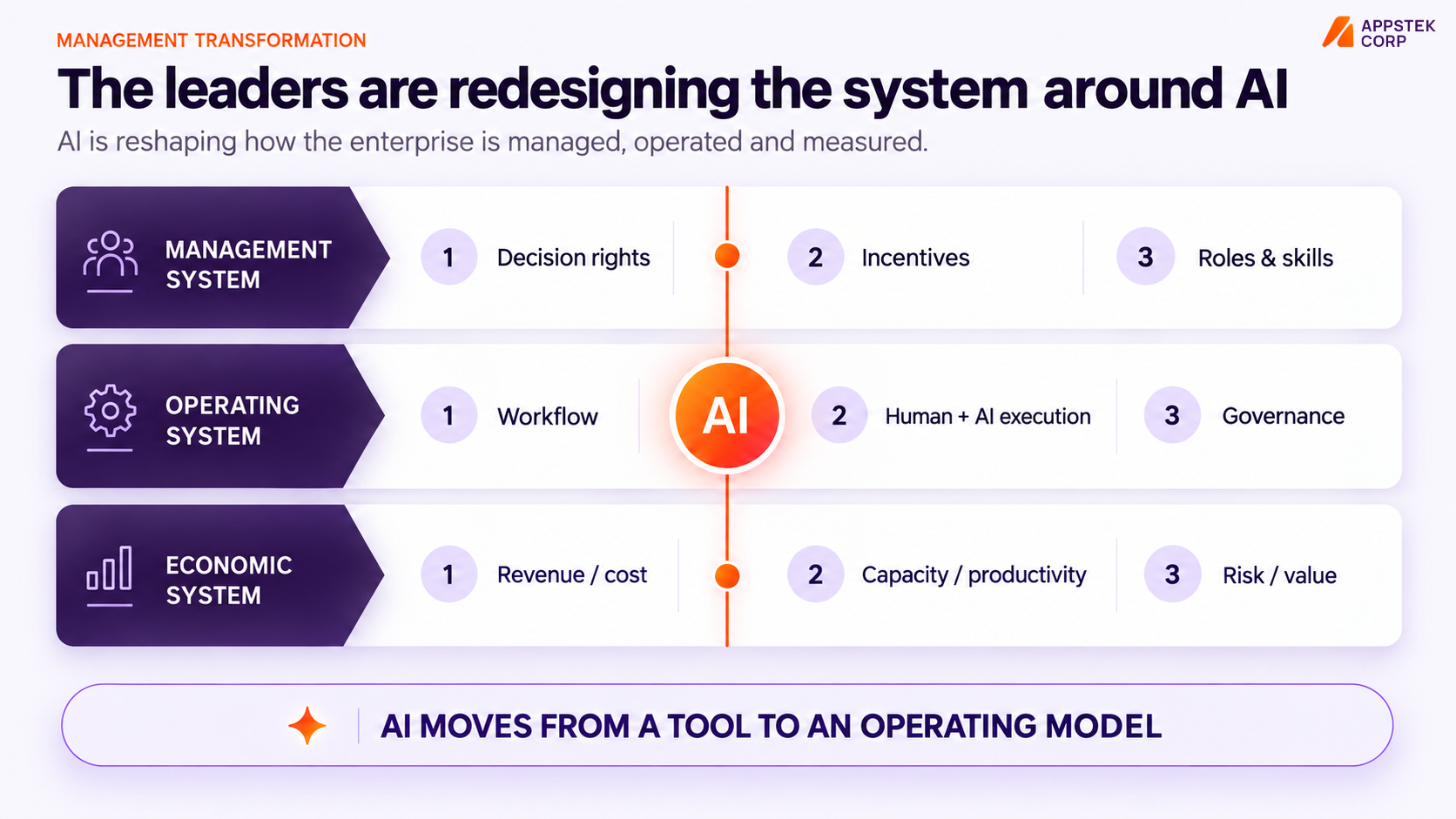
The companies moving furthest with AI are treating this as a management transformation, not a software deployment.
IBM’s 2026 CEO Study makes that point clearly. Its research shows that CEOs making greater progress with AI are actively redesigning decision rights, cross-functional collaboration, end-to-end workflows, and the balance between human judgment and AI-driven execution. IBM reports that CEOs who actively redesign how teams work together are more than twice as likely to have delivered on their business objectives.
The significance is easy to miss. The advantage does not come simply from having better access to AI. It comes from changing the organization around it.
Accenture provides one of the most visible examples of a company applying that logic internally. The company recorded $923 million under a business optimization program completed in fiscal 2026, including employee severance and asset impairments, while also undertaking a major operating model and talent transformation. Julie Sweet has described the organizational redesign as the largest operating model change in Accenture’s history. The company has also made AI fluency part of how employees are evaluated for advancement.
That matters because it moves AI out of the innovation agenda and into the management system. Skills, roles, organizational structure, career progression, and execution expectations begin changing together.
HCLTech is demonstrating another dimension of the same shift: the economics of delivery.
C. Vijayakumar has pointed to increasing non-linearity between revenue growth and headcount, noting that HCLTech had grown revenue while headcount remained relatively flat and that revenue per employee was increasing. More recently, he has described AI, automation, IP, and platform-led delivery as part of an evolving business model in which the same work can increasingly be delivered with fewer people.
For services businesses, that is a fundamental change. For decades, growth was closely linked to additional capacity. AI begins to weaken that relationship. When output, revenue, and headcount no longer move in lockstep, workforce planning, pricing, utilization, career structures, delivery models, and margin assumptions all have to be reconsidered.
That is what operating model change looks like in practice. Not a new tool layered onto the existing system, but a willingness to change the system itself.
What Recalibration Actually Requires
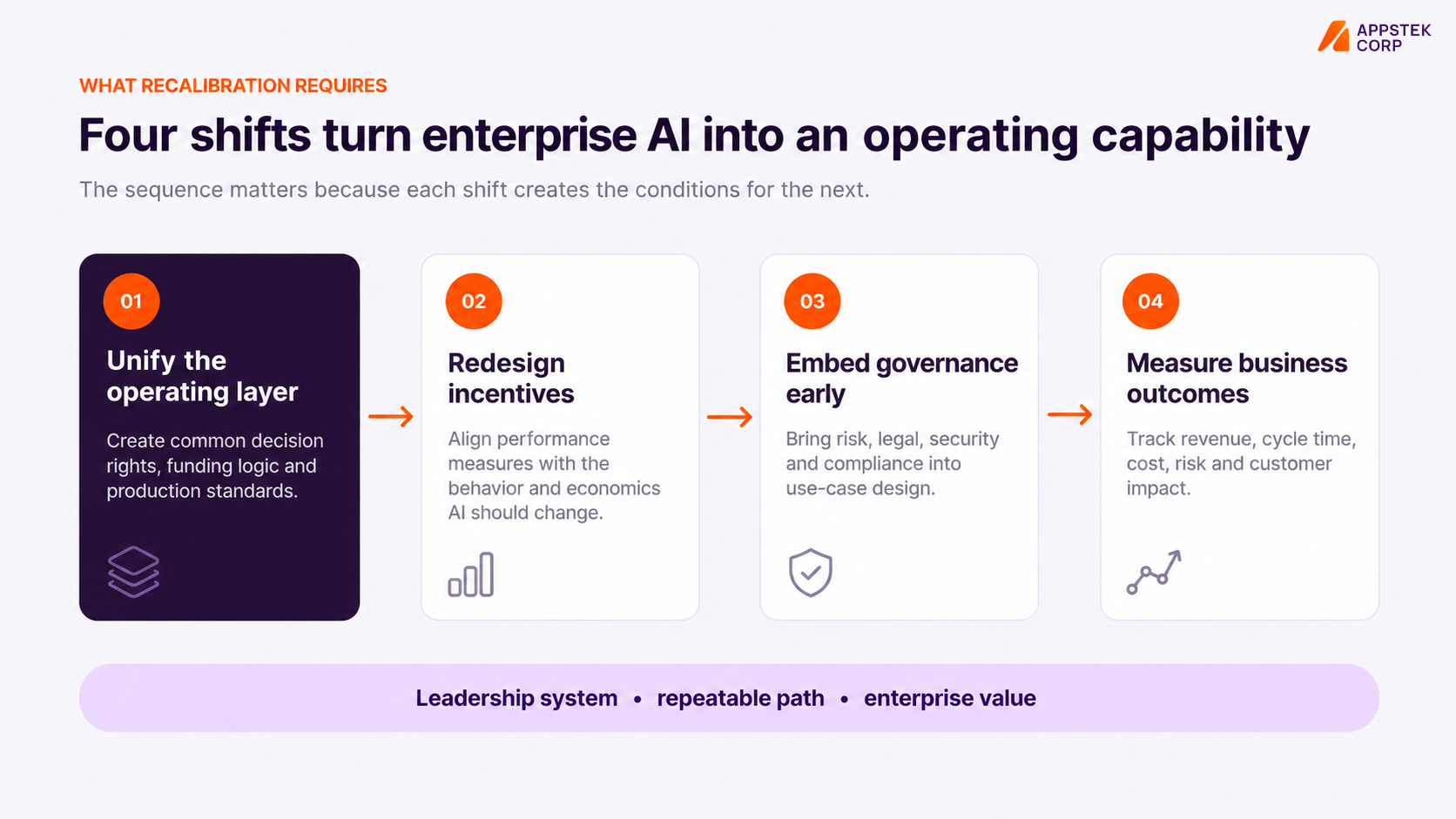
Four shifts, in the order I would prioritize them.
First, unify AI under one operating layer. That does not mean forcing the enterprise onto one model, one vendor, or one platform. It means creating common decision rights around AI. There should be clear accountability for which use cases move forward, how they are funded, what architecture and governance standards they must meet, and who owns the business outcome once they reach production.
The goal is not centralization for its own sake. It is consistency. A use case originating in finance and one originating in operations should not have completely different paths to production simply because they started in different parts of the organization.
Second, redesign incentives before you redesign workflows. If leaders want AI to change how work gets done, the performance system has to reinforce that change.
Managers cannot be asked to increase automation while being rewarded for preserving team size. Business units cannot be asked to prioritize enterprise-wide AI value while being measured only on local metrics. Employees cannot be told to adopt new ways of working while career progression continues to reward behaviors built around the old model. Change the scoreboard, and behavior begins to move with it.
Third, embed governance at the design stage, not the audit stage. Risk, legal, compliance, security, and privacy should be part of use-case design from the beginning. Their role should not simply be to approve or reject a finished system. They should help define where human review is mandatory, what decisions AI can make independently, which data can be used, what evidence must be retained, and how exceptions are escalated.
This shifts governance from a late-stage obstacle into an operating capability. It also makes scaling faster because the rules are known before the system is built.
Fourth, measure business outcomes, not pilot counts. Pilot counts are useful only when experimentation itself is the objective. Once AI becomes an enterprise priority, they become a weak measure of progress.
The measures that matter are much closer to the business: revenue impact, cycle time, error rates, cost to serve, conversion, productivity, risk exposure, customer experience, and decision speed. An AI initiative that reaches production but changes none of those outcomes is not transformation. It is deployment.
Leadership teams should be willing to retire the pilot-count dashboard and replace it with a smaller set of measures tied directly to enterprise value.
The Window Is Open, Not Indefinite
Every enterprise I speak with is somewhere on this curve, moving from scattered experimentation toward a more deliberate way of operating AI.
The organizations pulling ahead are not necessarily the ones with the most sophisticated models. They are the ones that recognized earlier that scaling AI requires decisions about ownership, economics, governance, incentives, workflows, and organizational design.
Those are leadership decisions. They cannot be delegated entirely to an AI center of excellence, an innovation team, or a procurement function.
The gap will also become harder to close over time. Organizations that operationalize AI successfully can reinvest the productivity, speed, data, and learning they gain into the next set of workflows. The advantage begins to compound. The implication for CEOs is straightforward.
Recalibrating the operating model is not a transformation project with a clean end date. AI will continue to change what can be automated, how decisions are made, what skills matter, and where economic value is created. The operating model therefore has to become more adaptive as well.
The question is no longer whether the enterprise has adopted AI. The more important question is whether the enterprise has changed enough to operate with it.

About The Author
Sanjoy Roy is the CEO of AppsTek Corp, bringing more than 22 years of executive leadership experience across enterprise technology, digital transformation, and global delivery. He has partnered with Fortune 500 organizations on large-scale modernization, operating model transformation, and technology-led growth, with a growing focus on AI-led innovation.