

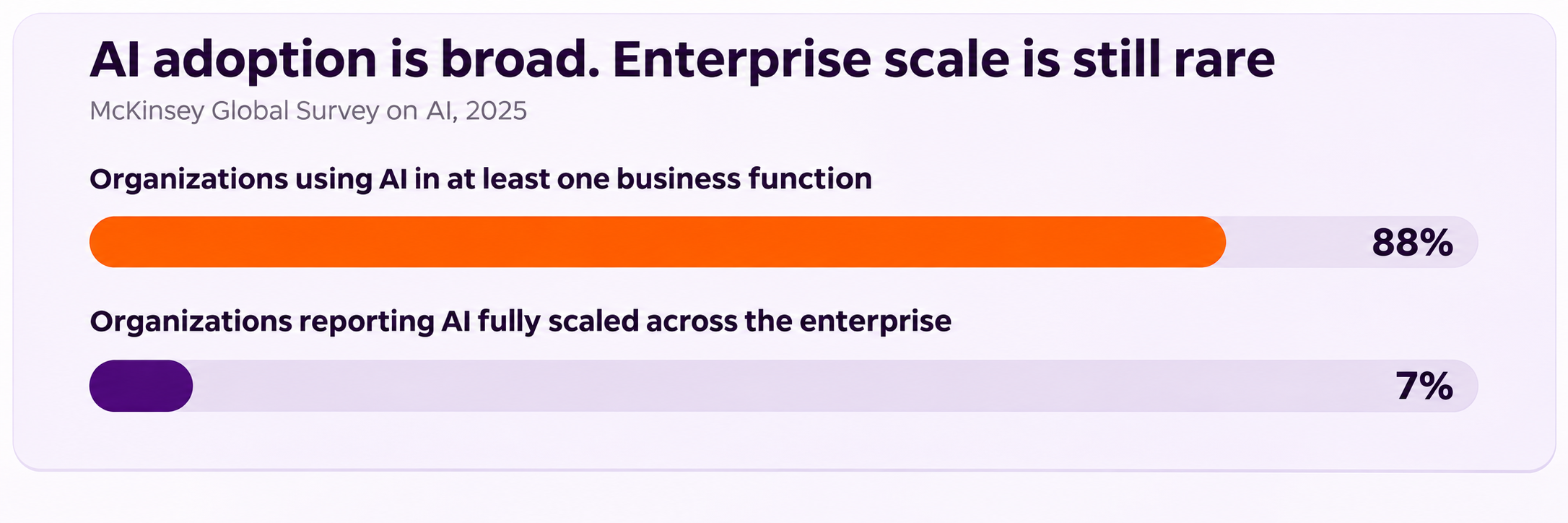
Enterprise AI no longer has an idea shortage; the harder problem is getting valuable ideas into production with clear economics and accountable ownership. McKinsey’s 2025 global survey found that 88% of respondents said their organizations were using AI in at least one business function, while only 7% said AI had been fully scaled across the enterprise. Deloitte’s 2026 State of AI research adds another useful signal: only 25% of respondents had moved 40% or more of their AI pilots into production.
The gap is primarily an execution problem. An Enterprise AI factory gives the business a repeatable way to take a qualified problem through readiness, engineering, evaluation, governance, deployment, and operations, while turning each release into reusable assets for the next one.
How Should Enterprises Build an AI Factory Strategy
A practical AI Factory strategy begins with the business outcome that matters, then works backward through the conditions required for production. AI portfolios often grow around available technology or long use-case lists while the financial owner and production path remain vague.
BCG’s 2026 CEO research found that nearly nine in ten CEOs were seeing cost or revenue benefits from AI in targeted areas, while only 14% had clearly defined P&L impact for all AI initiatives. Factory intake therefore has to connect value, readiness, risk, cost, and ownership before engineering capacity is committed.
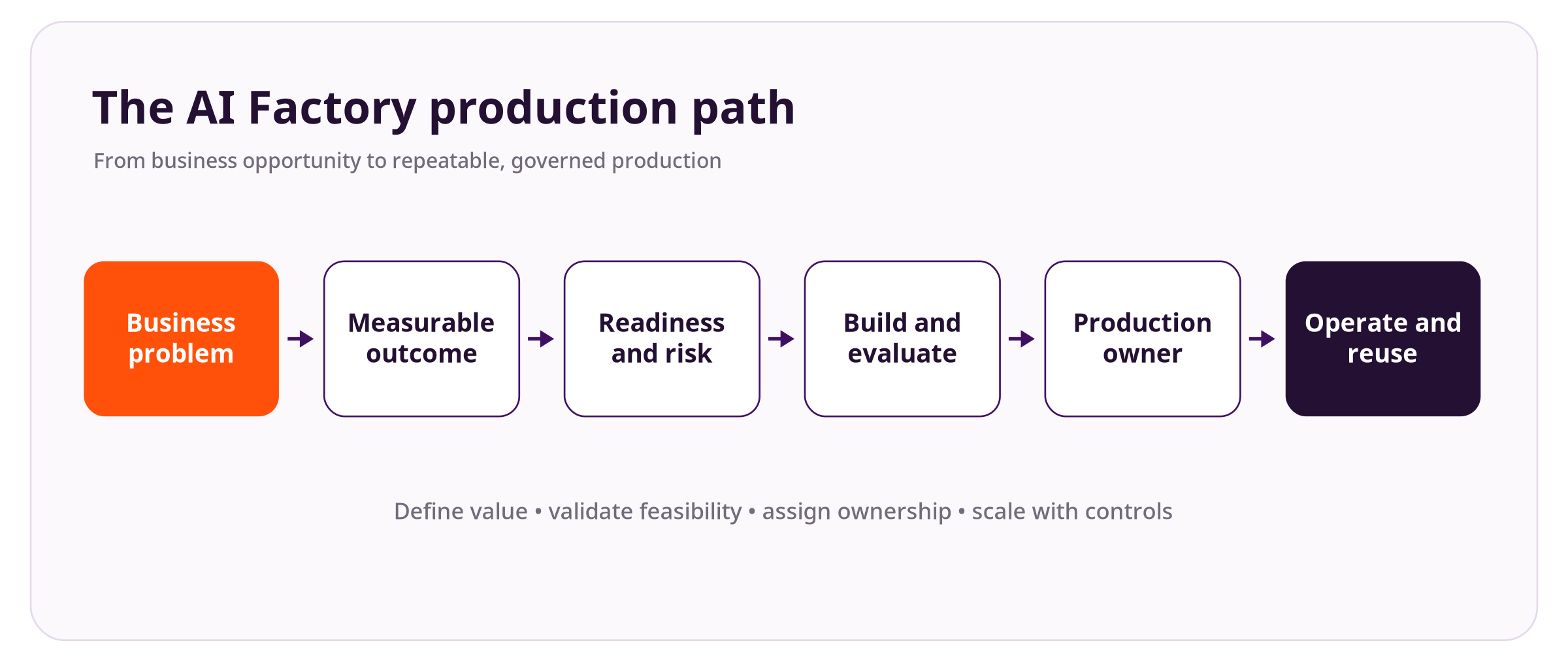
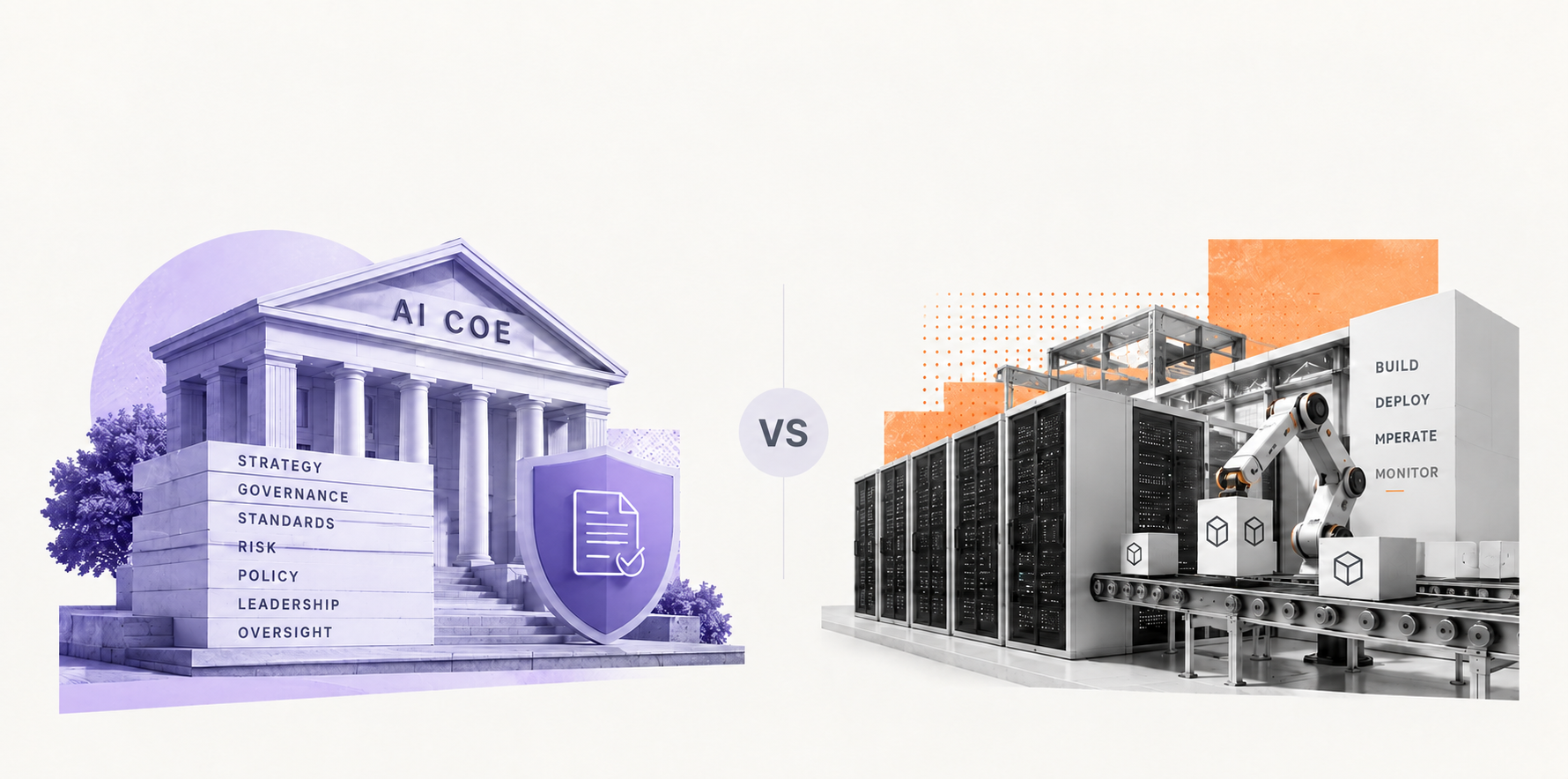
A central factory team can own the common delivery path, shared assets, architecture standards, and production controls, while domain leaders remain accountable for the process and the outcome. That balance matters because the factory should remove repeated setup work without pulling business ownership away from the people who understand the workflow.
How to Design Enterprise AI Factory Architecture for Production
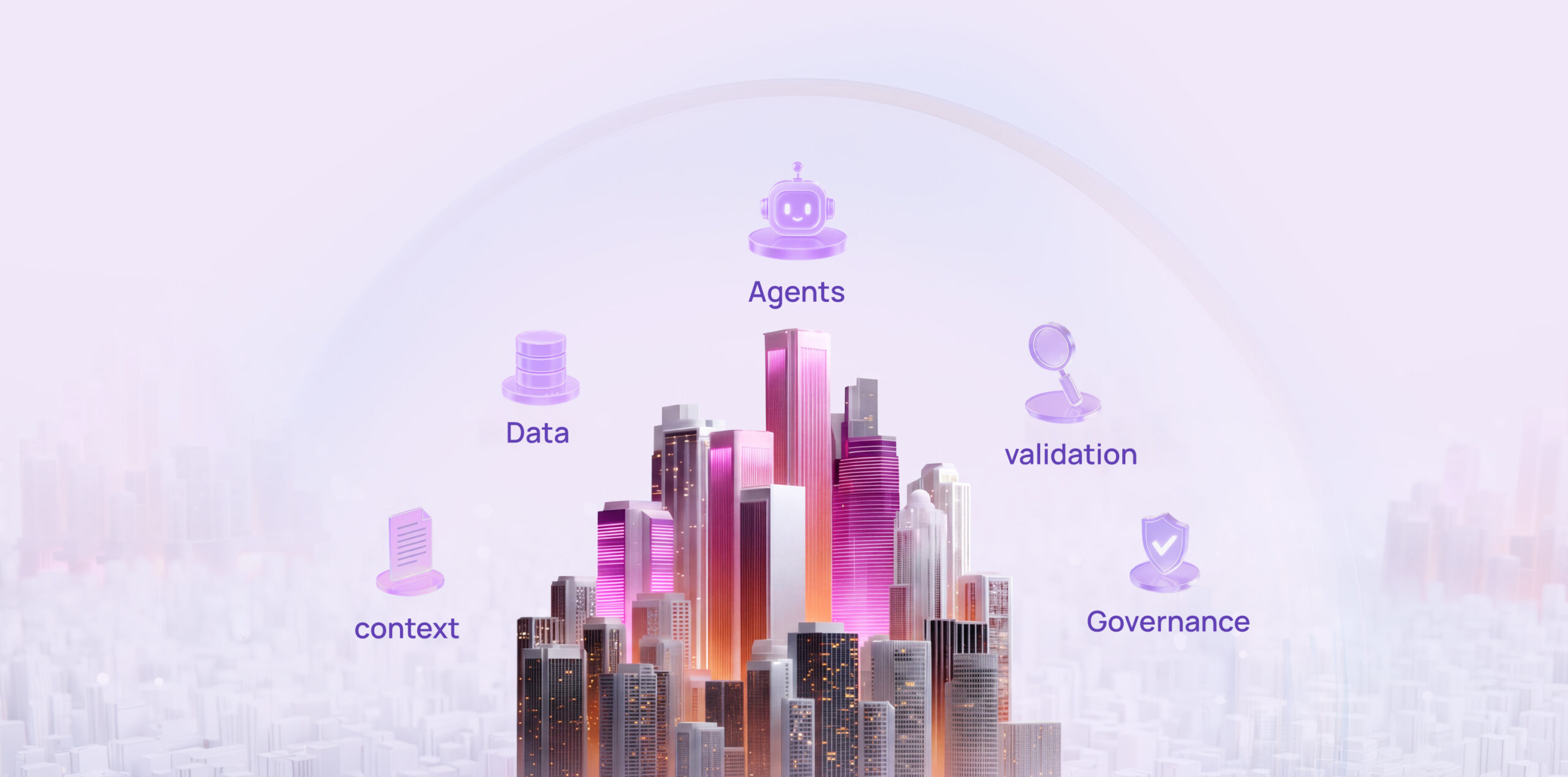
Once a use case clears intake, the technical job is to give it a stable route into the enterprise. That route needs governed data, model and retrieval services, agent logic, identity controls, APIs, orchestration, evaluation, deployment pipelines, and observability. The architecture becomes valuable when those capabilities are shared across releases.
AppsTek’s Enterprise AI Factory describes two connected layers: an operating layer that governs how demand moves into production, and an infrastructure layer that provides the technical foundation. Shared services then turn data access, model execution, policy enforcement, and operations into reusable capabilities.
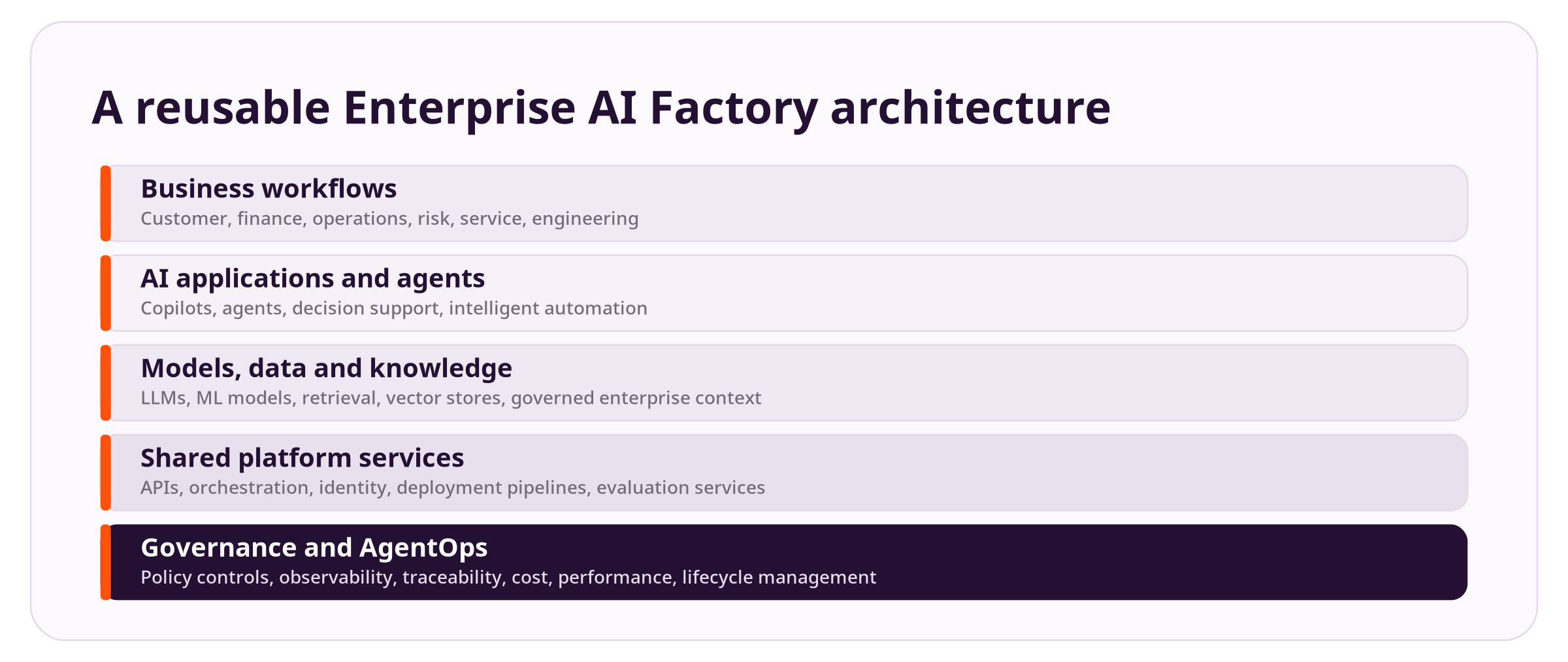
The architecture also needs room for model choice. A forecasting workflow, a document intelligence use case, and an enterprise agent can share the same factory while using different models and runtime patterns. AI ML Engineering work fits at this layer because production AI depends on lifecycle discipline across models, retrieval, evaluation, observability, and governed enterprise context.
How to Build AI Governance Into an Enterprise AI Factory
AI Governance slows delivery when key questions surface close to launch. The stronger pattern is to place those decisions inside the factory itself, so risk classification happens during intake, sensitive data access is resolved during design, tool permissions are reviewed before agent execution is enabled, and release gates are tied to evaluation evidence rather than a late-stage approval scramble.
An AI risk management framework provides a useful reference because it treats risk as part of the AI lifecycle. Agentic systems raise the bar further because the system can choose tools and take action. A recent industry survey of 306 practitioners across 26 domains in 2026 found that 68% of production agents executed ten steps or fewer before human intervention, while reliability remained the leading development challenge. Bounded workflows, traceable actions, and clear escalation paths carry practical engineering weight alongside governance requirements.
What the production gate should make clear
| Executive question | Evidence carried into production |
|---|---|
| Is the business outcome defined? | Named KPI, baseline, acceptance threshold, accountable owner |
| Can the system use the required data safely? | Approved sources, access controls, lineage, retention rules |
| Can an agent take action? | Tool permissions, approval thresholds, trace history, exception path |
| Can the release be operated day to day? | Monitoring, incident ownership, regression coverage, rollback plan |
What Are the Best Enterprise AI Factory Use Cases
Industry estimates prove that about 60% of the potential productivity gains from AI and automation sit in sector-specific workflows rather than generic corporate tasks. That is why an AI factory should be judged by how well it handles the operating context of an industry, including its systems, control points, data, and decision rights.
How Can an Enterprise AI Factory Improve KYC in Financial Services
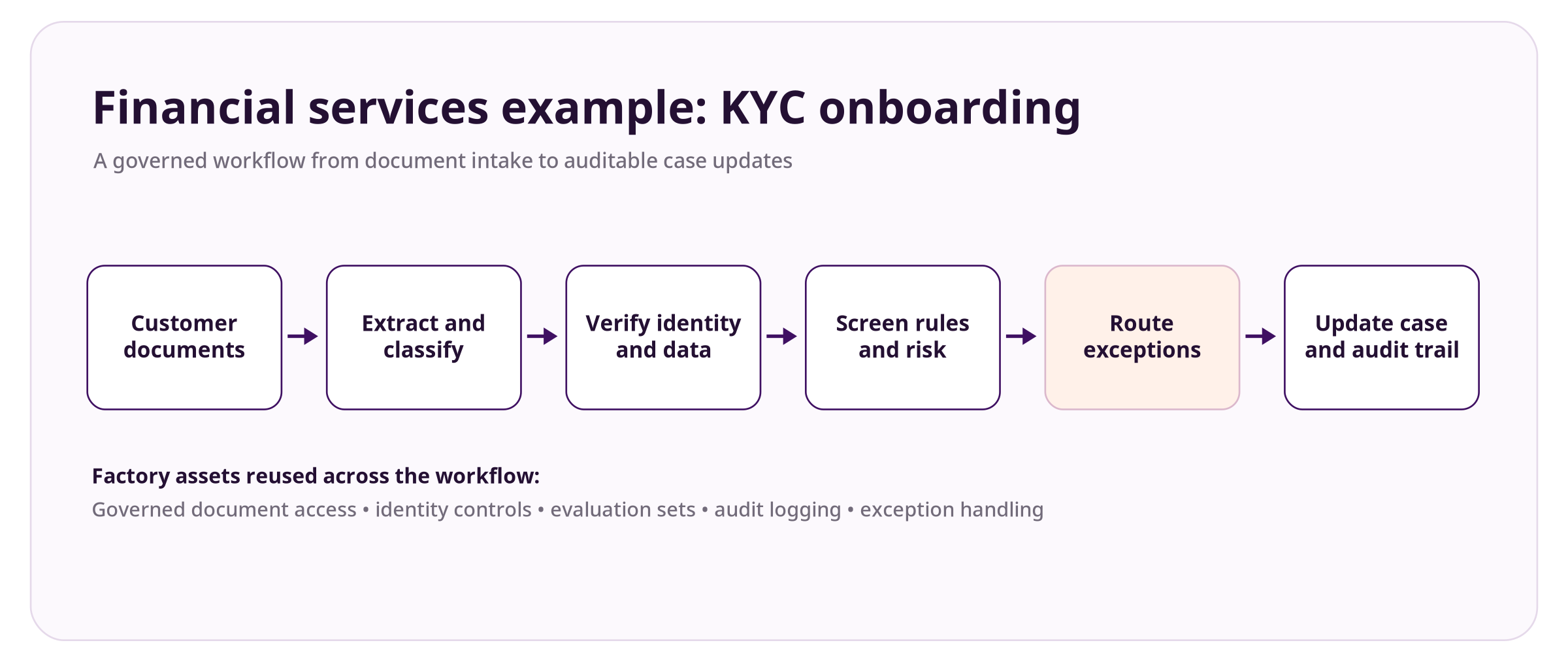
Consider customer onboarding and KYC. Document extraction may be the visible AI step, but production value appears when the workflow can verify data, apply screening rules, route higher-risk cases to review, update the case system, and preserve an audit trail. The factory supplies the reusable pieces behind that workflow: document access patterns, identity and permission controls, evaluation sets, model services, audit logging, and exception handling.
For a bank, the executive value is wider than model accuracy. A common factory can shorten the path from approved use case to governed release while keeping traceability and ownership consistent across onboarding, servicing, fraud operations, lending support, and other workflows that share the same enterprise foundations.
What Does an AI Factory Use Case Look Like in Manufacturing
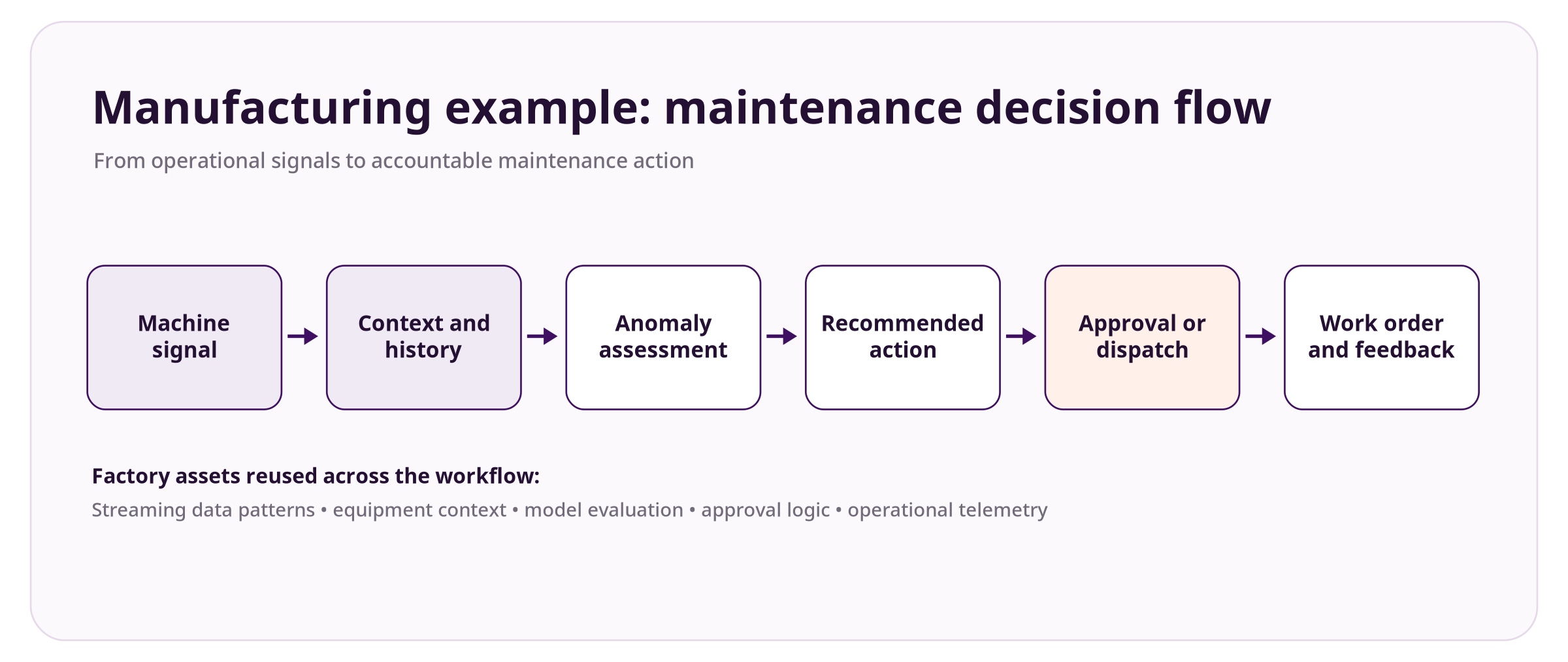
Manufacturing creates a different production problem. A maintenance use case may start with machine signals, but the workflow also needs equipment history, work orders, approval logic, and feedback from completed maintenance. A shared factory can connect those pieces so an anomaly model or agent can assess context, recommend an action, route the decision, and update the maintenance system.
The same foundation can support quality inspection, production planning, supply chain exceptions, and plant operations without rebuilding the full delivery stack each time. That is where reuse starts to show up as operating leverage rather than a technical convenience.
AgentOps Keeps the AI Factory Useful After Go-Live
Production AI changes because the environment around it changes. Data shifts, APIs evolve, business policies move, models are replaced, and users expose edge cases that were absent during testing. Monitoring the model alone leaves too much of the workflow invisible, especially when agents depend on retrieval, tools, approvals, and downstream systems.
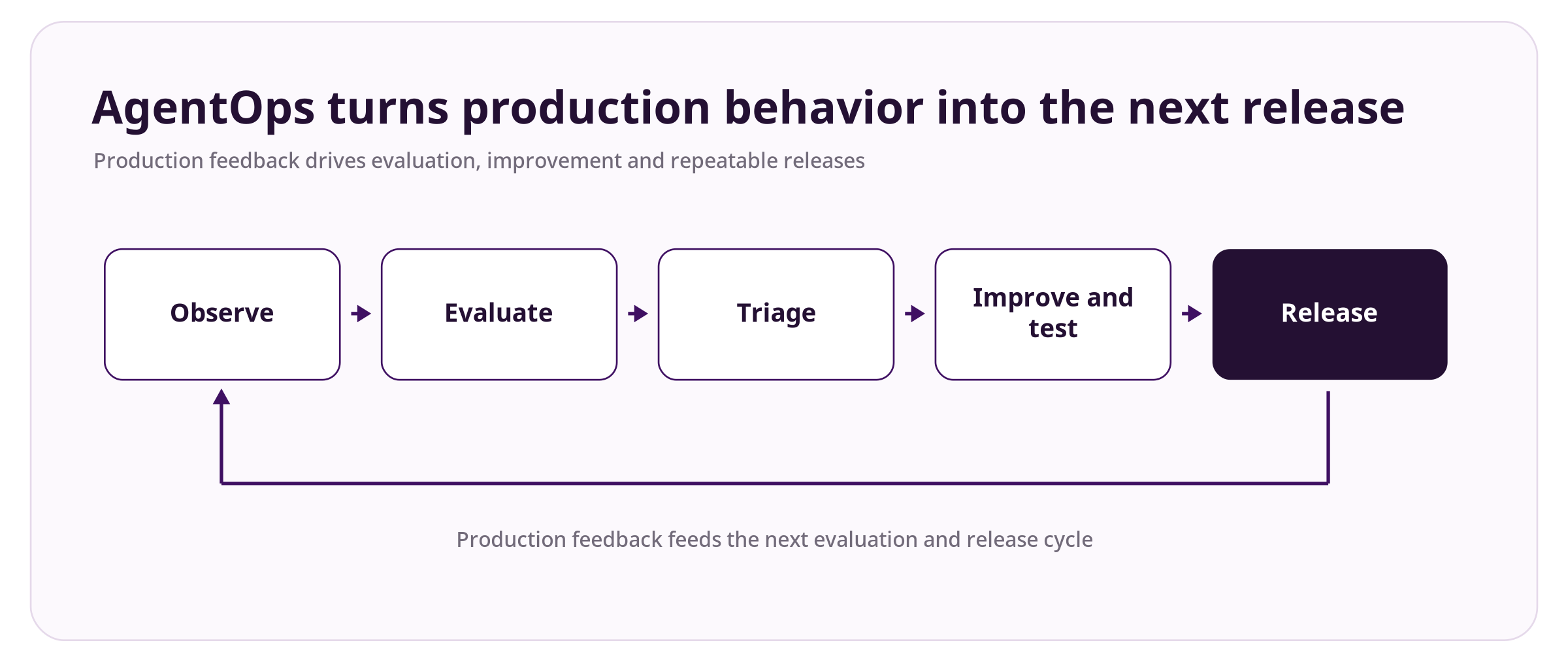
AgentOps closes that gap by treating traces, evaluations, incidents, cost, tool behavior, and business outcomes as part of one operating loop. NVIDIA’s enterprise AI factory guidance on AgentOps describes agents as versioned, testable, observable services that can be monitored and evolved over time. The executive implication is that go-live shifts the factory into a new phase of accountability rather than closing the project.
How Does an Enterprise AI Factory Scale Across the Business
The first production use case may carry a high setup cost because the operating model is being established at the same time. The fifth should inherit much of that work. Approved data connectors, retrieval patterns, agent tools, evaluation suites, governance controls, deployment templates, and observability components should accumulate as factory assets, with owners and version history attached.
The operating model matters as much as the platform. A central factory group can own the shared roadmap, engineering standards, reusable assets, governance patterns, and production tooling, while domain teams own business outcomes and adoption. Senior leadership then gets one view of capacity, value, risk, and reuse across the portfolio.
The board-level question is how reliably high-value AI can reach production, stay within its operating boundaries, and improve the economics of the next release. An AI Factory strategy succeeds when the answer becomes predictable, because the enterprise has built a production capability that compounds rather than restarting with each new idea.
Frequently Asked Questions
An Enterprise AI Factory is a repeatable operating model and technical foundation for developing, deploying, and managing AI solutions at scale. It combines business use-case intake, data engineering, model development, governance, evaluation, deployment, and ongoing operations. By reusing infrastructure, workflows, and controls, enterprises can move AI initiatives into production more consistently.
The key components include business use-case prioritization, governed data pipelines, AI and machine learning services, agent orchestration, APIs, security controls, evaluation frameworks, deployment pipelines, and production monitoring. Together, these capabilities provide a shared architecture that supports multiple AI applications without rebuilding the underlying infrastructure for every project.
Implementation timelines depend on enterprise data readiness, existing infrastructure, integration complexity, governance requirements, and the initial use cases. Organizations can begin with a focused production workflow and expand the factory as reusable capabilities mature. The priority is to establish reliable deployment, measurable business outcomes, and operational ownership before scaling across departments.
Enterprises can measure AI Factory ROI through business outcomes such as reduced operating costs, improved process efficiency, faster cycle times, and increased capacity. Factory-level metrics should also track deployment frequency, time to production, infrastructure costs, reusable asset adoption, and ongoing operational expenses. Comparing these results against predefined baselines helps establish financial accountability.
Traditional AI development often treats individual use cases as separate projects, with dedicated infrastructure, integrations, and deployment processes. An AI Factory standardizes these capabilities across multiple initiatives. It establishes shared engineering practices, governance controls, evaluation methods, and operational services, helping enterprises reduce duplicated effort while maintaining consistent production standards.
Further Reading
- The AI Factory Ecosystem
- Enterprise AI Factory: Building AI Beyond Use Cases
- Can Your Enterprise AI Roadmap Survive the Agentic Era?
- Agentic AI Governance: A Framework for Controlling Autonomous AI
- What Is Agentic AI Orchestration? A Complete Enterprise Guide
- A Complete Guide to Agentic AI Enterprise Search
- Agentic AI Checklist 2026 for Enterprise Leaders

About The Author
Myrlysa I. H. Kharkongor is Senior Content Marketer at AppsTek Corp, driving content strategy for the company’s digital engineering services to enhance brand presence and credibility. With experience in media, publishing, and technology, she applies a structured, insight-driven approach to storytelling. She distills AppsTek’s cloud, data, AI, and application capabilities into clear, accessible communications that support positioning and grow the brand’s digital footprint.