
Table of Contents
Why Generation 2 Architecture Changes the Cloud Equation
A Structural Advantage Across Performance Cost and Security
AI Cloud Infrastructure Built for Frontier Workloads
Cloud Economics That Change the Business Case
A Distributed Cloud Platform for Real Enterprise Constraints
Security Designed Into the Infrastructure Layer
AppsTek Oracle Cloud Infrastructure Services
Oracle Cloud Platform Knowledge Base
How does OCI reduce data egress costs
BaseWhat makes off-box virtualization different
Can Oracle databases operate inside other hyperscale environments



Artificial intelligence places heavier demands on compute, networking, storage, data movement, and security. Cloud estates built for routine virtualization can struggle when model training requires sustained GPU utilization and low-latency data access. Egress charges and software-based overhead can also raise operating costs quickly.
OCI addresses those constraints through architecture rather than temporary discounts. Network control, security functions, and storage input-output operations move away from the host hypervisor and onto dedicated data processing units. Customer workloads gain greater access to the compute resources purchased, while hardware isolation strengthens the security boundary.
The result is an Oracle Cloud Platform designed for demanding enterprise systems, generative AI, multicloud data access, and regulated deployment models.
Why Generation 2 Architecture Changes the Cloud Equation
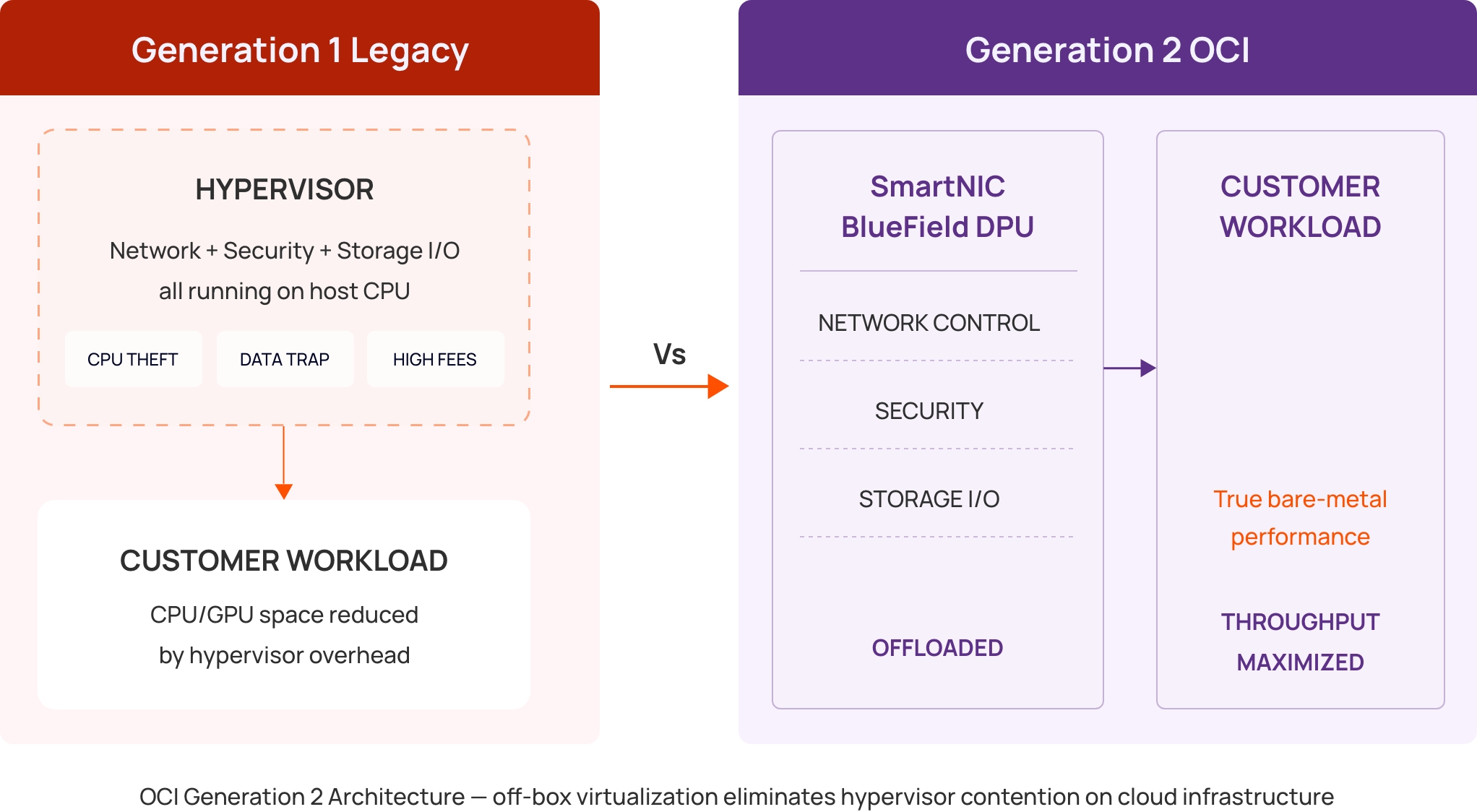
First-generation cloud platforms place networking, storage, and security activity inside the hypervisor. Those functions consume processor capacity that could support application workloads. The same design also creates added contention during intensive data movement and large-scale AI training.
OCI Generation 2 separates infrastructure operations from customer compute through off-box virtualization. Dedicated SmartNIC and BlueField data processing units handle network control, storage input-output, security enforcement, and related services. Bare-metal instances can therefore deliver direct hardware performance while preserving tenant isolation.
This architecture affects more than benchmark results. It changes how the Oracle Cloud Platform uses paid compute cycles and limits interference between infrastructure services and enterprise applications. It also creates a stronger base for GPU clusters and high-volume transaction systems.
The comparison diagram below shows the central difference. Legacy architecture shares host resources between the hypervisor and customer workloads. OCI places infrastructure services on dedicated hardware, allowing the workload to operate with fewer layers between application demand and physical capacity.
A Structural Advantage Across Performance Cost and Security
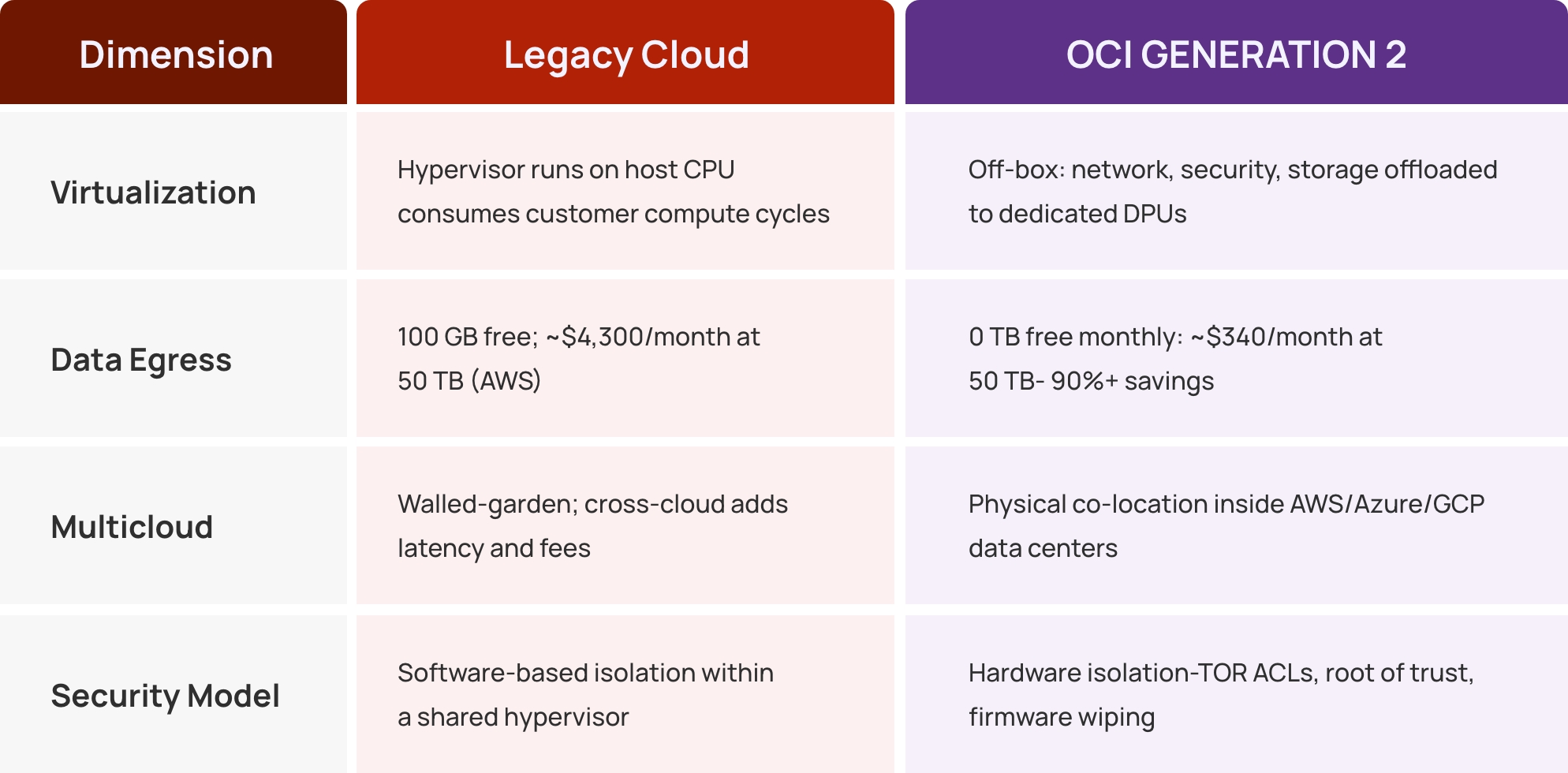
The Generation 2 model extends into cloud economics, multicloud access, and security controls. OCI includes 10 TB of monthly outbound data transfer, while common hyperscale allowances begin at much lower volumes. Physical co-location supports Oracle Database services within other major cloud environments. Hardware access controls and firmware wiping reinforce isolation between tenants.
Together, these design choices position the Oracle Cloud Platform as an integrated operating environment. Compute efficiency, data mobility, and security controls follow the same architectural logic.
AI Cloud Infrastructure Built for Frontier Workloads
Generative AI infrastructure depends on more than GPU availability. Cluster size, network fabric, congestion control, storage throughput, and direct memory transfer determine whether expensive accelerators remain productive during training and inference.
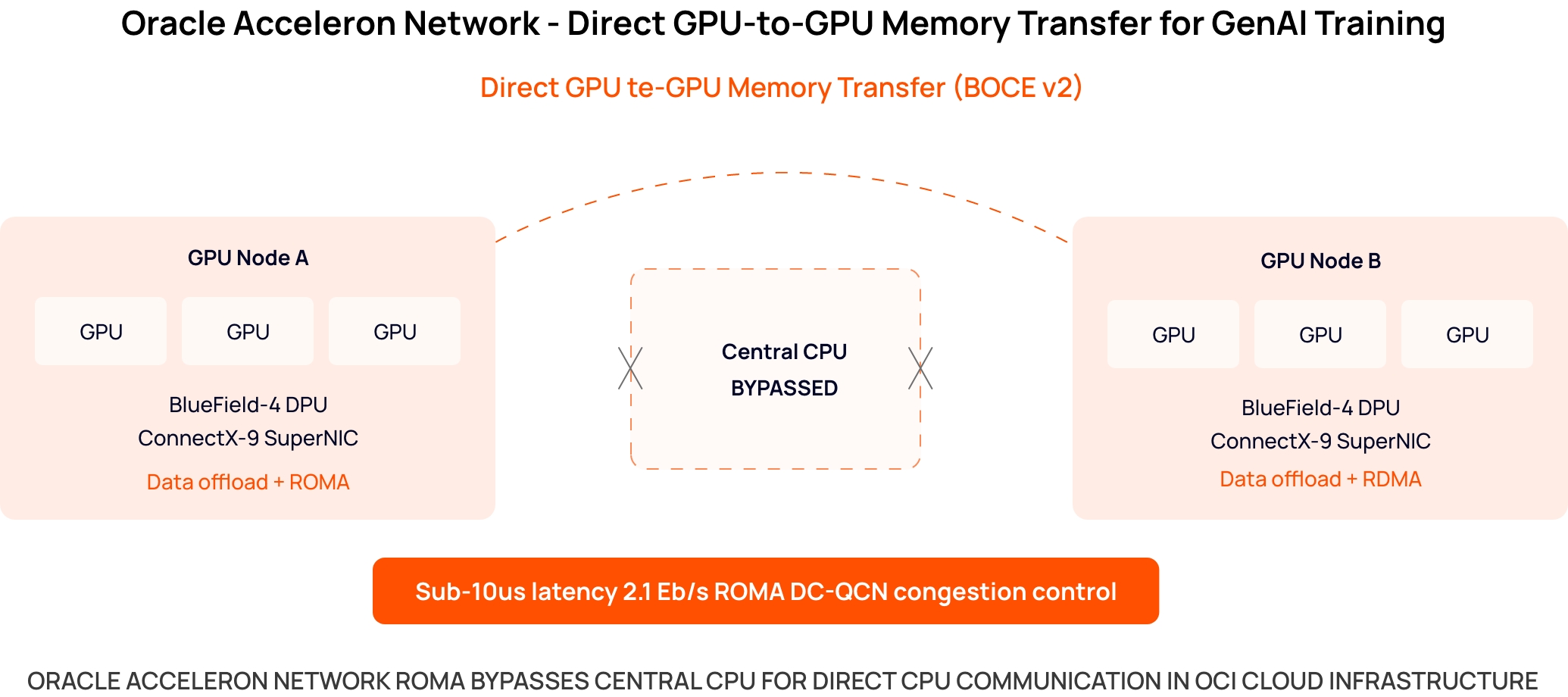
OCI superclusters can scale to 131,072 NVIDIA Blackwell or Rubin GPUs, with support for large AMD Instinct configurations. Oracle Acceleron provides the networking architecture behind these environments. RoCE v2 enables direct GPU-to-GPU memory transfer, while DC-QCN congestion control reduces packet loss during sustained training runs.
The Oracle Cloud Platform supports sub-10 microsecond network latency and high-volume remote direct memory access. This allows large model workloads to move data between accelerator nodes while reducing dependence on a central processor. BlueField data processing units and ConnectX SuperNICs extend that architecture across the cluster.
For enterprise programs, the practical value sits in utilization. Powerful GPUs still lose time through network bottlenecks. OCI is designed to keep accelerator resources active and support large distributed workloads with consistent throughput.
That capability also supports inference, simulation, analytics, digital twins, and other compute-intensive services. Hardware choice adds flexibility across model architectures and workload profiles rather than forcing every program into one accelerator family.
Cloud Economics That Change the Business Case
Cloud cost comparisons often focus on headline compute rates. Enterprise spending is broader. Storage, data movement, network services, regional premiums, idle capacity, and licensing decisions can materially change the final cost profile.
OCI E5 Flex compute can cost 30 to 50 percent less than comparable on-demand instance families cited in the source document. Block storage is listed at $0.0255 per GB, compared with higher published rates across competing platforms. Oracle Cloud Infrastructure also includes 10 TB of monthly data egress, which can create a major difference for data-intensive applications.
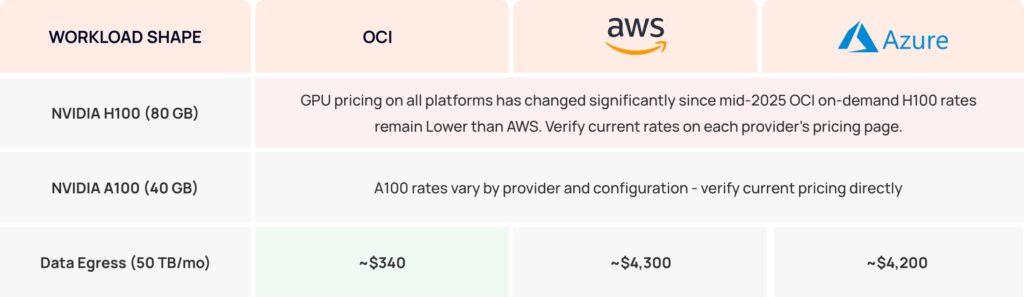
At 50 TB of monthly transfer, the source comparison places OCI near $340 and AWS near $4,300. The exact figure varies with region, service configuration, commercial terms, and current provider pricing. The structural point remains clear. Lower egress exposure can change the economics of analytics, AI pipelines, media workloads, replication, and cross-environment data access.
Uniform pricing across 50-plus cloud regions adds another layer of predictability. Identical services can carry different regional rates on other platforms. The Oracle Cloud Platform reduces that variation, which helps global enterprises model operating costs with greater consistency.
GPU pricing continues to change as new generations enter the market. Current rates still require workload-level validation. A sound OCI business case should combine instance price, achievable utilization, network efficiency, storage demand, licensing, migration effort, and expected egress. Architecture and consumption patterns matter more than a single list-price comparison.
What Is OCI? The Complete Enterprise Guide to Oracle Cloud Infrastructure in 2026
Oracle Cloud AI infrastructure: Inside the GPU Superclusters and Acceleron Network
Oracle Introduces an AI-Native Builder for Fusion Applications. Here’s What It Means
Oracle AI Data Platform: The Foundation of Pragmatic Enterprise AI
A Distributed Cloud Platform for Real Enterprise Constraints
Enterprise cloud strategy rarely fits a single public region. Data residency, latency, existing hyperscale commitments, disconnected operations, and industry regulation create different deployment requirements across the same organization.
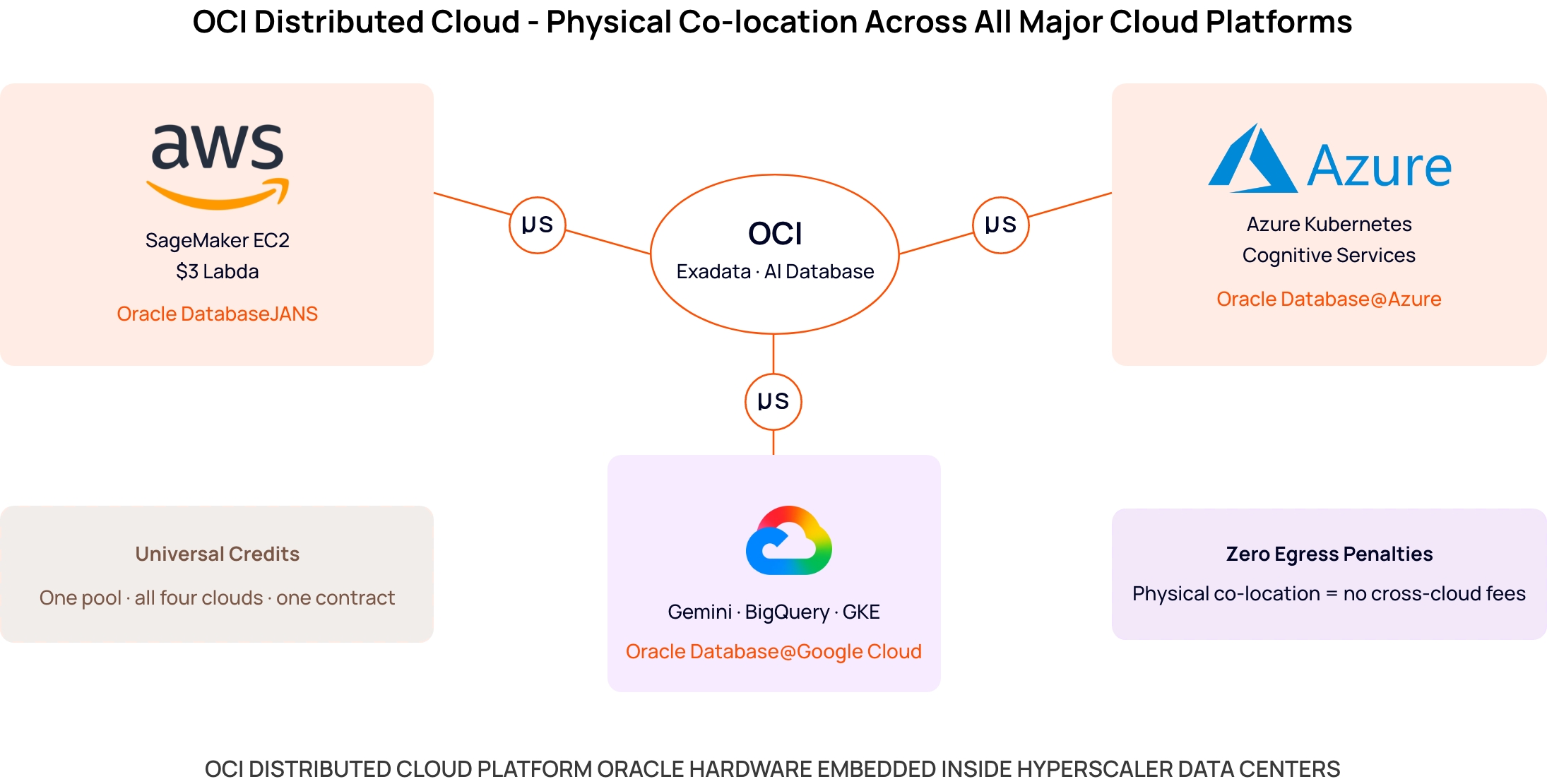
OCI addresses that reality through public cloud regions, dedicated environments, customer data center deployments, edge infrastructure, sovereign regions, and Oracle Database services embedded within AWS, Microsoft Azure, and Google Cloud. This distributed model gives the Oracle Cloud Platform a broader operating footprint without forcing database workloads away from the cloud services already supporting surrounding applications.
Oracle Database at Azure, Oracle Database at AWS, and Oracle Database at Google Cloud place Oracle hardware within hyperscaler data centers. Enterprise applications can connect services such as SageMaker, Azure Kubernetes Service, or Gemini with Exadata and Autonomous Database through low-latency paths. Physical proximity also reduces the cross-cloud transfer burden associated with distant architectures.
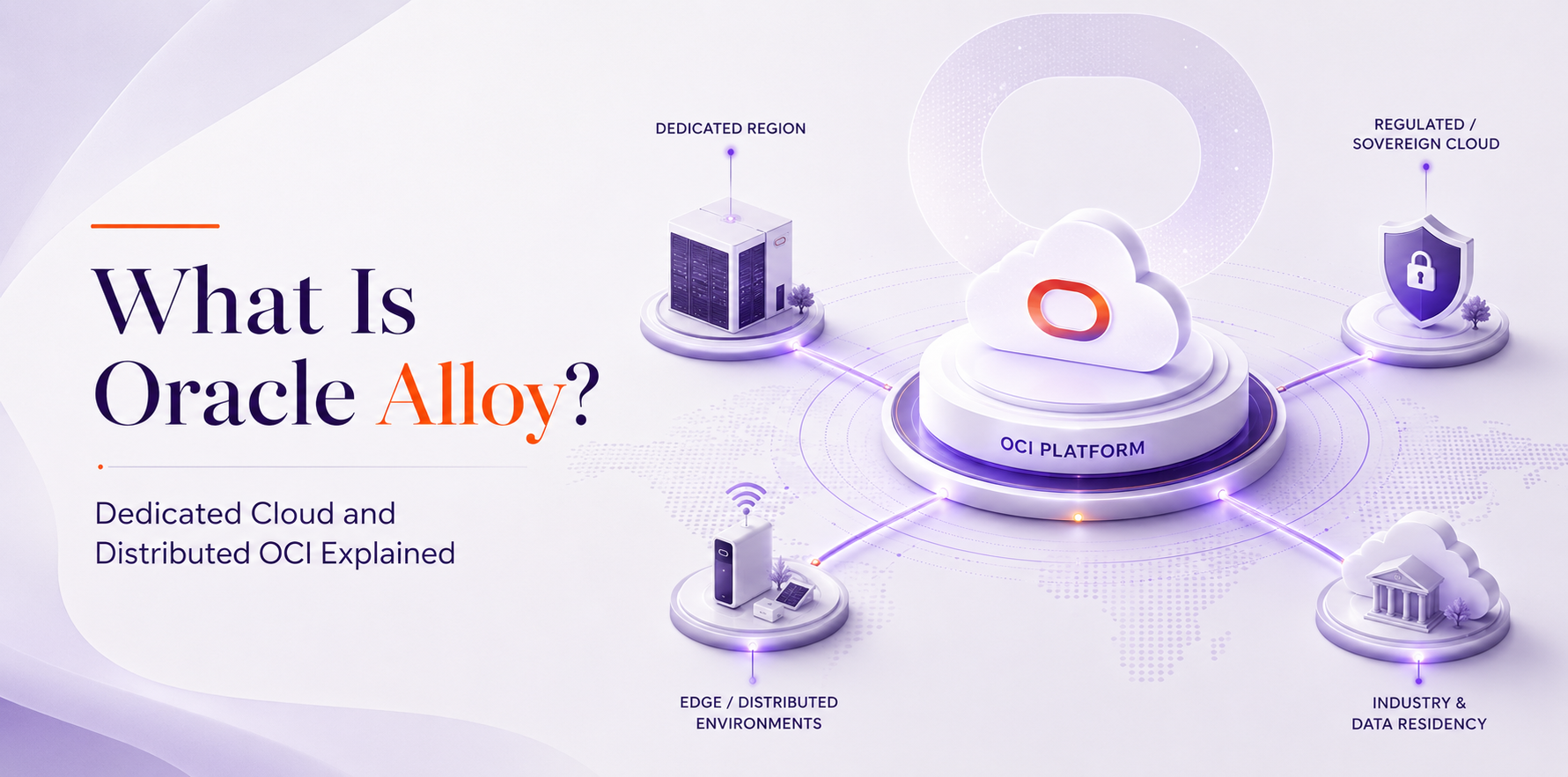
OCI Dedicated Region brings the public cloud service stack into a controlled enterprise location. Oracle Alloy supports partner-operated cloud environments, while Exadata Cloud at Customer keeps database services inside the data center. Roving Edge Infrastructure extends selected capabilities into remote or disconnected environments.
Sovereign and government regions address stricter residency and operational requirements. These deployment choices allow one cloud strategy to support commercial workloads, regulated data, defense environments, and remote AI inference within a consistent platform decision.
Multicloud Universal Credits further simplify procurement by creating a common consumption pool for eligible Oracle services across supported cloud environments. Technical placement can follow workload needs while commercial governance remains more consistent.
Security Designed Into the Infrastructure Layer
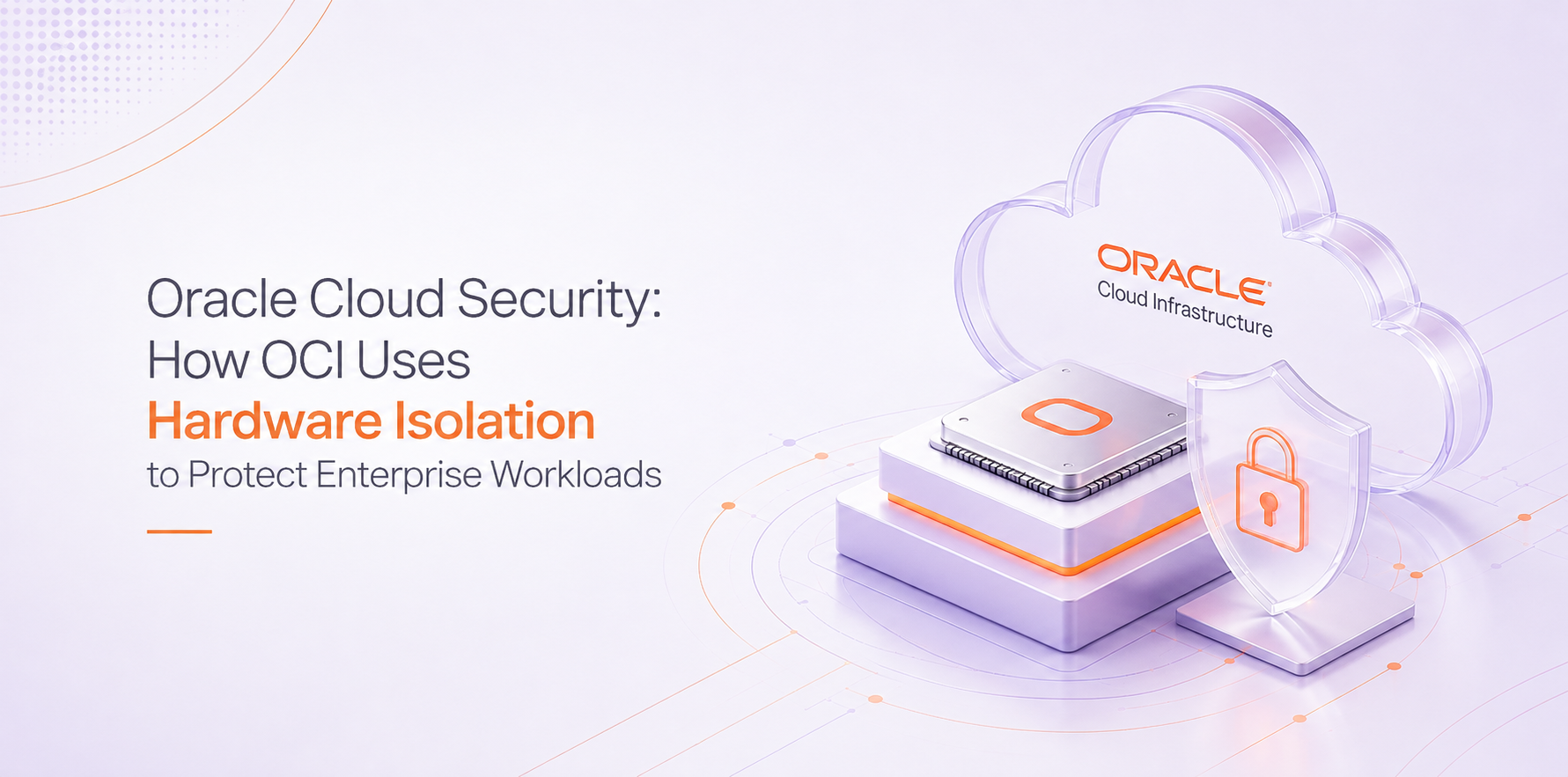
Security on OCI begins below the application stack. Top-of-rack switches map virtual source addresses to physical ports through hardware access control lists. Packets with mismatched assignments are dropped at the infrastructure layer, reducing exposure to tenant IP spoofing.
Bare-metal servers undergo automated firmware wiping and reinstallation between tenants. This hardware root of trust helps remove residual configuration and inherited vulnerabilities before capacity returns to service. Data at rest receives 256-bit encryption across block and object storage, while TLS 1.2 or higher protects control-plane traffic in transit.
These controls matter because enterprise cloud security depends on boundaries that remain consistent at scale. Software policies still play a central role, yet hardware isolation gives the Oracle Cloud Platform another enforcement layer beneath identity, network, and application controls.
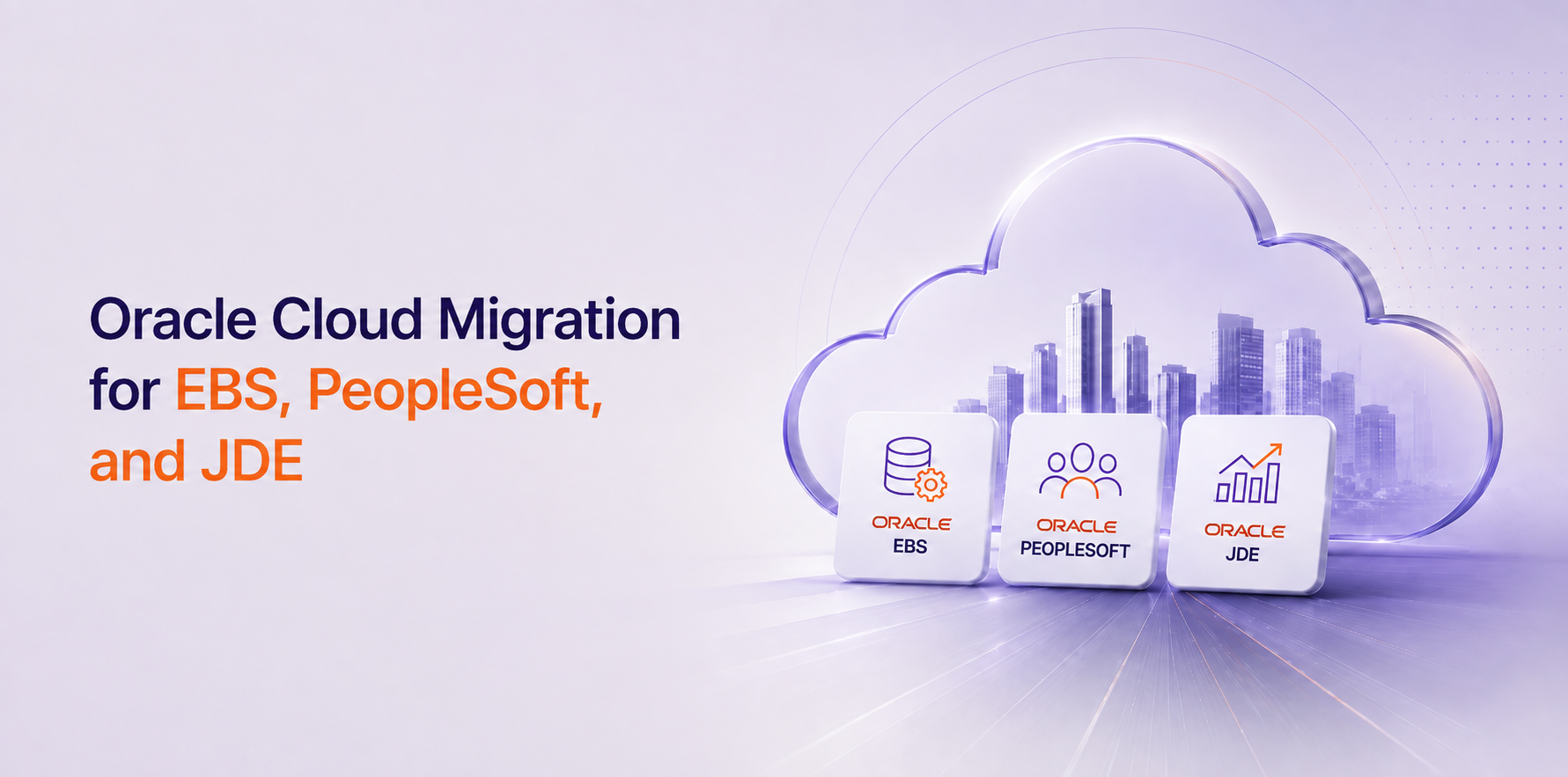
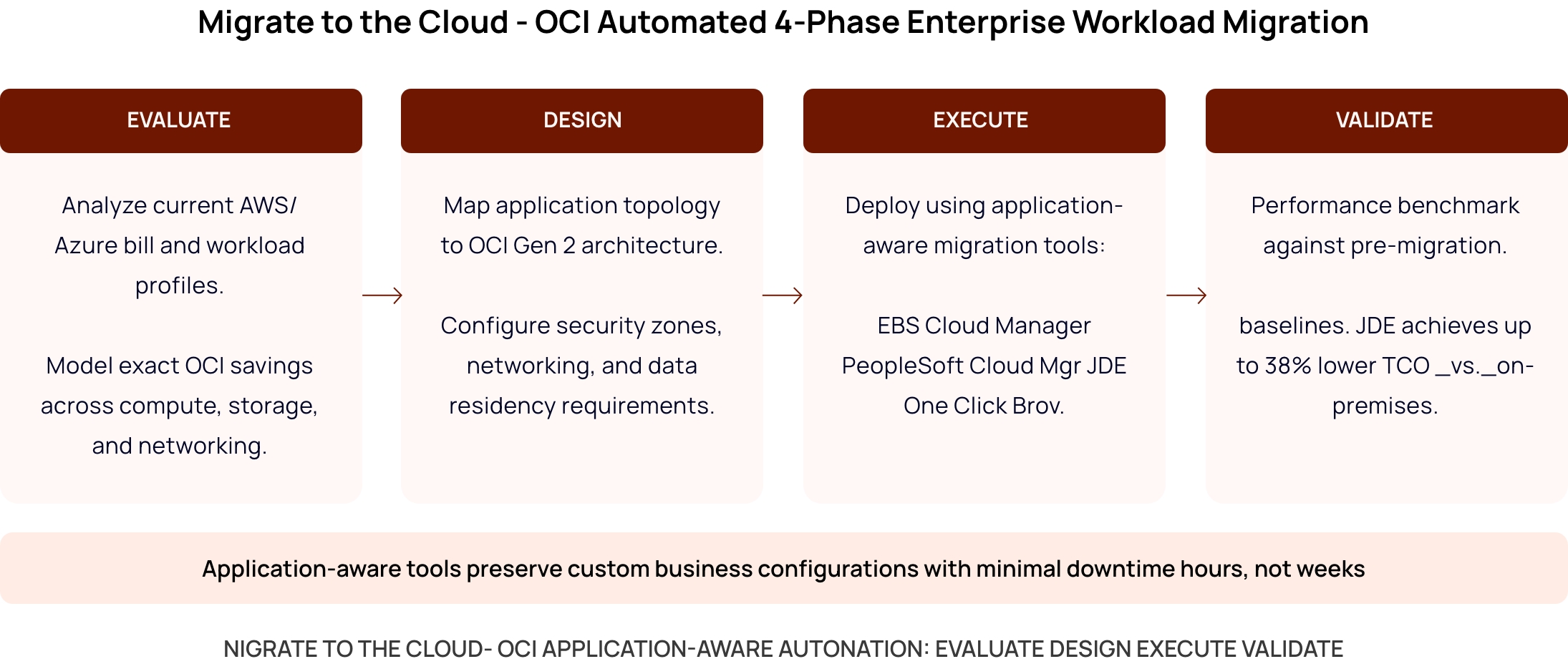
Application-aware migration tooling connects architecture with execution. EBS Cloud Manager, PeopleSoft Cloud Manager, and JD Edwards provisioning tools preserve business configurations while supporting migration, deployment, and validation. The four-phase model covers evaluation, target design, execution, and post-migration benchmarking.
An Oracle Cloud Platform migration should begin with baseline data for performance, cost, availability, security, and compliance. Target outcomes can then be measured after cutover rather than assumed during planning.
AppsTek Oracle Cloud Infrastructure Services
AppsTek helps organizations evaluate, architect, migrate, and optimize Oracle Cloud environments with a structured, business-first approach. Every engagement begins with a clear understanding of workload characteristics, commercial priorities, compliance requirements, and future AI ambitions, creating a roadmap built for measurable outcomes rather than infrastructure alone.
Continue exploring enterprise cloud transformation through the Oracle Cloud Infrastructure Services page, discover additional insights in the Oracle Cloud Platform Knowledge Base, or learn how AI-ready cloud architecture supports modern enterprise delivery across our AI & Data Services resources. When the time comes to evaluate Oracle Cloud for the next phase of digital transformation, Contact Us to schedule a conversation with an AppsTek expert
Frequently Asked Questions
Oracle Cloud Infrastructure includes 10 TB of monthly outbound data transfer in the pricing model described in the source document. That allowance can materially lower cost for analytics, replication, AI pipelines, and data-heavy enterprise applications. Final estimates should reflect current regional pricing and the expected monthly transfer profile.
Off-box virtualization moves network control, security functions, and storage input-output away from the host hypervisor and onto dedicated data processing units. Customer applications receive greater access to host compute capacity, while infrastructure services operate through a separate hardware path.
Oracle Database services are available within Microsoft Azure, AWS, and Google Cloud data centers through dedicated multicloud offerings. This model places Exadata and Autonomous Database close to native hyperscaler services, supporting low-latency integration and simpler data movement.
Strong candidates include Oracle enterprise applications, high-throughput databases, generative AI training, large-scale inference, data-intensive analytics, regulated systems, and multicloud architectures that depend on low-latency Oracle Database access. Suitability still depends on workload design, migration effort, operating model, and commercial terms.

About The Author
Rahul Sudeep, Senior Director of Marketing at AppsTek Corp, is a results-driven, AI-first B2B marketing leader with 15 years of experience scaling global enterprise SaaS companies. His expertise, honed at IIM-K, spans architecting high-impact go-to-market strategies, driving new market identification and positioning, and embedding Generative AI, LLMs, and predictive analytics into the core marketing function. Rahul unifies Technology, Sales, and Support teams around a single strategic hub, while also managing key Partner and Investor Relations. He leverages AI-driven insights to craft powerful brand narratives and hyper-personalized demand generation campaigns that drive measurable revenue growth and deepen customer engagement.