
Table of Contents
What Is Oracle Cloud Infrastructure?
How OCI Generation 2 Redefined Enterprise Cloud Architecture
Oracle Cloud AI Infrastructure Powers GPU Superclusters with Oracle Accelerator
Understanding Oracle Cloud Infra’structure Pricing
What the OCI Always Free Tier Includes
Oracle Alloy, 50+ Cloud Regions, and Multicloud Integration
How OCI Delivers Hardware Level Security
How OCI Simplifies Oracle Cloud Migration
Why Oracle Cloud Is More Than Infrastructure
OCI by Industry: Cloud Infrastructure for Regulated, Data-Heavy Enterprises
Who Is Oracle Cloud Infrastructure For?
Frequently Asked Questions About Oracle Cloud Infrastructure



Oracle Cloud Infrastructure (OCI) is Oracle’s next-generation cloud platform, delivering 200+ cloud services across 50+ global regions. Built on Generation 2 architecture that offloads network and security to dedicated DPUs, OCI provides true bare-metal performance, GPU superclusters for generative AI at zettascale, and cloud pricing up to 80% lower than AWS and Azure, with 10 TB of free monthly data egress and uniform pricing worldwide.
What Is Oracle Cloud Infrastructure?
Oracle Cloud Infrastructure (OCI) is a cloud platform developed by Oracle that provides enterprise-grade compute, storage, networking, database, and AI services. Unlike first-generation cloud platforms that evolved from consumer products, OCI was designed from scratch as a Generation 2 cloud, architecting security and performance at the hardware level rather than bolting them on as software layers.
Organizations evaluating cloud platforms for enterprise workloads, whether that means running Oracle Database, training generative AI models, or modernizing legacy ERP systems, will find that Oracle Cloud Infrastructure is the platform Oracle built specifically for those use cases.
OCI is not a rebrand of Oracle’s earlier cloud attempts. It is a ground up rebuild, launched as what Oracle calls “Generation 2” architecture, designed to solve the three structural problems that plague legacy cloud providers: hypervisor overhead, data egress costs, and vendor lock in.
OCI delivers a consistent set of 200+ cloud services across 50+ global cloud regions, commercial, government, and sovereign. Every region runs the same services at the same prices, which is a significant departure from AWS and Azure, where identical services can cost 60% more depending on which region you deploy in.
The platform spans four deployment models, including public cloud, dedicated cloud (Oracle Alloy), hybrid cloud (Exadata Cloud@Customer), and sovereign cloud, making it the only cloud platform that can operate wherever the enterprise needs it, from a public data center to a disconnected military installation.
The Core Cloud Services
At its foundation, OCI provides the same categories of cloud services one would expect from any major cloud platform: compute instances (virtual machines and bare-metal servers), block and object storage, virtual cloud networks, load balancers, identity and access management, and container orchestration via Kubernetes (OKE). Where OCI differentiates is in its database services, including Oracle Autonomous Database and Exadata Cloud Service are natively integrated with the platform in ways that no third-party cloud can match, and in its AI infrastructure, where OCI superclusters represent the largest commercially available GPU fabrics on any cloud platform.
The rest of this guide breaks down how each of these capabilities works, what it costs, and who it’s built for, with links to detailed deep-dives on each topic.
How OCI Generation 2 Redefined Enterprise Cloud Architecture
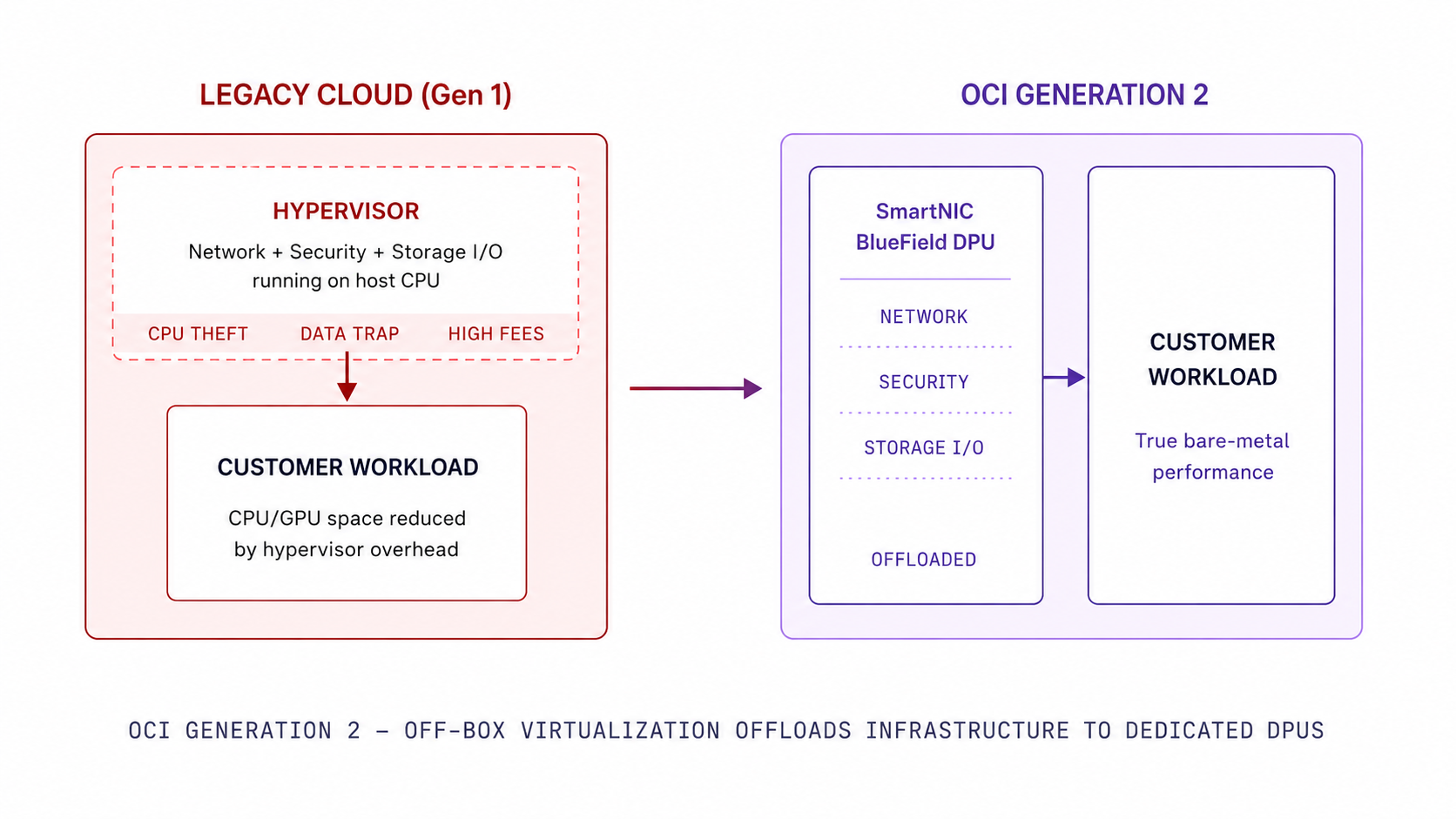
OCI Generation 2 architecture uses off-box virtualization, decoupling network control, security, and storage I/O from the hypervisor and moving them to dedicated SmartNIC/BlueField DPUs. This eliminates the CPU cycle theft caused by traditional hypervisors, delivering true bare-metal performance while enforcing hardware-level tenant isolation.
The reason OCI performs differently lies in the architectural choices made by traditional cloud platforms.
In a traditional Generation 1 cloud architecture, the model used by AWS, Azure, and Google Cloud, the hypervisor runs on the same host CPU as the application workload. The hypervisor is responsible for network traffic, security enforcement, and storage I/O, with each of these functions consuming compute resources that would otherwise be available to the application. Organizations pay for the full capacity of the server, yet a meaningful portion of the CPU is reserved for the cloud provider’s infrastructure. For GPU intensive workloads such as generative AI training, this overhead directly reduces the compute available for model execution.
OCI Generation 2 removes this architectural constraint. Oracle shifted network control, security processing, and storage I/O onto dedicated SmartNICs and BlueField DPUs, specialized processors that manage infrastructure operations independently of the host server. As a result, application workloads receive the full resources of the bare metal system without competing with infrastructure services. Oracle refers to this approach as off box virtualization, and it represents one of the defining architectural differences between OCI and traditional cloud platforms.
The result is a fundamental architectural redesign rather than an incremental improvement. OCI delivers true bare metal performance in a cloud environment while providing hardware level tenant isolation instead of software based isolation within a shared hypervisor.
| Dimension | Legacy Cloud | OCI Generation 2 |
|---|---|---|
| Virtualization | Hypervisor runs on host CPU, steals customer compute | Off-box: offloaded to SmartNIC/BlueField DPUs |
| Data Egress | 100 GB free; ~$4,300/mo at 50 TB (AWS) | 10 TB free monthly; ~$340/mo at 50 TB |
| Multicloud | Walled-garden; cross-cloud adds latency + fees | Physical co-location inside AWS/Azure/GCP |
| Security | Software-based isolation in shared hypervisor | Hardware isolation, ToR ACLs, root of trust |
| Pricing | Up to 60% regional upcharges | Uniform global pricing across 50+ regions |
Oracle Cloud AI Infrastructure Powers GPU Superclusters with Oracle Accelerator
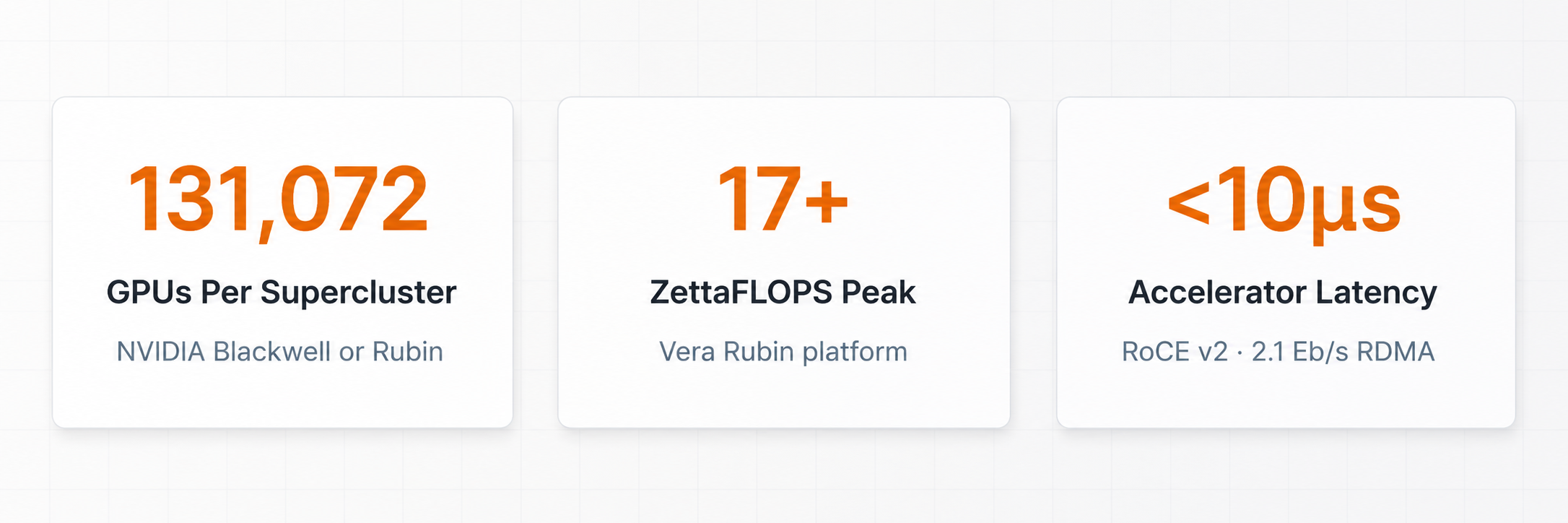
OCI superclusters scale up to 131,072 NVIDIA Blackwell or Rubin GPUs, delivering over 17 zettaFLOPS of peak performance. The Oracle Acceleron network uses RoCE v2 for sub-10 microsecond GPU-to-GPU latency and DC-QCN congestion control. OCI also offers 50,000 AMD Instinct MI450 GPUs for hardware flexibility across cloud services.
For enterprises building or fine-tuning generative AI models, the infrastructure bottleneck is not software, it is the network. Training a frontier LLM requires thousands of GPUs communicating at microsecond latency with zero packet loss.
OCI superclusters are the largest commercially available GPU fabrics on any cloud platform, powered by the NVIDIA Vera Rubin platform with BlueField-4 DPUs and ConnectX-9 SuperNICs. The Oracle Acceleron network enables direct GPU-to-GPU memory transfer via RDMA, bypassing the central CPU entirely.
Understanding Oracle Cloud Infrastructure Pricing
Oracle Cloud Infrastructure pricing costs approximately 50% less for compute, 70% less for block storage, and 80% less for networking compared to AWS and Azure. On NVIDIA H100 GPU clusters, OCI delivers a 58% financial advantage over AWS at $5.12/GPU-hr versus $12.29/GPU-hr. OCI includes 10 TB of free monthly data egress and uniform pricing across all 50+ cloud regions.
OCI’s pricing advantage is rooted in architecture rather than promotional discounts. Eliminating hypervisor overhead improves infrastructure efficiency. A flat rate global network removes regional pricing premiums. Including 10 TB of outbound data transfer each month, instead of the 100 GB offered by many cloud providers, reduces the hidden data egress costs that often inflate cloud spending on AWS and Azure.
The result is a lower total cost of ownership across the infrastructure stack, with up to 50% lower compute costs, 70% lower storage costs, 80% lower networking costs, and a 58% cost advantage for NVIDIA H100 GPU clusters.
What the OCI Always Free Tier Includes
Oracle Cloud Free Tier includes permanent access to 2 Ampere Arm A1 Flex compute cores, 12 GB of memory, 2 Autonomous Databases, 200 GB of block storage, 20 GB of object storage, and 10 TB of outbound data transfer each month, with no expiration date. Pay As You Go accounts may also qualify for up to 4 OCPUs and 24 GB of memory. In addition, Oracle provides a separate 30 day free trial with $300 in credits to evaluate paid cloud services.
The Always Free tier is designed for long term use rather than short term evaluation. It supports application prototyping, developer environments, lightweight production workloads, and hands on OCI exploration without ongoing infrastructure costs. The included 10 TB monthly outbound data transfer allowance also provides substantially more capacity than the free egress allowances offered by many public cloud providers, making it especially valuable for workloads that move significant volumes of data.
Oracle Alloy, 50+ Cloud Regions, and Multicloud Integration
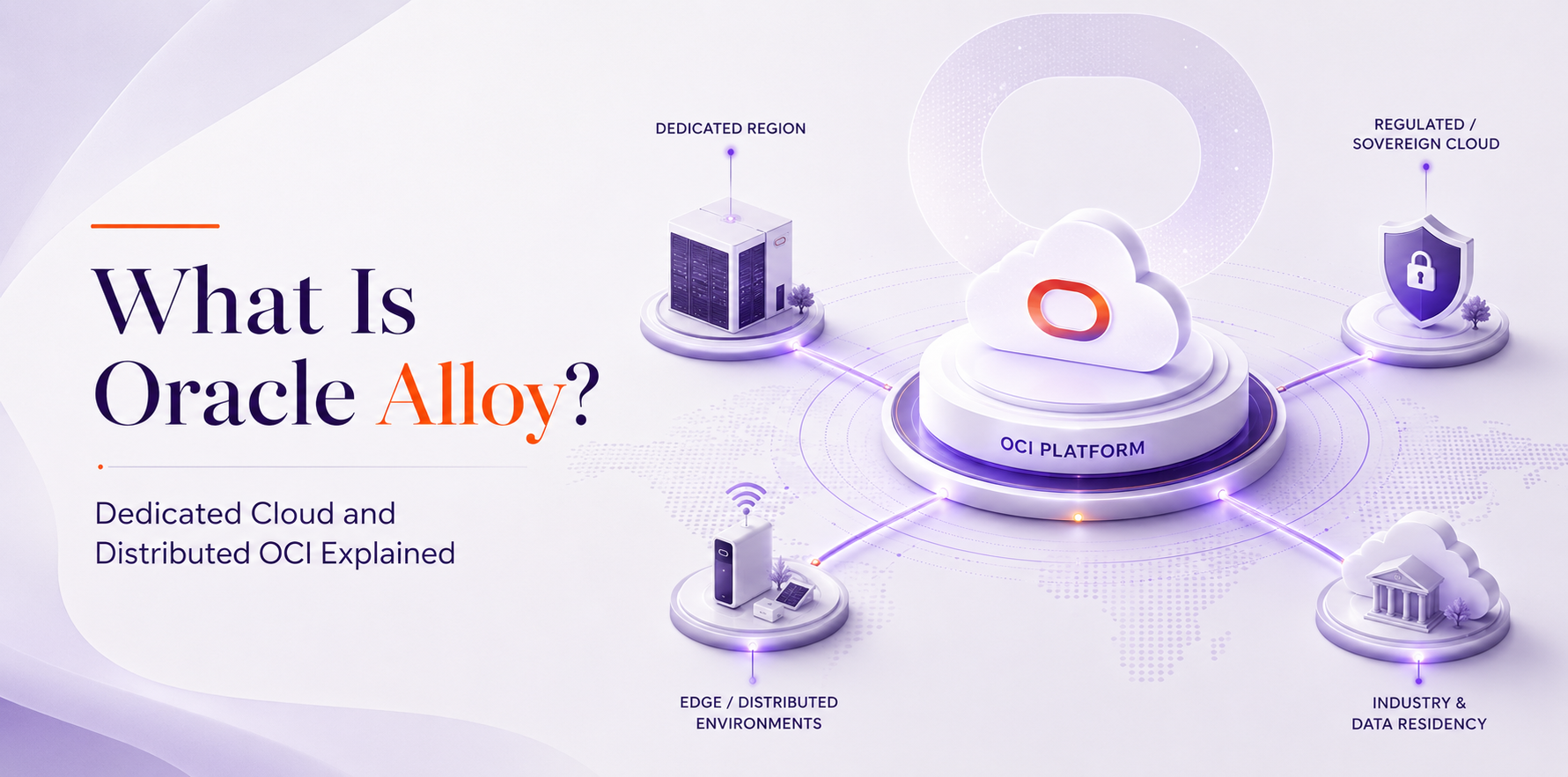
OCI operates as a distributed cloud platform with four deployment models: public cloud (50+ regions), dedicated cloud (Oracle Alloy), hybrid cloud (Exadata Cloud@Customer), and sovereign cloud. OCI also physically co-locates hardware inside AWS, Azure, and Google Cloud through Oracle Database@Azure, Oracle Database@AWS, and Oracle Database@Google Cloud, with zero cross-cloud egress fees. Multicloud Universal Credits let organizations spend one pool of credits across all four cloud platforms.
OCI is the only cloud platform that physically deploys its hardware inside other hyperscalers’ data centers. This means enterprises can run Oracle Exadata and Autonomous Database at microsecond latency alongside native AWS, Azure, or Google Cloud services, without cross-cloud egress penalties. Oracle Alloy extends this further by deploying the complete OCI stack inside your own data center. Universal Credits simplify procurement into a single contract across all four cloud platforms.
How OCI Delivers Hardware Level Security
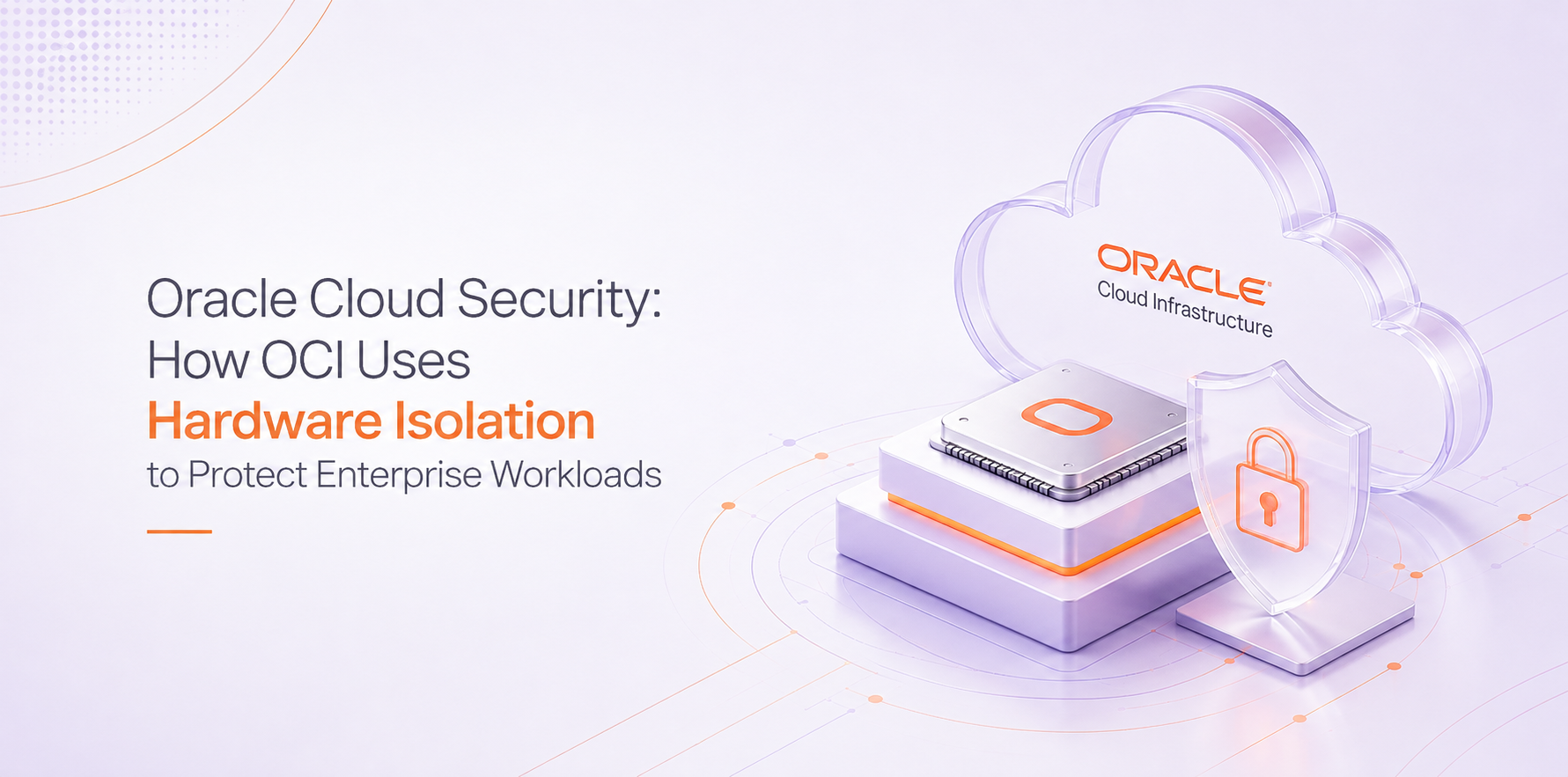
Oracle Cloud security is architectural. OCI prevents tenant IP spoofing through physical port mapping on Top-of-Rack switches with hardware ACLs. Every bare-metal server undergoes automated firmware wiping between tenants (hardware root of trust). All data is encrypted at rest with 256-bit encryption and in transit with TLS 1.2+.
On legacy cloud platforms, security is a software layer running inside a shared hypervisor. On OCI, security is enforced at the hardware level, independently of the customer workload, physical port mapping eliminates IP spoofing, hardware root of trust wipes firmware between tenants, and 256-bit encryption is default across all cloud services, not a configuration option.
How OCI Simplifies Oracle Cloud Migration
OCI provides application-aware migration tools that preserve custom business configurations with minimal downtime. Oracle EBS Cloud Manager automates E-Business Suite migration. PeopleSoft Cloud Manager handles PeopleTools 8.58+. JD Edwards One-Click Provisioning migrates complex JDE configurations within hours, achieving up to 38% lower TCO versus on-premises.
Generic lift-and-shift tools move the bits but break the custom configurations, security policies, and integration points your business depends on. OCI’s migration tools are application-aware, they understand the internal structure of EBS, PeopleSoft, and JDE, and preserve it through the migration. The result is enterprise cloud migration measured in hours, not weeks.
Why Oracle Cloud Is More Than Infrastructure
The decision to adopt Oracle Cloud Infrastructure is not purely technical. It involves total cost of ownership beyond the compute bill, cloud vendor lock-in and its impact on negotiation leverage, multicloud governance and operating model design, and the organizational changes required after migration, from team structures to skills and hiring. Enterprises that evaluate OCI only on specs miss the strategic advantages that matter most to CIOs, CFOs, and business leaders.
Every section so far has focused on the technical dimensions of OCI, explaining how the architecture works, how the network operates, and how the pricing model compares with other cloud platforms. Enterprise technology decisions, however, extend well beyond technical capabilities.
Executive stakeholders are typically focused on a different set of questions. Will the platform reduce total cost of ownership after accounting for licensing, application modernization, and workforce transition? How will it influence commercial negotiations with Oracle? What governance model will support a multicloud environment without increasing operational complexity? How will engineering teams adapt once the migration is complete?
These are the questions the following guides are built to answer, written for the CIO, CFO, and VP of IT, not the cloud architect.
OCI by Industry: Cloud Infrastructure for Regulated, Data-Heavy Enterprises
Oracle Cloud Infrastructure serves specific industry requirements that general-purpose cloud platforms struggle with, sovereign data residency for financial services and defense, HIPAA-ready architecture for healthcare, minimal-disruption ERP migration for manufacturing, and portfolio-scale analytics for real estate operations. Each industry has distinct compliance, latency, and data gravity requirements that map directly to OCI’s distributed cloud and security architecture.
Cloud infrastructure is not industry-neutral. A bank moving transaction processing to the cloud has fundamentally different requirements than a manufacturer migrating Oracle ERP, and both differ from a healthcare system that needs HIPAA-compliant data residency. OCI’s distributed cloud, sovereign regions, and application-aware migration tools address these requirements architecturally, not through add-on compliance layers.
Who Is Oracle Cloud Infrastructure For?
OCI is built for enterprises running Oracle Database or Oracle Applications, organizations training generative AI at scale, multicloud enterprises needing Oracle alongside AWS/Azure/GCP, regulated industries requiring sovereign cloud, and developers evaluating cloud platforms through the industry’s most generous Always Free tier.
Enterprise Oracle Shops
For organizations running Oracle Database, EBS, PeopleSoft, or JD Edwards on premises, OCI provides a native migration path, application aware tooling, and full Exadata performance without requiring application rearchitecture.
AI/ML Teams at Scale
OCI superclusters with up to 131,072 GPUs and Oracle Acceleron provide the scale and low-latency interconnect that distributed generative AI training demands, at 58% lower GPU cost than AWS.
Multicloud Enterprises
OCI’s physical co-location inside AWS, Azure, and Google Cloud delivers microsecond-latency interoperability with zero egress penalties, under one contract via Universal Credits.
Regulated Industries
OCI’s sovereign cloud regions (US, UK, Australia, EU) and Oracle Alloy dedicated deployments meet compliance mandates in BFSI, healthcare, defense, and government that public-only clouds cannot.
Developers and POC Builders
OCI’s Always Free tier, 2 Arm cores, 12 GB RAM, 2 Autonomous Databases, 10 TB egress, is one of the most generous permanent free offerings from any major cloud platform.
Cloud Cost Optimizers
OCI’s structural cost advantages, including 50% less compute, 70% less storage, 80% less networking, uniform global pricing, come from architecture, not short-term discounting.
Ready to Evaluate Oracle Cloud Infrastructure?
AppsTek’s OCI practice provides workload-level assessments, migration execution, and GenAI enablement, backed by 19 years of enterprise platform expertise and 150+ global clients.
Frequently Asked Questions About Oracle Cloud Infrastructure
OCI (Oracle Cloud Infrastructure) is Oracle's cloud platform providing compute, storage, networking, database, and AI services that enterprises rent on demand, built on Generation 2 architecture that delivers bare-metal performance and hardware-level security isolation.
OCI costs approximately 50% less for compute and up to 80% less for networking versus AWS. On NVIDIA H100 GPU clusters, OCI charges $5.12/GPU-hr compared to $12.29/GPU-hr on AWS, a 58% advantage. OCI also includes 10 TB of free monthly egress versus 100 GB on AWS.
Oracle Cloud Always Free includes 2 Arm A1 Flex cores, 12 GB RAM, 2 Autonomous Databases, 200 GB block storage, 20 GB object storage, and 10 TB monthly outbound transfer, permanently, with no time limit. Pay As You Go accounts may retain higher compute limits. A separate $300 trial credit is available for 30 days.
Off-box virtualization moves network control, security, and storage I/O from the hypervisor to dedicated SmartNIC/BlueField DPUs, eliminating CPU cycle theft and delivering true bare-metal performance with hardware-level tenant isolation.
Oracle Acceleron is OCI's AI networking architecture using RoCE v2 for direct GPU-to-GPU memory transfer at sub-10 microsecond latency with 2.1 Eb/s RDMA throughput and DC-QCN congestion control for large-scale generative AI training.
Yes. OCI physically co-locates hardware inside AWS, Azure, and Google Cloud through Oracle Database@Azure, Oracle Database@AWS, and Oracle Database@Google Cloud, thus enabling microsecond-latency access to Exadata and Autonomous Database with zero cross-cloud egress fees.
Oracle Alloy deploys the complete OCI cloud stack, all 200+ services including Autonomous Database, inside your own data center at public cloud pricing, for organizations with sovereign, regulatory, or latency requirements.
Oracle Cloud operates 50+ cloud regions across commercial, government, and sovereign deployments, each delivering 200+ services at uniform global pricing, unlike AWS and Azure, which charge up to 60% more in certain regions.
OCI provides application-aware tools: EBS Cloud Manager, PeopleSoft Cloud Manager, and JD Edwards One-Click Provisioning. These preserve custom configurations during migration, completing in hours with up to 38% lower TCO versus on-premises.
OCI superclusters support up to 131,072 NVIDIA Blackwell or Rubin GPUs delivering 17+ zettaFLOPS, plus 50,000 AMD Instinct MI450 GPUs. The Oracle Acceleron network provides sub-10 microsecond GPU-to-GPU latency for distributed AI training.

About The Author
Rahul Sudeep, Senior Director of Marketing at AppsTek Corp, is a results-driven, AI-first B2B marketing leader with 15 years of experience scaling global enterprise SaaS companies. His expertise, honed at IIM-K, spans architecting high-impact go-to-market strategies, driving new market identification and positioning, and embedding Generative AI, LLMs, and predictive analytics into the core marketing function. Rahul unifies Technology, Sales, and Support teams around a single strategic hub, while also managing key Partner and Investor Relations. He leverages AI-driven insights to craft powerful brand narratives and hyper-personalized demand generation campaigns that drive measurable revenue growth and deepen customer engagement.