Table of Contents
Why Oracle Cloud Begins with Architecture
How SmartNIC Isolation Protects Enterprise Workloads
Hardware Root of Trust Creates a Clean Starting Point
Zero-Trust Defaults Reduce Configuration Exposure
Oracle Cloud Security Key Management Options
Compliance Coverage Backend by Platform Controls
How OCI Differes from Legacy Cloud Security Designs



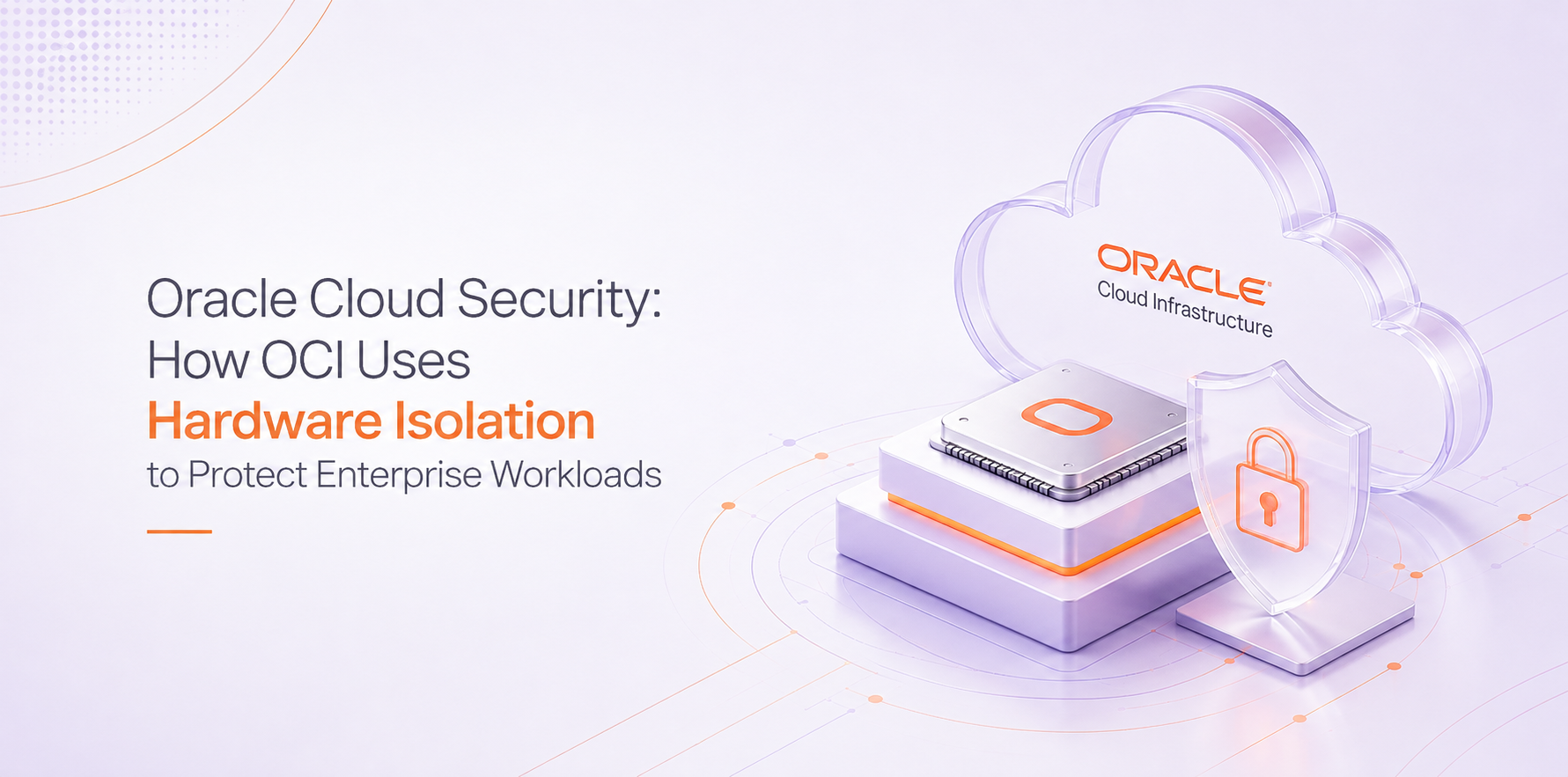
Oracle Cloud Infrastructure security begins below the operating system, where isolation, firmware integrity, network controls, encryption, and key custody are established. Oracle Cloud Security uses a Generation 2 architecture built around custom SmartNICs, a hardware root of trust, deny-all networking, and encryption that remains active by default.
That distinction matters for regulated and business-critical environments. Security products can strengthen monitoring and response, yet their effectiveness depends on the foundation beneath them. Oracle Cloud Security places core enforcement in hardware and platform defaults, creating a stronger baseline for every OCI implementation.
Why Oracle Cloud Security Begins with Architecture
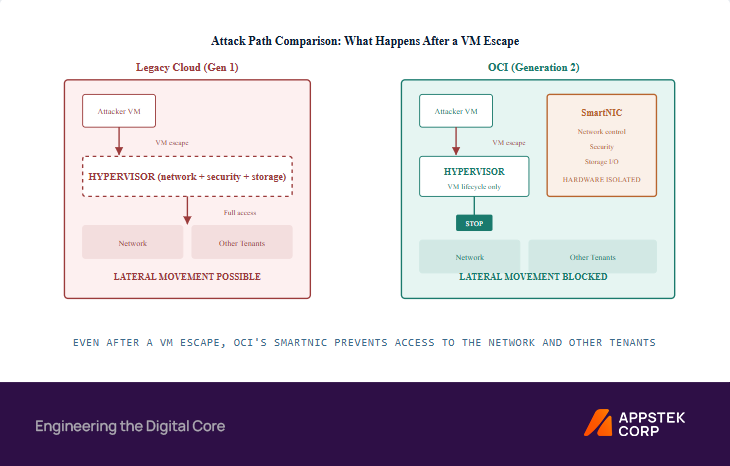
First-generation cloud designs often place virtual machine management and network virtualization inside the same hypervisor layer. A successful VM escape can therefore create access to network functions and expand the potential blast radius. Configuration controls still matter, although architecture determines how much power a compromised component can gain.
Oracle Cloud Infrastructure security separates those responsibilities. OCI moves network virtualization and privileged cloud control functions onto dedicated SmartNIC hardware. The host hypervisor retains a narrower role focused on basic virtual machine lifecycle operations and memory allocation. This separation reduces exposed code in the hypervisor and blocks direct control over the cloud network.
Oracle Cloud Security therefore treats tenant isolation as an architectural boundary rather than a software policy layered onto shared host functions. The design limits lateral movement and strengthens the base for workload security controls.
How SmartNIC Isolation Protects Enterprise Workloads
The SmartNIC acts as the physical enforcement point for tenant isolation. It operates inside a separate security perimeter. Network traffic between virtual machines passes through this hardware instead of the host hypervisor, so a compromised workload lacks authority over network virtualization.
This model changes the risk profile in two ways. The hypervisor carries fewer privileged functions, which lowers the number of components exposed to attack. A security issue affecting the host also remains confined because network control operates on separate hardware. The attacker gains no path to reconfigure virtual networking or reach neighboring tenants through the hypervisor.
OCI reinforces the boundary through packet validation at the physical network layer. Virtual source IP addresses are matched against assigned physical ports on top-of-rack switches. Hardware access control lists drop traffic when the mapping fails, reducing the opportunity for IP spoofing before software-based detection becomes necessary.
For an OCI implementation, this architecture supports stronger segmentation with fewer assumptions about the host layer. Oracle Cloud Infrastructure security removes a major concentration of privilege from the infrastructure stack.
Hardware Root of Trust Creates a Clean Starting Point
Oracle Cloud Security uses a dedicated trust card manufactured to Oracle specifications. Each bare-metal server receives verified firmware during provisioning, including storage controllers and management interfaces. When hardware moves to a new tenancy, the platform wipes and reinstalls firmware from a known-clean image.
This process addresses threats that can persist below the operating system. Firmware implants may survive reinstallation and evade software security tools. A hardware-based reset establishes a verifiable baseline before enterprise workloads begin running.
Oracle also maintains control across server design, testing, manufacturing, transit, and data center installation. That chain of custody supports environments where hardware provenance forms part of regulatory or sovereign-cloud requirements.
Zero-Trust Defaults Reduce Configuration Exposure
Oracle Cloud Infrastructure security begins with restrictive defaults. New environments start with deny-all network access, encrypted storage, protected control-plane traffic, and identity permissions that require explicit assignment. Access expands through deliberate policy decisions rather than inherited openness.
This orientation changes the impact of configuration drift. An incomplete rule is more likely to block access than expose a service. Exceptions become visible changes against a closed baseline.
Block Volume and Object Storage data is encrypted at rest by default, while control-plane traffic uses TLS 1.2 or higher. These controls reduce setup effort during an OCI implementation and simplify evidence collection for encryption requirements. Workload teams still need sound key governance, identity design, logging, and network segmentation, but the platform begins from a hardened position.
Oracle Cloud Security Key Management Options
OCI supports different levels of key isolation based on workload sensitivity and regulatory expectations. Shared Vault services cover standard enterprise encryption, Dedicated KMS provides single-tenant hardware security modules, and External KMS keeps key material under enterprise custody outside OCI.
| Tier | How It Works | Best Fit |
|---|---|---|
| OCI Vault | Shared HSM service managed within OCI | Standard enterprise encryption |
| Dedicated KMS | Single-tenant HSM with exclusive customer control | Regulated workloads needing isolated key infrastructure |
| External KMS | Keys remain in an enterprise-managed external system | Policies requiring external key custody |
External KMS is significant for policies that require encryption keys to remain outside cloud-provider infrastructure. OCI requests cryptographic operations through the external key store while the key material stays under enterprise control. This model supports sovereign, financial services, healthcare, and public-sector workloads where key custody must be independently demonstrable.
Selecting the appropriate tier during OCI implementation prevents later redesign. The decision should reflect data classification, audit requirements, recovery procedures, operational ownership, and acceptable dependency on external key infrastructure.
Compliance Coverage Backed by Platform Controls
OCI maintains more than 80 compliance programs across global standards, government requirements, industry frameworks, and regional obligations. The portfolio includes SOC reports, ISO certifications, FedRAMP High, PCI DSS, HIPAA, HITRUST, GDPR, BSI C5, NIS2, and DORA alignment.
Certification provides evidence that defined controls were independently assessed at a point in time. The stronger point for Oracle Cloud Security is consistency between the audited environment and the production architecture. SmartNIC isolation, hardware root of trust, encryption defaults, and restrictive networking remain permanent platform characteristics rather than temporary audit settings.
Oracle also provides assessment reports and control mappings through the Cloud Console. These materials support OCI implementation reviews, while enterprise teams retain accountability for workload configuration and shared-responsibility controls.
| Category | Certifications and Frameworks |
|---|---|
| Global standards | SOC 1, SOC 2, SOC 3, ISO 27001, ISO 27017, ISO 27018, ISO 27701, CSA STAR Level 2 |
| United States government | FedRAMP High JAB, DoD DISA SRG IL5, NIST 800-53 |
| Industry | PCI DSS, HIPAA, HITRUST |
| EU and regional | GDPR, BSI C5, NIS2, DORA, ENS, HDS |
| United Kingdom | UK Sovereign Cloud controls and NCSC sanitisation standards |
| Australia | IRAP and Australian data protection requirements |
How OCI Differs from Legacy Cloud Security Designs
The central difference is the location of isolation enforcement. Legacy designs concentrate network virtualization and workload management inside the hypervisor. OCI places network control on separate SmartNIC hardware and limits the hypervisor to a narrower function set.
That architectural choice reduces the consequences of a host-layer compromise. Oracle Cloud Infrastructure security also adds clean-state firmware provisioning, deny-all networking, and external key custody options. Security operations still require patching, monitoring, governance, and response readiness, yet the platform removes several risks through design before those processes begin.
| Security Dimension | Legacy Cloud Design | OCI Generation 2 |
|---|---|---|
| Network isolation | Enforced inside the hypervisor | Enforced by separate SmartNIC hardware |
| Hypervisor role | Workload, network, storage, and security functions | Narrow virtual machine lifecycle role |
| Firmware security | Provider-dependent provisioning controls | Hardware root of trust and clean firmware reset |
| Default network posture | Varies by service and configuration | Deny-all baseline with explicit access |
| Encryption at rest | May require service-level setup | Active by default for Block and Object Storage |
| Key custody | Provider or customer keys held in cloud infrastructure | External KMS keeps keys outside OCI |
| Supply chain | Standard third-party hardware chain | Oracle-designed hardware with controlled custody |
What a Secure OCI Implementation Still Requires
Strong architecture still requires disciplined execution. A secure OCI implementation needs clear tenancy design, compartment boundaries, least-privilege IAM policies, logging coverage, network segmentation, key ownership, backup protection, and continuous review of exposed services.
The platform baseline makes those controls easier to build and audit. SmartNIC isolation limits infrastructure-level lateral movement, encryption defaults reduce missed settings, and hardware root of trust establishes a clean provisioning state. The implementation team can focus on application risk, data access, operating procedures, and regulatory evidence instead of compensating for weaknesses in the underlying architecture.
Oracle Cloud Security creates the foundation. Governance and operational discipline determine how effectively that foundation protects production workloads.
Oracle Cloud Infrastructure delivers security at the architecture level, but translating that foundation into a hardened, well-governed production environment takes planning, expertise, and disciplined execution. AppsTek Corp brings deep Oracle experience across OCI implementation, Fusion Cloud adoption, integration, and ongoing managed services, helping enterprises design tenancy structures, enforce least-privilege access, configure encryption and key custody, and maintain compliance posture from day one.
Whether you are planning a new OCI deployment or strengthening an existing one, our team can help you build on the security baseline Oracle provides. Explore our full range of Oracle services or contact our Oracle experts to discuss your environment.
Frequently Asked Questions About Oracle Cloud Security
Custom SmartNICs isolate network virtualization from the host hypervisor. Even when a workload or hypervisor is compromised, network control remains on separate hardware. Switch validation drops packets when virtual source addresses fail to match assigned ports.
A dedicated trust card verifies and reinstalls clean firmware during bare-metal provisioning. Storage controllers and management interfaces return to a known-good state before a new tenancy receives the server, reducing the risk of persistent firmware implants.
Block Volume and Object Storage data is encrypted at rest by default. Control-plane traffic is protected in transit with TLS 1.2 or higher. Key management can use shared Vault services, Dedicated KMS, or External KMS.
External KMS suits workloads where policy or regulation requires encryption keys to remain under enterprise custody outside OCI. The model is relevant to sovereign environments and highly regulated data estates that need independent proof of key control.
OCI supports more than 80 programs, including SOC 1, SOC 2, SOC 3, ISO 27001, FedRAMP High, PCI DSS, HIPAA, HITRUST, GDPR, BSI C5, NIS2, and DORA alignment. Available coverage varies by service and region, so deployment planning should confirm the exact scope.

About The Author
Rahul Sudeep, Senior Director of Marketing at AppsTek Corp, is a results-driven, AI-first B2B marketing leader with 15 years of experience scaling global enterprise SaaS companies. His expertise, honed at IIM-K, spans architecting high-impact go-to-market strategies, driving new market identification and positioning, and embedding Generative AI, LLMs, and predictive analytics into the core marketing function. Rahul unifies Technology, Sales, and Support teams around a single strategic hub, while also managing key Partner and Investor Relations. He leverages AI-driven insights to craft powerful brand narratives and hyper-personalized demand generation campaigns that drive measurable revenue growth and deepen customer engagement.