

For years, traditional hyperscale’s operated on a lucrative, unspoken business model: make it free to bring your data in but charge a steep fee the moment you try to query, analyze, or deliver it elsewhere.
This hidden penalty, the cloud egress cost, quietly crippled enterprise budgets, forced architectural lock-in, and bottlenecked high-performance data workflows.
At Oracle AI World, Oracle Cloud Infrastructure (OCI) announced partnerships that remove egress fees on two key data paths.
By combining native data gravity with zero-egress economics across both inbound analytics (Snowflake on OCI) and outbound edge delivery (Cloudflare, Fastly, and Mainstreaming), Oracle has engineered a zero-egress data engine.
Here is a detailed analysis of how Oracle is lowering data movement costs, reducing data movement friction, and creating a blueprint for modern enterprise architecture.
How Egress Costs Crippled Enterprise Agility
In a traditional multicloud setup, enterprise data lives in a state of financial friction:
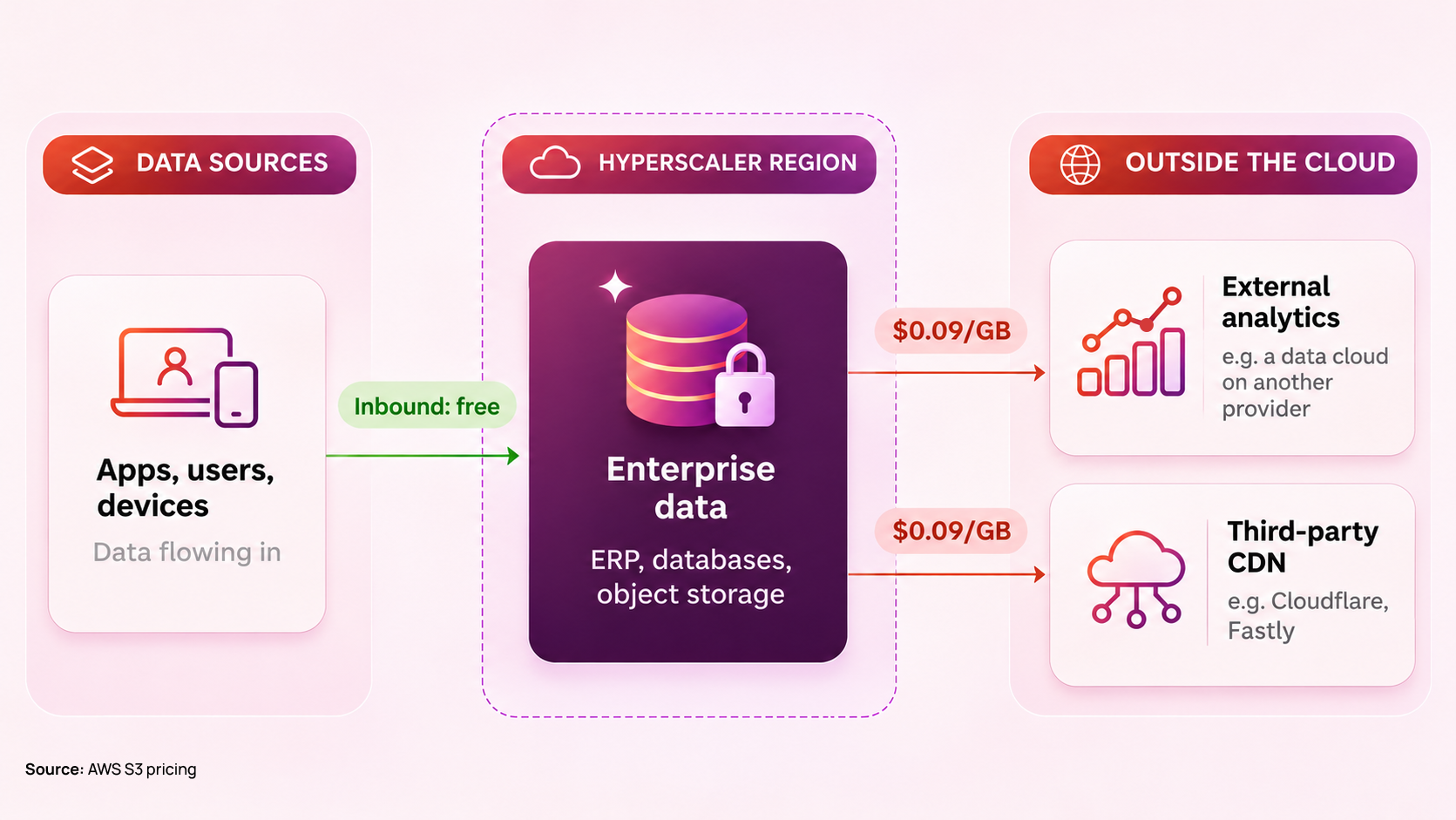
When core operational systems such as Oracle ERP, supply chain databases, and financial engines reside in the cloud, extracting value requires moving that data. Historically, every read request from an external analytics platform or every byte delivered to an end-user via a Content Delivery Network (CDN) incurred bandwidth transit fees.
As enterprises transitioned into real-time analytics and agentic AI, this model broke down:
- Artificial Data Silos: CIOs were forced to restrict data movement to avoid surprise bandwidth bills.
- Architecture Dictated by Cost: Infrastructure decisions were made based on network transit charges rather than performance or tool preference.
- AI Velocity Bottlenecks: Real-time AI agents demand continuous, high-volume access to operational data, making pay-per-byte egress models financially unsustainable.
Native Snowflake on OCI
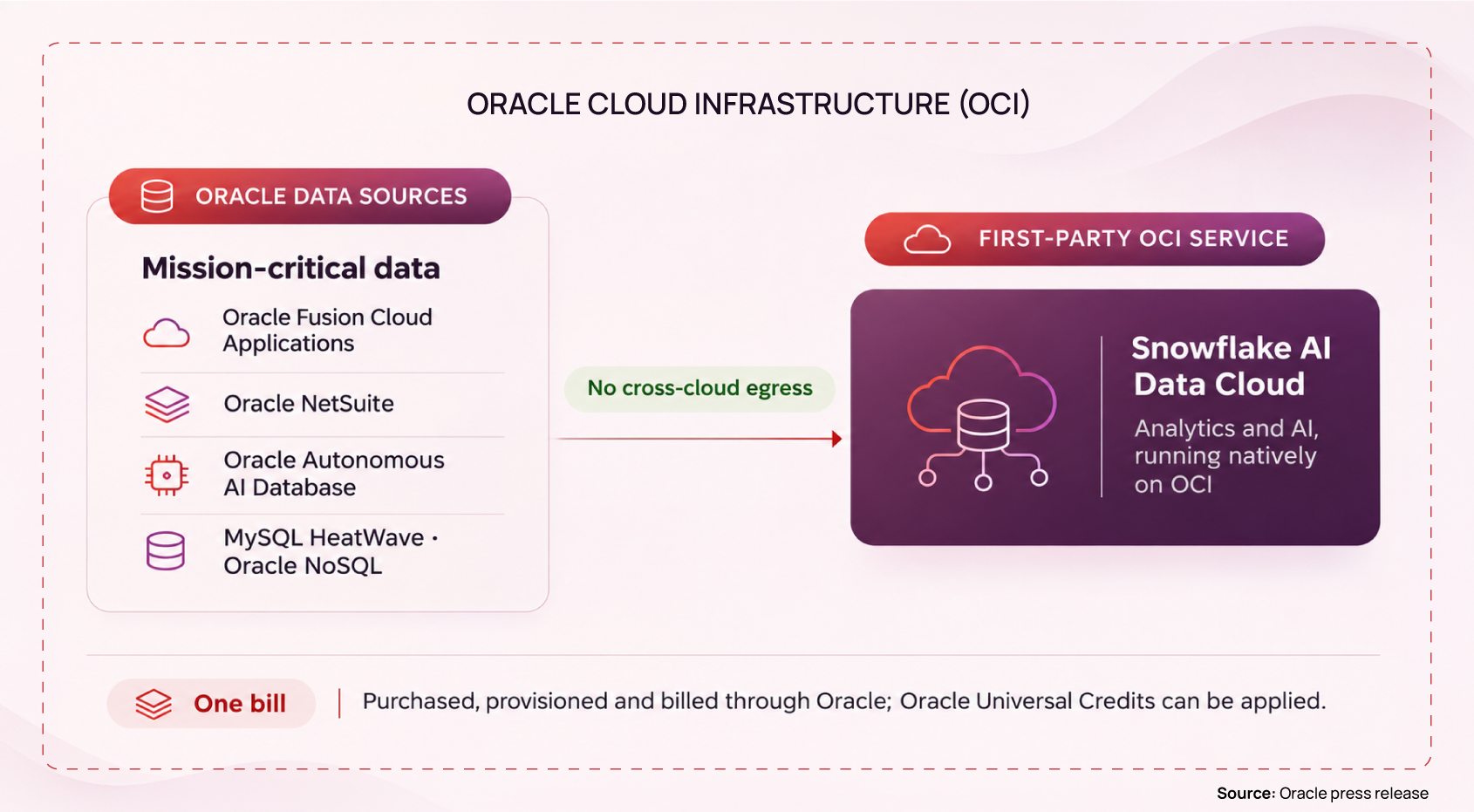
Oracle announced a first-of-a-kind partnership with Snowflake, introducing the Snowflake AI Data Cloud platform as a first-party native service on OCI.
The Architectural Shift
Rather than forcing organizations to extract massive operational datasets out of Oracle environments to run queries in Snowflake, Oracle brought Snowflake directly to where the data lives.
- Zero-Egress Analytics: By running Snowflake natively inside OCI alongside Oracle ERP and database estates, cross-environment data transfers incur zero egress fees when Snowflake runs in the same OCI region as your data.
- Eliminating Multi-cloud Friction: Joint customers no longer face a trade-off between Oracle’s transactional engine and Snowflake’s AI data cloud.
- Single-Commitment Procurement: Existing Oracle customers can utilize their standard OCI commitments to deploy and run Snowflake seamlessly.
By co-locating analytics directly against core data gravity, Oracle converted what was previously an expensive external pipeline into an in-cloud data flow with zero egress cost.
Waiving the Transit Fee to the World
Solving data movement inside the cloud fabric addresses only half the equation. Once data is processed, it must be delivered outward to global users, applications, and edge AI models.
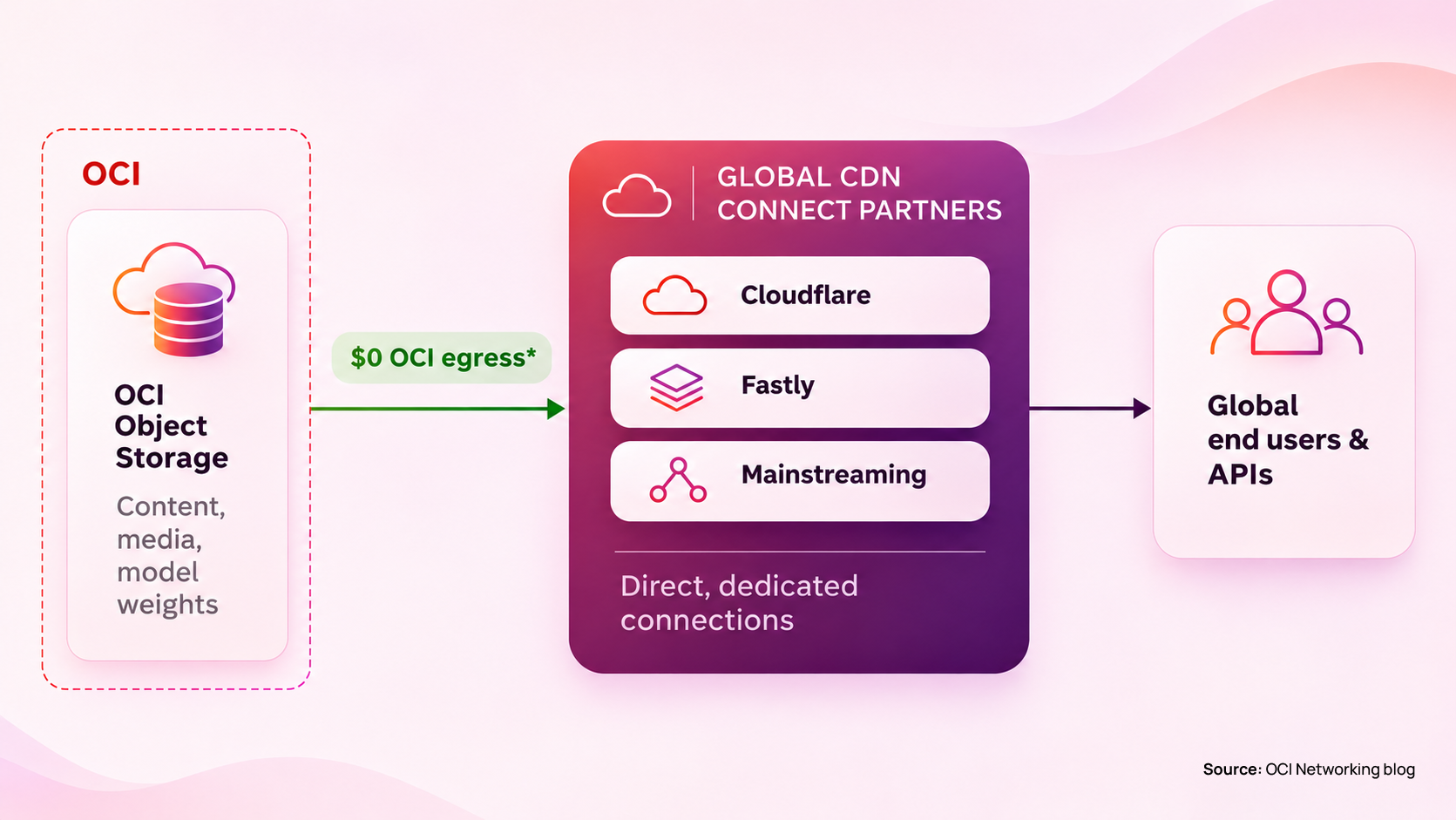
Oracle extended this by announcing strategic zero-egress partnerships with premier edge and CDN providers, including Cloudflare, Fastly, and Mainstreaming.
The Architectural Shift
Normally, streaming media, API payloads, and web applications passing from a cloud object store to an edge CDN generate significant outbound transfer charges.
Oracle’s zero-egress CDN interconnects change the calculus:
- Zero Egress Fees to Partner CDNs: Eligible cache fetches from OCI to partner CDNs carry zero OCI egress charges in supported regions.
- Better TCO for Global Delivery: Enterprises can stream media, push real-time data feeds, and power low-latency edge AI endpoints without paying egress fees between OCI and their CDN provider.
- Best-of-Breed Edge Stack: Organizations retain their existing CDN security and caching infrastructure (such as Cloudflare or Fastly) without paying OCI egress on eligible cache fetches in supported regions.
How OCI Lowers Total Cost of Ownership
To evaluate the financial impact of Oracle’s zero-egress architecture, consider the published economics of cloud networking. Standard cloud providers list public internet egress at $0.087–$0.09 per GB for the first 10 TB, tiering down to $0.05 per GB at high volume. By contrast, OCI provides 10 TB per month of free outbound transfer, charges $0.0085/GB beyond that in North America and Europe (roughly 10x lower than traditional hyperscalers) and, through OCI Global CDN Connect, waives OCI egress on eligible cache fetches to partner CDNs in supported regions. Snowflake running natively on OCI keeps analytics traffic inside OCI rather than sending it to another cloud.
Published Data Transfer Rates (list prices, US / Europe)
| Rate | AWS (US East) | OCI | Difference |
|---|---|---|---|
| Free outbound allowance | 100 GB / month | 10 TB / month | 100x higher |
| Outbound beyond free allowance | $0.09 / GB | $0.0085 / GB | ~10x lower |
| Egress to partner CDNs (Cloudflare, Fastly, Mainstreaming) | Standard egress rates | $0 on eligible cache fetches | Waived |
| Inbound data transfer | Free | Free | None |
The Total Cost of Ownership Impact
By removing the network transport penalty:
- Egress fees on Snowflake-on-OCI and eligible partner-CDN traffic can drop to zero.
- Budget Can Be Redirected: Budgets previously spent on network transport are redirected toward AI engineering, model training, and product development.
- Predictable Financial Modelling: CFOs gain more predictable costs for multi-cloud workflows.
OCI’s Zero-Egress Data Engine
When inbound data gravity (Snowflake) and outbound edge delivery (CDNs) are unified under Oracle’s zero-egress framework, the enterprise data engine runs with far less transport friction:
| Data Life Cycle Phase | Traditional Cloud Model | OCI Zero-Egress Model | Enterprise Impact |
|---|---|---|---|
| Ingestion & Storage | Free inbound, paid outbound | Native OCI Data Gravity | Centralized operational control (Oracle ERP/DB) |
| Inbound Analytics | High egress cost to query externally | Snowflake Native on OCI (Zero Egress) | Real-time querying without cross-cloud egress |
| Outbound Edge Delivery | High egress cost to push to CDNs | Partner CDNs / Cloudflare / Fastly (Zero Egress) | Better TCO at global scale |
The Strategic Takeaway for IT Leadership
Zero egress on these data paths is more than a pricing detail. It gives enterprises more choice in where their data and tools run.
By removing the financial penalties associated with data transit, OCI enables CIOs, CDOs, and Enterprise Architects to design data estates based on performance, proximity, and business value rather than bandwidth constraints.
Where AppsTek Can Help
Getting the most from these changes depends on how your data estate is set up today.
As an OCI partner, we work with enterprise teams to:
- Modernize Multi-cloud Architecture: Review current data pipelines and where egress applies.
- Unify Data Estates: Connect Oracle application data with Snowflake on OCI.
- Optimize TCO: Identify where transfer costs can be reduced.
Want to see what this means for your estate? Talk to our team.
Further Reading:
Frequently Asked Questions
Cloud egress costs are charges incurred when data moves from a cloud provider to external networks, applications, or services. Oracle Cloud Infrastructure (OCI) reduces these costs by offering 10 TB of free outbound data transfer per month and competitive rates beyond that allowance. Oracle's Snowflake partnership and OCI Global CDN Connect initiative are designed to reduce additional data movement charges on supported paths.
Snowflake on OCI is designed to run Snowflake AI Data Cloud natively within Oracle Cloud Infrastructure, closer to Oracle ERP and database environments. This reduces the need to transfer operational data to another cloud for analytics and AI processing. Supported in-cloud data transfers can avoid cross-cloud egress charges, although applicable costs depend on the deployment architecture and service configuration.
OCI Global CDN Connect is an Oracle networking initiative that provides direct connections between OCI Object Storage and participating content delivery networks, including Cloudflare, Fastly, and Mainstreaming. It eliminates OCI data egress charges for eligible CDN cache fetches in supported regions, helping enterprises reduce content delivery costs for streaming, applications, and AI workloads.
cloud-infrastructure
Oracle Cloud Infrastructure offers 10 TB of free outbound data transfer monthly, compared with AWS's commonly published 100 GB free internet transfer allowance. Beyond the free tier, OCI outbound transfer starts at $0.0085 per GB in North America, Europe, and the UK, while AWS pricing varies by service, region, and transfer volume. Actual savings depend on workload architecture and traffic patterns.
Oracle ASEAN+1
Enterprises can reduce total cost of ownership (TCO) by placing Snowflake analytics closer to Oracle ERP and database workloads on OCI, minimizing cross-cloud data transfers and unnecessary network charges. Combining this architecture with OCI Global CDN Connect can further reduce eligible outbound delivery costs. IT teams should assess data movement patterns, regional availability, and service pricing before estimating potential savings.

About The Author
Manisha Jadhav, Presales Executive at AppsTek Corp, specializes in solution consulting, business analytics, and enterprise technology solutions. With an MBA in Business Analytics from Symbiosis, she brings expertise in technical presales, business process optimization, and stakeholder engagement. She focuses on bridging business challenges with scalable technology solutions that improve operational efficiency, data visibility, and business outcomes.