

KEY TAKEAWAYS
- In The Mortgage Collaborative’s June 2026 survey, 83% of lenders were evaluating AI tools, 36% were piloting one or two, and only 17% had AI in live production.
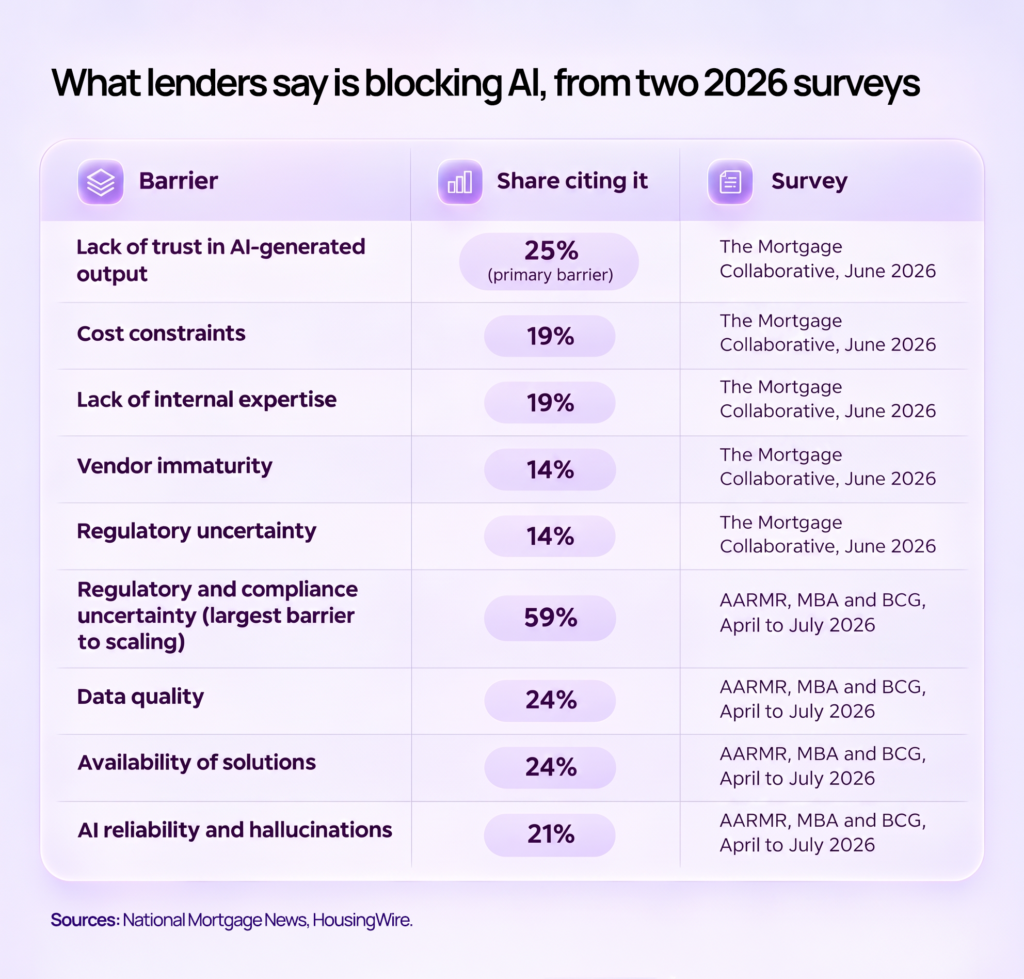
- Surveys name trust (25%), regulatory and compliance uncertainty (59% in a separate study) and data quality (24%) among the top barriers.
- The three are linked. Leaders will not sign off on output they cannot check, built on data they cannot trace, under rules they cannot show.
- A six-step path takes a pilot to production: one use case, named data, written decision rights, shadow-mode proof, sign-off by name, then monitoring.
Nearly every lender is looking at AI. Yet lender AI adoption is still far from where it counts: live production workflows. Per a recent industry survey, 83% of members were evaluating AI tools across their businesses, 36% were piloting one or two, and only 17% had AI in live production workflows.
The need is not in doubt. The same survey shows 86% of lenders naming lower production cost as their top operational priority, and three-quarters planning to grow production from the sales teams they already have. Lenders want more output without more payroll, and AI is the obvious route. So why does it stall between the pilot and actual mortgage operations?
What is actually stopping AI in mortgage lending in 2026?
Trust, regulatory uncertainty and data quality top the lists, and they are connected.
Two 2026 surveys ask the question in different ways. The table puts the answers side by side.
The joint survey adds a second finding that explains the stall: AI use is concentrated in productivity and document tasks, and measurable business results remain limited. When the benefit is hard to measure and the rules are unclear, nobody wants to be the person who approved it.
Why is trust the first blocker for lender AI?
Because trust is an evidence problem, not a feeling.
A senior leader cannot sign off on an output they cannot check. Most pilots produce answers without citations, results without a baseline and activity without an audit trail. The Mortgage Collaborative’s own analysis of its survey makes the point that trust and not capability, is gating adoption.
Evidence is what turns trust from a request into a fact. Every finding should cite the guideline or rule behind it. Every result should be compared with a baseline. Reviewers from an individual’s team should judge the output on their respective loans, because they trust what they have tested. We covered how this works across a 25-step loan in another piece, Agents on the Loan File.
How does data readiness hold AI back?
In mortgage operations, an agent that reads inconsistent data produces exceptions instead of reliable answers.
In the joint survey, 24% of lenders and servicers cited data quality as a barrier to scaling. A recently released article by MISMO’s president cites that mortgage companies need their data house in order before AI can deliver fully. That means critical data elements, documented lineage, named responsibility for quality, access and third-party use, and a governance committee with an operating cadence.
The practical test is simple. For a use case headed to production, every required data element should have a clearly identified owner and a traceable source of value. Where gaps or conflicts exist, those need to be measured first. The exception rate reveals the true cost of poor data quality.
Why does governance decide whether AI reaches production?
Because production means a regulator, an investor or a borrower can ask how a decision was made.
In the joint survey, 59% named regulatory and compliance uncertainty as the largest barrier to scaling AI. In The Mortgage Collaborative’s survey, nearly half of lenders had concerns about fair lending risk in AI-based decisioning, and 75% said automated decisioning now consumes more compliance resources than any other area.
Governance addresses these concerns before they arise. It establishes documented decision rights, an audit trail for every action, version-controlled models and rules, fair lending monitoring, and human approval for decisions involving judgment or liability. MISMO has published a framework for responsible AI in the mortgage ecosystem, helping lenders establish policies, inventory AI use cases, and assess associated risks. The framework provides a useful reference for lenders looking to formalize their AI governance practices.
How are trust, data and governance connected?
They are one problem seen from three chairs. The table shows what each looks like inside a lender and what removes it.
| Blocker | What it looks like | What removes it |
|---|---|---|
| Trust | Staff re-check everything the AI does. No executive will sign off. | Citations on every finding, a baseline, and shadow-mode results from your own reviewers |
| Data | Agents raise many exceptions on missing or conflicting fields. | Named critical data elements, owners and lineage, with exception rate tracked by cause |
| Governance | Compliance cannot show how a decision was made or that it was fair. | Written decision rights, an audit trail, version control, fairness monitoring and named approvals |
What does the path from AI pilot to production look like?
Six steps, each aimed at one of the blockers. Blue marks the data gate, lavender the governance gates and teal the trust gate.
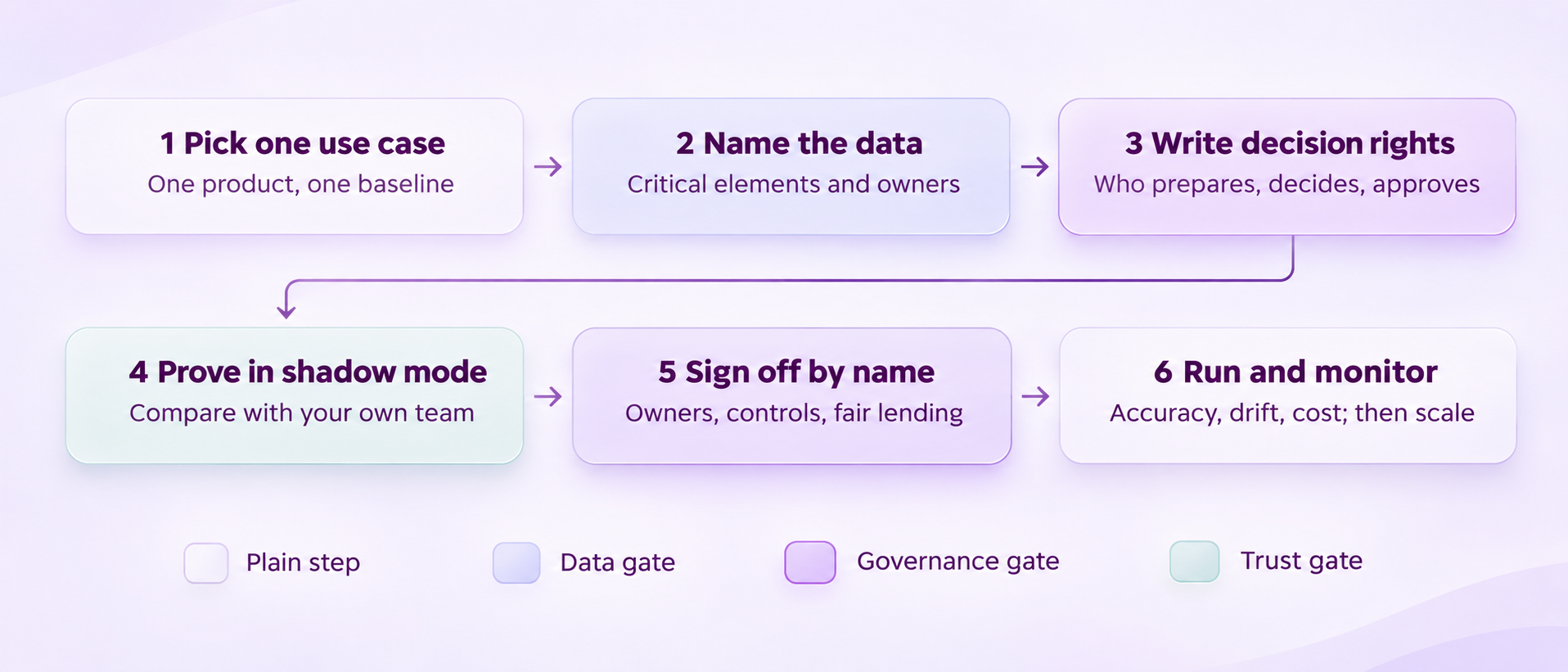
- Pick one use case: One loan product, one workflow and one measurable baseline. Favor high-touch work with low decision risk, such as document handling.
- Name the data: List the critical data elements the use case needs, who owns each and where the values come from. Measure missing and conflicting values before the AI touches them.
- Write decision rights: Decide in writing what the AI may prepare, what a rules engine decides and what a person approves.
- Prove it in shadow mode: Run it on live files beside your team. Reviewers compare the results with their own and log every difference.
- Sign off by name: Record who approved the success bar, the data, the controls and the fair lending monitoring, and when.
- Run and monitor: Track accuracy, drift, exception rate and run cost, keep a rollback ready, and scale one agent or product at a time.
Who should own what: the CEO, the CIO and the CCO?
Each leader owns one of the gates, and each has one question to ask.
| Role | Owns | The question to ask |
|---|---|---|
| CEO | The success bar and the risk appetite | What result would make us scale, and what would make us stop? |
| CIO | Data, integration, monitoring and vendor consolidation | Can we trace every value the AI used? |
| CCO | Decision rights, fair lending monitoring and the audit trail | Can we show an examiner how this decision was made? |
The CIO’s part is not small. In fact, a National Mortgage Professional survey, 64% of lenders named vendor and technology consolidation a priority. Every extra tool is another source of data to trace and another control to prove.
How do you start moving from pilot to production?
Start with the smallest version of all six steps. Pick one loan product and one agent. Set the baseline in week one, configure and test in week two, run in shadow mode in week three, and decide on day 30 whether to scale, adjust or stop. That is the 30-day pilot AppsTek AI Services starts with, and it is built so each step produces the evidence a CEO, a CIO and a CCO need to say yes.
Frequently asked questions
The main barriers to lender AI adoption are lack of trust in AI-generated outputs, poor data quality, and regulatory uncertainty. According to two 2026 industry surveys, 25% of lenders cited trust as their primary concern, while 59% of respondents in a separate survey identified regulatory and compliance uncertainty as the largest barrier to scaling AI. Addressing these issues requires traceable data, documented decision rights, and measurable pilot results.
Lender AI can support mortgage operations by handling document-intensive tasks, identifying data exceptions, and reducing repetitive manual work. However, successful implementation depends on reliable data, human oversight, and clearly defined approval processes. Starting with a single loan product and measurable workflow allows lenders to evaluate accuracy, operational costs, and readiness before expanding AI into production.
Fair lending monitoring helps lenders assess whether AI-supported decisions create potential fairness or compliance risks. It is particularly important when AI contributes to automated decisioning. Lenders need documented decision rights, audit trails, version-controlled models, and human approval for decisions involving judgment or liability. These controls help organizations demonstrate how decisions were made and support regulatory accountability.
Mortgage operations teams can evaluate an AI pilot through shadow-mode testing, where an AI agent processes live loan files alongside existing workflows without independently making operational decisions. Reviewers compare AI-generated outputs against established baselines, document discrepancies, and measure accuracy and exception rates. This provides evidence for determining whether the AI system is ready for production.
AI governance establishes the controls and accountability needed to scale lender AI safely across mortgage operations. It defines who owns the data, which decisions AI can support, when human approval is required, and how outcomes are monitored. Effective governance includes fair lending monitoring, audit trails, data lineage, and ongoing performance checks to help lenders manage risks as AI moves into production.

About The Author
Rahul Sudeep, Senior Director of Marketing at AppsTek Corp, is a results-driven, AI-first B2B marketing leader with 15 years of experience scaling global enterprise SaaS companies. His expertise, honed at IIM-K, spans architecting high-impact go-to-market strategies, driving new market identification and positioning, and embedding Generative AI, LLMs, and predictive analytics into the core marketing function. Rahul unifies Technology, Sales, and Support teams around a single strategic hub, while also managing key Partner and Investor Relations. He leverages AI-driven insights to craft powerful brand narratives and hyper-personalized demand generation campaigns that drive measurable revenue growth and deepen customer engagement.