Table of Contents
Why Enterprise AI Strategy Breaks Down After the Pilot Stage
From AI Initiatives to Repeatable AI Delivery
Definition: Enterprise AI Factory
The AI Factory Model: Continuous, Connected, and Reusable
Where the Project-Based AI Model Gets Expensive
Project-Centric AI vs. Enterprise AI Factory
What Changes When the Factory Model Is in Place
Why Agentic AI Raises the Stakes
Building an Enterprise AI Factory Starts With the Operating Model



Enterprise AI Factory: Why Your Use Case Backlog Isn't a Strategy
Enterprise AI has reached a point where use cases are no longer the main constraint. Organisations can identify opportunities for automation, prediction, personalisation, decision support, and generative AI across almost every function.
The harder challenge is repeatability.
A successful AI pilot proves that a model can work in a specific context. It does not prove that the enterprise can deploy, govern, monitor, and improve AI consistently across business units, systems, workflows, and regulatory environments.
That is the gap many AI strategies miss.
Scaling AI requires more than a strong use case and a working model. It requires the operating infrastructure to make AI reusable, governed, and production-ready across the enterprise.
That operating infrastructure is the enterprise AI factory.
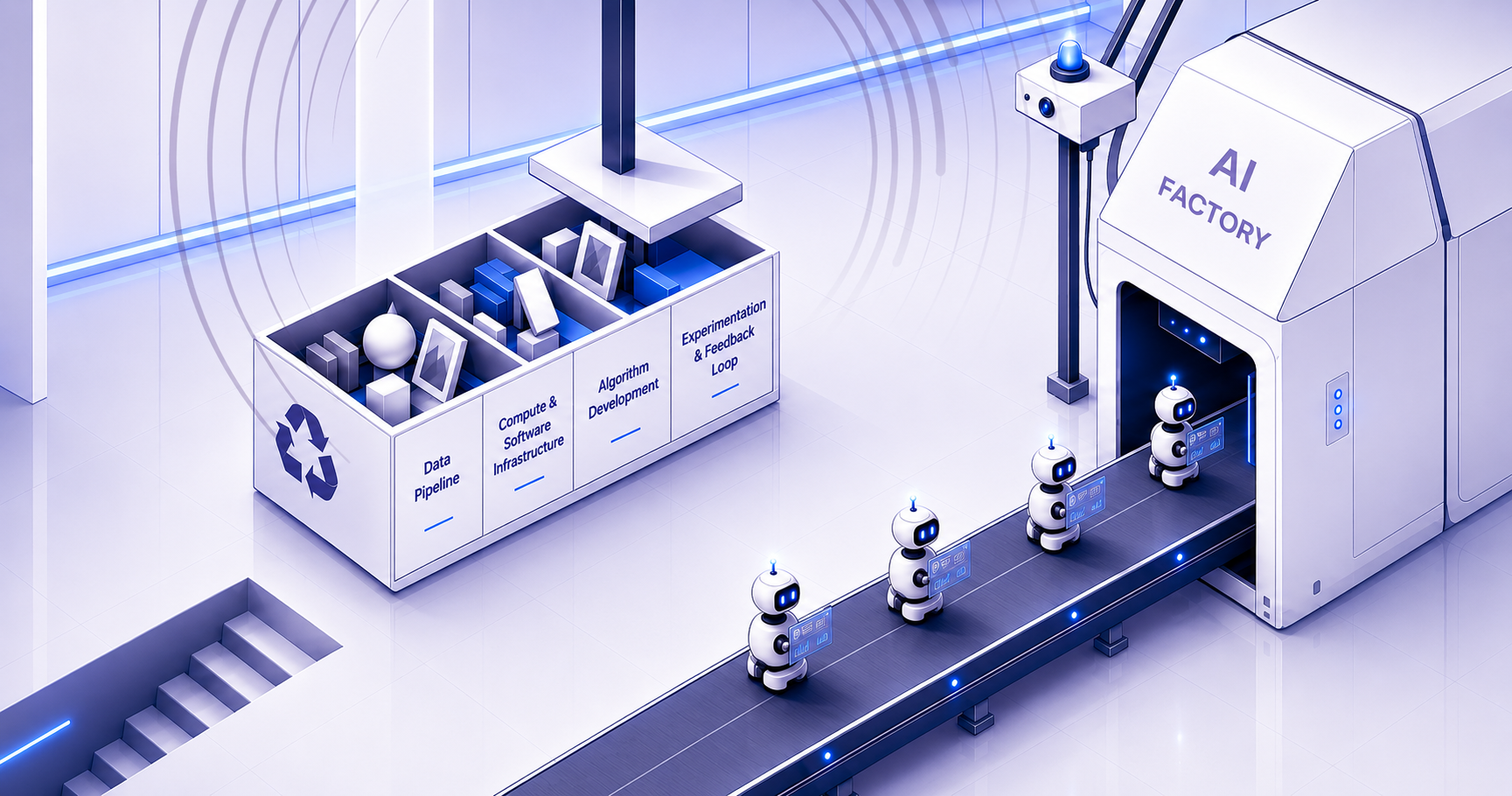
An enterprise AI factory connects data pipelines, model infrastructure, deployment processes, orchestration, governance, monitoring, and feedback loops into a repeatable system. It allows enterprises to move from isolated AI initiatives to a scalable model for building and improving AI capabilities over time.
For leaders shaping enterprise AI Strategy, this shift matters. AI does not become strategic simply because an organisation launches more pilots. It becomes strategic when the organisation builds the capability to turn AI into a repeatable part of how the business operates.
Why Enterprise AI Strategy Breaks Down After the Pilot Stage
Enterprise AI programs often begin with strong intent. A business function identifies a use case, a team develops a proof of concept, and early results create confidence.
The difficulty begins when the organisation tries to move from one successful use case to many.
A pilot can succeed with a narrow dataset, limited integrations, manual oversight, and a small group of technical owners. Production AI requires a different level of discipline. It needs consistent data access, security controls, governance, integration with enterprise systems, performance monitoring, and ownership beyond the initial project team.
This is where AI programs often lose momentum.
The issue is not always technical failure. It is often the absence of a repeatable path from AI experimentation to AI production.
Each initiative may solve part of the problem for itself. One team creates its own data preparation process. Another builds a separate deployment path. A third defines a different governance workflow. Over time, the enterprise ends up with AI activity, but not AI capability.
An enterprise AI factory addresses this problem by creating a common foundation for AI development, deployment, governance, monitoring, and continuous improvement.
The goal is not to centralise every AI decision. The goal is to stop rebuilding the same foundations for every new use case.
From AI Initiatives to Repeatable AI Delivery
As AI adoption expands across the enterprise, different functions often begin building their own initiatives. Customer service may explore AI assistants, finance may look at automation, operations may use predictive models, and IT may begin testing agentic AI workflows.
This is a natural stage in enterprise AI adoption. It shows that teams are finding relevant use cases and building confidence with the technology.
The challenge begins when each initiative develops its own way of working. One team creates its own data preparation process. Another defines its own deployment path. A third handles governance and monitoring differently.
Over time, this makes AI harder to scale. The organisation may have several useful initiatives, but each one depends on separate processes, tools, and ownership models.
A stronger enterprise AI Strategy creates a common delivery model. It defines how AI capabilities should be developed, deployed, governed, monitored, and improved across the business.
This is where an enterprise AI factory becomes useful. It gives teams a shared foundation without forcing every use case into the same structure. The result is not just more AI initiatives, but a more consistent way to deliver AI into production.
What is an AI Factory?
The term AI factory is often used in different ways.
Infrastructure providers may use it to describe high-performance data centres or GPU environments. Platform companies may use it to describe their AI development stacks. These components matter, but they do not fully define what an AI factory means for enterprise leaders.
In an enterprise context, an enterprise AI factory is a repeatable operating model for producing, deploying, governing, monitoring, and improving AI capabilities across the business. It is not just where models are built. It is how AI work moves from business problem to production capability.
An enterprise AI factory, sometimes referred to as an artificial intelligence factory, gives organisations a structured way to produce, deploy, monitor, and improve AI capabilities at scale.
A practical enterprise AI factory brings together:
- governed data pipelines
- reusable model development environments
- deployment and integration processes
- orchestration across systems, workflows, and agents
- monitoring for performance, drift, security, and business impact
- governance controls for compliance, access, explainability, and auditability
- feedback loops that improve future models and deployments
The value of this model is straightforward. Teams should not have to solve the same foundational problems every time they build a new AI solution.
Definition: Enterprise AI Factory
An enterprise AI factory is a continuously operating system that turns business data into trained, governed, deployed, and monitored AI capabilities.
It combines data infrastructure, model development, orchestration, deployment processes, governance, monitoring, and feedback loops so AI can scale across the enterprise as a repeatable capability.
In practical terms, an enterprise AI factory helps organisations move away from one-off AI projects and toward a structured model for building AI at scale.
The AI Factory Model: Continuous, Connected, and Reusable
A strong AI Factory Model has three practical characteristics: continuous, connected, and reusable.
1. Continuous
AI systems do not remain reliable simply because they performed well during a pilot. Data changes. Business rules change. Customer behaviour changes. Processes change. Market conditions change. Regulatory expectations also evolve.
The AI Factory Model treats deployment as the beginning of the lifecycle, not the end. Models are monitored in production, performance is reviewed, and feedback is used to improve future versions. This is important because AI value is not created only when a model goes live. Value is sustained when the model continues to perform in real business conditions.
2. Connected
AI cannot scale if each team works from a different foundation. An enterprise AI factory connects AI workloads to shared data infrastructure, common deployment patterns, orchestration layers, governance controls, and monitoring systems. This does not mean every use case must look the same. It means every use case should not have to start from zero. A connected approach allows the work done for one initiative to support the next.
3. Reusable
The factory model creates value because the work carries forward. Data quality improvements from one initiative can support future use cases. Governance patterns established for one deployment can reduce friction for others. Monitoring tools can be reused. Orchestration patterns can mature. Teams can build on what already exists. That is how AI deployment becomes faster, safer, and more cost-effective over time.
Where the Project-Based AI Model Gets Expensive
The project-based approach can work for experimentation. It becomes expensive when the enterprise tries to scale. The costs are not always visible in the early stages. They show up gradually through duplicated work, inconsistent governance, slow deployment cycles, unclear ownership, and limited reuse.
Repeated Data Work
A customer service team prepares customer interaction data for an AI assistant. A marketing team later prepares similar data for personalisation. A product team then repeats parts of the same process for churn prediction.
Each project may move forward, but the enterprise pays for similar work multiple times. In an enterprise AI factory, data work is treated as reusable infrastructure. Once data is governed, cleaned, and made usable, it can support multiple AI workloads.
Inconsistent Governance
When AI initiatives are handled project by project, governance becomes inconsistent. One model may have strong approval workflows. Another may have limited monitoring. A third may not have a clear process for reviewing outputs or escalating issues.
This creates risk, especially when AI begins to influence customer interactions, operational decisions, compliance workflows, or financial outcomes. An enterprise AI factory brings governance into the delivery model rather than treating it as a late-stage review.
Model Drift
AI models can degrade over time. A model that worked during a pilot may perform differently in production as data patterns shift, business conditions change, or user behaviour evolves.
Without monitoring, the problem may only become visible after the business impact is already negative. An enterprise AI factory includes monitoring and feedback loops so performance can be tracked, reviewed, and improved.
Talent Drag
AI teams lose momentum when they have to rebuild the basics for every project. Data scientists, ML engineers, architects, and AI product teams should be focused on business outcomes, workflow integration, model quality, and responsible scaling. Too often, they are pulled back into data access, environment setup, deployment issues, and governance rework.
A reusable factory model gives technical teams a stronger foundation and gives business teams a clearer path from idea to production.
Project-Centric AI vs. Enterprise AI Factory
| Project-Centric AI | Enterprise AI Factory |
|---|---|
| Starts from scratch with each use case | Builds on shared, reusable infrastructure |
| Data is prepared separately by each team | Governed data layers support multiple AI workloads |
| Governance is handled case by case | Governance is built into the operating model |
| Models are monitored inconsistently | Production monitoring is part of the lifecycle |
| ROI is measured mainly by project | Value compounds across deployments |
| AI knowledge stays inside teams | Patterns and learnings become reusable |
| Deployment depends on custom effort | Deployment follows repeatable processes |
What Changes When the Factory Model Is in Place
The shift to an enterprise AI factory changes how AI work moves across the business. It does not require every AI initiative to become large or centralised. It creates shared foundations that make AI delivery more consistent.
Data Becomes a Shared Asset
In the project model, each team asks: What data do we need for this use case? In the factory model, leaders also ask: What governed data capability should we build so multiple use cases can reuse it? That change matters. It turns data preparation from a project task into an enterprise capability.
Models Become Managed Assets
In the project model, a model may be built, deployed, and left alone unless something breaks. In the factory model, models are part of a managed lifecycle. They are monitored, reviewed, improved, and governed. This is especially important for AI systems embedded in core business workflows.
Governance Becomes Easier to Repeat
Governance is often seen as a blocker because it is introduced late. In an enterprise AI factory, governance is designed into the workflow from the start. Access controls, approval processes, auditability, explainability, and monitoring expectations are part of the operating model. This makes AI easier to scale because teams do not need to reinvent compliance and risk review for every deployment.
Returns Become More Repeatable
A single AI project may deliver value. A factory model improves the organisation’s ability to deliver value again. The first deployment may require more foundation-building. The second should be easier. The third should benefit from better patterns, better infrastructure, and clearer governance. That is the practical value of the enterprise AI factory.
Why Agentic AI Raises the Stakes
Agentic AI makes the factory conversation more urgent.
Traditional AI systems often provide predictions, recommendations, or generated outputs. Agentic AI systems can go further. They may plan tasks, call tools, access enterprise systems, trigger actions, and support decisions across workflows.
That creates a different operating requirement.
AI agents need governed data access, clear permissions, orchestration across tools and systems, monitoring of actions and outcomes, human escalation paths, audit trails, and security boundaries.
Without the right ai factory architecture, agentic AI can expose gaps that already exist in the enterprise: fragmented data, unclear governance, inconsistent monitoring, and weak integration with core systems.
This is why an enterprise AI factory is not only relevant to today’s AI projects. It is also the foundation for the next stage of AI-enabled operations.
The Board-Level Question
Use cases are usually the easiest part of the AI conversation. Enterprises can identify opportunities for automation, prediction, personalisation, and decision support across nearly every function.
The harder question is whether the organisation has the infrastructure to scale those use cases beyond isolated projects.
Does the enterprise have a repeatable way to deploy, govern, monitor, and improve AI across the business?
An enterprise AI factory helps answer it by creating a shared operating model for AI delivery. It brings together governed data, reusable model infrastructure, orchestration, deployment processes, monitoring, and feedback loops.
The value is practical: less duplication, stronger governance, faster deployment, and AI capabilities that become easier to reuse across the organisation.
Building an Enterprise AI Factory Starts With the Operating Model
A common mistake is to treat the AI factory as a technology purchase.
Technology is part of the answer, but it is not the starting point. The starting point is understanding how AI work currently moves through the organisation.
Leaders need to ask:
- Where does AI work begin?
- Who owns the business outcome?
- How is data accessed and governed?
- How are models deployed?
- Who monitors performance after launch?
- How are risks reviewed and escalated?
- Which components can be reused by future teams?
- Which parts of the current process are slowing deployment?
These questions reveal whether the organisation is ready to scale AI or only ready to run another pilot.
A minimum viable AI Factory Model should include:
- governed data infrastructure
- reusable model development and deployment environments
- orchestration across systems, tools, workflows, and agents
- monitoring for model performance, drift, security, and business impact
- governance controls for compliance, auditability, access, and explainability
- feedback loops that improve future deployments
- clear ownership across business, data, technology, risk, and operations
The goal is not to build a perfect factory before delivering value. A better approach is to build the factory through the first set of priority use cases, making sure each deployment leaves behind assets, patterns, and governance that the next deployment can use.
Conclusion: From AI Projects to AI Capability
Enterprise AI is moving from experimentation to execution. Pilots still matter. Use cases still matter. Model quality still matters. But they are not enough on their own. The next stage of enterprise AI Strategy is about repeatability.
Can the organisation deploy AI safely across functions? Can it reuse data and infrastructure? Can it monitor performance in production? Can it govern AI consistently? Can every deployment make the next one easier?
That is the role of the enterprise AI factory. It gives organisations a practical operating model for scaling artificial intelligence across the business. It reduces duplication, improves governance, accelerates deployment, and helps AI capabilities become more reusable over time. The real shift is from AI as isolated effort to AI as enterprise capability.
Frequently Asked Questions
An AI Factory is a repeatable operating model for building, deploying, governing, monitoring, and improving AI capabilities across the enterprise. It helps organisations move beyond isolated AI pilots by creating shared infrastructure, reusable processes, and feedback loops that make future deployments faster and more consistent.
Enterprise AI projects often fail to scale because each initiative is built separately. Teams duplicate data work, governance reviews, deployment processes, and monitoring efforts. The issue is not always the model. It is the lack of reusable infrastructure and operating discipline to move AI from pilot to production repeatedly.
An AI pilot tests whether a model or use case can create value in a limited setting. An AI Factory creates the production system needed to scale that value across the business through governed data, deployment infrastructure, orchestration, monitoring, and continuous improvement.
An AI Factory creates compounding returns by making AI work reusable. Data quality improvements, governance patterns, deployment processes, monitoring tools, and production feedback from one initiative can support future AI deployments, reducing cost, time, and risk.
An enterprise needs a clear view of its current data infrastructure, AI delivery process, governance model, deployment capabilities, and priority use cases. From there, leaders can define the minimum viable ai factory architecture required to support the first set of scalable AI deployments.
Start the Conversation
For enterprises ready to assess where their AI strategy stands today, the starting point is a clear view of what has already been built, what can be reused, and what is still missing.
AppsTek works with enterprise leaders to assess current AI maturity, define the right AI factory architecture, and design the operating model required to scale AI across the business.
Connect with AppsTek at appstekcorp.com

About The Author
Rahul Sudeep, Senior Director of Marketing at AppsTek Corp, is a results-driven, AI-first B2B marketing leader with 15 years of experience scaling global enterprise SaaS companies. His expertise, honed at IIM-K, spans architecting high-impact go-to-market strategies, driving new market identification and positioning, and embedding Generative AI, LLMs, and predictive analytics into the core marketing function. Rahul unifies Technology, Sales, and Support teams around a single strategic hub, while also managing key Partner and Investor Relations. He leverages AI-driven insights to craft powerful brand narratives and hyper-personalized demand generation campaigns that drive measurable revenue growth and deepen customer engagement.