Table of Contents
How Oracle Deep Trust AI Secures Every Agent Transaction
How Does OCI Identity and Access Management Govern AI Agent Access?
Is Your Oracle Database Ready for AI Agents? Five Security Questions to Ask
Preparing Oracle Cloud Infrastructure Databases for Agent-Driven Workloads
Further Reading: Oracle AI, Database Security, and Agentic Governance


KEY TAKEAWAYS
- AI agents will soon be the main users of enterprise databases, and today’s access models were built for people.
- On OCI, Oracle’s Deep Trust AI Architecture embeds security in the database, so agents only see the data their task needs.
- Leaders should plan agent identity, governance and auditability before agents reach production.
For as long as most of us have worked with enterprise databases, we’ve designed them for people. Someone clicks through an app, opens a dashboard, or types a query into a SQL workbench, and the database answers. Query patterns, response times, login rules: all of it assumed a human on the other end.
That assumption is starting to break. Roughly 30% of internet traffic today is machines talking to machines. Within three or four years, machines are expected to generate 80% to 90% of new data, and a growing share of those machines will be AI agents.
At Oracle AI World 2026, in the OCI Spotlight keynote, Oracle put it plainly: the next wave of database users will not be human. They will be agents, constantly interacting with enterprise data and context, and it is Oracle Cloud Infrastructure (OCI)’s job to improve the security posture of the data stored in the database.
When AI agents become the primary consumers of mission-critical business context, databases can no longer remain passive, static datastores. They must become active, self-securing systems that can keep up with agents.
Why Do AI Agents Require a Different Approach to Oracle Database Security?
In traditional enterprise architectures, databases waited for structured inputs. An application executed a query, the database returned rows, and the application rendered the result. Agentic workloads work completely differently. Oracle AI Agents run continuously, querying data, making inferences, calling external APIs, updating context, and executing multi-step business tasks. Oracle framed its database approach for this shift around four priorities:
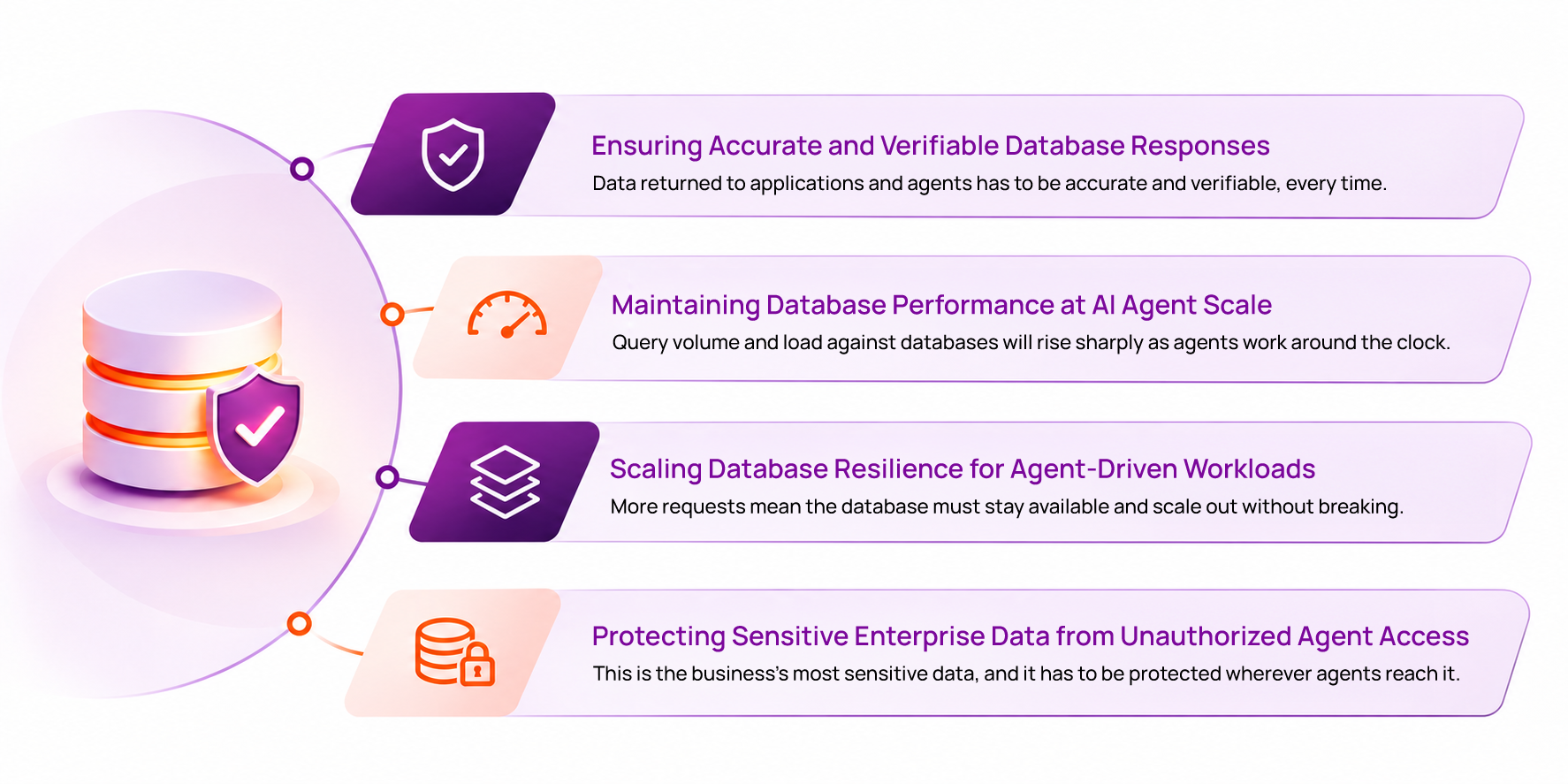
Solving this requires re-engineering the database stack specifically for agentic interactions. The architectural question is now changing from how efficiently a database serves applications to how reliably it supports autonomous decision-making.
How Oracle Deep Trust AI Secures Every Agent Transaction
As AI agents take on operational workflows, traditional database security models fall short. Granting an agent database connection credentials often gives it far broader visibility than required for its specific task.
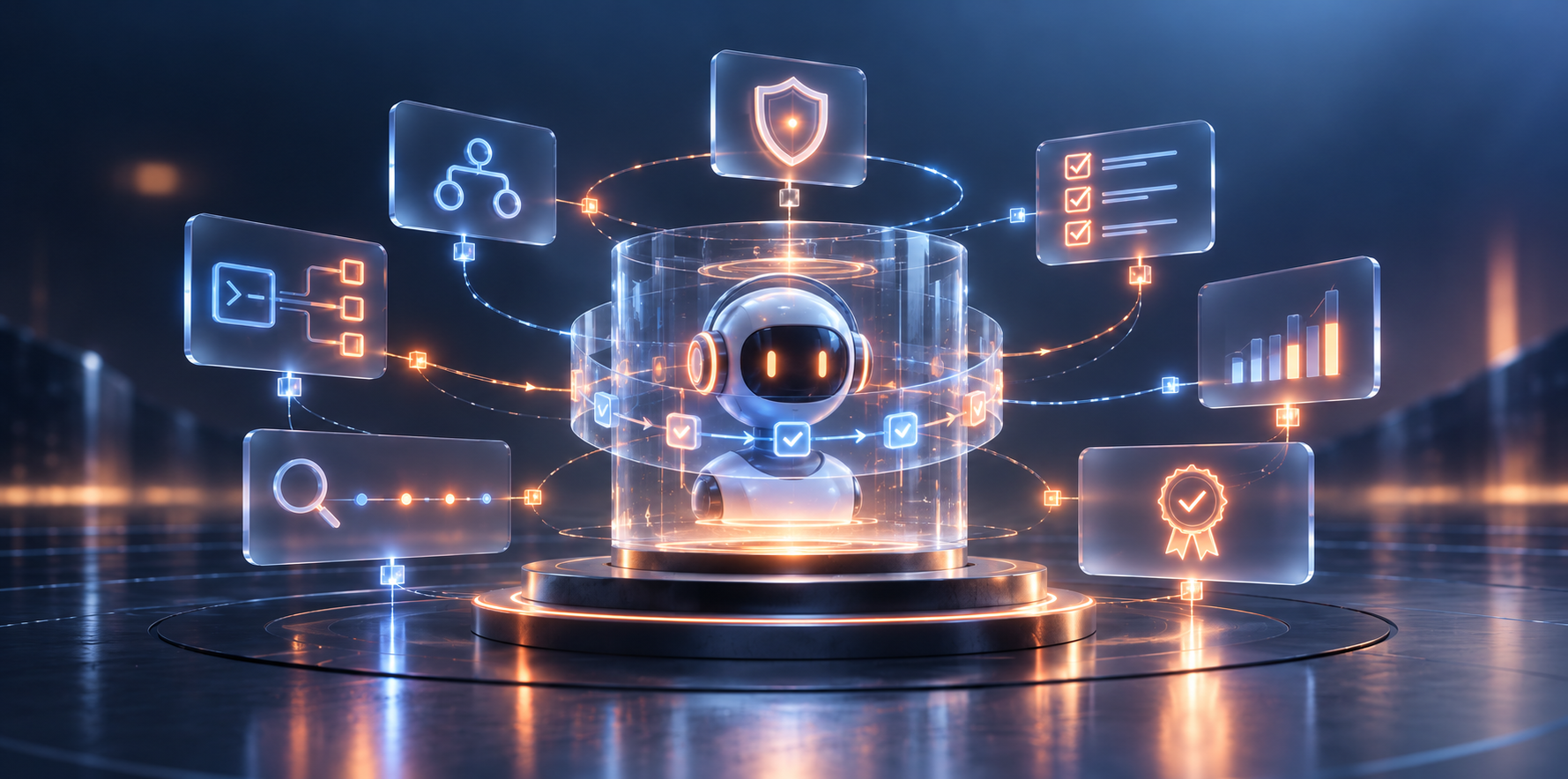
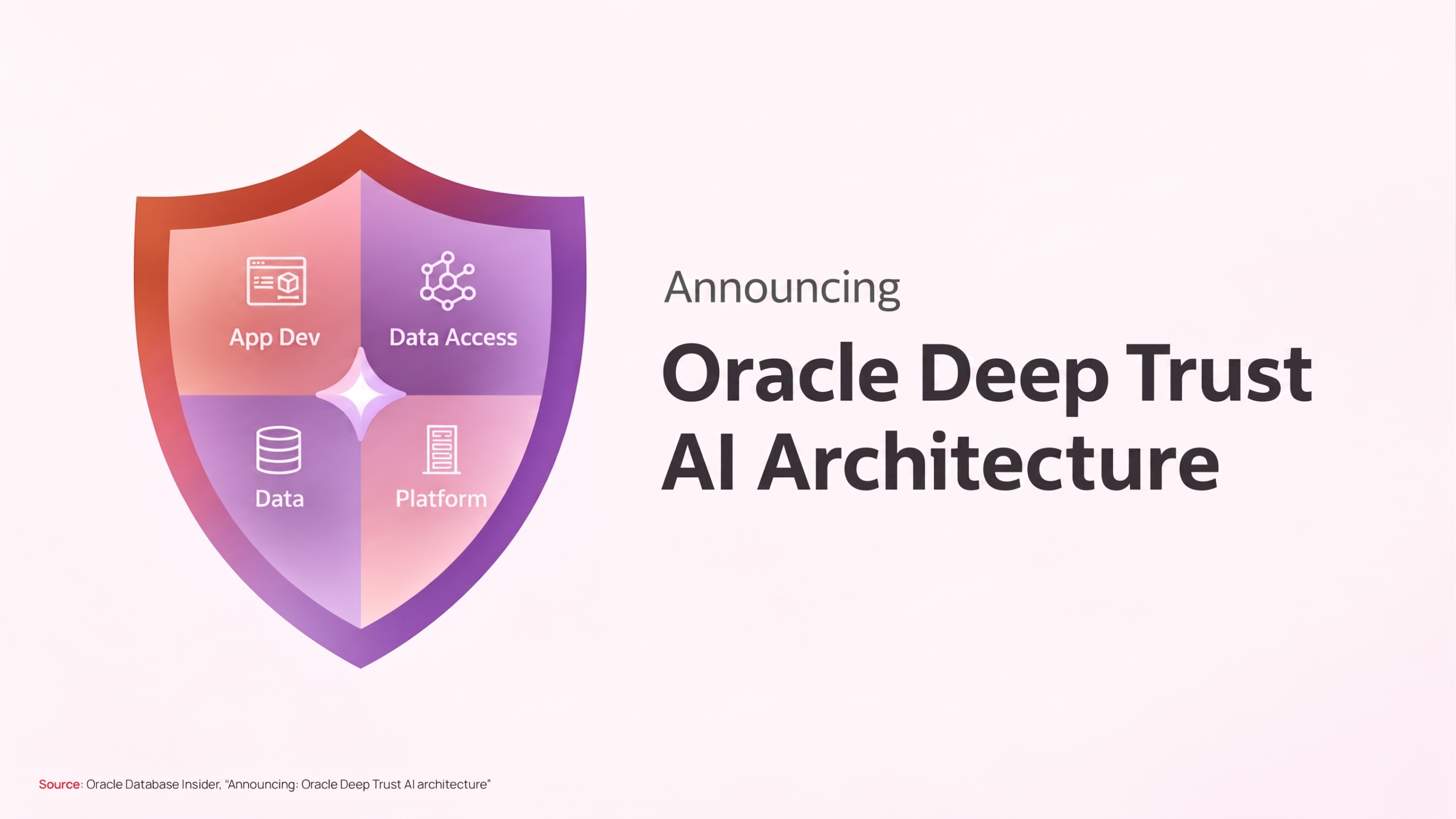
To secure the agentic era, Oracle announced the Oracle Deep Trust AI Architecture. As Oracle described it, the goal is to bring the security layer deeply embedded into the database itself, rather than leaving it to each application.
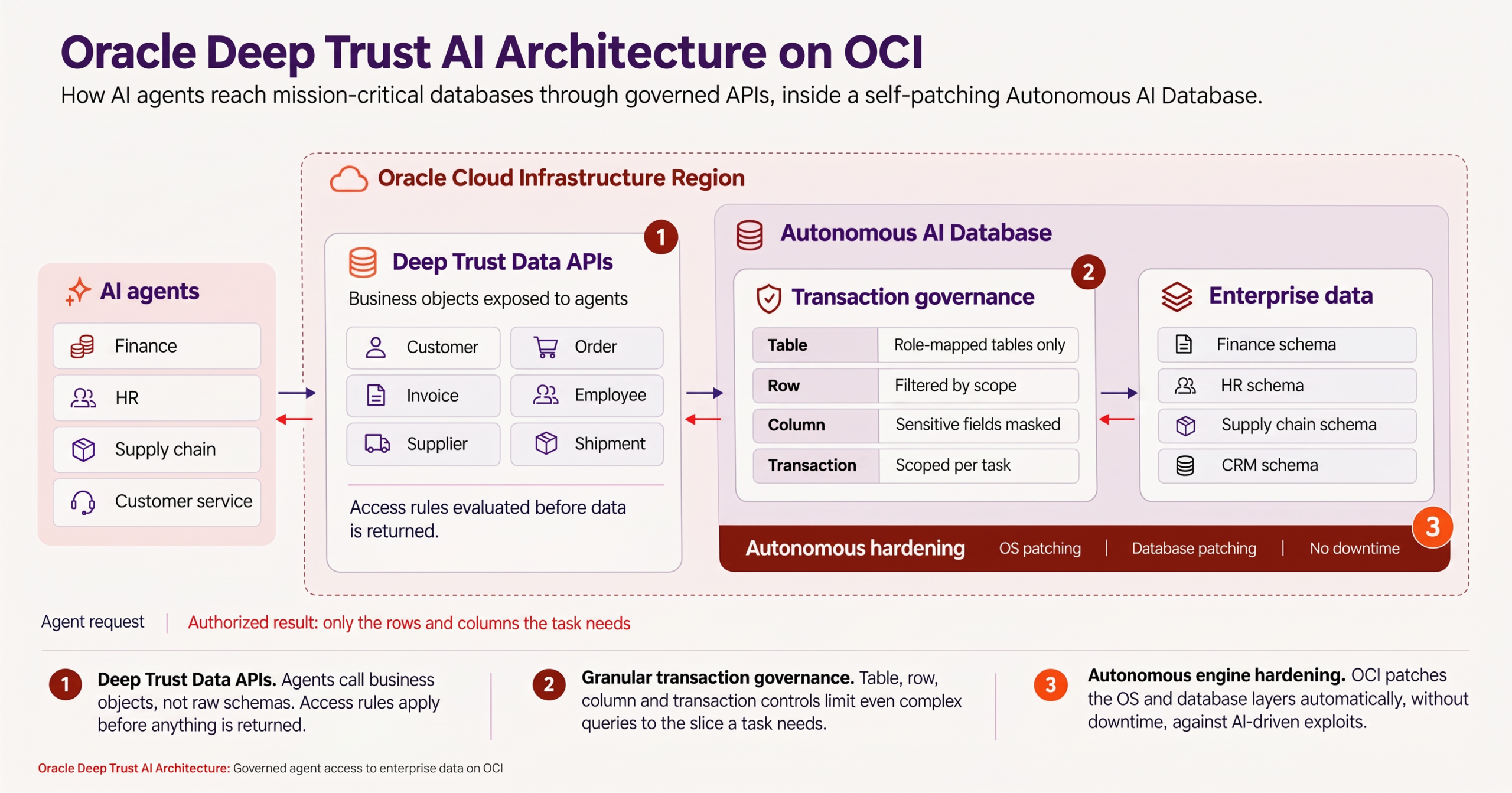
Instead of opening direct table access, Deep Trust works through three layers:
-
01
Granular Database Access and Transaction Controls
Row, column, table and transaction controls. Agents see only what the task needs.
-
02
Deep Trust Data APIs for Governed AI Agent Access
Agents use business objects, never raw schemas.
-
03
Automated Patching and Database Security Hardening
OS and database patched automatically, with no downtime.
How Does OCI Identity and Access Management Govern AI Agent Access?
As enterprise environments evolve to accommodate AI agents, identity management must extend beyond employees, administrators, applications, and service accounts to address a new category of identities with distinct access needs and operating behaviours.
An agent may execute a task for a particular employee, invoke multiple tools, request information from different databases, and initiate transactions within a single workflow. For that activity to remain accountable, the enterprise needs to know more than which application is connected to the database. It needs to establish:
-
1Who initiated the task
The employee, system, or authorized business process.
-
2Which agent performed the action
A uniquely identifiable agent or execution context.
-
3What authority was granted
The specific data and operations permitted for that task.
-
4When access was valid
A bounded execution window rather than indefinite credentials.
-
5What happened
An auditable record of queries, decisions, and transactions.
Consider an AI agent that processes a purchase requisition on behalf of a department manager:
STEP 1 · ALLOWED
The agent checks budget availability and pulls supplier details.
STEP 2 · ATTEMPTED
It tries to place a purchase above its delegated limit.
STEP 3 · REJECTED
The database blocks it. Final approval stays with the manager.
The transaction is rejected regardless of how confidently the AI model interprets its instructions. This is where context-aware access, short-lived credentials, and approval controls become essential.
In the keynote, Oracle outlined how OCI Identity and Access Management is evolving for this. Biometric support helps ensure that when a human is said to be in the loop, they genuinely are. For agents, OCI is adding short-lived credentials that can be governed and audited, with just-in-time access that adapts to the context of the work an agent is doing
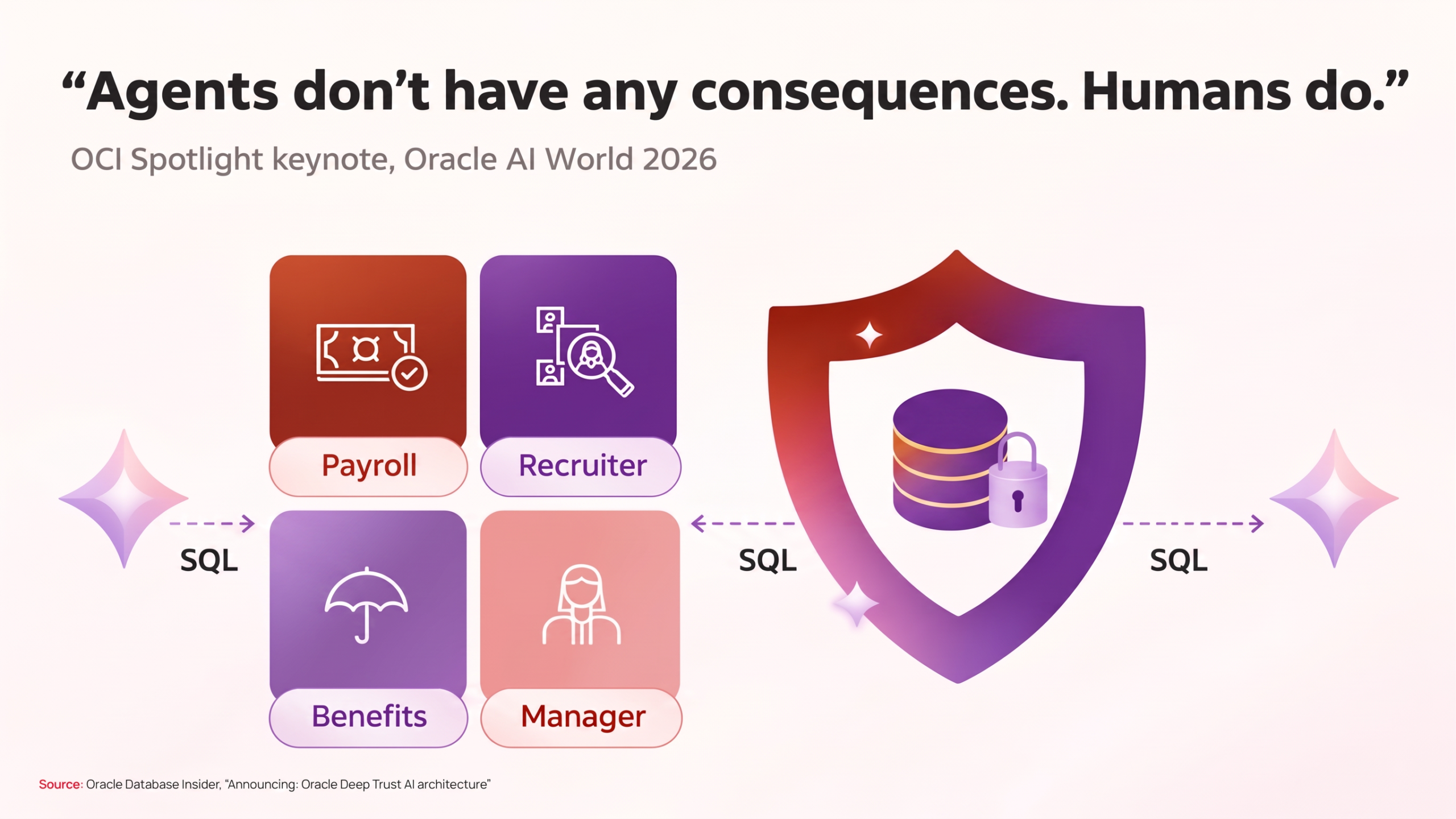
The principle is straightforward: an AI agent’s permission should reflect its assigned business task, not the maximum privileges available through its technical connection.
Is Your Oracle Database Ready for AI Agents? Five Security Questions to Ask
Preparing databases for AI agents does not mean replacing your existing enterprise architecture. It means extending it to accommodate a new kind of software user. Start by identifying the business processes where AI agents will read or change mission-critical data. Then run through this checklist:
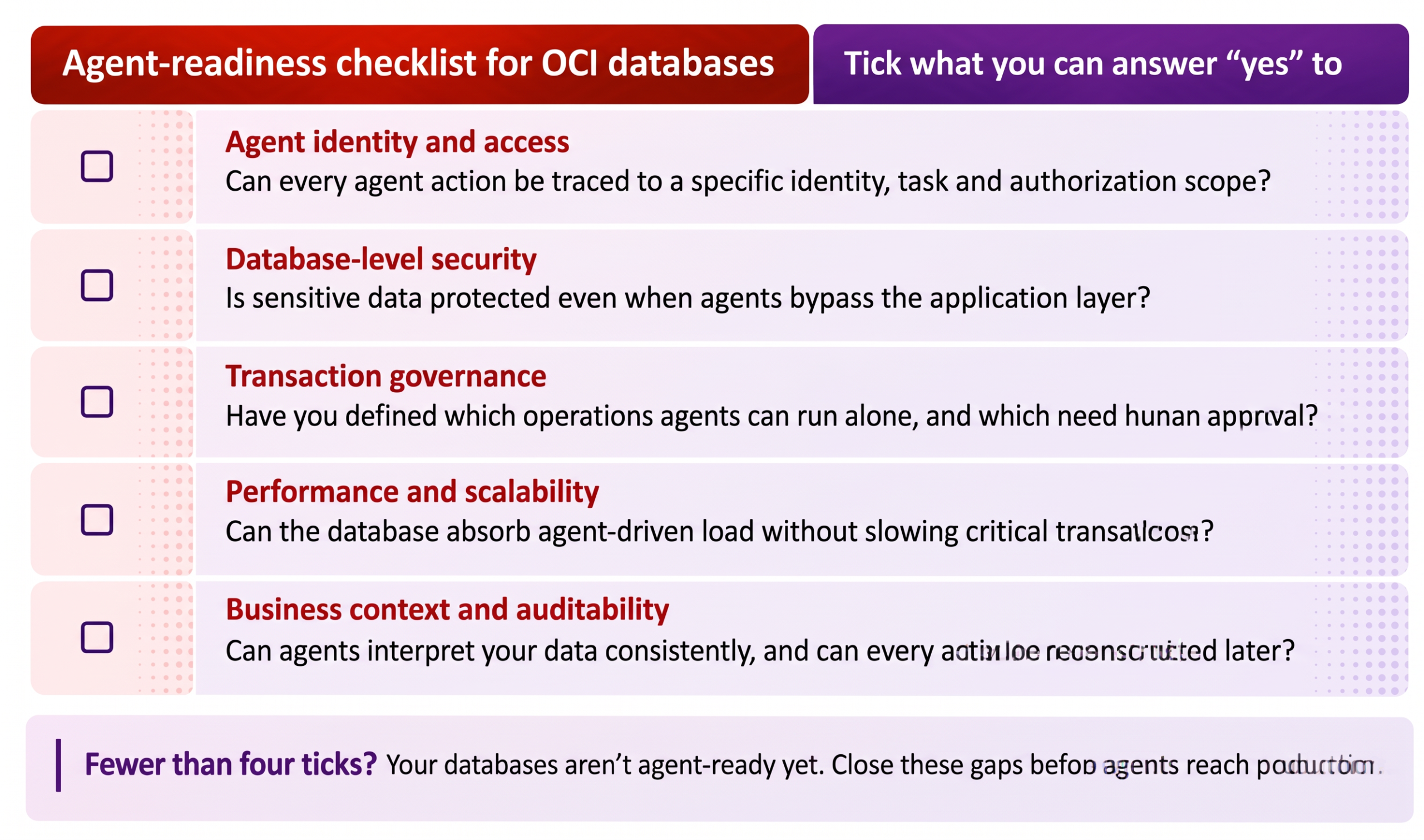
Address these during solution design, not after agents are in production. Security controls, data architecture, and agent orchestration must be built as connected parts of the same system. That is particularly important in Oracle Cloud Infrastructure environments, where financial, operational, workforce, and supply chain records frequently support critical business processes. Lorem ipsum dolor sit amet, consectetur adipiscing elit. Ut elit tellus, luctus nec ullamcorper mattis, pulvinar dapibus leo.
Preparing Oracle Cloud Infrastructure Databases for Agent-Driven Workloads
As AI agents become active users of enterprise databases, securing access, governing transactions, and maintaining accountability must be built into the architecture. Oracle Deep Trust AI Architecture marks an important step toward making that possible.
AppsTek helps enterprises prepare their Oracle Cloud Infrastructure (OCI) environments for agent-driven workloads through database security, identity governance, and Autonomous AI Database deployment and management. Prepare Your OCI Environment for AI Agents →
Frequently Asked Questions
Oracle Deep Trust AI Architecture is a framework designed to embed security, privacy, and business rules into the underlying enterprise technology stack. It addresses trust across four layers: software platform, data, data access, and application development. This helps organizations govern how AI agents and applications access sensitive enterprise information without relying solely on application-level safeguards.
Oracle Cloud Infrastructure (OCI) supports secure AI agent access through identity and access management, controlled authorization, and database security capabilities. Organizations can combine these controls with Oracle's database-level protections to restrict sensitive data access, govern transactions, and maintain accountability across agent-driven workflows.
Database-level security protects enterprise information when AI agents access data outside traditional application workflows. By enforcing access policies and business rules at the data layer, organizations can reduce the risk of unauthorized access, excessive privileges, and invalid transactions, regardless of which authorized application or agent initiates the request.
Oracle Autonomous AI Database supports agent-driven workloads through automated security patching, encryption, scalable infrastructure, and autonomous database management. These capabilities help organizations maintain database security, availability, and performance as AI agents generate additional queries and transactions. Agent-specific authorization and governance policies must still be configured appropriately.
Enterprises should begin by assessing agent identity, database permissions, transaction controls, workload scalability, and auditability. Each AI agent should have clearly defined authorization boundaries, access limited to its assigned tasks, and human approval requirements for sensitive operations. These controls should be established before agents access mission-critical Oracle databases in production.
Further Reading: Oracle AI, Database Security, and Agentic Governance

About The Author
Manisha Jadhav, Presales Executive at AppsTek Corp, specializes in solution consulting, business analytics, and enterprise technology solutions. With an MBA in Business Analytics from Symbiosis, she brings expertise in technical presales, business process optimization, and stakeholder engagement. She focuses on bridging business challenges with scalable technology solutions that improve operational efficiency, data visibility, and business outcomes.