
Table of Contents
Why Integration Architecture Becomes Complicated Around Oracle Fusion
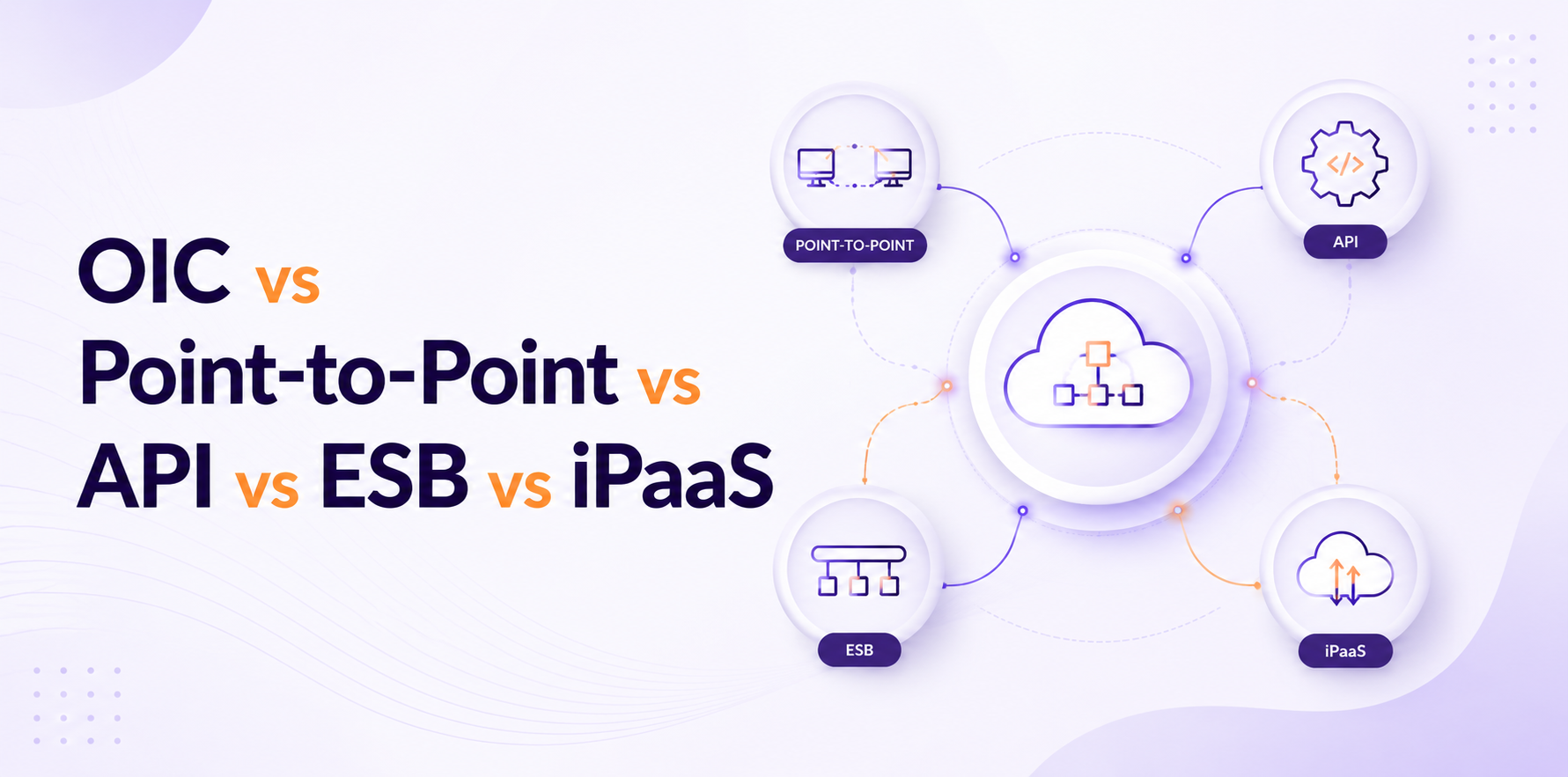
OIC vs CustomIntegration Approaches
OIC vs Point-to-Point Integration
OIC vs Custom API and Microservice Integration
OIC vs Traditional ESB or SOA Middleware
OIC vs Event-Driven Integration
Which OIC Integration Pattern Fits Which Workload?
How OIC Handles Hybrid Integration
Where OIC Creates the Most Enterprise Value
Oracle Integration Cloud Best Practices
OIC Is Usually the Integration Layer
Which Integration Approach Should You Choose?



Enterprise integration environments usually need several approaches working together. Oracle Integration cloud can provide a managed layer for connectivity, transformation, orchestration, and monitoring, while APIs, event platforms, custom services, and existing middleware continue handling workloads that need specialized logic or different architectural characteristics
For organizations running Oracle ERP, HCM, SCM, CX, E-Business Suite, or mixed application environments, the more useful question is: Which integration responsibilities belong in OIC, and which should remain outside it?
That distinction becomes increasingly important as an enterprise moves from a handful of interfaces to hundreds of integrations that need to remain secure, observable, maintainable, and adaptable.
Why Integration Architecture Becomes Complicated Around Oracle Fusion Cloud Integration ?
A typical Oracle Fusion Cloud integration landscape rarely involves only two applications.
Finance may exchange information with banks, tax platforms, procurement systems, payment providers, and analytics platforms. HCM may connect with payroll, benefits, identity, and learning systems. Supply chain workflows can involve logistics providers, warehouses, suppliers, manufacturing applications, and external data services.
The architectural challenge is therefore not simply, “Can these two applications connect?” It becomes:
- Where should orchestration logic live?
- How should data be transformed?
- What happens when an endpoint fails?
- Which integrations need immediate responses?
- Which processes can run asynchronously?
- How are private applications connected?
- Who monitors the integration after go-live?
- How much custom code should the enterprise own?
Those decisions determine whether an integration estate remains manageable as it grows.
OIC vs Custom Integration Approaches
There is no universally superior integration model. Each approach solves a different problem.
| Integration Approach | Best Fit | Key Advantage | Main Limitation |
|---|---|---|---|
| Oracle Integration Cloud (OIC) | Oracle Fusion and multi-application business workflows | Centralized connectivity, transformation, orchestration, and monitoring | Not ideal for every highly specialized processing requirement |
| Point-to-Point Integration | Simple connections between two stable systems | Fast and relatively straightforward to implement | Becomes harder to maintain as interfaces multiply |
| Custom APIs / Microservices | Specialized business logic and custom processing | Maximum development flexibility and runtime control | Enterprise owns development, monitoring, deployment, and maintenance |
| Traditional ESB / SOA | Mature enterprise integration estates | Established orchestration for complex legacy environments | Can retain infrastructure and administration overhead |
| Event-Driven Integration | Real-time events and loosely coupled processes | Supports asynchronous communication and event distribution | Requires disciplined event and message governance |
| Third-Party iPaaS | Broad non-Oracle SaaS environments | Can provide large cross-platform connector ecosystems | Oracle-specific depth depends on the chosen platform |
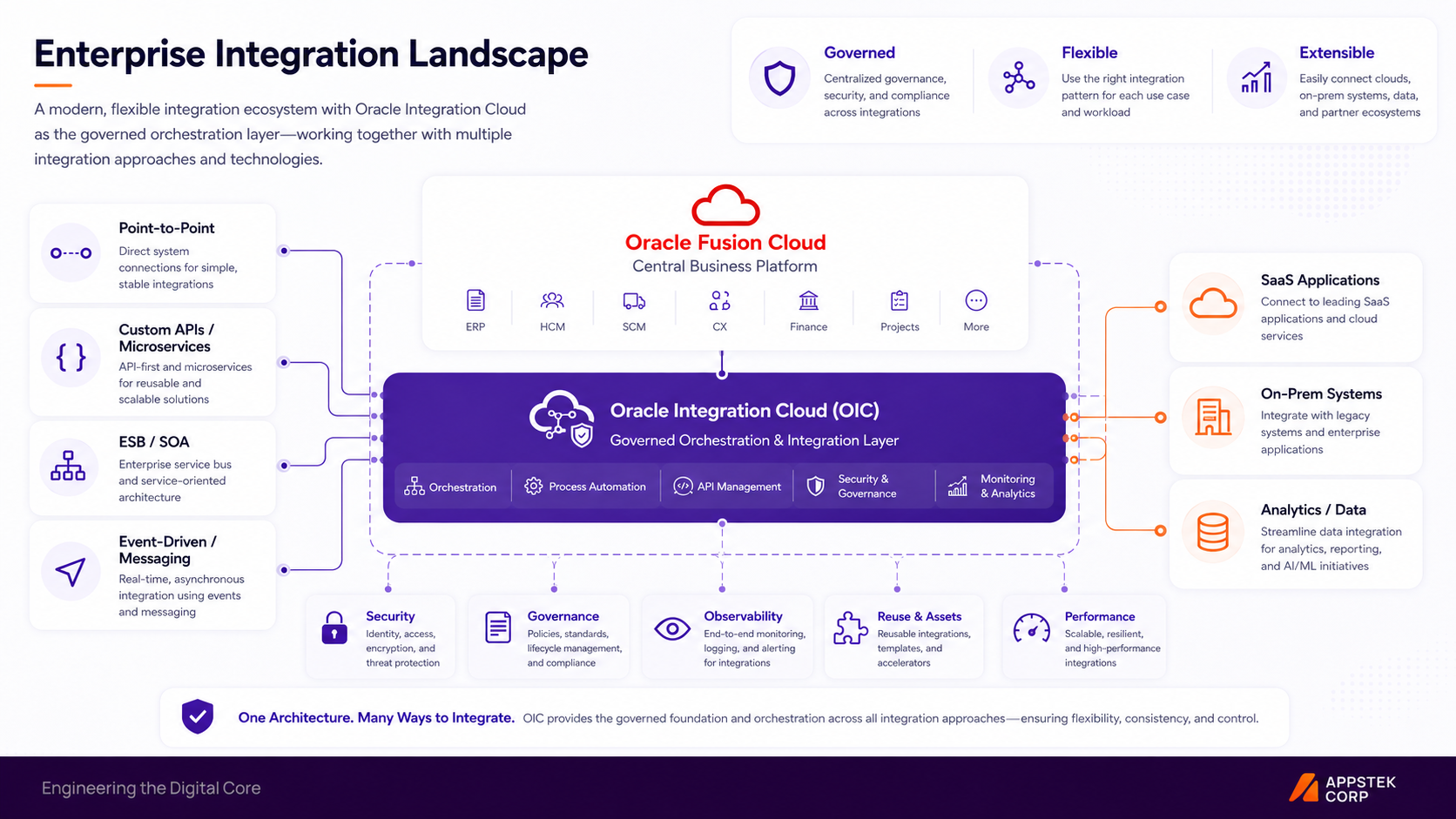
Oracle Integration should therefore be viewed as part of the architecture rather than automatically becoming the architecture.
OIC vs Point-to-Point Integration
Point-to-point integration is often attractive because it solves an immediate problem quickly. Application A calls Application B. Authentication is configured. Data is mapped. The connection works.
For a small number of stable systems, that may be completely reasonable. The problem appears as the application estate grows.
Imagine Oracle Fusion ERP connecting independently to a banking platform, CRM, procurement applications, tax services, warehousing systems, analytics platforms, expense applications, and internal databases. Each connection may then carry its own authentication configuration, mappings, transformations, retry logic, error handling, and support process.
Point-to-point can work well when:
- Only two applications are involved.
- Transformation requirements are minimal.
- The interface is unlikely to change.
- The business process does not require orchestration.
- Separate monitoring is acceptable.
OIC becomes more valuable when:
- Several systems participate in one workflow.
- Fusion is a major system of record.
- Transformations are reused.
- Integration failures need centralized visibility.
- Interfaces are expected to increase over time.
The question is therefore not whether point-to-point works. It is whether it remains manageable at enterprise scale.
OIC vs Custom API Integration and Microservice Integration
Custom integration provides something OIC should not try to replace completely: unrestricted development flexibility.
A development team may build services in Java, .NET, Python, Node.js, or another technology stack and optimize them around a very specific processing requirement.
That makes sense when the workload includes proprietary algorithms, specialized transformations, compute-heavy processing, reusable domain services, low-level protocol requirements, or unique latency and runtime requirements.
But custom development also transfers operational ownership to the enterprise. The development team typically owns the service lifecycle around deployment, scaling, observability, versioning, testing, authentication, runtime updates, and compatibility with connected applications.
When to Use Oracle Integration Cloud vs Custom Development
| Requirement | OIC | Custom Development |
|---|---|---|
| Oracle Fusion connectivity | Strong fit | Possible |
| Prebuilt application adapters | Strong fit | Usually requires development |
| Multi-step business orchestration | Strong fit | Requires custom implementation |
| Highly specialized algorithms | Limited / depends on requirement | Strong fit |
| Centralized integration monitoring | Built into the platform | Must be designed |
| Maximum runtime control | Moderate | Strong fit |
| Reusable integration workflows | Strong fit | Possible |
| Rapid integration delivery | Strong fit for supported patterns | Depends on development effort |
| Highly custom processing | Possible but not always ideal | Strong fit |
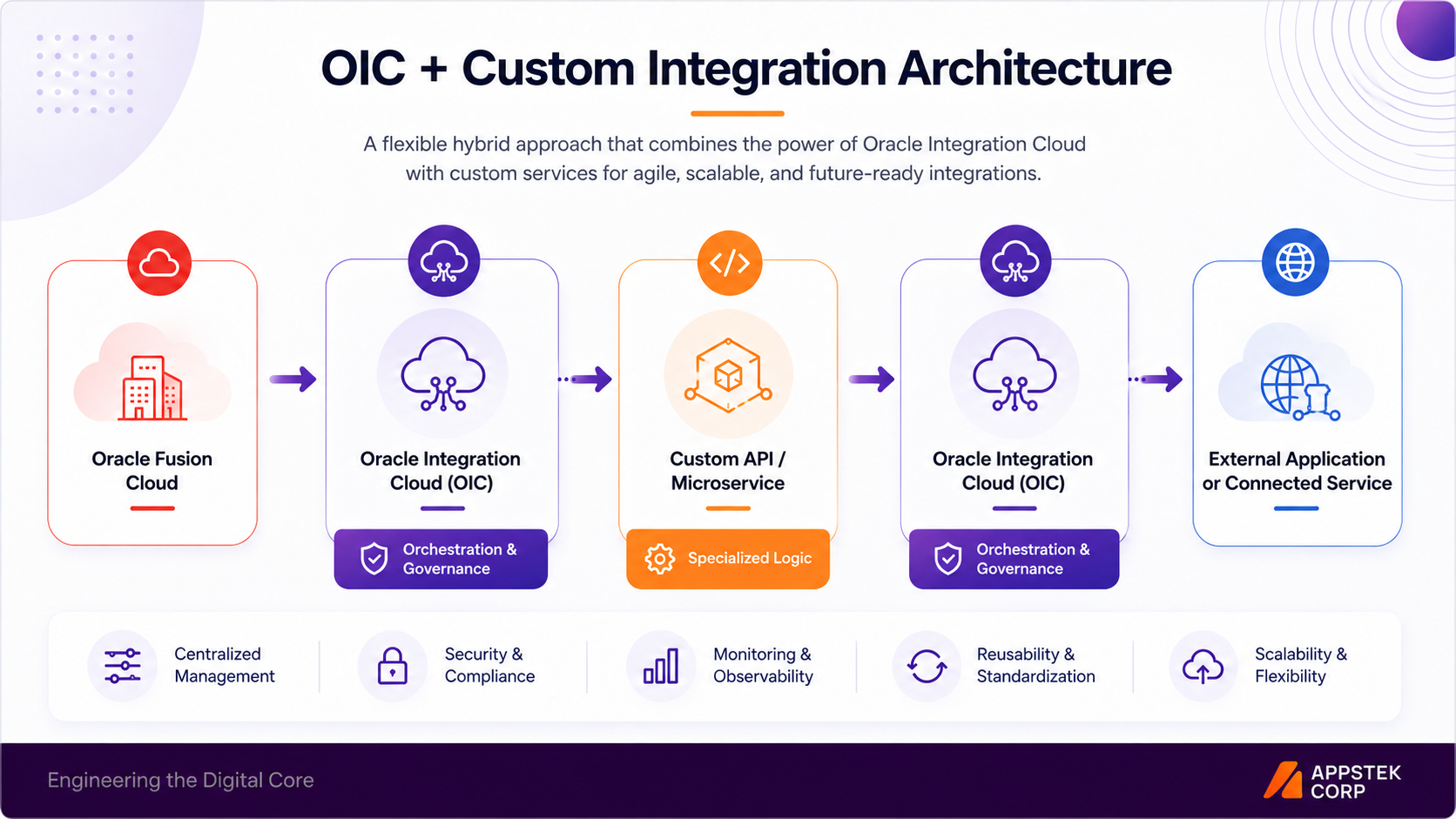
A useful architecture may look like: Oracle Fusion → OIC → Custom Service → OIC → External Application. OIC manages connectivity and the business flow, while the custom service handles specialized logic.
OIC vs Traditional ESB or SOA Middleware
Many large enterprises already operate Oracle SOA Suite, an enterprise service bus, or another established middleware platform. Those environments should not automatically be replaced simply because Oracle Fusion is being introduced.
A stable integration that has operated successfully for years may have little business justification for immediate redevelopment.
A more realistic modernization model keeps established middleware supporting stable legacy processes, introduces OIC for appropriate new cloud and Fusion integrations, and modernizes older interfaces when application changes, support requirements, security needs, cost, or business transformation justify it.
OIC vs Event-Driven Integration
Not every integration should be synchronous.
Consider a new purchase order created in Fusion. Logistics, analytics, inventory, notifications, supplier systems, and customer applications may all need the event, but the originating transaction should not necessarily wait for every downstream application to finish processing.
That is where event-driven architecture becomes useful.
Messaging or event infrastructure distributes events. OIC orchestrates the business process that happens because of those events.
Large enterprises may therefore use a messaging or streaming platform for high-volume event distribution while using OIC to coordinate Fusion-related business actions.
Which OIC Integration Patterns Fit Which Workload?
One of the most important architectural decisions is choosing an integration pattern based on workload behavior rather than implementing every interface the same way.
| Business Requirement | Recommended Pattern | Example |
|---|---|---|
| Application requires an immediate response | Application / API-driven | Fusion ERP requests supplier information |
| Processing can continue without keeping the user waiting | Asynchronous workflow | Employee onboarding across downstream applications |
| Data must move at predictable intervals | Scheduled integration | Nightly finance synchronization |
| A business activity should trigger processing | Event-driven integration | Purchase order event triggers logistics processing |
| Private application must communicate with cloud applications | Hybrid integration | Fusion connects to an internal database or ERP |
| Specialized computation is required | OIC + Custom Service | OIC calls a purpose-built pricing or calculation service |
| Events must reach several consumers | Messaging/Event Platform + OIC | Order events feed analytics, warehouse, and downstream processes |
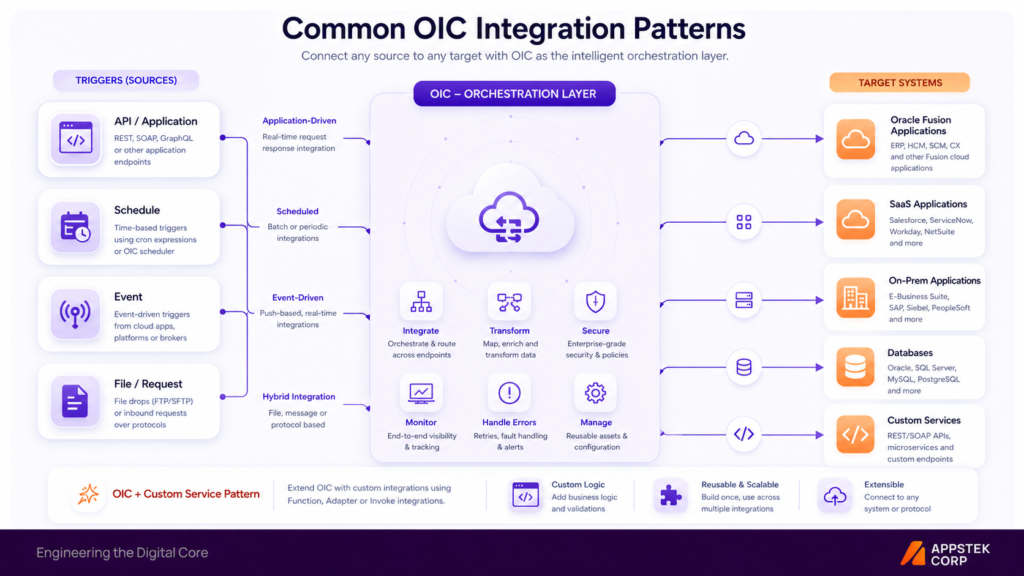
These OIC integration patterns prevent architecture from becoming unnecessarily dependent on polling, long synchronous chains, or oversized integration flows.
OIC vs Third-Party iPaaS
Third-party integration platforms can make sense when an organization’s application estate is predominantly non-Oracle or the enterprise has already standardized its integration governance around another platform.
The decision changes when Oracle Fusion sits at the center of critical transactions. The evaluation should not begin with, “Which iPaaS has more connectors?” It should begin with, “Which systems own our most important transactions?”
If Finance, HCM, SCM, CX, Oracle Database, EBS, or other Oracle applications sit at the center of those transactions, Oracle-specific integration depth becomes much more important.
How OIC Handles Hybrid Integration
Most enterprise estates are hybrid. Not every application is exposed through the public internet, and many organizations still maintain internal databases, private APIs, data center applications, legacy platforms, manufacturing systems, and private cloud environments.
That means Oracle Fusion Cloud integration often needs to extend into private infrastructure without forcing every application to become publicly accessible.
Where OIC Creates the Most Enterprise Value
The strongest OIC use cases are often not technically difficult connections. They are operationally complex business workflows.
Consider employee onboarding. Creating the employee record may trigger identity provisioning, payroll setup, benefits enrollment, equipment requests, learning assignments, building access, and manager notifications.
Each individual API call may be straightforward. The complexity comes from coordinating the full process: which step happens first, what happens when one downstream system fails, whether the transaction can be replayed, and how a support team traces the affected business record.
That operational layer is one of the reasons OIC becomes more valuable as integration complexity increases.
Oracle Integration Cloud Best Practices
The number of integrations deployed is not a measure of architectural maturity. A large OIC environment can still become difficult to operate if every project develops integrations differently.
| Best Practice | Why It Matters |
|---|---|
| Keep integrations modular | Smaller flows are easier to test, change, reuse, and troubleshoot. |
| Use asynchronous processing for long-running work | Reduces dependency on long synchronous call chains. |
| Avoid unnecessary polling | Event or application triggers may eliminate repetitive scheduled processing. |
| Separate orchestration from complex computation | Keeps specialized logic in services designed for it. |
| Standardize error handling | Makes failures easier for support teams to understand and recover. |
| Define business identifiers for tracking | Helps connect technical failures with actual business transactions. |
| Design observability from the beginning | Prevents monitoring from becoming a post-production exercise. |
| Reuse connections and common patterns | Reduces duplicated authentication and mapping logic. |
| Check recipes and accelerators first | Existing patterns may provide a faster starting point. |
The most important of these oracle integration cloud best practices is architectural discipline. OIC should become a reusable enterprise integration layer, not simply another place where every project builds isolated workflows.
OIC Is Usually the Integration Layer, Not the Entire Integration Architecture
A mature enterprise architecture does not force every requirement through one platform. Different technologies should have clear responsibilities.
OIC
Specialized Technologies
- Oracle and SaaS connectivity
- Transformation
- Business orchestration
- Integration monitoring
- Hybrid connectivity
- Custom APIs and microservices for specialized logic
- Event platforms for high-volume distribution
- Existing middleware for stable legacy integrations
- Point-to-point for simple low-risk interfaces
Use OIC where standardization, orchestration, connectivity, and operational visibility create value. Use specialized technologies where their technical strengths justify them.
Which Integration Approach Should You Choose?
| If Your Situation Looks Like This... | Consider |
|---|---|
| Oracle Fusion is central to the process | OIC |
| Several applications participate in one business workflow | OIC |
| Two stable applications need a simple interface | Point-to-Point or API |
| Complex proprietary processing is required | Custom API / Microservice |
| Large numbers of events must reach several consumers | Event / Messaging Platform |
| Stable legacy middleware already works reliably | Retain it until modernization has a clear reason |
| Oracle and non-Oracle platforms need coordinated workflows | OIC + APIs / Events / Custom Services |
| Private systems need to participate in Fusion workflows | OIC hybrid connectivity |
| One technology is expected to replace every integration approach | Reconsider the architecture |
A Practical Integration Decision Checklist
Before deciding where an interface belongs, ask:
- Is Oracle Fusion involved in the transaction?
- How many applications participate?
- Does the workflow require orchestration?
- Is a suitable adapter or existing connection pattern available?
- Does the interaction need an immediate response?
- Could the process run asynchronously?
- Is a business event available?
- Is high-volume event distribution required?
- Does the integration require private connectivity?
- Does specialized processing justify custom development?
- How will errors be monitored and recovered?
- Who will maintain the integration in three years?
These questions usually reveal the architecture more clearly than a feature-by-feature platform comparison.
Conclusion
The OIC versus custom integration debate becomes much more useful when it moves away from choosing a winner.
Oracle Integration Cloud is strongest when enterprises need a governed connectivity and orchestration layer around Oracle Fusion and the surrounding application ecosystem. Custom APIs, microservices, event platforms, existing middleware, and even simple point-to-point connections still have legitimate roles.
The goal is not to eliminate them. The goal is to stop every project from inventing its own integration architecture.
A well-designed Oracle Fusion Cloud integration strategy uses OIC integration patterns for repeatable enterprise workflows while preserving custom engineering where it creates genuine technical or business value.
That balance creates an integration foundation that can evolve as applications, data flows, and enterprise requirements change.

About The Author
Rahul Sudeep, Senior Director of Marketing at AppsTek Corp, is a results-driven, AI-first B2B marketing leader with 15 years of experience scaling global enterprise SaaS companies. His expertise, honed at IIM-K, spans architecting high-impact go-to-market strategies, driving new market identification and positioning, and embedding Generative AI, LLMs, and predictive analytics into the core marketing function. Rahul unifies Technology, Sales, and Support teams around a single strategic hub, while also managing key Partner and Investor Relations. He leverages AI-driven insights to craft powerful brand narratives and hyper-personalized demand generation campaigns that drive measurable revenue growth and deepen customer engagement.