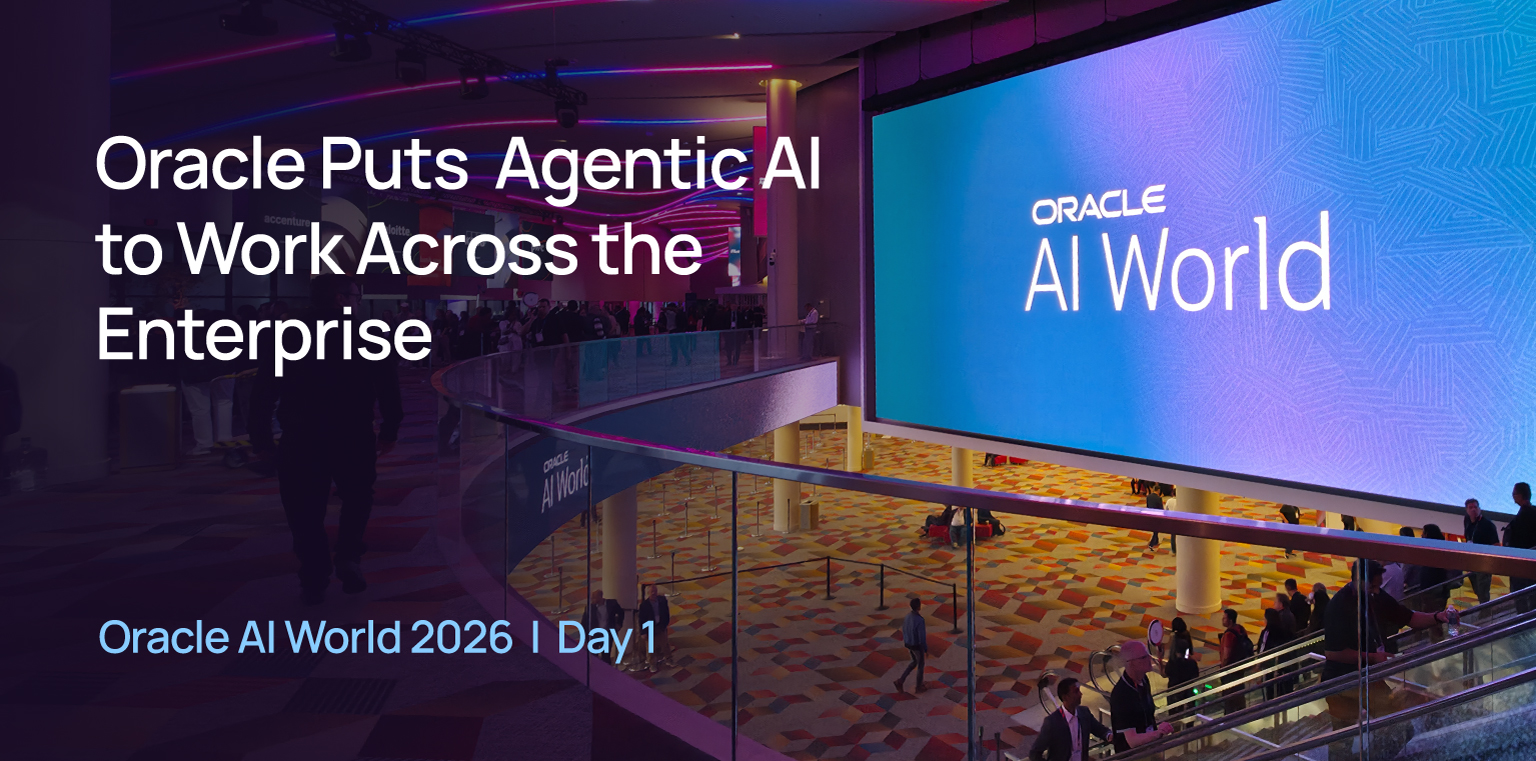


Oracle opened Oracle AI World 2026 in Las Vegas with a clear message: AI should do more than provide answers. It should help get the work done.
During a sold-out keynote on October 26, Oracle announced three new Oracle Fusion AI capabilities for its cloud software, which large companies use to run finance, HR, supply chain, and customer service. Live demonstrations across shipping, HR, restaurants, and emergency care showed how these capabilities could move AI beyond recommendations and into execution.
Here is what the Oracle AI World keynotes revealed about the company’s direction and what the announcements mean for enterprise leaders.
Oracle's Vision for Applied AI in the Enterprise
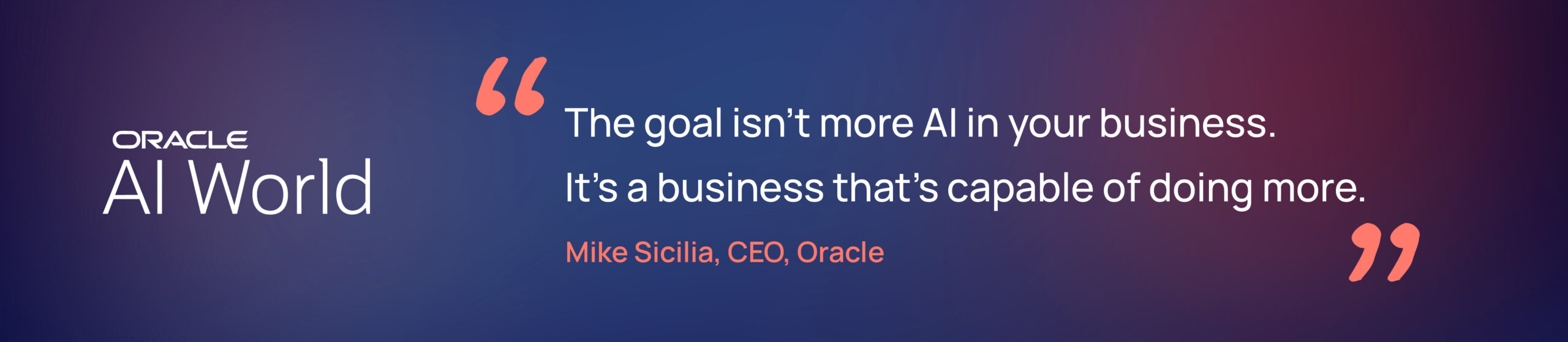
Oracle CEO Mike Sicilia set the tone early. Many companies already use AI to identify problems and reduce costs. The next step is enabling AI to act on what it finds. That requires four things: access to enterprise data, an understanding of its business context, sufficient computing power, and integration into the software employees use every day.
Business software still requires people to do much of the legwork, including identifying the right system, navigating screens, and securing approvals. Sicilia challenged this approach with a straightforward question: Why should anyone need six different systems to get one thing done?
Three New Oracle Fusion AI Capabilities
Chris Leone, who leads Oracle’s applications team, followed with three announcements that bring AI closer to everyday enterprise operations:
- Fusion Claw: Enables AI to handle more complex, extended tasks that typically require a specialist, such as a planner or financial analyst.
- Fusion Companion and Fusion Agentic Home: Allow employees to request what they need in plain language rather than navigating menus and screens.
- The Fusion Setup and Configuration Registry: Helps AI tools configure Oracle’s software for new customers, a process that currently involves months of manual work.
All three capabilities are available to customers now.
Fusion Claw Demo: AI That Executes, Not Just Recommends
The distinction became clear during a live demonstration built around a shipping company’s planning screen. Oracle’s AI identified orders at risk of running late, found two truckloads that could be combined to save $12,000, and reshuffled some orders.
Oracle then demonstrated Oracle Fusion Claw taking on a more demanding assignment: reworking the entire shipping plan. The revised plan filled trucks to 88% of capacity, up from 61%, and saved $58,000. Fusion Claw also recognised where human judgment was needed, routing five uncertain loads to a human planner before executing the remaining work.
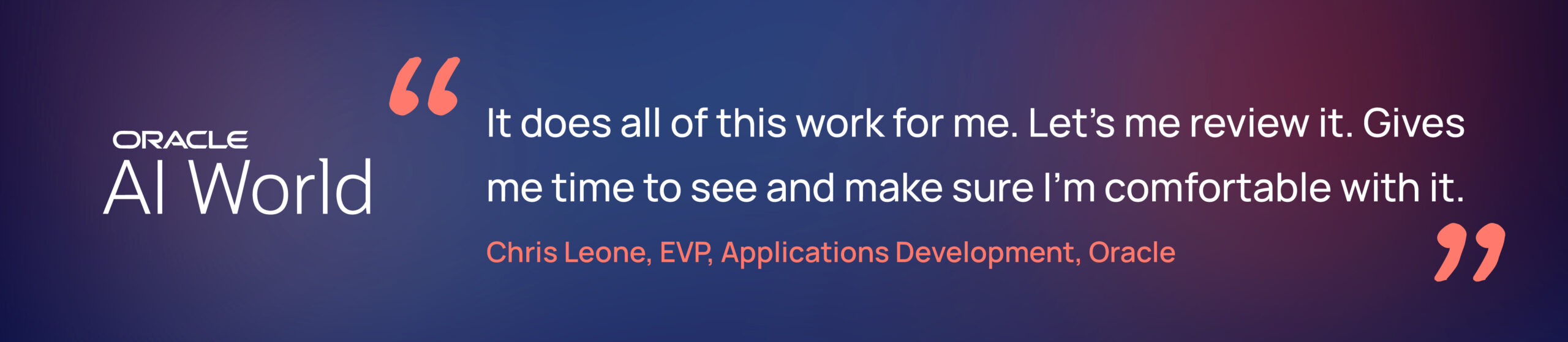
Oracle now offers 75 ready-made AI applications across finance, HR, supply chain, and customer service. Of these, 25 use Fusion Claw, bringing agentic execution into a broader portfolio of enterprise applications. A closer examination of how Fusion Claw works will follow in an upcoming article.
Fusion Companion and Agentic Home: Getting Work Done Without Navigating Menus
Using business software often means knowing exactly where to click, whether that involves opening a particular screen, finding a report, or submitting an approval. Fusion Companion removes much of that navigation.
Employees can describe what they need in plain language, and Companion determines how to fulfil the request while respecting company security rules governing access and permissions. The capability works inside ChatGPT, with support for other AI assistants to follow.
Fusion Agentic Home brings the same approach to a mobile application for Android and iPhone. Designed for employees who spend much of their working day away from a desk, it supports voice-based interactions. A store worker could report hours aloud, while a head nurse could request a revised schedule for the following week.
Together, these capabilities show how an Oracle agentic application can make enterprise software easier to use by bringing actions closer to employees, rather than requiring them to navigate the application.
Fusion Setup and Configuration Registry: Faster Oracle Fusion Implementations
Before a company can use business software, its rules, approval workflows, and configuration settings must be established. This process is often among the slowest and most expensive parts of an implementation, with consultants repeating much of the same work for different customers.
Oracle’s Fusion Setup and Configuration Registry aims to change that process. It functions as a step-by-step instruction manual for configuring Oracle software, structured so AI tools can follow the instructions and perform the setup, with experts reviewing the work before it goes live.
Oracle’s developers will maintain the registry as the software evolves. The resource is free and publicly available, giving implementation teams and AI tools access to a common foundation for configuration.
The intended outcome is a faster, less expensive implementation process that frees teams to focus more of their time on improving business operations.
Agentic AI in Action: Spectrum, Burger King Italia and Oracle Health
Oracle AI World also featured customer demonstrations showing how these capabilities are being applied in real operating environments.
Spectrum, the US telecom and cable provider, uses AI helpers called “Ask HR” for approximately 100,000 employees, many of whom work in stores, vans, and call centres. In the demonstration, an employee whose daughter had been rushed to hospital requested time off through her phone and received approval with one tap. The system also notified her manager, found someone to cover her shift, and subsequently initiated her leave paperwork. Decisions involving pay and sensitive personal matters remain with people.
QSRP, which operates Burger King restaurants in Italy, developed a control centre that identifies failing delivery orders, determines the cause, and resolves the issue across every affected restaurant at once. Sophie Buresi, its head of AI, explained that a busy restaurant manager needs to understand what is wrong and what action to take in under five seconds.
In healthcare, paramedics shared video from police body cameras, patient vital signs, and their own assessments with an emergency room doctor before the patient arrived. In a separate demonstration, Oracle’s AI helped a hospital investigate why fewer heart procedures were being booked. The analysis identified fewer referrals from local doctors, a competing clinic that had recently opened nearby, and two insurance plans that increased costs for patients.
These examples showed how agentic capabilities can connect information with action across different industries, while keeping operational requirements and human oversight central to the process.
Trust and Governance in Enterprise AI
Throughout the keynote, Sicilia returned to a central principle: AI systems capable of taking action require clear boundaries. They must respect spending approval limits, protect patient information, and route decisions requiring human judgment to the appropriate people.
He closed with examples of AI helping governments predict food shortages in Africa, reinforcing the broader potential of enterprise intelligence when it operates within clear governance frameworks.
Trust, he argued, is something organisations must earn through how their systems behave, rather than something they can simply announce.
Meet AppsTek at Oracle AI World 2026
Oracle is advancing its applications strategy with a clear focus on execution. Fusion Claw enables AI to handle more complex tasks, Fusion Companion simplifies how employees interact with enterprise software, and the Fusion Setup and Configuration Registry aims to accelerate implementations.
Together, these Oracle Fusion AI capabilities signal a shift in Oracle’s applications strategy, moving AI beyond recommendations towards execution within governed enterprise workflows.
For business leaders following Oracle AI World, the central question is how to translate these capabilities into measurable outcomes across existing systems and teams. The technology establishes new possibilities, but business results will depend on how effectively organisations integrate it into their operations.
AppsTek Corp is in Las Vegas through October 28. Connect with the team to discuss Oracle AI, agentic applications, and opportunities to turn enterprise AI capabilities into practical business outcomes.

About The Author
Rahul Sudeep, Senior Director of Marketing at AppsTek Corp, is a results-driven, AI-first B2B marketing leader with 15 years of experience scaling global enterprise SaaS companies. His expertise, honed at IIM-K, spans architecting high-impact go-to-market strategies, driving new market identification and positioning, and embedding Generative AI, LLMs, and predictive analytics into the core marketing function. Rahul unifies Technology, Sales, and Support teams around a single strategic hub, while also managing key Partner and Investor Relations. He leverages AI-driven insights to craft powerful brand narratives and hyper-personalized demand generation campaigns that drive measurable revenue growth and deepen customer engagement.