
Table of Contents
Start Here: An Honest ssessment, Not a Sales Pitch
Five Signals That Prove OCI Aligns with Enterprise Priorities
Three Signals That OCI is Not The Right Move
Evaluating OCI Within an Enterprise Cloud Strategy
Determining Where OCI Fits Within The Enterprise



As enterprise cloud infrastructure becomes increasingly distributed, selecting the right platform requires far more than comparing features or pricing. Every cloud platform excels in different areas, making workload alignment, governance, and long-term operating economics far more important than vendor positioning.
This guide presents a structured framework for evaluating whether OCI aligns with enterprise priorities while identifying situations where alternative cloud solutions for enterprise may offer a better fit.
Start Here: An Honest Assessment, Not a Sales Pitch
Selecting among cloud solutions for enterprise is rarely about identifying the provider with the longest feature list. Every enterprise cloud strategy should begin by evaluating architectural alignment, workload characteristics, compliance obligations, operational maturity, and existing technology investments.
OCI delivers differentiated value for certain enterprise profiles while offering fewer advantages for others. Organizations that evaluate OCI without first defining those architectural boundaries risk overlooking meaningful opportunities or introducing unnecessary complexity into the broader enterprise cloud infrastructure.
Many cloud evaluations begin with vendor demonstrations and conclude with proof-of-concept exercises designed to validate individual services. While useful, these exercises rarely answer the more important strategic question.
Given existing technology investments, operating models, governance structures, and long-term business objectives, does OCI strengthen the enterprise cloud strategy or introduce additional operational complexity?
Experience across Oracle, SAP, NetSuite, and broader enterprise transformation initiatives demonstrates that OCI can significantly improve performance, cost efficiency, and operational resilience when the underlying workload profile aligns with its architectural strengths. Under different circumstances, the same platform may create avoidable complexity that outweighs its benefits.
Those indicators can usually be identified before vendor selection begins.
Rather than presenting another feature comparison, this guide evaluates five conditions that indicate strong OCI alignment, three conditions where OCI may not represent the optimal choice, and a readiness framework that supports objective enterprise cloud strategy decisions before engaging technology vendors.
Five Signals that Prove OCI Aligns with Enterprise Priorities
OCI consistently delivers the strongest business value when enterprise cloud infrastructure includes substantial Oracle technology investments, GPU-intensive AI initiatives, regulatory deployment requirements, multicloud architectures requiring Oracle data services, or cloud cost structures heavily influenced by data transfer charges.
Enterprise Operations Depend on Oracle Database, EBS, PeopleSoft, or JD Edwards
A significant Oracle technology footprint remains the strongest indicator that OCI deserves serious evaluation.
Organizations operating Oracle Database, Oracle E-Business Suite, PeopleSoft, or JD Edwards benefit from migration tooling designed specifically for Oracle workloads, along with access to Exadata and Autonomous Database capabilities that competing hyperscalers cannot fully replicate.
Although Oracle workloads can operate successfully on AWS or Azure, licensing considerations, performance optimization, and long-term support complexity typically increase over time.
The evaluation extends beyond determining whether Oracle workloads can run elsewhere. The more strategic question examines whether the cumulative operational cost, licensing overhead, and administrative complexity justify remaining on another platform when OCI was purpose-built for those workloads.
Within a broader enterprise cloud strategy, OCI frequently becomes the natural destination for Oracle-centric applications while complementary workloads continue operating on other cloud platforms.
Cloud Costs Are Being Driven by Data Egress Charges
Data transfer charges often become a hidden driver of long-term cloud expenditure. Organizations operating analytics platforms, disaster recovery environments, API-intensive applications, or multicloud synchronization workloads frequently discover that monthly egress costs increase alongside business growth.
Unlike pricing differences negotiated through procurement, egress costs represent structural characteristics of the underlying platform.
OCI includes 10 TB of outbound data transfer each month without additional charges. At approximately 50 TB of monthly outbound traffic, OCI costs roughly $340 compared to more than $4,300 on AWS.
For enterprises where cloud economics are increasingly shaped by data movement rather than compute, this pricing model can materially improve the financial efficiency of enterprise cloud infrastructure.
GPU Compute Economics No Longer Support the Current Cloud Platform
Generative AI, foundation model training, advanced analytics, and large-scale machine learning continue driving demand for high-performance GPU infrastructure. When AI initiatives require NVIDIA H100 clusters or comparable GPU resources, infrastructure pricing often becomes the limiting factor rather than technical capability.
OCI changes those economics through consistently lower GPU pricing compared with competing hyperscalers. The advantage, however, applies only to organizations operating genuinely GPU-intensive workloads. Enterprises primarily focused on inference, lightweight AI models, or limited experimentation are unlikely to realize significant savings because GPU consumption remains relatively modest.
Within an enterprise cloud strategy centered on production AI, however, OCI can substantially reduce infrastructure costs while improving the scalability of AI workloads.
Regulatory Requirements Demand Sovereign, Dedicated, or Air Gapped Cloud
Organizations operating in highly regulated industries often evaluate cloud platforms through the lens of compliance rather than feature breadth.
Financial services, healthcare, defense, government, and critical infrastructure sectors frequently require strict controls around data residency, operational isolation, and regulatory governance. Standard public cloud deployments may satisfy some requirements, while others demand a more specialized deployment model.
OCI offers one of the industry’s broadest distributed cloud portfolios, including sovereign cloud regions, dedicated regions deployed inside customer data centers, and air-gapped environments designed for disconnected operations.
Although competing hyperscalers provide government and regulated cloud offerings, OCI’s deployment flexibility enables organizations to align enterprise cloud infrastructure with stringent compliance requirements without compromising operational consistency.
For organizations where regulatory obligations shape technology decisions, deployment flexibility becomes a foundational element of enterprise cloud strategy rather than an optional capability.
Multicloud Architectures Depend on Oracle Data Services
Multicloud has evolved into the operating model for many large enterprises. Different cloud providers support different business priorities, making workload placement a strategic decision instead of a platform standardization exercise.
Organizations that depend on Oracle Database while simultaneously operating workloads on AWS, Azure, or Google Cloud often encounter higher latency, increased data transfer costs, and additional operational complexity when connecting services across providers.
OCI addresses these challenges through physical co-location with major hyperscalers, enabling Oracle Database services to operate alongside workloads running on AWS, Azure, and Google Cloud with microsecond latency and significantly reduced network overhead.
This advantage primarily benefits enterprises with mature multicloud environments rather than organizations beginning their cloud journey. Within a governed enterprise cloud strategy, OCI strengthens multicloud architectures by allowing Oracle workloads to remain on the platform optimized for Oracle technologies while adjacent applications continue operating where they deliver the greatest business value.
Three Signals That OCI Is Not the Right Move (or Not Yet)
OCI represents a strong fit for specific enterprise profiles, but every enterprise cloud strategy should also identify situations where another platform offers a better long-term outcome.
Organizations with minimal Oracle technology investments, engineering teams deeply invested in another hyperscaler, or cloud-native applications tightly coupled to provider-specific services may experience higher transition costs than business benefits.
Recognizing these conditions early helps prevent unnecessary migration initiatives while ensuring enterprise cloud infrastructure remains aligned with long-term operational objectives.
Limited Oracle Technology Investment
Organizations operating few or no Oracle technologies have less reason to adopt OCI as a primary cloud platform. OCI remains a capable enterprise cloud platform, yet many of its strongest differentiators, including Exadata, Autonomous Database, and Oracle-aware migration tooling, provide the greatest value when Oracle applications already form part of the technology landscape.
Without those workloads, migration introduces platform transition costs while delivering fewer differentiated advantages. Under these circumstances, OCI may still represent an excellent choice for GPU-intensive AI workloads, regulated deployments, or specific Oracle data services. As the primary destination for enterprise cloud infrastructure, however, the overall business case becomes considerably weaker.
Engineering Investments Are Deeply Embedded in Another Cloud Platform
Cloud platforms influence far more than infrastructure. Engineering skills, deployment pipelines, automation frameworks, monitoring platforms, governance processes, and operational knowledge evolve alongside the chosen cloud ecosystem.
Organizations with mature AWS or Azure environments often maintain years of investment across CI/CD pipelines, Infrastructure as Code, observability platforms, security controls, and cloud operations.
Replacing those operational foundations requires significant time, retraining, and organizational change while introducing transition risk. A more practical enterprise cloud strategy frequently involves adopting OCI selectively for Oracle-specific workloads instead of pursuing a full-scale platform migration.
Applications Depend on Provider-Specific Cloud Services
Cloud-native applications frequently become tightly integrated with proprietary platform services. Architectures built around AWS Lambda, DynamoDB, Amazon SQS, Azure Functions, Cosmos DB, or Service Bus often require substantial redevelopment rather than simple migration.
Equivalent services exist within OCI, yet application interfaces, deployment models, automation pipelines, and operational procedures differ enough to require architectural redesign.
Migration becomes worthwhile only when those workloads also benefit from OCI’s differentiated strengths, including Oracle optimization, GPU economics, compliance capabilities, or multicloud Oracle integration. Absent those drivers, platform migration introduces complexity without creating proportional business value.
A Practical Summary:
OCI delivers its greatest value when enterprise cloud infrastructure naturally aligns with Oracle technologies, GPU-intensive AI initiatives, regulated deployment requirements, or governed multicloud architectures.
When those conditions are absent, alternative cloud solutions for enterprise may provide a stronger strategic fit while avoiding unnecessary migration effort.
OCI may still play an important role within a broader enterprise cloud strategy through targeted workload placement rather than serving as the organization’s primary cloud platform.
Evaluating OCI Within an Enterprise Cloud Strategy
OCI is rarely evaluated today as a direct replacement for AWS or Azure.
Modern enterprises increasingly build technology ecosystems around multiple cloud providers, selecting each platform according to workload characteristics, regulatory requirements, and operational priorities. Effective enterprise cloud strategy focuses on placing the right workloads on the right platform while maintaining governance, visibility, and operational consistency across the environment.
The central question is no longer whether one cloud platform is superior to another.
A stronger evaluation asks which workloads belong on OCI, which should remain on existing cloud platforms, and how enterprise cloud infrastructure can operate seamlessly across both.
Multicloud has become an operational reality for large enterprises. Success depends less on the number of cloud providers and more on the governance model supporting them.
OCI typically enters enterprise cloud strategies through one of three pathways.
The first involves Oracle-centric workloads. Organizations running Oracle Database and Oracle Applications on-premises often identify OCI as the logical destination for those environments while retaining cloud-native applications on existing hyperscalers.
The second pathway is driven by cloud economics. GPU-intensive AI workloads or applications generating substantial outbound data transfer costs frequently produce measurable savings after selective migration to OCI, without disrupting broader application portfolios.
The third pathway focuses on compliance. Organizations requiring sovereign cloud, dedicated regions, or isolated deployment environments often adopt OCI to satisfy regulatory obligations while maintaining other enterprise applications on existing cloud platforms.
Across each scenario, the objective remains consistent.
Enterprise cloud infrastructure succeeds through intelligent workload placement rather than wholesale platform replacement. Every workload should operate where it delivers the greatest balance of performance, governance, operational efficiency, and long-term business value.
Determining Where OCI Fits Within the Enterprise
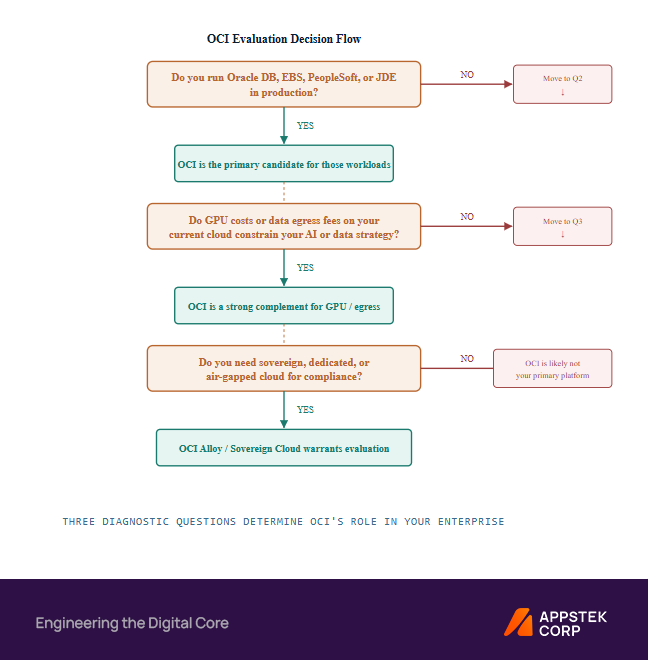
An OCI evaluation begins with three diagnostic questions:
- Does the organization have a significant Oracle technology footprint?
- Are GPU intensive or data egress heavy workloads constrained by cloud costs?
- Do regulatory or operational requirements call for sovereign, dedicated, or air gapped cloud deployment?
A positive answer to one or more of these questions indicates that OCI merits a formal workload assessment. When all three answers are negative, OCI may still deliver value as a targeted platform for specific use cases or as part of a broader multicloud strategy. The business case for adopting OCI as the primary cloud platform, however, is considerably weaker.
OCI Readiness Checklist Before Vendor Evaluation
Successful cloud initiatives begin with internal assessment rather than vendor engagement. A structured readiness review enables organizations to evaluate enterprise cloud infrastructure requirements objectively while establishing priorities before entering technology discussions. Assessment should focus on four key dimensions.
Dimension 1: Oracle Technology Footprint
- Which Oracle products (Database, EBS, PeopleSoft, JDE, Fusion, NetSuite) run in production today?
- What is the database estate, and how many instances, what size, and on which versions?
- How customized are your Oracle applications? Are there custom modules, integrations, or configurations that a generic migration tool would not preserve?
- What is the current Oracle licensing model (on-premises, BYOL, ULA, cloud subscription)?
Dimension 2: Cloud Cost Structure
- What is the current monthly data egress volume and associated cost across existing cloud platforms?
- Are regional pricing premiums being paid for deployments outside US East or EU West?
- Which GPU types and capacity levels are required for AI and ML workloads, and what are the associated monthly costs at current provider rates?
- How is cloud spending distributed across compute, storage, and networking?
Dimension 3: Compliance and Data Residency
- Do any workloads require data to remain within a specific country or legal jurisdiction?
- Do business operations involve defense, intelligence, government, or other sectors that require air gapped or classified infrastructure?
- Do regulatory frameworks such as GDPR, HIPAA, SOX, or PCI DSS impose requirements on where and how data is stored and processed?
- Would a dedicated cloud region, deployed within the organization’s data center and operated by the cloud provider, satisfy compliance requirements that a public cloud deployment cannot?
Dimension 4: Organizational Readiness
- What cloud platform expertise exists across engineering teams, including certifications, operational experience, and automation assets?
- How much infrastructure as code, CI/CD automation, and monitoring relies on the current cloud provider’s native services versus portable technologies such as Terraform, Kubernetes, or Prometheus?
- Does the organization have the operational capacity to manage a multicloud environment, or would an additional cloud platform introduce governance and operational complexity?
- Which internal stakeholders, including finance, compliance, engineering, and procurement, must be aligned before a cloud platform decision is made?
Scoring guidance: If Dimension 1 shows a significant Oracle footprint AND Dimensions 2 or 3 show structural cost or compliance drivers, the OCI evaluation merits a formal workload assessment. If Dimension 1 is empty and Dimension 4 shows deep investment in a competing platform, OCI is better evaluated as a tactical complement (for specific workloads) rather than a primary platform migration.
Ready to Run the OCI Readiness Assessment?
AppsTek’s OCI practice helps organizations evaluate OCI alongside other cloud solutions for enterprise, delivering workload-level assessments across Oracle footprint, cost structure, compliance posture, and organizational readiness. Connect with an Oracle expert today.
Frequently Asked Questions About Oracle Cloud AI Infrastructure
For enterprises with significant Oracle technology footprints, OCI is not just a realistic alternative, it is often the optimal primary platform for those workloads. For organizations with no Oracle investment and deep AWS/Azure expertise, OCI is better evaluated as a strategic complement for specific workloads (GPU compute, data egress optimization, sovereign cloud) rather than a wholesale replacement.
Yes. Most enterprise OCI adoptions start with a single workload category, typically Oracle Database migration, GPU compute for AI, or a sovereign cloud requirement, while keeping existing workloads on the incumbent provider. OCI's physical co-location inside AWS, Azure, and Google Cloud data centers enables microsecond-latency interoperability, making incremental adoption practical without rearchitecting your existing stack.
Organizational readiness, specifically, the cost of rebuilding automation, retraining teams, and establishing operational playbooks on a new platform. The infrastructure cost comparison may favor OCI, but if the team has three years of AWS-specific tooling and expertise, the transition cost is measured in productivity loss and hiring, not just licensing fees. Evaluate Dimension 4 of the readiness checklist honestly before committing.
Both, but in sequence. Begin with an independent workload assessment conducted by a services partner that works across multiple cloud platforms. An objective evaluation helps identify which workloads are well suited to OCI and which are better served elsewhere. Once that assessment is complete, engage Oracle to discuss commercial terms with a clear understanding of the architectural fit.
Entering the Oracle sales process with an independent assessment strengthens negotiating leverage, reduces the risk of overcommitting, and grounds commercial discussions in validated technical and business requirements.
A well-structured evaluation typically takes 6 to 10 weeks: 2 weeks for the internal readiness assessment (the checklist in this guide), 2 to 4 weeks for a workload-level technical assessment and cost model, and 2 to 4 weeks for stakeholder alignment and commercial negotiation. Enterprises that skip the internal readiness step often spend months in an unfocused evaluation that produces ambiguous conclusions.

About The Author
Rahul Sudeep, Senior Director of Marketing at AppsTek Corp, is a results-driven, AI-first B2B marketing leader with 15 years of experience scaling global enterprise SaaS companies. His expertise, honed at IIM-K, spans architecting high-impact go-to-market strategies, driving new market identification and positioning, and embedding Generative AI, LLMs, and predictive analytics into the core marketing function. Rahul unifies Technology, Sales, and Support teams around a single strategic hub, while also managing key Partner and Investor Relations. He leverages AI-driven insights to craft powerful brand narratives and hyper-personalized demand generation campaigns that drive measurable revenue growth and deepen customer engagement.