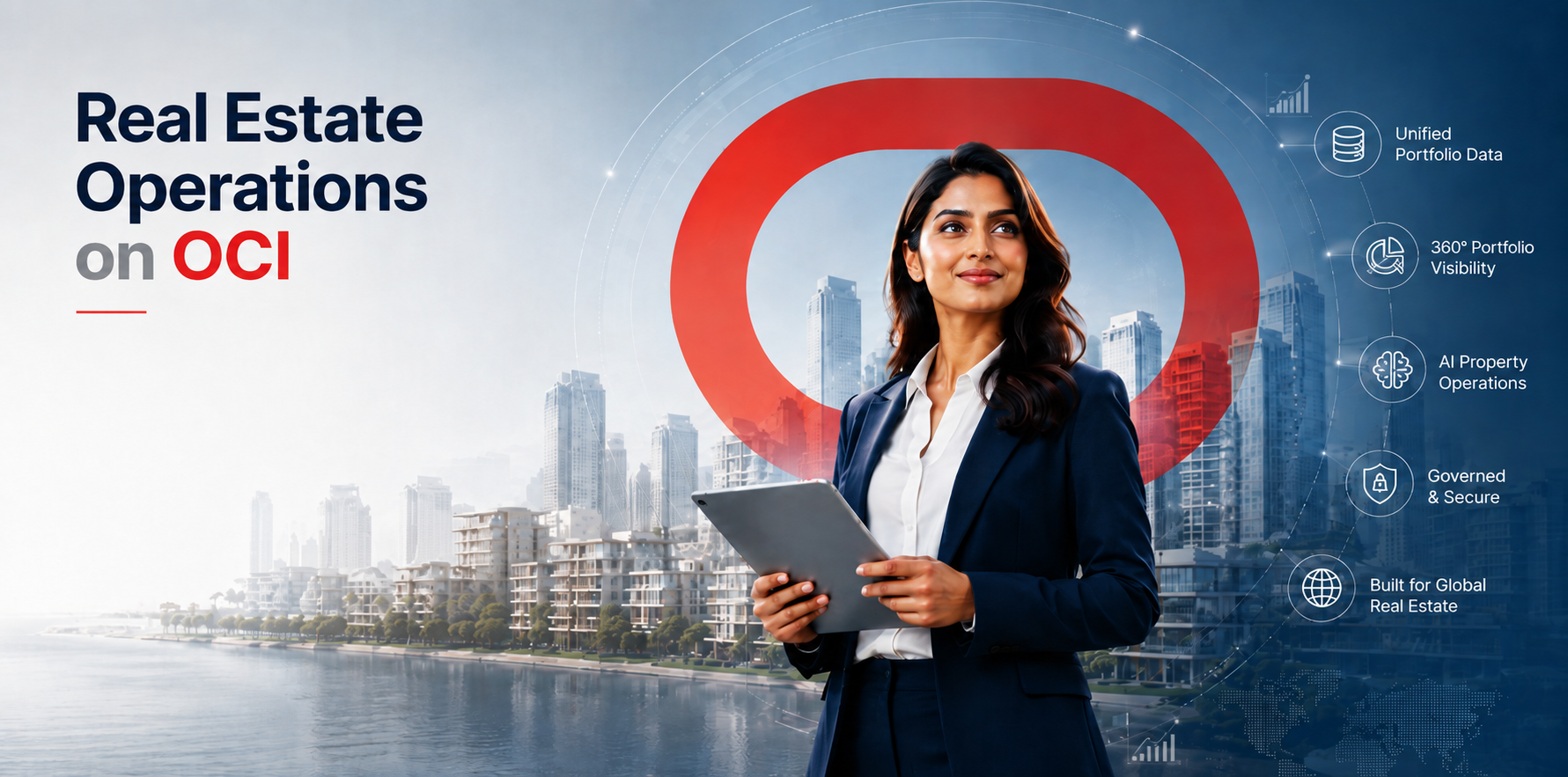



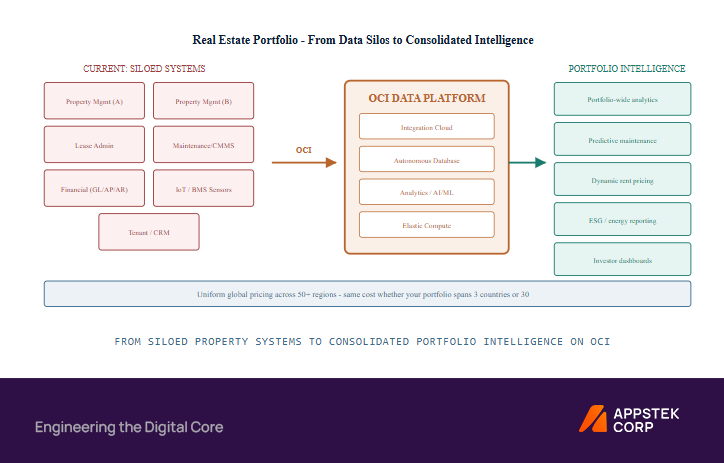
Real Estate Operations on OCI provides a shared data and integration layer across that fragmented estate. Oracle Integration connects applications and building data, while Oracle Autonomous AI Database creates a consolidated portfolio foundation. OCI Compute supports reporting peaks, Oracle Analytics Cloud turns governed data into insight, and OCI Data Science supports machine learning. The result is a stronger Real Estate Operating Model that keeps current systems of record in place while making portfolio data usable across operations and AI Property Operations.
Why do global real estate portfolios struggle with fragmented data
A portfolio-level question quickly exposes disconnected systems. Calculating blended occupancy across 500 properties, weighted by revenue and adjusted for lease expiration risk, may require several exports followed by manual reconciliation. Analyst time disappears into preparation before the answer reaches decision-makers. Portfolio analysis needs a platform that can ingest information, map different data models, preserve lineage, and make trusted records available at enterprise scale.
The proptech market offers deep software for leasing, facilities, tenant engagement, energy management, and investor reporting. That depth creates value inside each function, yet it can also expand the number of data boundaries. MRI Software’s 2026 analysis describes the same pattern: point solutions outside an integrated architecture create silos, increase complexity, and limit scale. Integration and governance become operating requirements rather than cleanup projects.
Acquisitions make the issue more visible. Each transaction can introduce another property platform, a different chart of accounts, new vendor records, and separate operating standards. After several acquisitions, a real estate group may run multiple property and finance environments without a dependable portfolio view. Enterprise leaders then struggle to compare occupancy, lease exposure, maintenance demand, operating cost, and regional performance through one model.
AI raises the cost of fragmented data. Buildium reported that property management AI adoption increased from 20% to 58% in one year, while only 8% of companies had fully automated a workflow. AI Property Operations depend on connected records with reliable context. Predictive maintenance needs sensor history, equipment hierarchies, and work orders across buildings. Pricing intelligence needs occupancy, lease, market, and transaction data in comparable formats. Data readiness becomes the dividing line between a promising pilot and repeatable operational value.
What must cloud infrastructure solve for enterprise real estate
A modern Real Estate Operating Model needs infrastructure that can unify application data, absorb reporting peaks, support properties across jurisdictions, connect building systems, and apply controls to tenant information. The root cause sits at the data, integration, compute, or deployment layer.
| Challenge | What it looks like | Infrastructure response |
|---|---|---|
| Data consolidation | Property platforms hold separate occupancy, revenue, and lease views. | Integration and database services map records into a common portfolio model. |
|
Reporting peaks |
Close and investor reporting create short periods of heavy demand. | OCI resources scale for the window, then reduce as demand falls. |
| Global operations | Properties across regions require local services. | OCI regions support local deployment with consistent service pricing. |
|
IoT and BMS data |
Building systems produce high-volume operational data. | Oracle Integration connects flows for database and analytics use. |
| Tenant data privacy | Rules and residency requirements vary by jurisdiction. | Distributed deployment options support jurisdiction-specific architecture. |
How does OCI support a modern Real Estate Operating Model
OCI can operate as the shared data platform beneath established property applications. Yardi, MRI, RealPage, finance systems, maintenance platforms, and tenant applications remain the systems used for daily work. Oracle Integration connects those environments, Oracle Autonomous AI Database consolidates governed portfolio data, and Oracle Analytics Cloud supports reporting.
OCI Compute can expand during month-end or quarter-end processing, then contract as demand falls. This architecture supports Real Estate Operations on OCI without forcing a portfolio-wide replacement and gives acquired assets a repeatable route into the enterprise data model.
Oracle Autonomous AI Database as the portfolio data foundation
Oracle Autonomous AI Database automates routine provisioning, backups, patching, tuning, and elastic scaling. That reduces the operational burden on property technology teams with limited database capacity. Data from property, finance, maintenance, and building systems can be standardized into a common model for occupancy, revenue, lease exposure, asset condition, and operating cost. Governance, access design, data quality, and application security remain part of the Real Estate Operating Model.
Oracle Integration for a connected property technology stack
Oracle Integration provides prebuilt adapters, orchestration, visual mapping, and runtime monitoring across cloud and on-premises applications. A hub-and-spoke pattern lets each system connect through a governed layer instead of a growing web of point-to-point interfaces. Property data can then move into finance, analytics, maintenance, and reporting services through reusable flows. Each new asset gains a consistent route into the enterprise data model.
Why uniform global pricing matters across portfolio geographies
Global portfolios often need services near properties and tenants for performance, resilience, and residency. OCI operates 50-plus public cloud regions across 28 countries and promotes consistent service pricing across public regions. Comparable services therefore carry the same published base price across geographies. Taxes, commercial agreements, and implementation choices still affect the final bill, but the model gives portfolio leaders a more stable basis for forecasting.
How 10 TB of free monthly outbound data transfer supports analytics
Real estate analytics depends on data moving between properties, regions, applications, and reporting environments. OCI pricing includes the first 10 TB of outbound data transfer each month at no charge. Rates above that allowance vary by originating geography, so current pricing should guide the architecture. The allowance can still cover a meaningful share of occupancy, sensor, finance, and market data movement.
Which AI Property Operations become practical on OCI
Consolidated property data turns isolated AI experiments into governed capabilities. Predictive maintenance can combine BMS signals, asset age, inspections, and work orders to identify equipment risk. Pricing models can evaluate market conditions alongside occupancy and lease timing, with business rules and human approval shaping action.
ESG reporting can unify energy, water, emissions, and certification data. Portfolio risk analytics can track lease concentration, tenant exposure, market conditions, and occupancy trends. Each use case follows the same sequence: connected data, trusted context, governed models, and action inside operational workflows.
| AI use case | Data required | OCI capability | Operational impact |
|---|---|---|---|
| Predictive maintenance | BMS signals, work orders, asset age | Oracle Integration, Autonomous AI Database, OCI Data Science | Earlier risk detection and better maintenance planning |
| Pricing intelligence | Market, occupancy, lease, and demand data | Autonomous AI Database, OCI Data Science, Oracle Analytics Cloud | Faster governed pricing recommendations |
| ESG reporting | Energy, water, emissions, certifications | Oracle Integration, Autonomous AI Database, Oracle Analytics Cloud | Consistent reporting and clearer efficiency opportunities |
| Portfolio risk | Leases, tenant exposure, market and occupancy trends | Autonomous AI Database, Oracle Analytics Cloud, OCI AI Services | Current risk views and earlier concentration signals |
The market evidence supports the infrastructure case. Buildium’s 2026 research confirms rapid AI adoption alongside limited end-to-end automation. MRI Software identifies clean, governed, unified data as a prerequisite for AI at scale. McKinsey estimates that AI and automation could create roughly $430 billion to $550 billion in annual value across real estate, construction, and development. Real Estate Operations on OCI supplies the data foundation, integration patterns, cloud controls, and analytics services needed to move AI Property Operations into repeatable production workflows.
Conclusion
Real estate portfolios grow more complex with every acquisition, new property, and additional application. Long-term value comes from creating a connected operating model where portfolio data, operational workflows, and AI work together under consistent governance. Real Estate Operations on OCI provides that foundation, enabling organizations to modernize data without replacing the systems that already run the business.
Enterprise success depends on more than cloud infrastructure alone. It requires the right integration strategy, governed data architecture, and a roadmap that turns AI Property Operations into measurable business outcomes.
Explore how AppsTek helps enterprises modernize Oracle environments through its Oracle Cloud Infrastructure Services, discover additional insights about Oracle, or connect with our specialists to discuss a real estate modernization strategy built around connected data, enterprise AI, and long-term operational resilience.
Frequently asked questions about Real Estate Operations on OCI
OCI complements established property platforms. Operational teams can continue using Yardi, MRI, RealPage, and other systems for leasing, accounting, maintenance, or tenant service. Oracle Integration connects those applications, Oracle Autonomous AI Database consolidates selected records, and Oracle Analytics Cloud makes governed information available for portfolio reporting and AI use cases.
OCI offers public, sovereign, dedicated, and customer-site deployment choices. Placing workloads in an approved region can support residency requirements, although compliance also depends on data classification, replication, encryption, access controls, backup location, and operating procedures. A common architecture can span countries while deployment decisions remain aligned with local obligations.
Oracle Autonomous AI Database acts as a governed portfolio data store. It can ingest records from property, finance, maintenance, and building systems, then standardize them for analysis. Automated administration supports variable reporting demand, while the shared model provides dependable inputs for maintenance intelligence, pricing analysis, ESG reporting, and risk monitoring.
A multi-country portfolio often needs cloud capacity in several regions for performance, resilience, or residency. Regional price differences can make forecasts dependent on asset location. OCI's consistent regional pricing creates a clearer planning base as properties are acquired, sold, or added in new markets, while taxes and contract terms remain part of the final calculation.
Value depends on equipment hierarchies, sensor coverage, work-order history, failure labels, and maintenance workflows. Portfolios with connected BMS and CMMS data can begin with condition-based alerts, then introduce predictive models as historical evidence improves. The business case should measure avoided downtime, emergency work, service response, equipment life, and false-alert rates rather than rely on one industry benchmark.

About The Author
Rahul Sudeep, Senior Director of Marketing at AppsTek Corp, is a results-driven, AI-first B2B marketing leader with 15 years of experience scaling global enterprise SaaS companies. His expertise, honed at IIM-K, spans architecting high-impact go-to-market strategies, driving new market identification and positioning, and embedding Generative AI, LLMs, and predictive analytics into the core marketing function. Rahul unifies Technology, Sales, and Support teams around a single strategic hub, while also managing key Partner and Investor Relations. He leverages AI-driven insights to craft powerful brand narratives and hyper-personalized demand generation campaigns that drive measurable revenue growth and deepen customer engagement.