



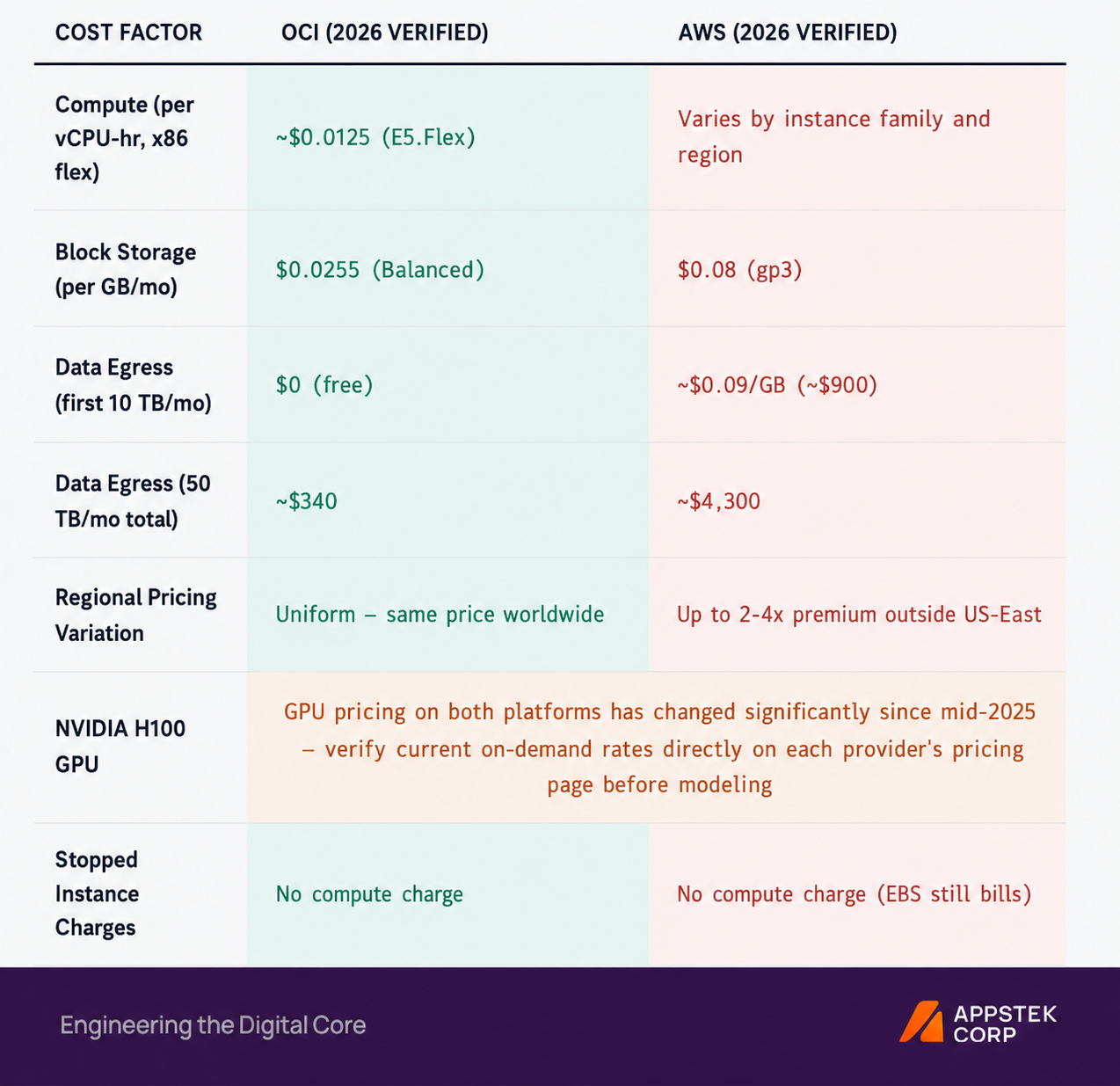
Oracle Cloud Infrastructure costs less structurally than AWS for general compute. Block storage drops by up to 70 percent at $0.0255 per GB compared to $0.08 per GB. Data egress offers 10 TB free monthly alongside 100 GB on the competing platform. At 50 TB of monthly egress volume, OCI bills approximately $340 whereas AWS charges around $4,300.
GPU pricing on both platforms shifted significantly throughout 2025 and 2026. OCI H100 on-demand rates remain consistently lower than AWS equivalent offerings. Exact figures change frequently. Direct verification on each provider pricing page remains essential before committing budgets.
AWS wins on managed service breadth alongside specialized instances like Graviton or A10-class GPUs. Partner integration depth heavily favors the Amazon ecosystem. The right Oracle Cloud vs AWS evaluation requires pinpointing the lowest overall expense for a specific workload profile. IT leaders must factor in software
Why List Prices Miss the Actual Cost Story
Every Oracle Cloud vs AWS comparison tends to open the same way: a table of on-demand hourly rates side by side. OCI’s general-purpose compute lands roughly 50% cheaper, and the recommendation writes itself before analysis begins.
That framing skips several structural realities. On-demand pricing reflects what buyers pay with zero commitment, no reserved capacity, and no negotiated enterprise agreement, and very few enterprises operate production estates that way. The realistic 12-month cost depends on variables no list-price table can express: compute rates, egress charges, Oracle licensing, regional premiums, commitment discount structures, and behavior under scale. The analysis below models three enterprise scenarios at 2026 pricing.
The Structural Reason OCI Costs Less
The OCI cost advantage is architectural rather than promotional. On AWS, a portion of every host CPU is consumed by the hypervisor managing network traffic, security enforcement, and storage I/O, and buyers pay for that CPU time even though the application never receives it. OCI’s Generation 2 architecture moved those functions to dedicated hardware processors, so 100% of the CPU billed flows to the workload, reflecting a permanent silicon-level design choice rather than a discount campaign expiring next quarter.
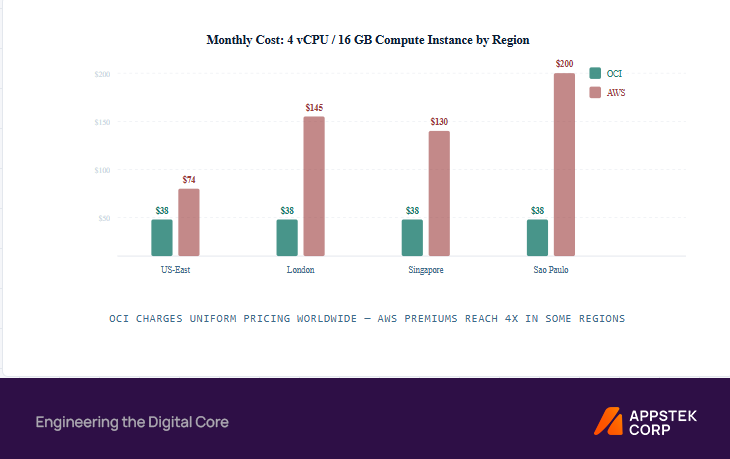
Two additional policies compound the gap. OCI charges uniform pricing across 50+ cloud regions worldwide, while AWS varies rates by geography, so the same m6a.xlarge instance can cost more than twice as much in London against Virginia, and nearly four times as much in Sao Paulo. OCI also includes 10 TB of monthly egress at zero charge while AWS includes 100 GB, a delta that can outweigh compute savings entirely for workloads moving meaningful data out of the cloud.
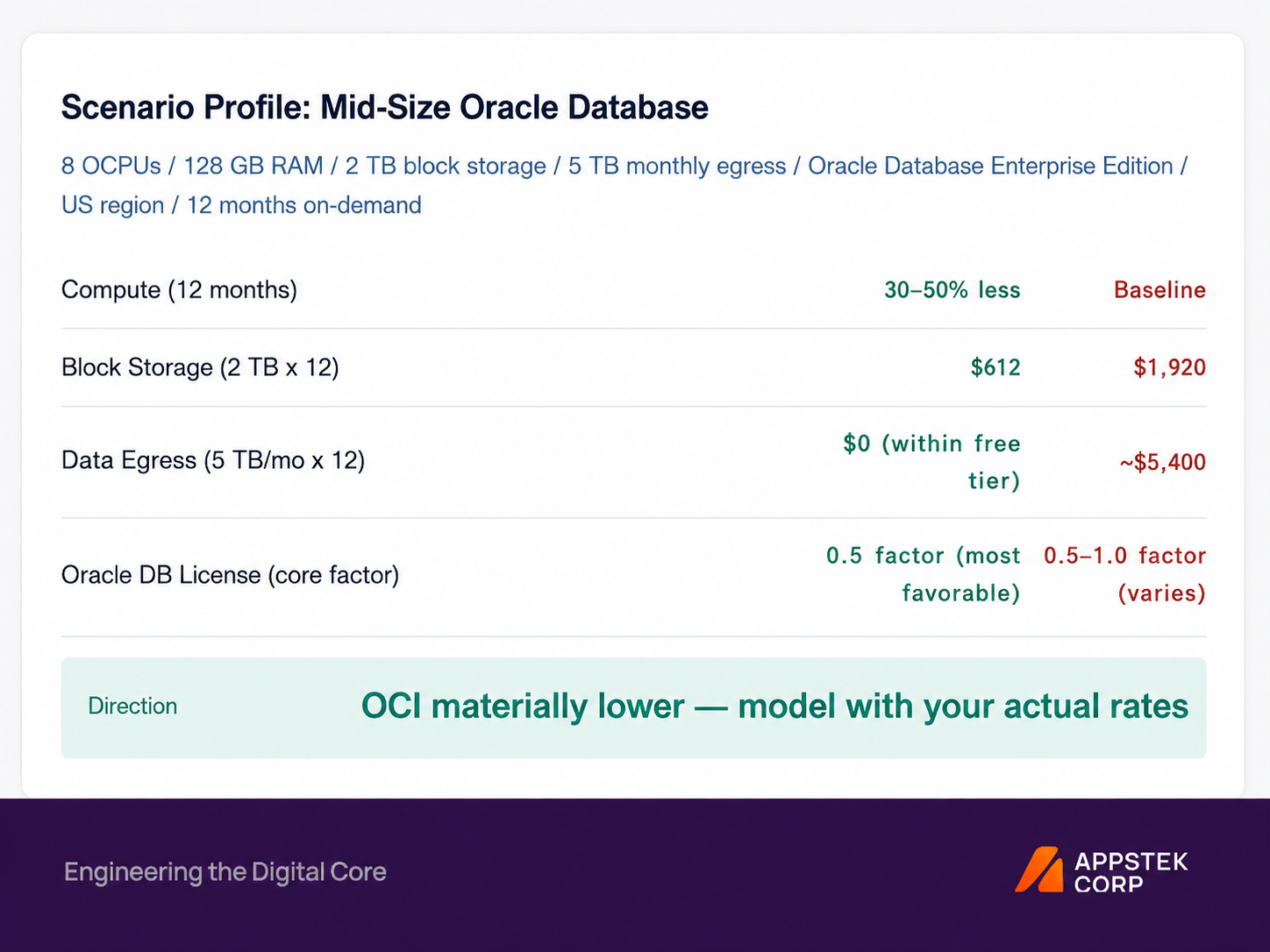
Scenario 1: Oracle Database Production Workload Across 12 Months
Oracle Database workloads generate the widest cost gap between OCI and AWS, driven by several compounding factors: OCI compute typically comes in 30 to 50% below equivalent AWS instances, egress inside the 10 TB free tier eliminates transfer charges completely, and Oracle licensing terms sit materially in OCI’s favor. For enterprises with significant Oracle Database estates, the licensing advantage alone can exceed the compute savings.
Oracle Database licensing applies a “core factor” multiplier determining how many processor licenses each core requires. On OCI, the core factor sits at 0.5, the most favorable rate available. On AWS, the core factor depends on processor type and typically ranges from 0.5 to 1.0, with vCPU-to-license mapping calculated differently. The practical effect: running the same workload on AWS demands additional licenses, higher support fees, and greater audit exposure than running the identical workload on OCI. This licensing decision precedes the infrastructure decision, and it frequently drives a larger cost difference than compute pricing alone.
Scenario 2: AI/ML GPU Workload Across 12 Months
GPU cloud pricing shifted significantly since mid-2025, with AWS cutting H100 on-demand rates and OCI adjusting its rate card in response. As of mid-2026, OCI’s H100 on-demand pricing remains below AWS for equivalent bare-metal configurations, though the gap depends on instance type, region, and commitment model. AI training generates large checkpoint files transferred out of the cloud, where OCI’s 10 TB of free monthly egress removes a cost that grows linearly on AWS.
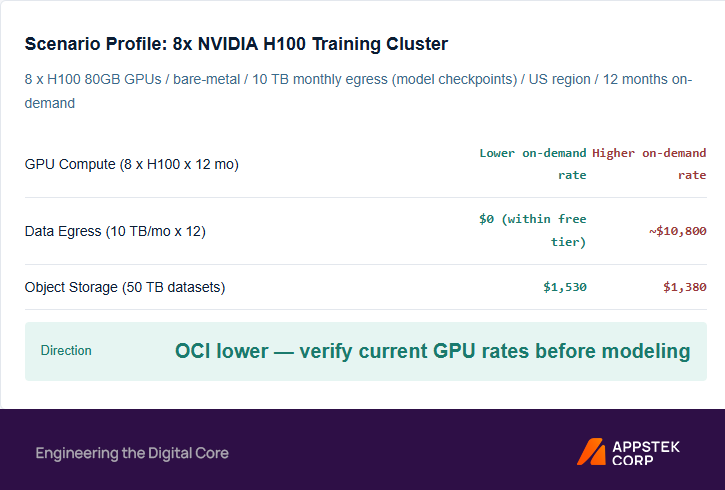
GPU cloud rates rank as the most volatile category in cloud infrastructure. AWS cut H100 pricing by up to 44% in June 2025, and OCI adjusted rates accordingly, so any comparison built around specific hourly GPU rates goes stale within months. The structural advantages holding steady include OCI’s 10 TB of free monthly egress (worth roughly $10,800 annually at 10 TB per month), bare-metal architecture that removes hypervisor overhead consuming GPU cycles, and uniform global pricing eliminating regional GPU premiums entirely. For smaller GPU configurations such as A10-class inference nodes, AWS has historically delivered competitive or lower pricing than OCI, with dynamics shifting as GPU count and egress volumes climb.
What Is OCI? The Complete Enterprise Guide to Oracle Cloud Infrastructure in 2026
Scenario 3: Data-Heavy Multicloud Application Across 12 Months
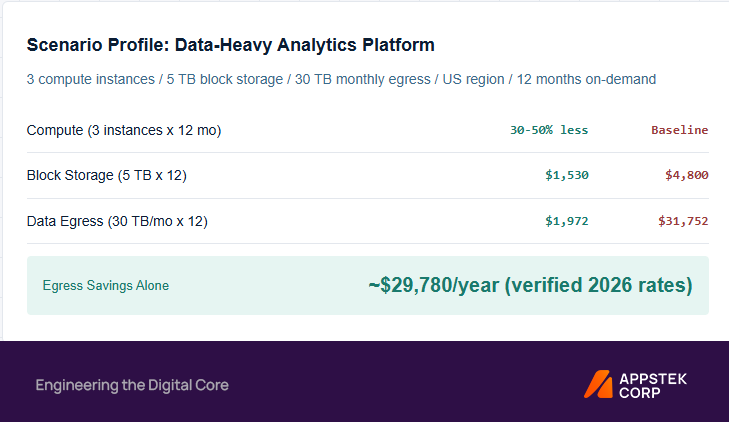
For data-heavy applications transferring 30 TB per month, egress alone lands at approximately $1,972 annually on OCI (10 TB free plus 20 TB at $0.0085/GB) versus roughly $31,752 on AWS (at approximately $0.09/GB), a verified difference of nearly $30,000 annually on egress alone. Combined with OCI’s lower compute and storage rates, total 12-month savings typically exceed 50% for data-intensive workloads.
Egress becomes the surprise line item for enterprises migrating to AWS out of on-premises environments where data movement ran essentially free. At 30 TB monthly, egress on AWS runs nearly as high as compute itself, producing a 16x delta against OCI on a single line item. For multicloud architectures where data moves regularly between OCI and AWS or Azure, OCI’s physical co-location inside hyperscaler data centers eliminates cross-cloud egress entirely.
The Oracle Licensing Factor Cloud Comparisons Skip
Beyond core factor mechanics, Oracle’s BYOL conversion allows existing on-premises licenses to apply to OCI through a straightforward mapping, whereas applying those same licenses to AWS carries more restrictive terms and greater compliance complexity. For enterprises with heavy prior investment in Oracle licensing, the conversion advantage can outweigh compute savings inside the first year. Audit exposure also stays lower on OCI because deployments can be verified against entitlements natively. Many AWS vs Oracle Cloud comparisons skip this factor entirely, and any Oracle Cloud vs AWS cost comparison omitting a licensing line item is structurally incomplete.
Regional Pricing and the Hidden AWS Cost Outside US-East
AWS charges different prices for identical services across regions. According to Oracle’s own comparison page verified in 2026, the same general-purpose compute instance can cost more than 2x in London and nearly 4x in Sao Paulo compared to US-East. OCI charges uniform pricing across 50+ regions worldwide. For enterprises operating across multiple geographies, that AWS regional divergence can inflate the total cloud bill by 30 to 60% compared to the US-East baseline, a premium with no equivalent on OCI.
Across global deployments running dozens or hundreds of instances, this divergence alone can account for tens of thousands of dollars in annual cost difference before egress, storage, or licensing enter the calculation.
Where AWS Still Wins: An Honest Assessment
AWS retains clear advantages across managed service breadth, ecosystem and third-party integrations, small-scale GPU workloads (A10-class), and Graviton (Arm) price-performance. Enterprises whose primary workloads are cloud-native microservices built on AWS-specific managed services will find that switching costs to OCI exceed the infrastructure savings.
AWS offers over 200 managed services, many of which have no direct equivalent on OCI. Architectures depending on DynamoDB, Kinesis, SQS, Step Functions, or Aurora PostgreSQL sit on AWS-native services with no API-compatible replacement on OCI, so moving those workloads means rearchitecting rather than rehosting. AWS Marketplace and third-party tooling integrations also remain broader than OCI’s, which compounds for engineering teams running playbooks built around AWS-native tooling. For single-GPU or dual-GPU A10-class inference, AWS pricing has historically been competitive or lower than OCI, and AWS Graviton processors deliver strong price-performance for cloud-native workloads compiled for Arm architecture.
The honest read: AWS suits organizations without an Oracle footprint, with deep AWS-native managed service dependencies and workloads built for Graviton. OCI wins on Oracle workloads, GPU-intensive AI, data-heavy applications, sovereign cloud requirements, and global deployments where uniform pricing and egress economics matter. Enterprises in 2026 increasingly evaluate both platforms as complements rather than competitors.
Cloud economics extend well beyond infrastructure pricing. Architecture, workload design, AI readiness, and long-term operating costs ultimately determine where value is created. Explore how Oracle Cloud Infrastructure supports enterprise modernization, AI, and high-performance workloads, or discover additional insights across our resources.
Frequently Asked Questions About Oracle Cloud AI Infrastructure
Yes, across compute, storage, and egress at on-demand list rates. OCI block storage runs approximately 70% cheaper ($0.0255/GB versus $0.08/GB), data egress runs dramatically cheaper (10 TB free monthly versus 100 GB on AWS). General compute lands 30 to 50% below AWS for equivalent instances.
Typically yes. Oracle's core factor is most favorable on OCI at 0.5, meaning fewer licenses per core, while on AWS the core factor and vCPU mapping can raise effective licensing cost by 30 to 100%. BYOL conversion also runs more straightforwardly on OCI, and audit exposure stays lower because OCI can verify entitlements natively.
AWS prices services independently by region based on local infrastructure costs, tax structures, and market conditions, so the same instance type can cost 2x more in London and nearly 4x more in Sao Paulo compared to US-East. OCI charges uniform pricing worldwide across all 50+ regions, removing regional cost variability for global deployments.
AWS makes sense when workloads are tightly coupled to AWS-native managed services such as DynamoDB or Step Functions, when engineering automation sits entirely inside AWS, when GPU needs are small-scale A10-class inference, or when applications are already optimized for Graviton. Under those conditions, switching costs typically exceed infrastructure savings.
Yes. OCI physically co-locates hardware inside AWS data centers through Oracle Database@AWS, so data moves between OCI and AWS at microsecond latency inside the same facility with zero cross-cloud egress charges applied. Universal Credits allow both platforms to be procured under a single contract.

About The Author
Rahul Sudeep, Senior Director of Marketing at AppsTek Corp, is a results-driven, AI-first B2B marketing leader with 15 years of experience scaling global enterprise SaaS companies. His expertise, honed at IIM-K, spans architecting high-impact go-to-market strategies, driving new market identification and positioning, and embedding Generative AI, LLMs, and predictive analytics into the core marketing function. Rahul unifies Technology, Sales, and Support teams around a single strategic hub, while also managing key Partner and Investor Relations. He leverages AI-driven insights to craft powerful brand narratives and hyper-personalized demand generation campaigns that drive measurable revenue growth and deepen customer engagement.