Table of Contents
How common is mortgage fraud risk in 2026?
Why does document review fail against AI-forged papaerwork?
What does it mean to verify mortgage documents against source data?
What does a source-data verification workflow look like?
Where do people stay in control of fraud decisions?
How do lenders stop payoff and wire fraud?
What should COO and a COO Measure?
How do lenders start verifying against source data?
What does AI-forged paperwork mean for mortgage lenders?



Key Takeaways
- Fraud risk is rising: Cotality estimates that 1 in 112 US mortgage applications showed indications of fraud risk in Q3 2026, up from 1 in 119 in Q2.
- Document review has a blind spot: A forged document can be flawless, because document review checks the paper against itself.
- Source data closes the gap: Lenders confirm each fact where it originates and look for patterns across loans that a single file hides.
- People keep the decisions: The agent scores and explains, the risk team decides, and a call-back confirms any payoff or wire change.
A pay stub arrives with a clean employer logo and year-to-date totals that match the loan application. The reviewer checks the arithmetic, confirms the figures against the file, and moves on, having done everything the process asks. The review was sound, yet the pay stub was built to pass it.
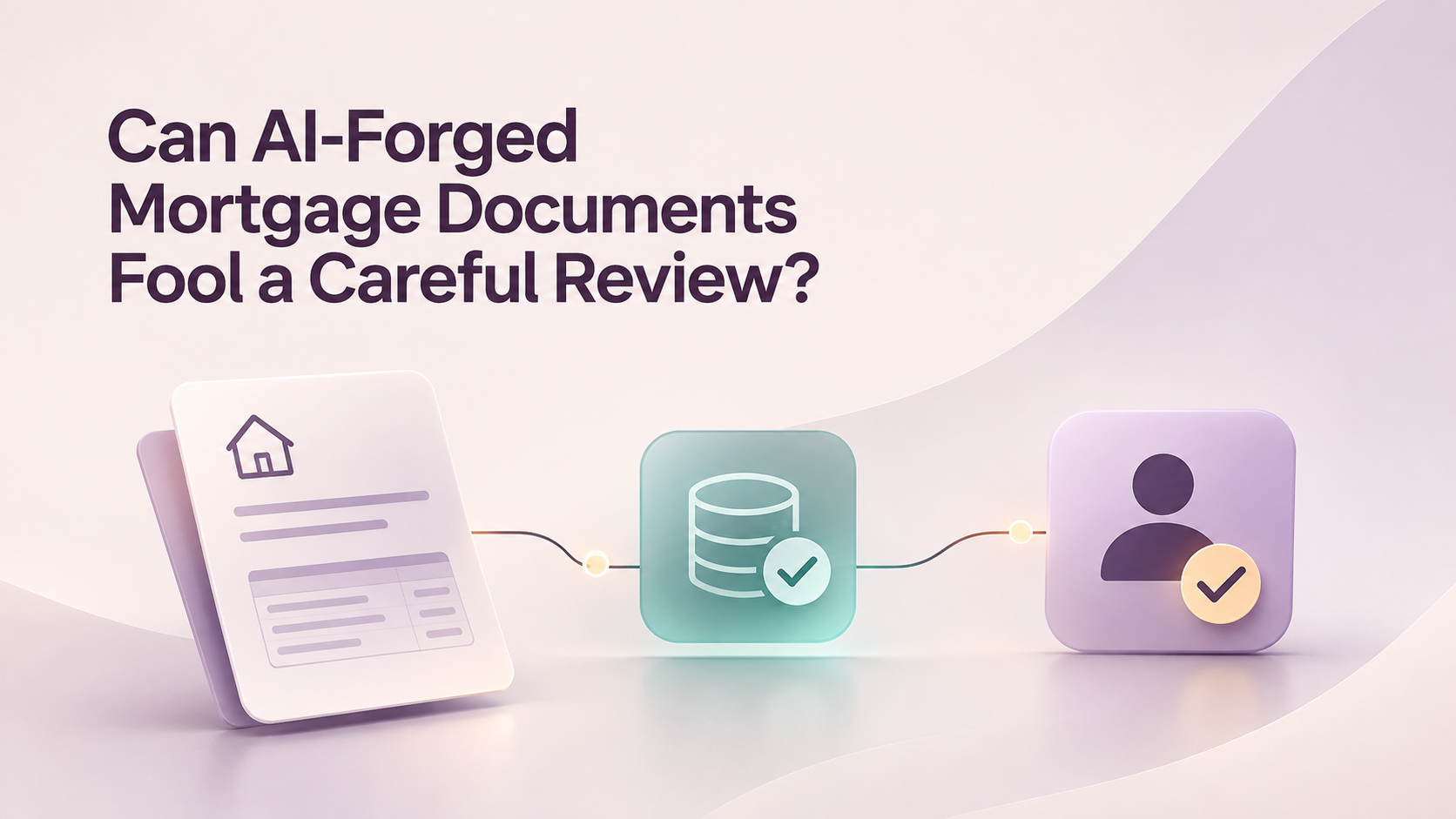
AI-forged mortgage documents change what a careful review can prove. As forgeries become more polished, a document check tells a lender less about the borrower behind it. For chief operating officers (COOs) and chief compliance officers (CCOs) at US mortgage lenders, the practical answer is to verify each borrower fact against source data and to keep accountable people in charge of every decision. The sections below explain why document review falls short, how source-data verification works, and where human oversight belongs.
How common is mortgage fraud risk in 2026?
Cotality estimates that 1 in 112 US mortgage applications showed indications of fraud risk in the third quarter (Q3) of 2026, up from 1 in 119 in the second quarter. The company’s National Mortgage Application Fraud Risk Index rose 5.8% to 139 in Q3, following a 9.1% rise in Q2, when purchase loans climbed to 72% of application volume from 59% in Q1. Purchase loans tend to carry more risk because they require income, asset, and appraisal documents, which gives fraudsters more paperwork to alter.
The headline figure needs careful reading. Cotality’s index measures applications with indications of fraud risk, as scored by its LoanSafe Fraud Manager predictive tool. The index does not count proven fraud, and it does not isolate AI-forged paperwork. Cotality tracks six categories: identity, income, occupancy, property, transaction, and undisclosed real estate debt.
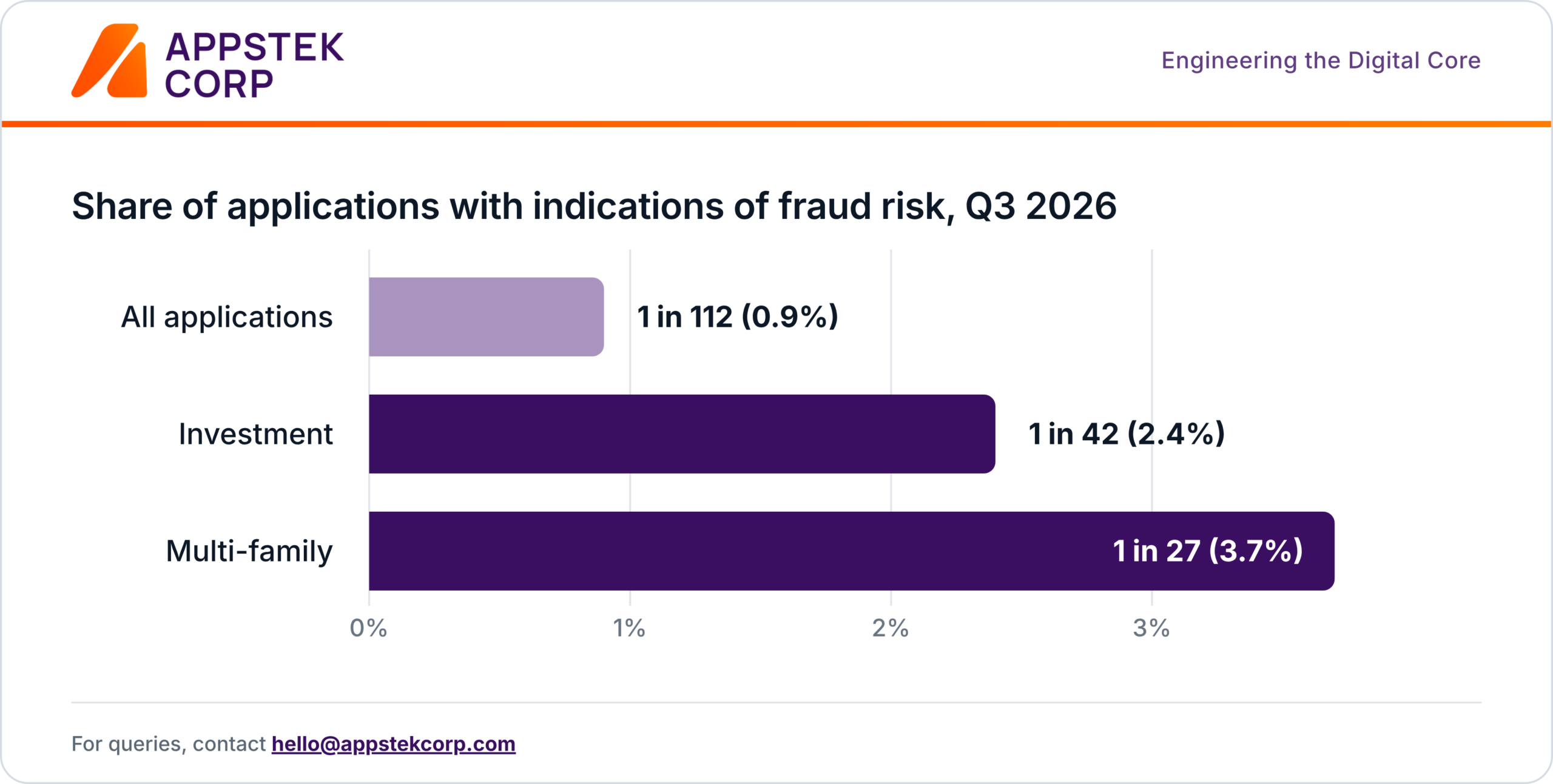
Risk is also concentrated. In Q3 2026, about 1 in 42 investment applications and 1 in 27 multi-family applications showed indications of fraud risk, and property fraud risk rose more than any other category. In Q2, undisclosed real estate debt was the only category that rose year over year. Neither risk is something a borrower’s own documents will volunteer.
Why does document review fail against AI-forged paperwork?
Document review checks a document against itself, and generative AI makes a document consistent with itself.
- The forgery is internally consistent: Generative AI tools reproduce fonts, layouts, and totals that agree with one another. The tells that reviewers once relied on, such as sums that do not add up or uneven spacing, are the first to disappear.
- Genuine documents can be edited rather than rebuilt: An altered bank statement keeps nearly all of its authentic detail, so a surface check passes it. Cotality’s Q3 2026 report warns that generative AI tools enable “sophisticated document alteration that can easily bypass manual, human review”.
- Single-file review hides the pattern: Cotality advises lenders to look for patterns in the data, because AI-altered documents are not always easy to spot on a loan-by-loan basis.
- Identity can be faked too: In the American Land Title Association (ALTA) 2026 seller impersonation fraud study, 87% of title firms rated spoofed contact information as at least a somewhat common tactic, and 58% said the same of deepfake image or voice technology. A phone call or video chat, on its own, no longer proves who someone is.
The target is also moving. FundingShield, which monitors wire and title fraud risk across a portfolio of more than $120 billion, reported that 45.32% of the transactions it monitored in Q2 2026 were flagged for issues, up from 43.72% in Q1. The firm also identified a new and growing category of identity and payoff fraud flags, driven by deepfake seller impersonation and mortgage payoff schemes.
What does it mean to verify mortgage documents against source data?
Source-data verification treats every borrower document as a claim and confirms that claim where the fact originates. The document still matters, but as a pointer to the evidence rather than as the evidence itself.
| What the borrower provides | What document review sees | What source-data verification checks |
|---|---|---|
| Pay stub | Consistent totals and a plausible employer | Income and employment confirmed with the payroll or employer data source |
| Bank statement | Balances and deposits that look normal | Account data received directly from the bank with the borrower's consent |
| Photo ID | A valid-looking document and photo | An ID check plus a liveness match to the person applying |
| Payoff letter or wire instruction | Correct letterhead and wording | The payoff matched to title data and confirmed by call-back to a known number |
| Real estate owned and occupancy | Whatever the borrower stated | Property and public-record data, including debts the borrower did not list |
Source verification still requires judgment. What it removes is the need to judge a forgery by eye.
What does a source-data verification workflow look like?
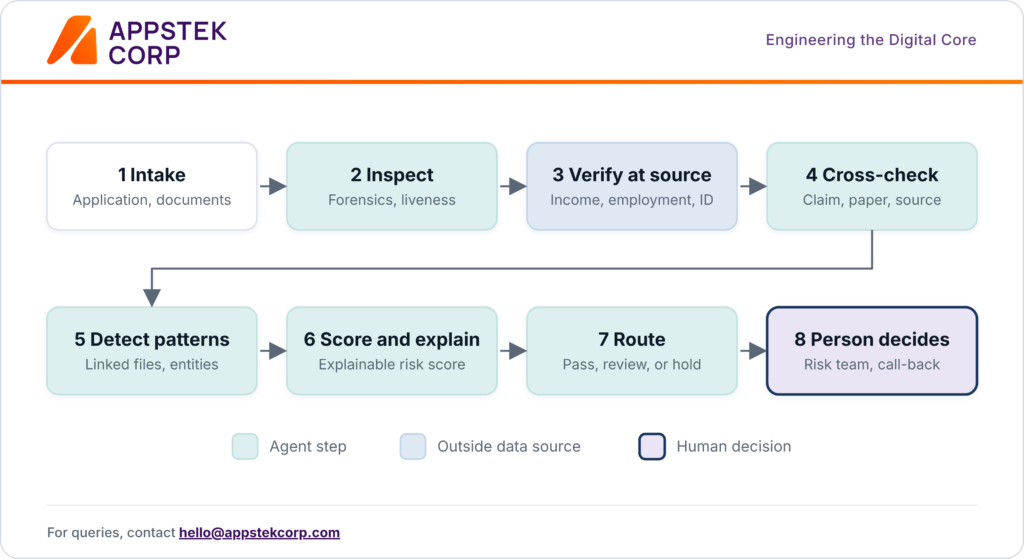
The fraud and identity agent in AppsTek AI Services for mortgage lenders follows eight steps. In Figure 2, teal steps belong to the agent, the blue step is a check against an outside data source, and the lavender step is a decision made by a person.
NUMBERED STEPS
- Intake: The application, documents, and ID arrive through any channel and are tied to one loan file.
- Inspect: The agent checks each document for edits, inconsistent metadata, and signs of AI generation, and matches the ID to a live person, with voice and video checks for deepfake indicators.
- Verify at the source: Income, employment, and identity are confirmed directly with the data sources rather than from the borrower’s copy.
- Cross-check: The agent compares what the borrower stated, what the documents show, and what the source returned, and lists every mismatch.
- Detect patterns: The agent looks across files for reused profiles and linked entities, such as the same phone number, address, or device behind unrelated borrowers.
- Score and explain: The agent produces a risk score with the reasons behind it, in plain language that a reviewer can challenge.
- Route: Low-risk files continue, mid-risk files go to review, and high-risk files are held before funds move.
- Decide: The risk team clears the file, asks for more evidence, or holds it, and the closer confirms any payoff or wire change by call-back.
Where do people stay in control of fraud decisions?
People stay in control at every decision point. The agent never denies a loan and never accuses a borrower, and the risk team decides what happens to a flagged file. The person who approves a hold is not the person who releases it. Every score comes with its reasons, false positives are tracked so alerts do not overwhelm the team, identity data is handled under privacy controls, and every action is logged. For a CCO, that log is the evidence of how each flag was handled and why.
How do lenders stop payoff and wire fraud?
Lenders should treat any change to payoff or wire instructions as suspect until it is confirmed. The payoff should match title data, and confirmation should come by call-back to a number already on file, never to a number in the message requesting the change. Requesting and releasing funds should stay in different hands. Voices can be cloned and phone numbers can be spoofed, so the only reliable check is one the fraudster does not control.
What should a COO and a CCO measure?
Five measures show whether source-data verification is working and what it costs the team.
| Measure | What it tells you |
|---|---|
| Share of files verified at source | How far the lender has moved from paper to proof |
| Flags confirmed | Whether the alerts are real |
| False-positive rate | What the alerts cost the team in time |
| Time to clear a flag | Whether the risk team is a bottleneck |
| Files held before funding | How much fraud risk was stopped before money moved |
For scale, at Cotality’s Q3 2026 industry average of 1 in 112, a lender taking 5,000 applications a year would see about 45 with indications of fraud risk. The figure is arithmetic on an industry index rather than a forecast for any lender’s book, but it shows the size of the queue a verification process has to handle.
How do lenders start verifying against source data?
Start with one loan product where documents carry the most weight, such as purchase loans. In week 1, set a baseline: the share of files with alerts and the time it takes to clear them. Next, run the fraud and identity agent in shadow mode alongside the current process, and let the fraud team compare its results with their own. On day 30, review the results against the baseline and decide whether to scale, adjust, or stop. AppsTek AI Services structures its 30-day pilot around these steps.
What does AI-forged paperwork mean for mortgage leaders?
A clean document can no longer stand as evidence of a true fact. As generative AI lowers the cost of a convincing forgery, lenders that confirm income, employment, identity, and payoff details at the source, and that look for patterns across files, are likely to be better placed to manage fraud risk than lenders that rely on closer reading alone. Accountability does not move to the software: the risk team still makes every call, with clearer evidence in front of it. A single product and a 30-day baseline give operations and compliance teams measured results to act on before they commit to a wider rollout.
Talk to an AppsTek Corp expert to explore a 30-day rollout and establish a measurable foundation for stronger fraud detection.
Frequently Asked Questions
Lenders can detect AI-forged mortgage documents by examining document metadata, identifying signs of digital alteration, and verifying borrower information against original data sources. Cross-checking income, employment, identity, and financial records helps expose inconsistencies that visual document reviews may miss.
Source-data verification is the process of validating borrower information directly with its originating source rather than relying solely on submitted documents. It helps mortgage lenders confirm income, employment, identity, bank balances, and property details using independent data sources.
AI agents can inspect documents for signs of manipulation, compare submitted information against source data, identify suspicious patterns across loan files, and generate risk scores with supporting explanations. Human risk teams retain authority over investigation and lending decisions.
Lenders can reduce payoff and wire fraud by independently verifying payoff instructions against title data and confirming changes through callbacks to previously verified phone numbers. Separating approval and fund-release responsibilities adds another layer of control.
Traditional document review evaluates the consistency and appearance of submitted paperwork. AI-generated and manipulated documents can reproduce authentic layouts, figures, and formatting, making visual inspection less reliable. Source-data verification provides independent evidence to validate borrower claims.
Further Reading

About The Author
Rahul Sudeep, Senior Director of Marketing at AppsTek Corp, is a results-driven, AI-first B2B marketing leader with 15 years of experience scaling global enterprise SaaS companies. His expertise, honed at IIM-K, spans architecting high-impact go-to-market strategies, driving new market identification and positioning, and embedding Generative AI, LLMs, and predictive analytics into the core marketing function. Rahul unifies Technology, Sales, and Support teams around a single strategic hub, while also managing key Partner and Investor Relations. He leverages AI-driven insights to craft powerful brand narratives and hyper-personalized demand generation campaigns that drive measurable revenue growth and deepen customer engagement.