Table of Contents
Why Does Oracle Fusion Claw Change AI Agent Testing?
What Should Enterprises Validate in Oracle Fusion AI Agents?
How Does Agentic Quality Engineering Strengthen Oracle AI Agent Validation?
Does Oracle Already Provide AI Agent Testing Tools?
How Can AppsTek’s QSpeak Support Agentic Oracle Application Testing?
What Should CIOs Measure Before Scaling Oracle AI Agents in 2027?
Validate Your Oracle AI Workflows Before Scaling Autonomy



An AI agent can complete a transaction successfully and still make the wrong business decision. Who validates the difference?
Oracle Fusion Agentic Applications are changing how enterprises execute work. With Oracle Fusion Claw introduced in September 2026 and expanded through Fusion 26D, AI agents can analyze information, revise plans, and execute authorized actions across finance, HR, and supply chain.
For CIOs and enterprise application leaders, the opportunity is significant. So is the responsibility.
As businesses delegate more work to AI agents, quality engineering must validate what agents decide, what they execute, and whether their actions meet business expectations.
Why Does Oracle Fusion Claw Change AI Agent Testing?
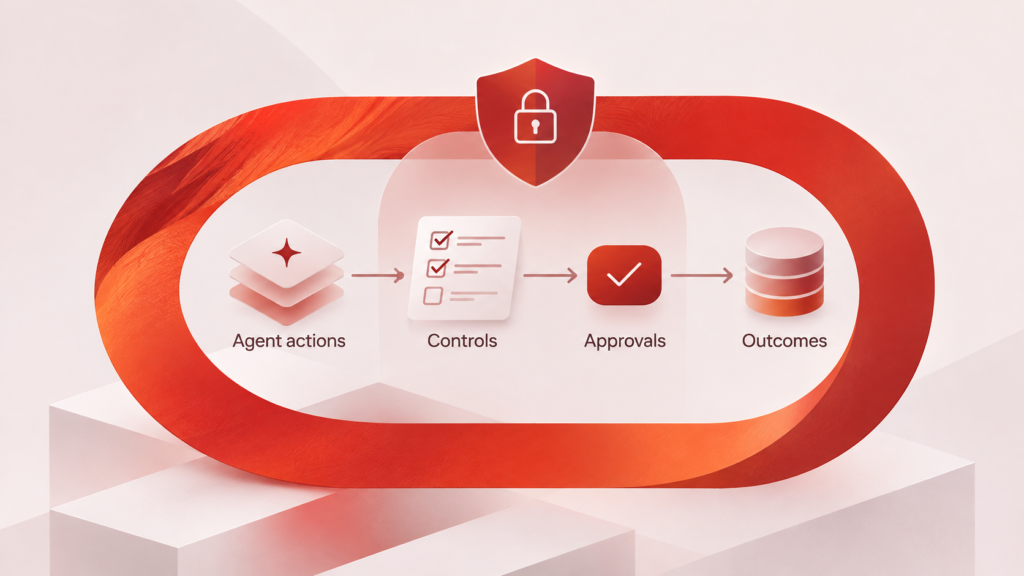
Oracle Fusion Claw is a governed execution runtime designed to help Fusion Agentic Applications complete complex, long-running work.
Oracle’s September 2026 announcement introduced 25 Claw-powered applications, bringing its portfolio to 75 Fusion Agentic Applications.vThese capabilities span financial reconciliation, workforce planning, supply chain execution, and other enterprise processes.
Oracle incorporates governance through its Enterprise Operating Envelope, Outcome Trust Harness, and Outcome Receipts. However, organizations must still verify whether their configured business workflows, permissions, integrations, and approval requirements behave as intended.
AI agent testing provides that assurance by evaluating agent behavior against expected business outcomes and defined controls.
What Should Enterprises Validate in Oracle AI Agents?
Testing autonomous workflows requires attention to the complete business process, including decisions made between transactions.
Consider an Oracle finance agent investigating invoice exceptions. The agent may identify discrepancies, recommend actions, and initiate permitted workflow steps. Quality Engineering must verify whether those actions respect company policies and produce accurate results.
| Validation area | Business question |
|---|---|
| Agent decisions | Did the agent apply the correct business rules? |
| Permissions | Did it remain within authorized access? |
| Approval workflows | Were required human approvals obtained? |
| Data integrity | Were records updated accurately? |
| Exception handling | Were unusual cases escalated correctly? |
| Execution evidence | Can reviewers trace decisions and outcomes? |
For leadership, these checks help translate AI governance requirements into measurable operational assurance.
How Does Agentic Quality Engineering Strengthen Oracle AI Agent Validation?
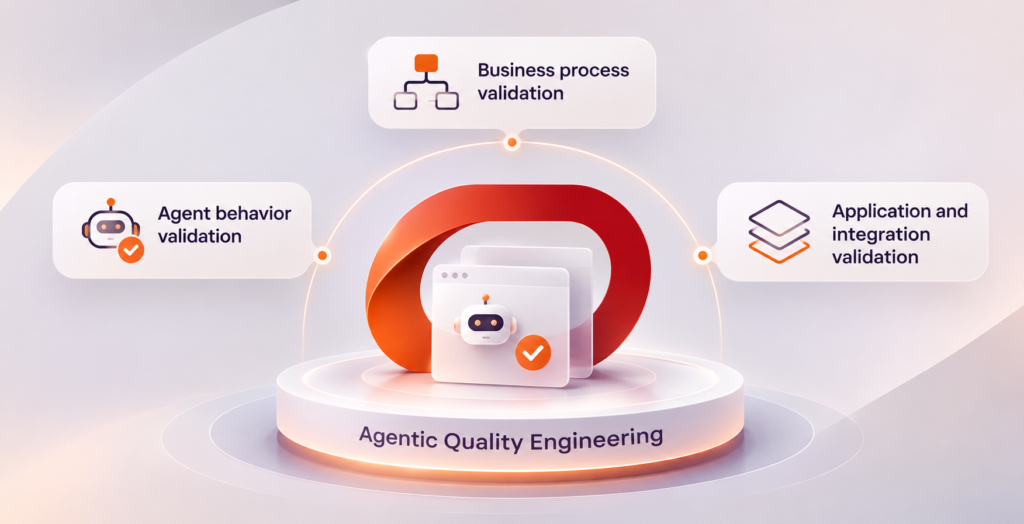
Agentic Quality Engineering uses specialized AI agents to support test preparation, scenario generation, automation development, and ongoing maintenance. For Oracle Fusion testing, an effective approach connects three validation layers.
- Agent behavior validation
Evaluate expected responses, decisions, workflow routes, escalation conditions, and authorization boundaries using approved scenarios.
- Business process validation
Verify whether the agent’s actions produce correct outcomes across financial, operational, and employee workflows.
- Application and integration validation
Test the surrounding Oracle applications, APIs, connected systems, and downstream transactions affected by agent execution.
Together, these layers help engineering teams identify problems that individual functional tests may miss.
Does Oracle Already Provide AI Agent Testing Tools?
Yes. Oracle Fusion 26D includes the Agentic Testing and Lifecycle Automation Suite (ATLAS) for AI Agent Studio.
ATLAS supports repeatable workflow tests, deterministic assertions, semantic evaluation, recorded data replay, and model comparisons.Oracle also provides monitoring and evaluation capabilities for AI agents.These native capabilities are important parts of the testing ecosystem.
Enterprise Quality Engineering teams must additionally consider how agent-driven workflows interact with configured applications, external platforms, and existing business processes. A coordinated testing strategy can combine Oracle’s native validation tools with broader enterprise application testing and integration assurance.
How Can AppsTek's QSpeak Support Agentic Oracle Application Testing?
AppsTek Corp provides Agentic Quality Engineering services powered by QSpeak, its Agentic AI Software Testing Accelerator.
QSpeak uses specialized AI agents to accelerate requirement analysis, test scenario generation, application mapping, and automation development. Its self-healing capabilities help maintain eligible automated tests as application interfaces evolve.
For an Oracle finance workflow, QSpeak can help engineers translate documented approval rules into test scenarios, develop supported automation, and validate surrounding application interactions.
Human review checkpoints preserve engineering accountability. Oracle-specific integration, access, and technical compatibility must be validated during implementation. QSpeak should complement appropriate native Oracle agent evaluations rather than replace them without demonstrated compatibility.
The business objective is to improve coverage and reduce repetitive testing effort across enterprise workflows. Explore AppsTek’s Agentic AI Software Testing Accelerator.
What Should CIOs Measure Before Scaling Oracle AI Agents in 2027?
Enterprise leaders need evidence that greater autonomy produces reliable business outcomes.
Five measures can guide quality assurance investments:
- Policy compliance: Percentage of evaluated agent actions meeting defined business rules.
- Approval adherence: Percentage of applicable transactions following required approval paths.
- Exception handling: Percentage of tested exceptions correctly identified and escalated.
- Business outcome accuracy: Percentage of validated workflows producing expected results.
- Testing efficiency: Engineering effort required to prepare, execute, and maintain regression coverage.
Results should be assessed against an approved baseline and risk thresholds. Oracle’s 2026 developments make agentic application validation a practical consideration for 2027 enterprise AI adoption.
Validate Your Oracle AI Workflows Before Scaling Autonomy
Greater automation requires equally strong assurance over business outcomes. AppsTek helps enterprises evaluate Agentic QE opportunities across Oracle applications and connected workflows.
Start a 2-week QSpeak Proof of Concept to assess test automation opportunities, business-process coverage, and engineering efficiency in a selected Oracle workflow.
Frequently Asked Questions
Enterprises can use Oracle AI Agent Studio evaluation capabilities and ATLAS to validate agent responses, workflow behavior, execution routes, and expected outcomes. Broader application and integration testing helps verify business-process impacts.
AI agent testing evaluates agent decisions, responses, permissions, and workflow behavior. Oracle regression testing verifies that application functionality and business processes continue working after changes. Enterprise workflows may require both.
Software testing AI accelerator supports test scenario generation, automation development, and self-healing maintenance. Direct validation of specific Oracle AI agent internals requires technical compatibility assessment and should not be assumed.
As Oracle applications introduce more autonomous workflows, enterprises need to validate business rules, permissions, exception handling, and downstream transaction outcomes alongside conventional application functionality.

About The Author
Neha Bartwal is a Senior SEM Executive at AppsTek Corp, with over 8 years of experience in digital marketing, specializing in SEO, AEO, AI marketing, and brand positioning. She drives initiatives across search visibility, website quality engineering, lead generation, and employee branding. Combining strategic thinking with an understanding of enterprise technology, Neha translates complex technical concepts into business-focused narratives, leveraging AI-driven marketing strategies to strengthen brand authority, expand digital presence, and accelerate B2B growth.