



• ISO Certified ISO/IEC 27001:2022
Summarize the article now ChatGPT Perplexity Claude

Enterprise testing automation is becoming a unit-cost challenge. Each release adds workflows, integrations and regression paths while Quality Engineering budgets stay tightly controlled. The pressure appears in maintenance, contractor spend, rework and rising cost per release. 

Agentic QE gives technology leaders another way to scale. Goal-oriented AI agents can support requirements analysis, test generation, workflow mapping, execution analysis and automation maintenance under human governance. The value comes from increasing testing capacity with slower growth in recurring effort. 
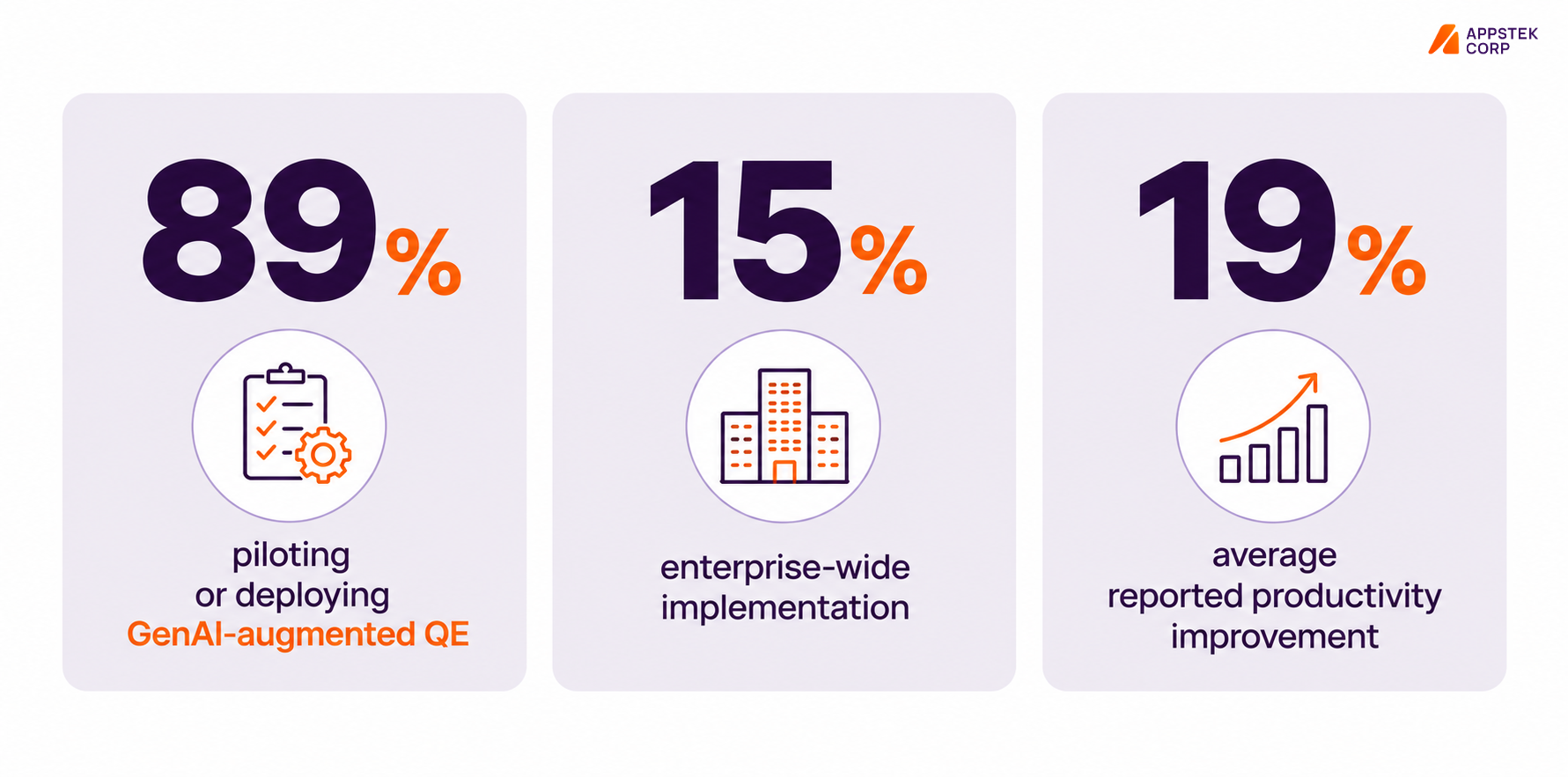
GenAI adoption in Quality Engineering

The World Quality Report 2025 found that 89% of surveyed organizations were piloting or deploying GenAI-augmented QE, while 15% had reached enterprise-wide implementation. Respondents reported an average productivity improvement of 19%. The gap keeps executive attention on operating economics, governance and integration quality. 

What Agentic QE Changes Financially

Agentic QE extends AI test automation beyond isolated tasks by applying goal-oriented agents across requirements analysis, test generation, workflow mapping, execution support, maintenance, and quality intelligence. 

For QE leaders, that can release hours spent creating and repairing test assets. For engineering leaders, it can expand release capacity. For CIOs and finance teams, the key measure is validated delivery per dollar of QE spend. 
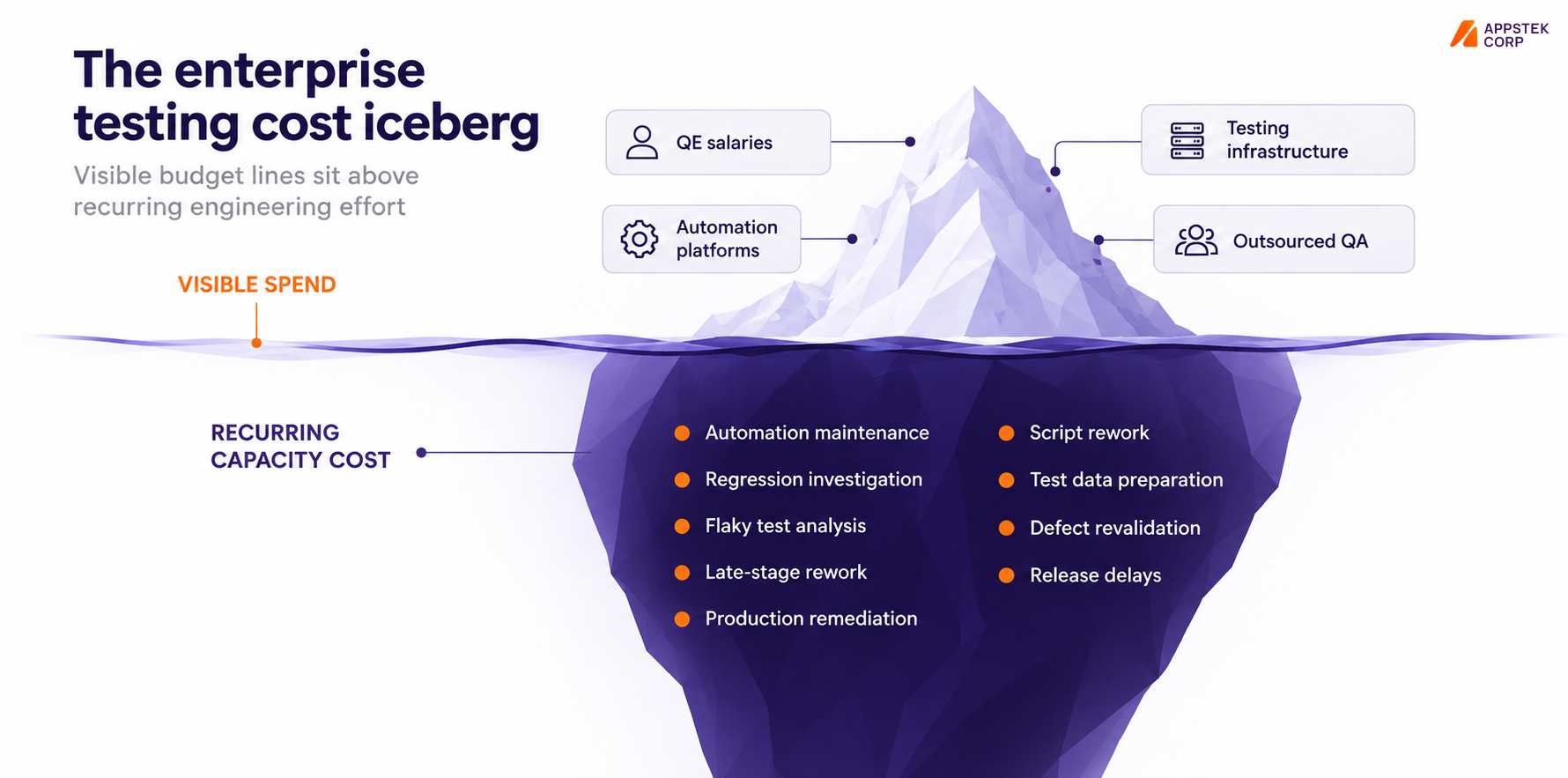
Why Enterprise Test Automation Develops a Cost Ceiling

Automation makes high-volume regression practical, yet every automated asset creates an operating requirement. UI changes, API updates, new acceptance criteria and evolving integrations can trigger script updates, reruns and failure analysis across mature test estates. 

That work behaves like a maintenance tax on delivery. Time spent repairing automation is unavailable for new coverage, exploratory testing or release readiness. As regression scope grows, maintenance can push the cost curve upward. 
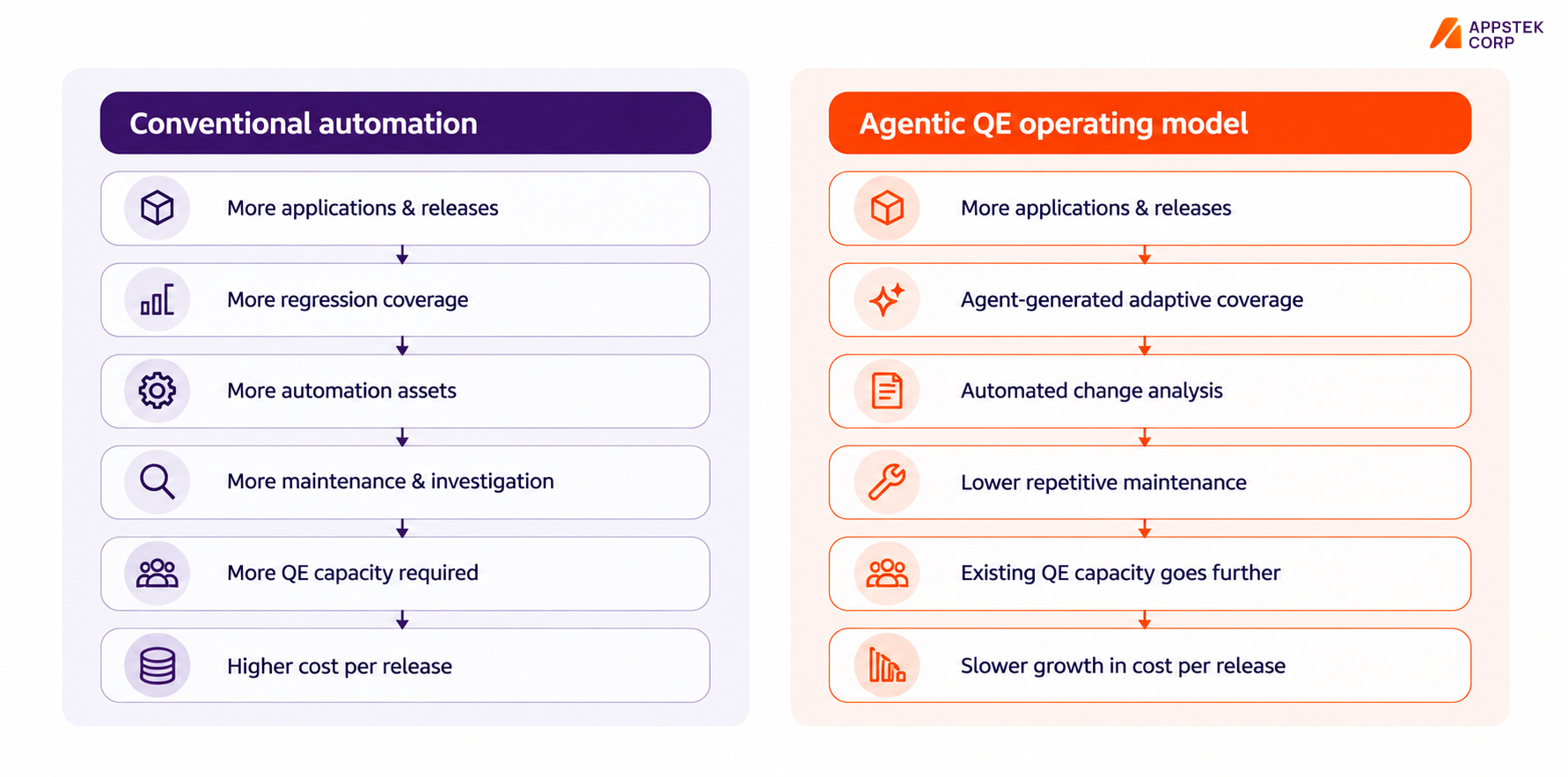
agentic QE

Traditional QE vs. Agentic QE: Where the Economics Shift

Sovereignty Deployment Models
Cost Driver Traditional Enterprise QE Agentic QE
Test Creation Engineers translate requirements into scenarios and automation Agents generate scenario candidates from requirements and workflows for review
Regression Maintenance Scripts require repeated updates as applications evolve Self-healing and change-aware automation reduce repetitive repair
Failure Investigation Engineers classify defects, environment issues and broken tests Agents support classification, correlation and impact analysis
Coverage Expansion More scope usually requires more engineering effort Coverage can expand with lower incremental human effort
Human Focus Capacity is absorbed by creation and maintenance More capacity moves toward risk, governance and quality decisions

The executive metric is validated delivery capacity per dollar of Quality Engineering spend. It connects QE activity to technology productivity and unit cost. 

Four Cost Levers to Measure

AI test automation
  1. Test creation: Agents can turn requirements and user stories into candidate scenarios and automation faster, allowing specialists to spend more time on business logic, edge cases and risk.
  2. Maintenance: Self-healing and change-aware automation can reduce the recurring effort tied to selectors, workflow changes and broken regression paths. Track maintenance hours released back to delivery.
  3. Earlier risk detection: Per industry research post-release defects can cost up to 15 times more to fix than issues resolved early in development. Earlier detection protects developer capacity, release schedules and support costs.
  4. Headcount elasticity. Agent-supported testing can increase the amount of coverage and release volume a team supports before additional staffing or outsourced capacity is required. This is often the clearest finance-facing benefit.

What Finance and Technology Leaders Should Measure

Executive Metric What It Reveals
Cost per Release Whether testing expense is growing faster than delivery
Cost per Validated Requirement How efficiently QE turns requirements into tested software
Regression Maintenance Hours How much capacity is consumed maintaining automation
Outsourced Testing Spend How much external capacity is needed to keep pace
Defect Escape Rate Financial exposure created by late discovery
Release Cycle Time How quickly engineering investment reaches production

These measures create a shared language across QE, engineering and finance. Script counts describe activity. Unit economics show whether the testing operating model is becoming more efficient. 

Build the ROI Case Around a Real Baseline

Step What to Measure
1. Baseline Current Cost Internal QE labor, outsourced testing, maintenance, tooling, rework and release delays
2. Identify Addressable Effort Test design, script creation, maintenance, failure analysis and repetitive validation
3. Measure Pilot Impact Hours saved, coverage gained, cycle-time change, quality impact and avoided external capacity
4. Decide Where to Scale Compare measurable benefit with implementation and operating cost

A baseline-led model ties the investment decision to the actual environment. Labor mix, automation maturity and release cadence vary widely, so ROI from AI test automation programs should come from measured change. 

Pilot to scale validate the economics

A focused pilot should target a high-cost QE workflow, apply agents inside the existing toolchain, and compare effort, coverage, cycle time and quality against the baseline. Enterprise-wide scale still depends on integration, privacy, reliability and skills. 

The Business Case for Agentic QE

Enterprise software portfolios will continue adding integrations, workflows and release volume. Quality Engineering needs an operating model that can absorb that growth while keeping the incremental cost of validation under control. 

Agentic QE can move repetitive work across requirements analysis, test generation, maintenance and execution intelligence toward AI agents, while people retain control over business risk, governance, exceptions and release confidence. The financial case becomes stronger when leaders can show lower recurring effort, higher delivery capacity and a measurable improvement in unit cost. 

For organizations evaluating the model, AppsTek Agentic QE Services provides one implementation perspective, while the Agentic AI adoption in QE checklist can help structure internal readiness discussions. 

Frequently Asked Questions

It can reduce repetitive effort across test design, automation creation, maintenance, failure analysis and regression execution. The financial value appears through lower maintenance hours, lower cost per validated requirement, avoided external capacity and more release volume from existing teams. 

Cost per release, cost per validated requirement, regression maintenance hours, outsourced QA spend, defect escape rate and release cycle time give leaders a practical view of the economics. 

Establish a baseline for testing labor, maintenance, outsourcing, rework and release cycle time. Apply Agentic QE to a focused workflow, measure the change and compare the gain with implementation and operating cost. 

Yes. A practical adoption model should layer agent-driven analysis, generation and maintenance into existing testing and CI/CD environments so enterprises can validate value without rebuilding the full toolchain. 

Oracle has announced that Oracle AI Agent Studio, including the AI-native builder experience and AI Studio Skill, is available at no additional cost for Oracle Fusion Applications customers. Organizations should review current Oracle licensing documentation or consult their Oracle representative for environment-specific guidance. 

Myrlysa

About The Author

Myrlysa I. H. Kharkongor is Senior Content Marketer at AppsTek Corp, driving content strategy for the company’s digital engineering services to enhance brand presence and credibility. With experience in media, publishing, and technology, she applies a structured, insight-driven approach to storytelling. She distills AppsTek’s cloud, data, AI, and application capabilities into clear, accessible communications that support positioning and grow the brand’s digital footprint.

  • ISO Certified ISO/IEC 27001:2022