


Enterprise AI conversations are narrowing to a more specific question than they were a year ago. It is no longer only whether to use a large language model, but which model, whose infrastructure it runs on, and under which jurisdiction’s laws it operates. As organizations move generative AI from pilots into regulated, revenue-bearing workflows, the model layer itself becomes a sovereignty and AI governance decision, not just a technology choice.
This is the third piece in AppsTek’s sovereign AI series. The first article mapped the full enterprise stack across data, infrastructure, sovereign cloud, applications, and models. The second examined how sovereignty extends into autonomous agents. This piece goes one layer deeper into a question enterprise architects are asking with increasing urgency: when does an organization actually need a sovereign LLM, meaning a model it can control, host, or restrict to a defined jurisdiction, rather than a general-purpose model consumed through a public API?
What Makes an LLM "Sovereign"
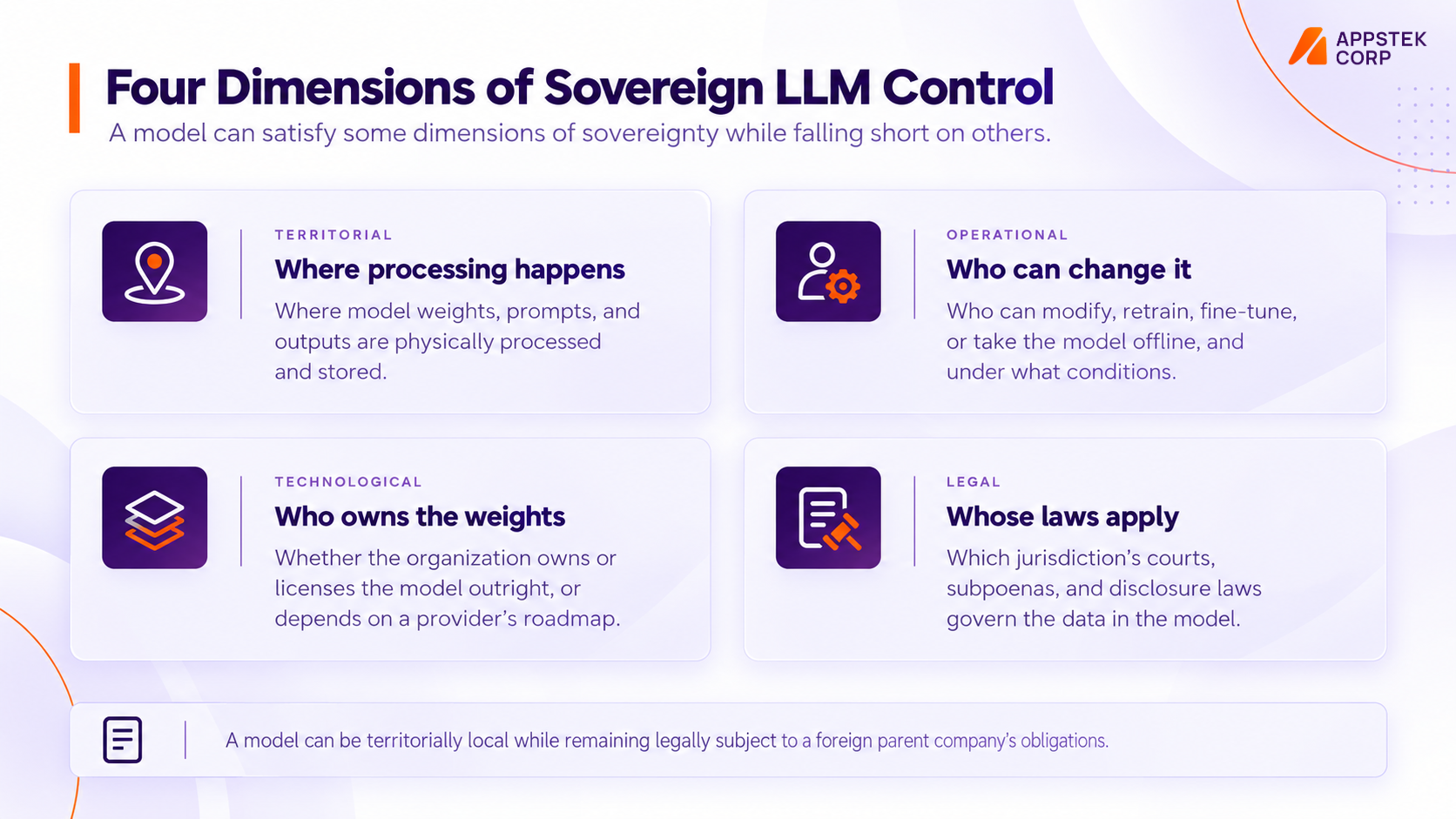
A sovereign LLM is not simply a model that happens to run in a particular country. Sovereignty at the model layer spans four related dimensions.
Territorial control determines where model weights, prompts, and outputs are physically processed and stored. Operational control determines who can modify, retrain, fine-tune, or take the model offline, and under what conditions. Technological control determines whether the organization owns or licenses the model weights outright, or is dependent on a provider’s roadmap and API availability. Legal control determines which jurisdiction’s courts, subpoenas, and disclosure laws, including frameworks such as the CLOUD Act, apply to the data flowing through the model.
A commercial API-based model can satisfy some of these dimensions and not others. A model hosted in-region by a hyperscaler, sometimes marketed as a sovereign cloud offering, may satisfy territorial control while remaining subject to a foreign parent company’s legal obligations. A self-hosted open-weight model can satisfy all four dimensions, at the cost of taking on the operational work a provider would otherwise handle.
Why This Question Has Become Urgent
Three forces are pushing sovereign LLM decisions onto enterprise roadmaps faster than most architecture teams expected.
Regulatory exposure is the most immediate. The EU AI Act phases in on a fixed timeline: prohibited AI practices became enforceable in February 2025, obligations for general-purpose AI model providers, including transparency and training-data documentation, took effect in August 2025, and obligations for high-risk AI systems, including conformity assessments, reach full enforcement in August 2026. An LLM used in employment screening, credit decisions, healthcare triage, or critical infrastructure can trigger high-risk classification regardless of where the model happens to run, and high-risk systems require documentation, audit trails, and conformity assessments that many general-purpose API services are not built to expose in full.
Jurisdictional risk compounds the regulatory picture. Legal frameworks such as the US CLOUD Act can compel a provider to disclose data to a foreign government regardless of where that data is physically stored, a conflict that the Schrems II ruling found structurally difficult to reconcile with EU data protection law. For enterprises operating across borders, this means storage location alone does not resolve legal exposure.
Investment and market signals confirm the shift is not theoretical. Gartner forecasts worldwide sovereign cloud infrastructure-as-a-service spending will reach approximately 80 billion dollars in 2026, a 35.6 percent increase over 2025, with governments and regulated industries such as energy, utilities, and telecommunications as the leading buyers. NVIDIA has reported that its sovereign AI revenue roughly tripled to more than 30 billion dollars in fiscal 2026. In a McKinsey survey of roughly 300 executives, investors, and government officials, 71 percent characterized sovereign AI as an existential concern or a strategic imperative rather than a secondary consideration.
None of this means every enterprise needs to self-host every model. It means the decision now deserves a deliberate framework rather than a default.
The Deployment Spectrum
Sovereignty over an LLM is not binary. In practice, enterprises choose a point along a spectrum, trading operational simplicity for control.
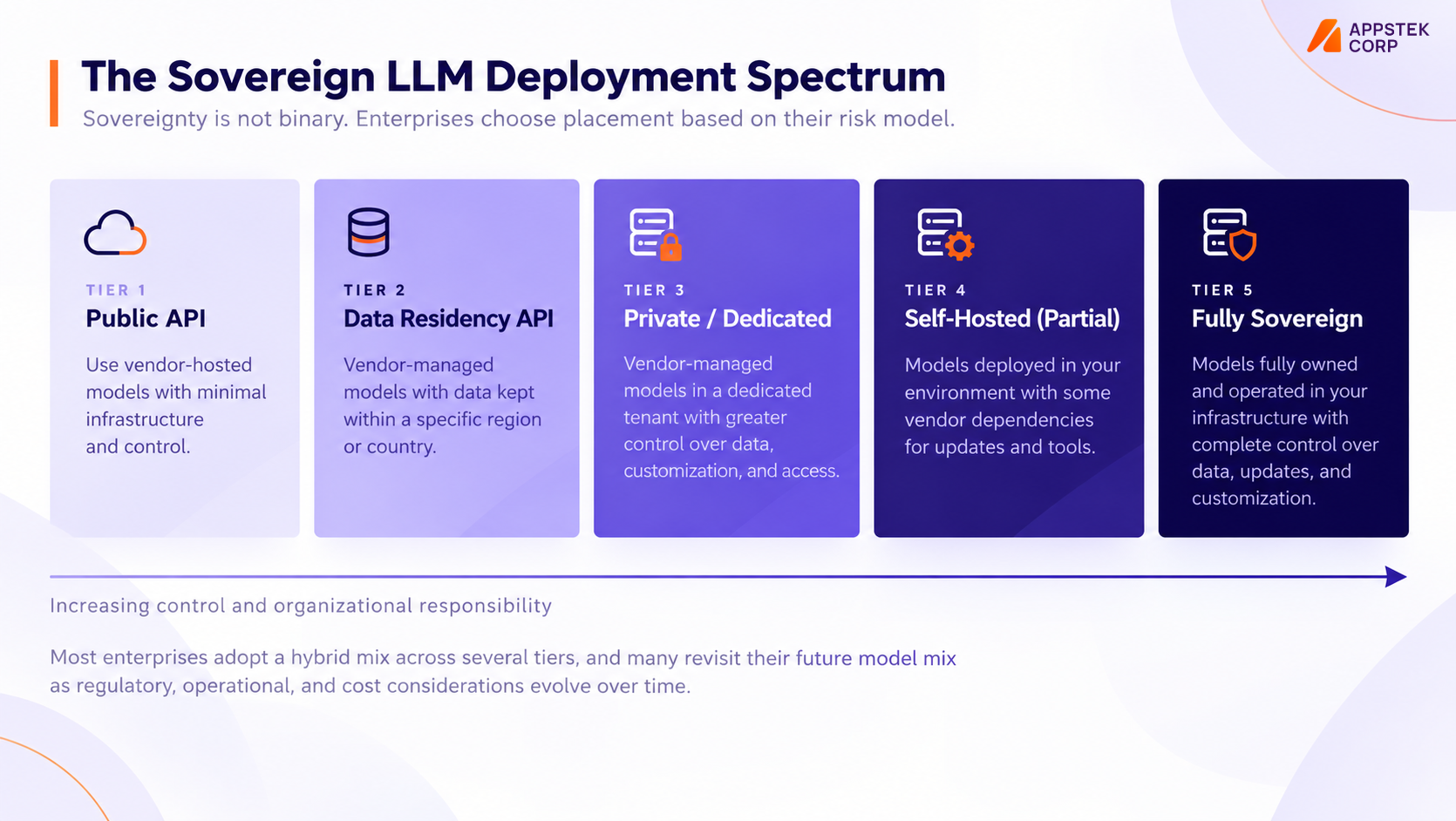
At one end, a public multi-tenant API offers the least control and the least operational burden. Moving along the spectrum, a data-residency or regional API keeps processing within a defined geography while the underlying infrastructure and legal entity remain the provider’s. A private or dedicated-tenancy deployment isolates compute and, in some cases, model weights within a customer-controlled environment while a vendor still manages the platform. At the far end, a fully self-hosted open-weight model, whether in a private cloud or an air-gapped on-premises environment, gives the enterprise direct control over weights, infrastructure, and data flow, along with full responsibility for operating it.
Most enterprises will not standardize on a single point on this spectrum. A workload processing public marketing content has little reason to bear the operational cost of self-hosting. A workload processing regulated health records, government data, or proprietary source code may have little choice but to move toward the self-hosted end.
The Technical Decision Criteria
Five factors determine where a given workload should sit on that spectrum.
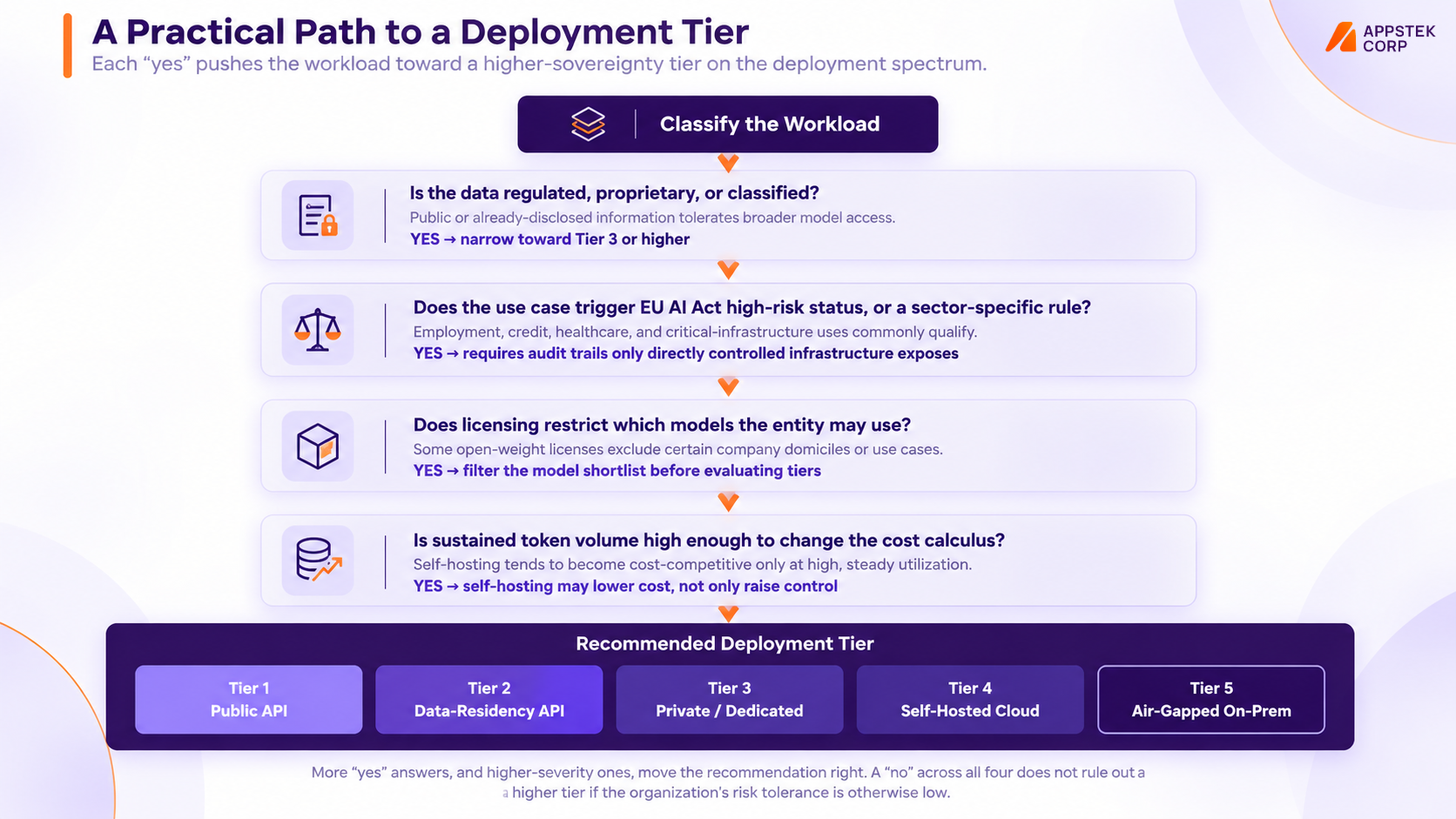
Data classification and workload sensitivity: Public or already-disclosed information tolerates broader model access. Regulated, proprietary, or classified information narrows the acceptable set of deployment options, sometimes to a single self-hosted or air-gapped tier.
Regulatory classification: Whether a use case falls under the EU AI Act’s high-risk category, or under sector-specific rules such as financial services or healthcare regulation, determines how much documentation, auditability, and human oversight the deployment must support. These requirements are often easier to satisfy with infrastructure the enterprise directly controls, but they still depend on AI governance processes that extend well beyond the deployment choice itself.
Token volume and cost economics: Cost does not favor self-hosting by default. Based on published self-hosting cost analyses, commercial APIs typically remain the more economical choice below roughly 5 million tokens processed per day. Between 5 million and 50 million tokens per day, the answer depends heavily on sustained utilization. Above roughly 50 million tokens per day at steady load, self-hosted infrastructure tends to become the lower-cost option. These figures are illustrative rather than universal and should be validated against current provider pricing and actual workload patterns before use in a business case.
| Deployment option | Approx. monthly cost at 10M tokens / day |
|---|---|
| Commercial API | ~€250 / month |
| EU data-residency cloud API | ~€540 / month |
| Rented self-hosted GPUs (e.g. L40S class) | ~€2,150 / month |
Licensing terms: Open-weight models are not uniformly open. Meta’s Llama 4 community license, for example, excludes companies domiciled in the European Union from using its multimodal capabilities, a restriction enterprises must check against their own entity structure before standardizing on a given model family. License review belongs in the same governance process as data classification, not as an afterthought.
Operational readiness: Self-hosting shifts cost from a per-token fee to fixed infrastructure plus engineering time. Industry guidance on self-hosted LLM operations suggests budgeting a minimum of half to a full full-time engineering role in the first year for model serving, monitoring, and governance work, a cost that frequently exceeds the hardware budget itself for mid-sized deployments.
Infrastructure Requirements for Self-Hosting
Enterprises that conclude a workload belongs on the self-hosted end of the spectrum face a second, more technical set of decisions: how much compute the model actually requires.
Memory, specifically GPU VRAM, is typically the binding constraint rather than raw compute throughput. A useful approximation is that total VRAM required equals model weights plus key-value cache plus operational overhead, with a safety margin of roughly 20 to 30 percent added to the base figure. A 70-billion-parameter model quantized to INT4 precision requires approximately 39 gigabytes for weights alone, which can fit on a single high-end workstation GPU; the same model at full FP16 precision requires roughly 140 gigabytes, which typically requires multiple data center-class GPUs.
| Hardware tier | Typical capacity | Model fit |
|---|---|---|
| Workstation GPU | 32 to 48 GB VRAM | 30B models at INT8, or 70B models at INT4 quantization |
| Data center GPU | 80 to 192 GB VRAM | Flagship dense models at higher precision; typically multi-GPU |
| Apple Silicon (unified memory) | 64 to 256 GB | Mid-size models, at lower throughput than dedicated GPUs |
Quantization is the primary lever enterprises use to fit larger models into smaller infrastructure footprints. Reducing a model from FP16 to INT8 or INT4 precision cuts memory requirements substantially, generally at a measurable but often acceptable cost to output quality, and evaluating that quality tradeoff against the specific workload is a necessary step before committing to a hardware tier.
Beyond raw hardware, production self-hosting requires an inference serving layer. Options in common enterprise use include vLLM, a widely adopted default that reduces memory fragmentation; SGLang, which some benchmarks show delivering meaningfully higher throughput on certain model architectures; TensorRT-LLM, tuned specifically for NVIDIA hardware; and Text Generation Inference, which integrates closely with the Hugging Face ecosystem. Lighter tools such as Ollama and llama.cpp are common for proof-of-concept work but are generally not the production standard at enterprise scale.
Self-hosting also removes the content filtering, abuse prevention, and safety tooling that commercial API providers typically bundle into their service. Enterprises taking on self-hosted models take on the responsibility to build or integrate equivalent content filtering, audit logging, role-based access control, and a process for verifying the provenance of downloaded model weights before deployment.
Choosing Among Open-Weight Models
The open-weight model landscape changes quickly, and any specific comparison risks going stale within months. The general categories, however, are stable enough to plan around.
| Model family | License | Notes |
|---|---|---|
| DeepSeek V4 | MIT | Long context window; strong reasoning benchmark results |
| Gemma 4 | Google terms | Broad language coverage; single-GPU variant available |
| Qwen 3.5 | Apache 2.0 | Strong performance-per-parameter efficiency |
| GLM-5.2 | MIT | Optimized for agentic, tool-using workflows |
| Llama 4 (multimodal) | Meta community license | Wide ecosystem support; license excludes EU-domiciled companies from multimodal use |
| Mistral models | Varies by model and version | Strong EU-based deployment and enterprise support options |
License terms, context window, and language coverage vary meaningfully across these families, and new versions supersede older ones on a timeline measured in months rather than years. Published benchmark leaderboards are a reasonable starting point for narrowing candidates, but benchmark performance alone should not decide a procurement outcome. Fine-tuning support, the maturity of the surrounding tooling ecosystem, the availability of enterprise support contracts, and independent safety evaluation all affect total cost of ownership in ways a leaderboard score does not capture. Enterprises should treat any specific model comparison, including the one above, as a starting point for evaluation rather than a final answer, and should re-verify current model versions, benchmark standings, and license terms directly with the model provider before a procurement decision.
A Decision Framework
Bringing these criteria together, a practical decision path runs from workload classification through to a recommended deployment tier.
Questions to Ask Before Selecting a Sovereign LLM Deployment
- Who is accountable for this model’s outputs and its ongoing compliance? Every production LLM deployment needs a clear organizational owner, regardless of deployment tier.
- What is the actual sensitivity classification of the data involved? Public or already-disclosed information tolerates broader model access than regulated or proprietary data.
- Does this use case fall under a high-risk category in applicable regulation? The EU AI Act and sector-specific rules can trigger documentation and audit requirements that shape the deployment tier.
- What does the license actually permit for this entity and use case? Open-weight licenses are not uniformly open, and some exclude specific company domiciles or applications.
- What is the realistic, sustained token volume, not the peak? Cost economics favor self-hosting only at high, steady utilization, not at occasional peak demand.
- Does the organization have the operational capacity to run and govern this model? Self-hosting shifts cost from a per-token fee to infrastructure and engineering time that must be budgeted and staffed.
Governance Does Not Change With the Deployment Tier
Choosing a point on the sovereignty spectrum resolves where a model runs and who controls it. It does not resolve how the model is governed once it is in production.
The identity, access, and audit controls described in AppsTek’s earlier pieces on the sovereign AI stack and on agentic AI governance apply equally to a self-hosted open-weight model and to a commercial API, the underlying AI governance requirements don’t change with the deployment tier. A self-hosted model still needs defined ownership, documented approval for the workloads it serves, monitored usage, and a process for revoking access when requirements change. Moving to a more sovereign deployment tier increases the enterprise’s operational responsibility; it does not reduce the governance work required to run the model safely, and exposure under frameworks like the CLOUD Act does not disappear simply because infrastructure sits on domestic soil, it depends on which corporate entity operates it.
Making the Call
Most enterprises will end up running a portfolio rather than a single answer: commercial APIs for general-purpose, lower-sensitivity workloads, and self-hosted or dedicated-tenancy models for the subset of workloads where data sensitivity, regulatory classification, licensing terms, or sustained volume justify the added operational commitment. A financial services firm, for instance, might route public-facing customer support through a commercial API while routing credit decisioning and regulated document review through a self-hosted model that keeps weights, prompts, and outputs inside its own controlled environment.
The question worth asking is not whether sovereign LLMs are necessary in the abstract. It is which specific workloads, under which specific regulatory and data-sensitivity conditions, cross the threshold where the operational cost of control becomes worth paying. Enterprises that build that evaluation into their model selection process, rather than defaulting to whichever model is easiest to integrate, will be better positioned as both regulation and the open-weight model landscape continue to move.
Appstek Corp helps enterprises evaluate, architect, and operationalize the right LLM deployment strategy for each workload, balancing sovereignty requirements with performance, scalability, cost, and operational complexity. Contact Appstek Corp to assess where greater model control can create meaningful value for your AI strategy.

About The Author
Wanpherlin M. Shangpliang is a Marketing Manager at AppsTek Corp, driving strategic marketing initiatives across digital, content, and brand communications. She focuses on positioning AppsTek’s AI offerings and comprehensive digital engineering services while supporting market outreach across key industries. With expertise in campaign management, content strategy, and audience engagement, Wanpherlin builds effective marketing programs that drive measurable growth and strengthen AppsTek’s overall presence.