Table of Contents
How Oracle Alloy Makes Distributed OCI Practical
Oracle Alloy Creates a Branded Cloud Business
OCI Dedicated Region Keeps The Full Control Plane Local
Sovereign Cloud For Enterrpsie
Isolated Regions and Roving Edge Extend The Spectrum
A Practical decision Framework For Distributed OCI



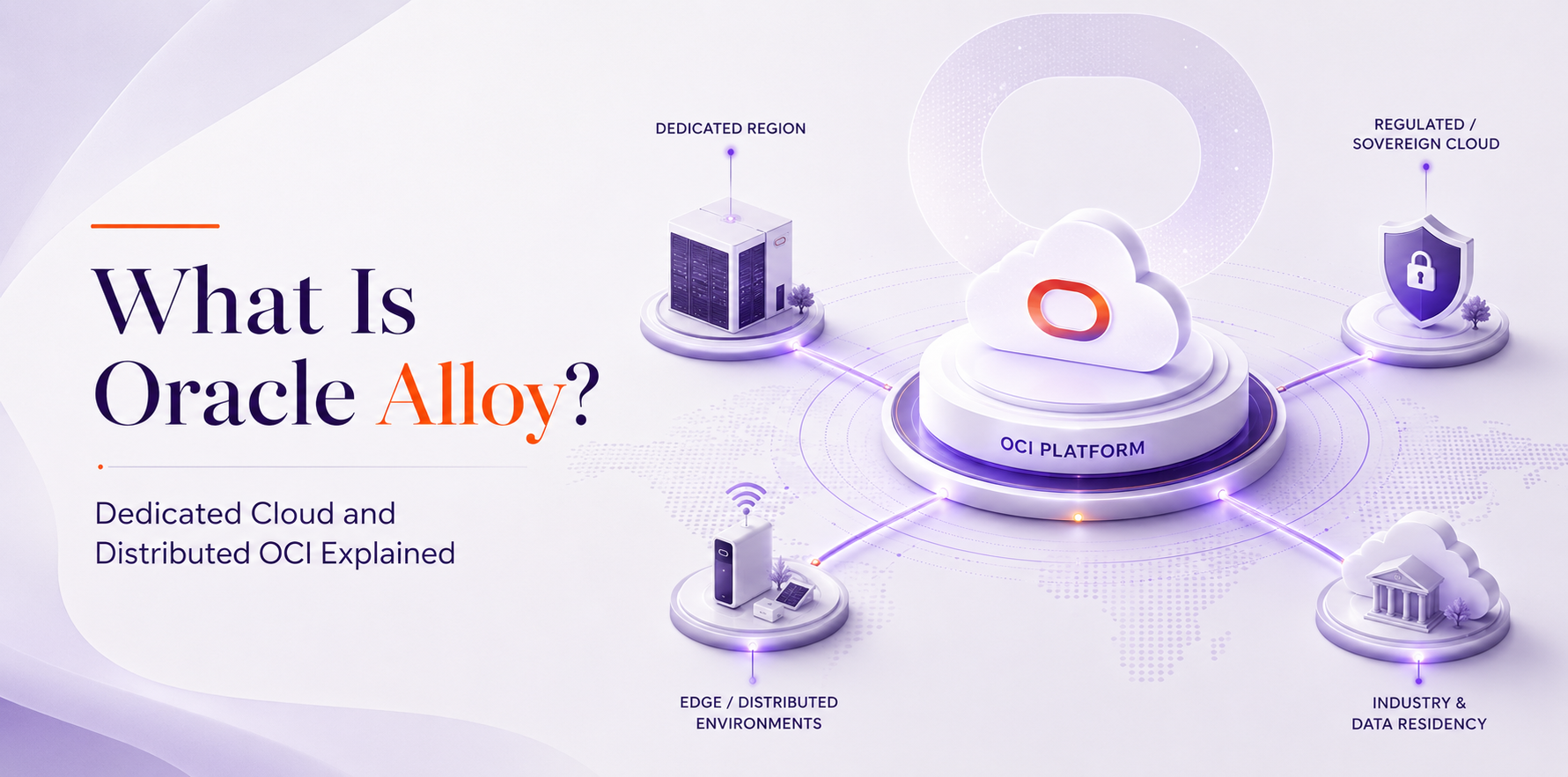
Oracle’s distributed cloud gives enterprises several ways to run OCI services where operational, regulatory, or commercial requirements demand. Oracle Alloy enables a partner-operated cloud under a distinct brand. OCI Dedicated Region places the complete OCI stack inside an enterprise data center. Regulated regional environments support national and sector-specific controls, while Isolated Regions and Roving Edge extend OCI into air-gapped or disconnected locations. The architecture keeps the platform consistent across deployment models, reducing the fragmentation that often follows a mixed cloud strategy.
How Oracle Alloy makes distributed OCI practical
Oracle Alloy is a complete cloud infrastructure platform that allows service providers, system integrators, independent software vendors, and large enterprises to operate cloud services under their own brand. The operator controls pricing, billing, customer relationships, service packages, and support tiers. Oracle maintains the underlying platform and delivers updates across the same broad OCI service portfolio available in public regions.
Enterprise workloads rarely share one location profile. Financial systems may require locally controlled infrastructure. Government workloads can demand restricted operational access. Manufacturing and field operations may depend on local processing when connectivity becomes intermittent. Oracle addresses these conditions through deployment models built on common services, APIs, service levels, and commercial principles.
This consistency changes the migration and operating discussion. Deployment location becomes a governance decision instead of a forced trade-off against platform capability. Development can remain in a public region, regulated production can run in a locally governed environment, and remote operations can use edge infrastructure while teams continue working with familiar OCI tooling.
Oracle Alloy creates a branded cloud business
Oracle Alloy goes beyond a resale arrangement. A partner operates the customer-facing cloud experience, defines rate cards, creates product bundles, manages subscriptions, and sets commercial terms through an integrated operator console. Branding can extend across the interface, legal terms, support model, and invoicing experience. Oracle remains responsible for platform maintenance, security updates, and new service releases.
The model creates a practical route into cloud services for organizations with local market access or regulated customer relationships. Building a hyperscale platform independently would require sustained engineering investment across compute, storage, networking, identity, security, databases, and service operations. Alloy provides that foundation while leaving room for market-specific services and differentiated commercial packaging.
Operators already using Oracle Alloy
Current deployments illustrate the range of use cases. Du in the United Arab Emirates uses the platform to deliver locally governed services for public sector customers. Team IM supports the New Zealand market through in-country operations. Nomura Research Institute, originally the first OCI Dedicated Region customer, now also operates Oracle Alloy to deliver sovereign cloud and managed services to financial sector customers in Japan, while Polo Strategico Nazionale supports Italian public sector requirements. Each example combines OCI capability with local control, local operations, or sector-focused value.
Software and hardware extensibility
Operators can extend the platform with custom services built through the same developer, user experience, DevOps, and security capabilities used across OCI. Specialized hardware can also become part of the environment, including industry appliances or established enterprise systems. This creates room for differentiated services around data residency, sector workflows, managed operations, and regional compliance.
OCI Dedicated Region keeps the full control plane local
OCI Dedicated Region deploys the full public cloud stack inside an enterprise facility. The model includes more than 200 OCI services, generative AI capabilities, and Autonomous Database. It can begin with a compact three-rack footprint and expand as demand grows. Oracle manages infrastructure operations, capacity planning, updates, and service delivery, while the enterprise controls the physical site.
The defining architectural point is the location of both the data plane and the control plane. Management traffic, metadata, logging, and workload data remain within the local environment. That design supports organizations where complete residency extends beyond application data and includes administrative operations. Public cloud pricing principles and service levels remain aligned with the broader OCI platform.
Dedicated Region serves internal enterprise workloads, while Alloy supports an operator serving external customers. The technology foundation is closely related, yet the commercial purpose differs. The Sultanate of Oman operates two Dedicated Regions supporting more than 120 government entities under its Vision 2040 digital transformation program, while NRI’s early adoption of Dedicated Region for financial SaaS platforms preceded its expansion into Oracle Alloy, demonstrating how enterprises can progress across the distributed OCI spectrum as requirements evolve.
Sovereign Cloud for Enterprises
Oracle also operates physically and logically isolated regional environments for regulated public sector and commercial workloads. Legal entities, personnel access, operational boundaries, and governance structures are aligned with the jurisdiction served. The goal is a structurally separated environment rather than a policy layer placed over a standard commercial region.
Regional sovereignty supports locally governed operations
The European Union offering runs across Frankfurt and Madrid as a separate realm operated through EU-incorporated entities and EU-resident personnel. The design aligns with GDPR, NIS2, DORA, Schrems II, and related guidance. Existing Oracle commercial mechanisms, including Universal Credits and Oracle Support Rewards, can apply within the environment.
The United Kingdom model uses regions in London and Newport for government and defense workloads, with authorized local personnel and support for OFFICIAL SENSITIVE information. Separate United States environments address federal civilian, defense, and classified national security requirements. Australia operates an isolated government region in Canberra for public sector and defense workloads.
Across these regional models, the central value is operational sovereignty backed by physical separation and jurisdiction-specific governance. The approach supports data residency, access control, support boundaries, and local accountability while retaining a broad OCI service set.
Isolated regions and Roving Edge extend the spectrum
Oracle Cloud Isolated Regions address environments where internet connectivity is prohibited or operationally unsuitable. Compute, storage, networking, identity, and security services run inside an air-gapped perimeter. Classified defense and intelligence workloads are the clearest examples, although highly sensitive finance and healthcare operations can also require similar separation.
Roving Edge Infrastructure solves a different location problem. Ruggedized devices bring selected OCI services to remote sites, factory floors, disaster recovery locations, and field operations. Local processing continues during limited connectivity, with synchronization occurring when a secure connection becomes available. Planned data transfer gateway capabilities extend controlled movement between edge devices, on-premises systems, and regional OCI environments.
Together, Isolated Regions and Roving Edge complete the distributed spectrum. One model prioritizes permanent separation, while the other supports portable or intermittently connected computing. Both reduce reliance on continuous public network access without forcing a separate technology stack.
A practical decision framework for distributed OCI
The right model follows the operating requirement. Public cloud fits workloads seeking broad scale and fully managed infrastructure. Alloy fits organizations building a branded cloud business. Dedicated Region fits enterprises requiring the full OCI stack inside a controlled facility. Regulated regional environments fit jurisdiction-led data and access requirements. Isolated Regions fit classified or air-gapped operations, while Roving Edge supports remote processing close to the point of activity.
| Requirement | Best fit | Why it fits |
|---|---|---|
| Maximum scale with no data center ownership | Public Cloud | Broad regional reach, more than 200 services, fully managed operations |
| Operate a branded cloud platform | Oracle Alloy | Independent branding, pricing, billing, customer management, and service packaging |
| Run the full OCI stack inside a controlled facility | Dedicated Region | Three to 450 racks with local data and control planes |
| Meet European Union residency and access requirements | EU regulated realm | Frankfurt and Madrid with EU entities and resident personnel |
| Support United Kingdom government or defense workloads | UK regulated regions | London and Newport with restricted local access |
| Serve United States federal or defense requirements | Government and defense environments | FedRAMP High, IL5, and classified options |
| Support Australian government workloads | AU regulated region | Canberra with separation from commercial regions |
| Process classified data in a disconnected environment | Isolated Region | Air-gapped architecture with local OCI services |
| Run cloud services at remote or mobile locations | Roving Edge | Ruggedized local processing with controlled synchronization |
A single enterprise can use several models at once. Public regions may support development and analytics, a local region can host regulated production, and edge devices can process data in remote operations. Common APIs, tooling, service patterns, and pricing principles make that combination easier to govern than a collection of unrelated platforms.
The deployment choice starts with control requirements
The strongest deployment decision begins with five questions: where data must reside, who can administer the platform, how reliably each site connects, whether the environment serves internal teams or external customers, and how much service consistency matters across locations. Oracle’s distributed model turns those answers into an architecture choice rather than a collection of exceptions. A clear control baseline also makes future expansion easier because each workload can move into the right operating boundary without rebuilding the cloud foundation.
Choosing the right distributed OCI model is an architecture decision that shapes data residency, operational control, compliance posture, and long-term cost structure, and the answer often involves more than one deployment option working together.
AppsTek Corp helps enterprises navigate that decision across the full Oracle stack, from OCI migration and infrastructure design to cloud engineering and managed services that sustain the environment after go-live. For a deeper look at OCI’s capabilities and how they map to enterprise workloads, explore our Oracle Cloud Infrastructure services, or go through our complete guide to Oracle Cloud Infrastructure, or reach out to our Oracle team to discuss deployment requirements directly.
Frequently Asked Questions About Oracle Cloud Security
Oracle Alloy is a full cloud infrastructure platform for organizations operating services under their own brand. The operator controls the commercial model and customer experience, while Oracle maintains the underlying OCI platform and service updates.
Alloy supports a cloud operator serving customers through a branded platform. OCI Dedicated Region supports internal enterprise workloads inside a controlled facility. Both use OCI technology, although ownership, audience, billing, and service responsibilities follow different models.
The deployment can begin with three racks and expand toward a much larger footprint as demand grows. Oracle handles capacity forecasting, installation, infrastructure operations, and platform updates.
The European Union realm operates in Frankfurt and Madrid. Both regions remain physically and logically separated from commercial Oracle Cloud regions and use EU-based legal entities and resident operational personnel
An Isolated Region is a permanent air-gapped cloud environment for highly restricted workloads. Roving Edge uses portable, ruggedized infrastructure for local processing in remote or intermittently connected locations.

About The Author
Rahul Sudeep, Senior Director of Marketing at AppsTek Corp, is a results-driven, AI-first B2B marketing leader with 15 years of experience scaling global enterprise SaaS companies. His expertise, honed at IIM-K, spans architecting high-impact go-to-market strategies, driving new market identification and positioning, and embedding Generative AI, LLMs, and predictive analytics into the core marketing function. Rahul unifies Technology, Sales, and Support teams around a single strategic hub, while also managing key Partner and Investor Relations. He leverages AI-driven insights to craft powerful brand narratives and hyper-personalized demand generation campaigns that drive measurable revenue growth and deepen customer engagement.