Table of Contents
Why Oracle Application Migration Requires an Application-Aware Approach
Oracle EBS Migration with EBS Cloud Manager
What EBS Cloud Manager Automates
PeopleSoft Cloud Manager for Coordinates LifeCycle Control
JD Edwards One-Click Provisioning for Faster Deployment
The Four-Phase Oracle Application Migration Workflow
What Remains Stable and What Changes on OCI



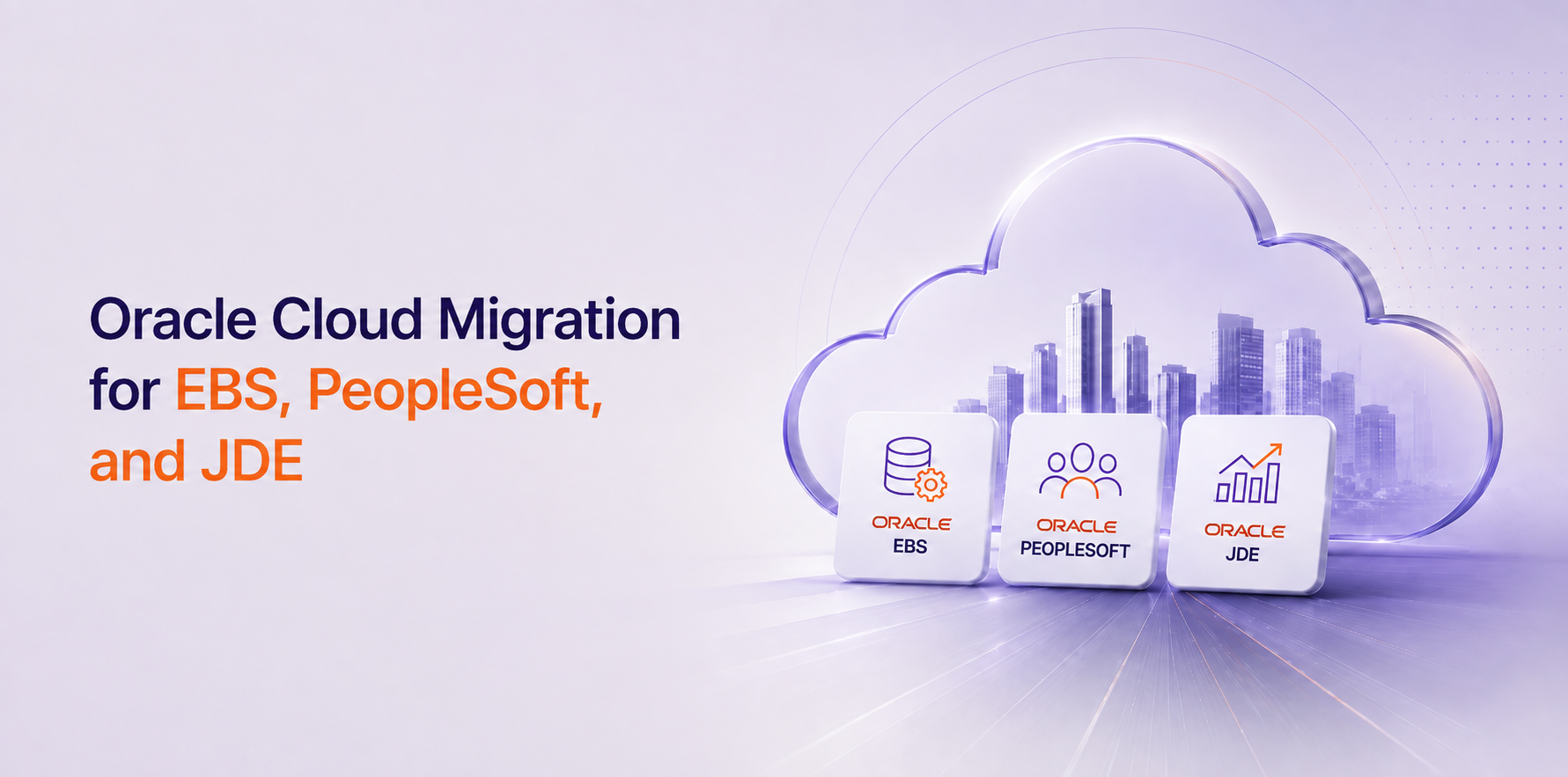
Oracle provides application-aware tools for moving E-Business Suite, PeopleSoft, and JD Edwards EnterpriseOne to OCI while preserving the application structures that carry daily operations. EBS Cloud Manager, PeopleSoft Cloud Manager, and JD Edwards One-Click Provisioning reduce manual setup, coordinate migration tasks, and extend into lifecycle management after cutover. A disciplined Oracle Cloud Migration therefore becomes an application transition with controlled infrastructure change, rather than a basic server relocation. Oracle reports up to 39% lower total cost of ownership for migrated applications, while selected EBS environments have reported stronger workload and reporting performance on OCI.
Why Oracle Cloud Migration Requires an Application-Aware Approach
Oracle enterprise platforms hold years of configuration decisions inside modules, custom extensions, database settings, security policies, reporting structures, and external connections. A generic migration utility can copy a virtual machine and restore storage in a new environment. That process has limited awareness of concurrent processing, PeopleTools dependencies, JDE server relationships, or the patch combinations that keep production behavior stable.
Oracle Application Migration addresses that gap through tools designed around each application architecture. The migration engine recognizes configuration layers, dependency chains, and validation checkpoints before the target environment becomes operational. This matters because a technically successful boot offers little value when approval flows fail, batch schedules drift, integrations lose connectivity, or custom forms behave differently after cutover.
The central challenge sits inside the application ecosystem. Infrastructure remains essential, yet continuity depends on preserving business logic and proving that the target behaves like the source under real workloads. Application-aware tooling narrows the risk surface by coordinating infrastructure creation, application transfer, database movement, and post-migration verification through a connected workflow.
Oracle EBS migration with EBS Cloud Manager
Oracle EBS Cloud Manager is a web-based platform for provisioning, migrating, and managing E-Business Suite environments on OCI. It discovers the source landscape, creates the target infrastructure, transfers the application and database layers, and supports validation after deployment. The service also handles backups, patching, and cloning, which allows the operating model to mature beyond the initial move.
A well-planned Oracle EBS migration can preserve CEMLI objects, concurrent manager definitions, business workflows, reports, and integration logic. External endpoints may require DNS, firewall, or routing updates because the OCI network introduces new addresses and security boundaries. Very large databases can follow manual transfer guidance when network movement creates an impractical cutover window, while Oracle Zero Downtime Migration can support database transition paths where applicable.
What EBS Cloud Manager automates
The strongest value appears in repeatable administration. Cloud Manager can coordinate patching across the application and database tiers, assign backup policies, clone environments for testing or training, and manage zone segregation for internal and external access. Multiple zones of the same type can share a load balancer, reducing unnecessary network complexity. These capabilities shift experienced administrators away from script maintenance and toward release control, governance, resilience, and performance engineering.
Selected organizations have reported about 30% improved EBS workload performance after migration to OCI and up to 10% faster reporting, supported by bare-metal compute and high-performance block storage. Results depend on source design, workload behavior, sizing, and tuning, so pre-migration baselines remain critical.
PeopleSoft Cloud Manager for coordinated lifecycle control
PeopleSoft Cloud Manager supports PeopleSoft 9.2 or later with PeopleTools 8.58 or later. It provisions OCI environments, clones databases, deploys application images, applies PeopleTools updates, coordinates infrastructure CPU patching, and supports connections to PeopleSoft Update Manager. The tool understands the relationship between web servers, application servers, process schedulers, and the database tier, allowing the environment to move as a coordinated unit.
Templates define the target topology and create repeatable non-production environments after migration. That consistency improves testing because development, quality assurance, and training instances can follow the same deployment pattern. PeopleSoft 9.1 and earlier releases can still run on OCI through a manual deployment path supported by compatible operating systems and database versions. Version mapping should be completed early so upgrade requirements, operating system support, and cutover design remain aligned.
JD Edwards One-Click Provisioning for faster deployment
JD Edwards One-Click Provisioning uses a Configure-Orchestrate-Deploy model to create EnterpriseOne environments on OCI. The configure stage captures credentials, network parameters, and application settings. Orchestration builds a deployment plan around the source topology, while deployment provisions OCI resources and installs the JDE stack with existing customizations carried forward.
The capability is exclusive to OCI and can compress a deployment that traditionally required weeks into a guided process measured in hours. Terraform integration adds infrastructure-as-code control, allowing deployment configurations to be versioned and reproduced. After cutover, elastic capacity can support month-end processing, seasonal demand, and other workload peaks without the hardware planning cycle associated with on-premises environments. Oracle reports up to 39% lower total cost of ownership for JD Edwards on OCI compared with on-premises operation.
The four-phase Oracle Application Migration workflow
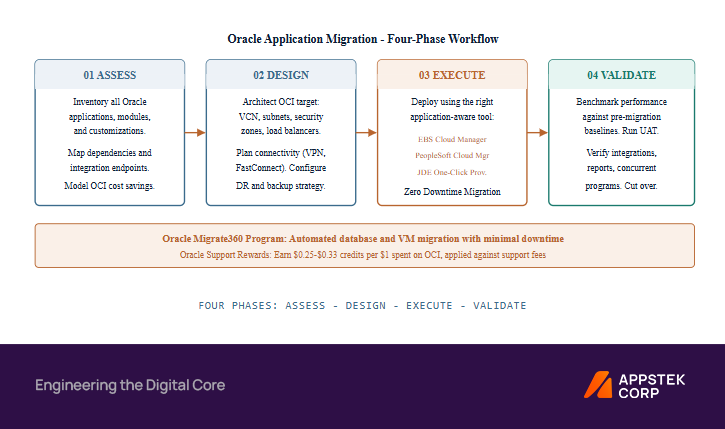
A reliable migration follows four connected phases. Assessment inventories workloads, records customizations, maps dependencies, establishes performance baselines, and models the expected financial case. Design converts those findings into an OCI architecture covering compute, storage, virtual cloud networks, identity controls, recovery objectives, connectivity, and zone separation.
Execution creates the target through the relevant application-aware tool, transfers application and database components, and uses a cutover sequence designed around business tolerance. Validation compares the target with source baselines, tests integrations, runs user acceptance scenarios, checks batch performance, and confirms recovery procedures. Oracle Migrate360 can support eligible database and virtual machine migrations, while Zero Downtime Migration can reduce database interruption within supported designs.
Each phase should produce evidence for the next decision. An incomplete dependency map weakens architecture. Weak baselines make performance claims difficult to prove. Limited acceptance testing transfers risk into production. The workflow succeeds when business owners, application specialists, database teams, security leaders, and infrastructure engineers share the same cutover criteria.
What remains stable and what changes on OCI
Application-aware tools preserve the configuration layers that define how work gets completed. The interface remains familiar for end users, while the infrastructure and operating model change beneath it. OCI compute, block storage, virtual cloud networks, hardware-isolated security controls, and automated lifecycle functions replace physical server ownership and individually maintained scripts.
| Category | What happens |
|---|---|
| Custom forms and extensions | Preserved, including CEMLI objects, localizations, modifications, and integration components |
| Business rules and workflows | Preserved, including concurrent programs, approval hierarchies, workflow definitions, and operating rules |
| Integrations | Logic remains intact; DNS, firewall, certificates, or endpoint addresses may require updates |
| Reports and analytics | Preserved, with potential reporting gains when storage and database sizing match workload needs |
| Security policies and IAM | Application security remains; infrastructure controls transition to OCI identity, network, and isolation services |
| User experience | The application interface remains familiar after DNS cutover and access validation |
| Infrastructure | Physical servers move to OCI compute, block storage, virtual cloud networks, and managed recovery patterns |
| Operations model | Manual scripts give way to policy-driven patching, backup, cloning, monitoring, and lifecycle administration |
| Performance | Improvement depends on baselines, architecture, sizing, storage design, and post-cutover tuning |
| Cost | Capital expense shifts toward consumption, while hardware refresh cycles and data center overhead decline |
The DBA role evolves toward cloud operations
Traditional database expertise remains foundational after migration. Attention shifts toward Terraform, VCN design, IAM governance, automated lifecycle controls, observability, capacity policy, and recovery testing. Upskilling during the migration creates faster operational independence because the same team can connect application behavior with the OCI services supporting it.
Moving Oracle EBS, PeopleSoft, or JD Edwards to OCI is an application transition, not just an infrastructure project, and the difference between a smooth cutover and a prolonged stabilization period often comes down to how well the migration team understands the application stack underneath.
AppsTek Corp brings that depth across Oracle E-Business Suite, Fusion Cloud, integration, and ongoing managed services, from assessment and architecture through cutover and post-migration lifecycle operations. If you are evaluating an OCI migration or need to pressure-test a plan already in progress, explore our full Oracle services or connect with our Oracle experts to discuss your environment.
Frequently Asked Questions About Oracle Cloud Migration
A standard EBS lift-and-shift using EBS Cloud Manager often takes 8 to 16 weeks across assessment, design, execution, and validation. A combined upgrade to EBS 12.2 and Oracle Database 19c can extend the program to 30 to 56 weeks, depending on customization volume, remediation effort, testing depth, and cutover constraints.
PeopleSoft Cloud Manager requires PeopleSoft 9.2 or later and PeopleTools 8.58 or later. Earlier releases can use a manual OCI deployment on supported operating systems. The target path should reflect the exact PeopleSoft release, PeopleTools level, database version, operating system, integrations, and planned upgrade sequence.
JD Edwards One-Click Provisioning is available exclusively on OCI. EnterpriseOne can run on other cloud platforms through manual deployment, while the guided Configure-Orchestrate-Deploy workflow and its OCI-specific automation remain tied to Oracle Cloud Infrastructure.
Oracle's application-aware tools are designed to preserve custom forms, extensions, business rules, concurrent programs, workflow definitions, reports, and integration logic. Endpoint addresses may change after the network cutover, so DNS records, firewall policies, certificates, and external allowlists should be tested before production release.
Oracle Support Rewards allows eligible organizations to earn $0.25 to $0.33 in credits for each dollar spent on OCI, with credits applied against qualifying Oracle technology support fees. The program can strengthen the business case alongside infrastructure savings, improved lifecycle automation, and the removal of hardware refresh cycles.

About The Author
Rahul Sudeep, Senior Director of Marketing at AppsTek Corp, is a results-driven, AI-first B2B marketing leader with 15 years of experience scaling global enterprise SaaS companies. His expertise, honed at IIM-K, spans architecting high-impact go-to-market strategies, driving new market identification and positioning, and embedding Generative AI, LLMs, and predictive analytics into the core marketing function. Rahul unifies Technology, Sales, and Support teams around a single strategic hub, while also managing key Partner and Investor Relations. He leverages AI-driven insights to craft powerful brand narratives and hyper-personalized demand generation campaigns that drive measurable revenue growth and deepen customer engagement.