
Table of Contents
Why AI Infrastructure Has Become the Bottleneck
Anatomy of an OCI Supercluster
How Oracle Acceleron Eliminates the AI Bottleneck
How RoCE v2 Removes the CPU from the Data Path
How DC QCN Solves Network Congestion for AI Workloads
GPU Hardware Available on OCI Including NVIDIA Blackwell, Rubin, and AMD Instinct MI450
The AI Training Journey from Data to Production on OCI
Knowing When OCI Superclusters Deliver Value
Frequently Asked Questions About Oracle Cloud AI Infrastructure



Oracle Cloud AI infrastructure is built around GPU superclusters, the largest commercially available GPU fabrics on any cloud platform, and the Oracle Acceleron network, a purpose-built networking architecture that uses RoCE v2 and DC-QCN to deliver sub-10 microsecond GPU-to-GPU latency at 2.1 Eb/s RDMA throughput.
This article explains how OCI organizes up to 131,072 GPUs into training-ready clusters, how Oracle Acceleron eliminates the network bottleneck that cripples distributed AI on other cloud platforms, why the hardware composition matters for enterprises scaling generative AI workloads, and how these capabilities influence an Oracle cloud migration strategy for AI-intensive workloads.
Why AI Infrastructure Has Become the Bottleneck
The limiting factor in training frontier generative AI models has shifted from algorithmic complexity to infrastructure capacity. Training runs now span thousands of GPUs operating for weeks, where a single network bottleneck, packet drop, or congestion event can stall the entire job. The cloud platform’s GPU fabric, network topology, and congestion control mechanisms now determine whether a training run finishes in days or fails after consuming millions of dollars in compute.
There is a common assumption that the hard part of building AI is the model architecture, the transformer design, the training recipe, the data curation pipeline. That was true five years ago, it however does not hold true today.
Currently, the architectures are largely known. The training recipes are published or purchasable. The real differentiator is whether the infrastructure can sustain a distributed training run across thousands of GPUs for weeks without interruption.
A single congestion event in the network fabric can force a checkpoint rollback that wastes hours of accumulated gradient computation. A poorly designed interconnect adds latency to every all-reduce operation, compounding across billions of parameters until the effective training throughput is a fraction of what the hardware should deliver.
This is why the conversation about cloud AI has moved from “which GPU is fastest” to “which cloud platform has the networking fabric, congestion control, and failure recovery to keep thousands of GPUs productive simultaneously.” That is the problem Oracle Cloud AI infrastructure was specifically engineered to solve.
Anatomy of an OCI Supercluster
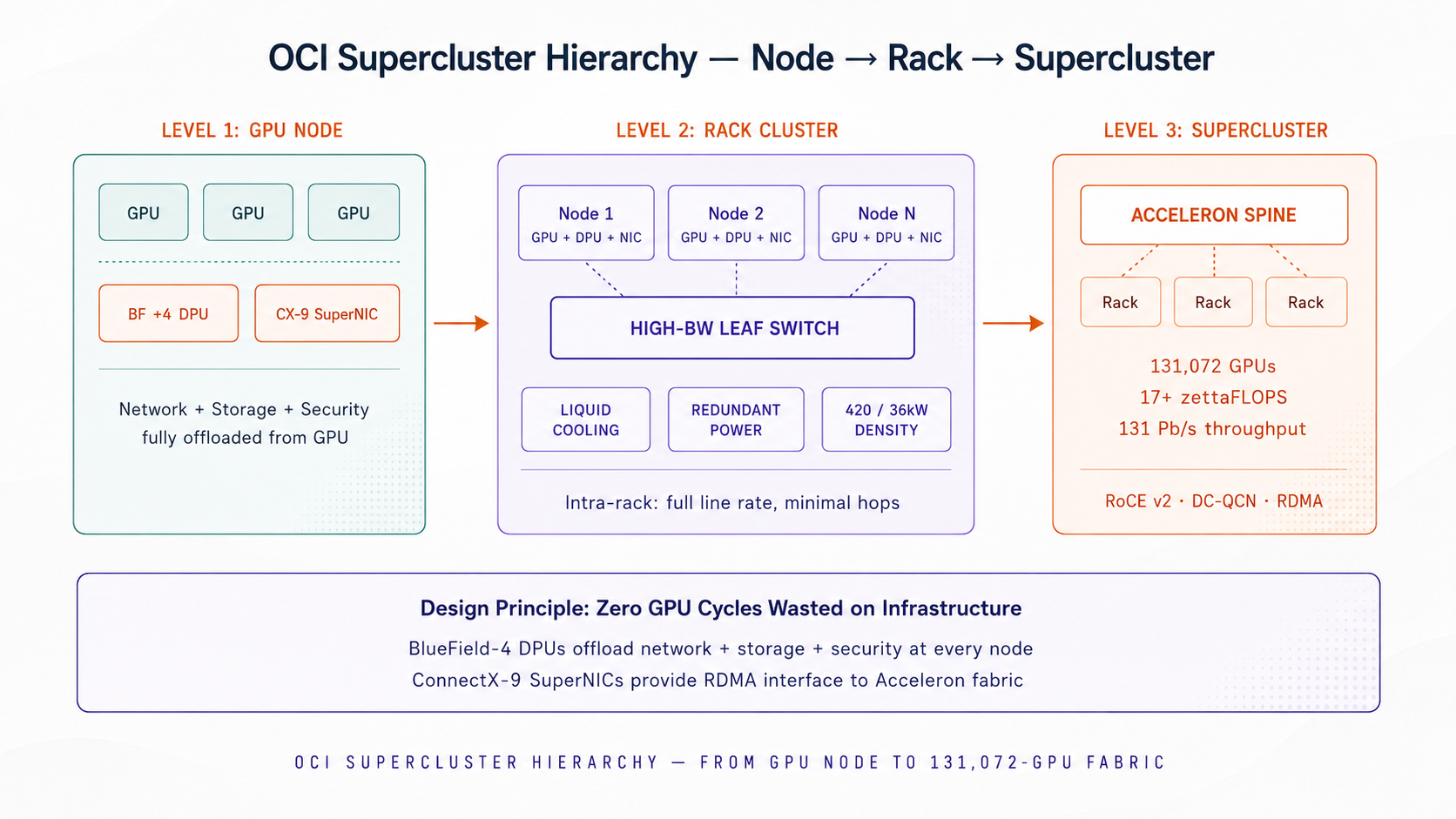
An OCI supercluster is a hierarchically organized GPU fabric that scales from individual GPU nodes to rack-level clusters to a unified supercluster of up to 131,072 NVIDIA Blackwell or Rubin GPUs. Each node pairs GPU accelerators with BlueField-4 DPUs and ConnectX-9 SuperNICs that offload all data movement, storage I/O, and security processing, ensuring that 100% of GPU cycles are available for model computation. The nodes are interconnected through the Oracle Acceleron network at up to 131 Pb/s of front-end throughput.
Understanding how OCI organizes its AI infrastructure requires looking at three levels: the node, the rack, and the supercluster. Each level addresses a different scaling challenge, and the design decisions at each level have direct consequences for training performance.
Level 1: The GPU Node
Each GPU node is where computation actually happens. A node pairs multiple GPU accelerators (NVIDIA Blackwell or Rubin) with dedicated BlueField-4 Data Processing Units and ConnectX-9 SuperNICs. The BlueField-4 DPUs handle all network control, storage I/O, and security enforcement, this is the off-box virtualization principle applied specifically to AI workloads.
The ConnectX-9 SuperNICs provide the RDMA-capable network interface that connects the node to the Acceleron fabric. Together, they ensure that the GPU silicon is never interrupted by infrastructure operations. Every cycle goes to matrix multiplication, attention computation, or gradient synchronization, nothing is wasted on network management or security processing.
Level 2: The Rack Cluster
GPU nodes are organized into rack-level clusters connected through high-bandwidth leaf switches. Within a rack, inter-node communication operates at full line rate with minimal hop counts.
Rack-level clustering is where most intra-layer parallel communication happens during training, the parameter server operations that synchronize weights across a model-parallel partition. The rack design also incorporates the physical infrastructure that GPU-scale compute demands: liquid cooling loops rated for sustained thermal loads, redundant power delivery at up to 30 kW per rack, and 42U density configurations that maximize GPU count per square foot of data center floor space.
Level 3: The Supercluster
The supercluster is the full fabric, up to 131,072 GPUs operating as a single addressable training environment. At this level, the Oracle Acceleron network spine connects rack clusters into a unified topology with up to 131 Pb/s of front-end throughput. The engineering challenge here is not raw bandwidth, it is congestion control.
When 131,072 GPUs execute an all-reduce operation simultaneously, the traffic pattern creates massive incast bursts that would overwhelm conventional Ethernet fabrics. Acceleron’s DC-QCN protocol is specifically designed to manage this traffic pattern without triggering Priority Flow Control pauses, buffer bloat, or deadlock conditions that stall training.
How Oracle Acceleron Eliminates the AI Bottleneck
Oracle Acceleron is a purpose-built networking architecture for OCI AI infrastructure. It uses RDMA over Converged Ethernet version 2 (RoCE v2) to enable direct GPU-to-GPU memory transfer that bypasses the central CPU entirely. Custom Data Center Quantized Congestion Notification (DC-QCN) prevents the Priority Flow Control storms, buffer bloat, and network deadlocks that cripple distributed AI training on conventional Ethernet fabrics. The result is sub-10 microsecond latency at 2.1 Eb/s aggregate RDMA throughput across the entire supercluster.
In distributed AI training, GPUs do not operate independently. They execute collective communication operations, all-reduce, all-gather, reduce-scatter, that synchronize model parameters and gradients across every GPU participating in the training run. The performance of these operations depends entirely on the network. A GPU that computes a gradient in 2 milliseconds but waits 50 milliseconds for the network to synchronize it is operating at roughly 4% efficiency. This is the bottleneck that Acceleron was designed to eliminate.
How RoCE v2 Removes the CPU from the Data Path
Conventional cloud networking routes GPU-to-GPU traffic through the host CPU’s network stack, the operating system processes every packet, consuming CPU cycles and adding latency at every hop. RoCE v2 (RDMA over Converged Ethernet version 2) removes the CPU from this path entirely. One GPU writes directly into another GPU’s memory over the Ethernet fabric, bypassing the CPU, the operating system, and the traditional socket-based networking layers. The hardware handles the transport, and the GPU receives the data in its memory without any software intervention on either end. On Acceleron, this operates at sub-10 microsecond end-to-end latency per operation.
How DC QCN Solves Network Congestion for AI Workloads
RoCE v2 solves the latency problem, but it creates a new one: at supercluster scale, thousands of simultaneous RDMA flows generate traffic patterns that overwhelm conventional Ethernet congestion control.
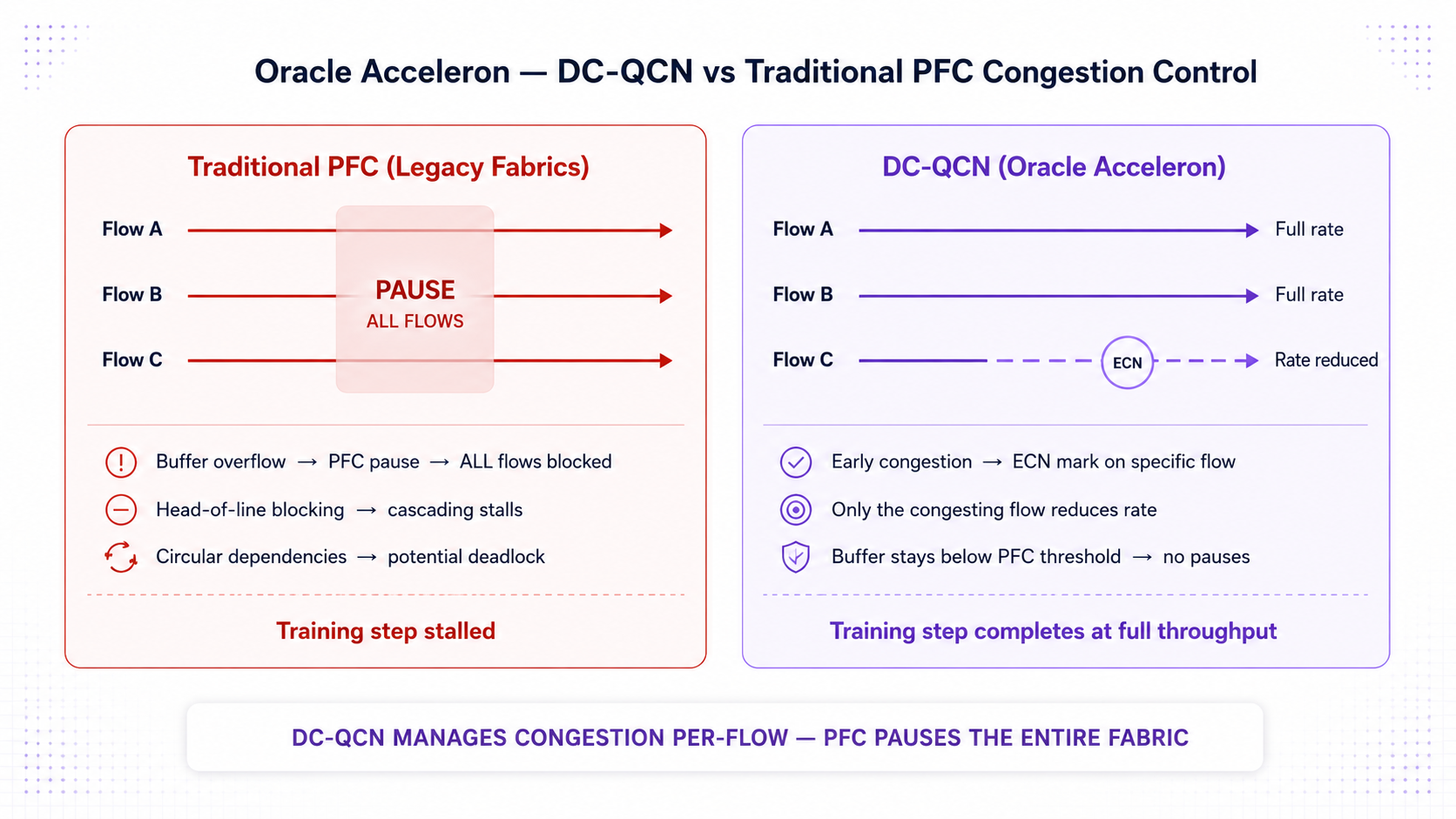
The standard approach, Priority Flow Control (PFC), tells upstream switches to pause sending when buffers fill. But PFC is a blunt instrument. It pauses entire priority classes, not individual flows, creating head-of-line blocking that cascades across the fabric. In severe cases, PFC pauses create circular dependencies that deadlock the entire network.
Oracle Acceleron uses DC-QCN (Data Center Quantized Congestion Notification) instead. DC-QCN operates at the individual flow level: when a switch detects early signs of congestion, it marks packets with an ECN (Explicit Congestion Notification) flag rather than pausing the entire port.
The sending GPU node then reduces its transmission rate for that specific flow, surgically, without affecting the thousands of other flows sharing the same fabric. This keeps buffer utilization below the PFC trigger threshold, preventing pauses entirely rather than recovering from them after the fact.
The distinction matters at scale. In a 131,072-GPU supercluster executing a synchronized all-reduce, tens of thousands of flows converge on spine switches simultaneously. A fabric that relies on PFC would trigger cascading pauses that stall the entire training step. Acceleron’s DC-QCN keeps every flow regulated independently, maintaining aggregate throughput at 2.1 Eb/s without a single PFC pause event.
GPU Hardware Available on OCI Including NVIDIA Blackwell, Rubin, and AMD Instinct MI450
OCI superclusters support three GPU families: NVIDIA Blackwell and NVIDIA Rubin (both available in clusters up to 131,072 GPUs via the Vera Rubin platform), and AMD Instinct MI450 Series (available in clusters up to 50,000 GPUs). The NVIDIA path is powered by BlueField-4 DPUs and ConnectX-9 SuperNICs that offload data movement. AMD Instinct MI450 provides an alternative for enterprises that require hardware diversity or have specific compute-to-memory ratio requirements.
OCI does not lock enterprises into a single GPU vendor. The supercluster architecture supports both NVIDIA and AMD accelerators, each optimized for different workload characteristics and procurement strategies.
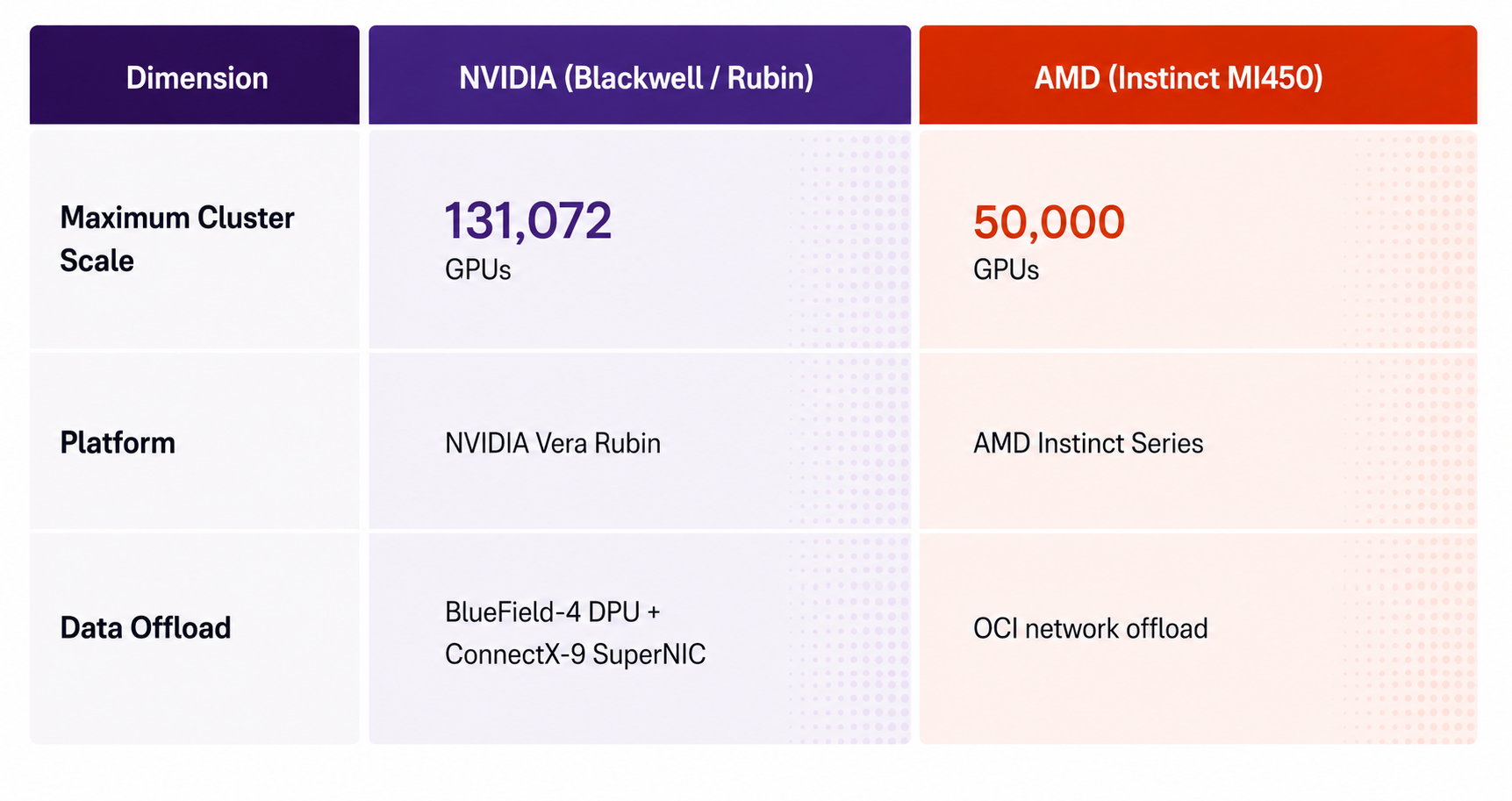
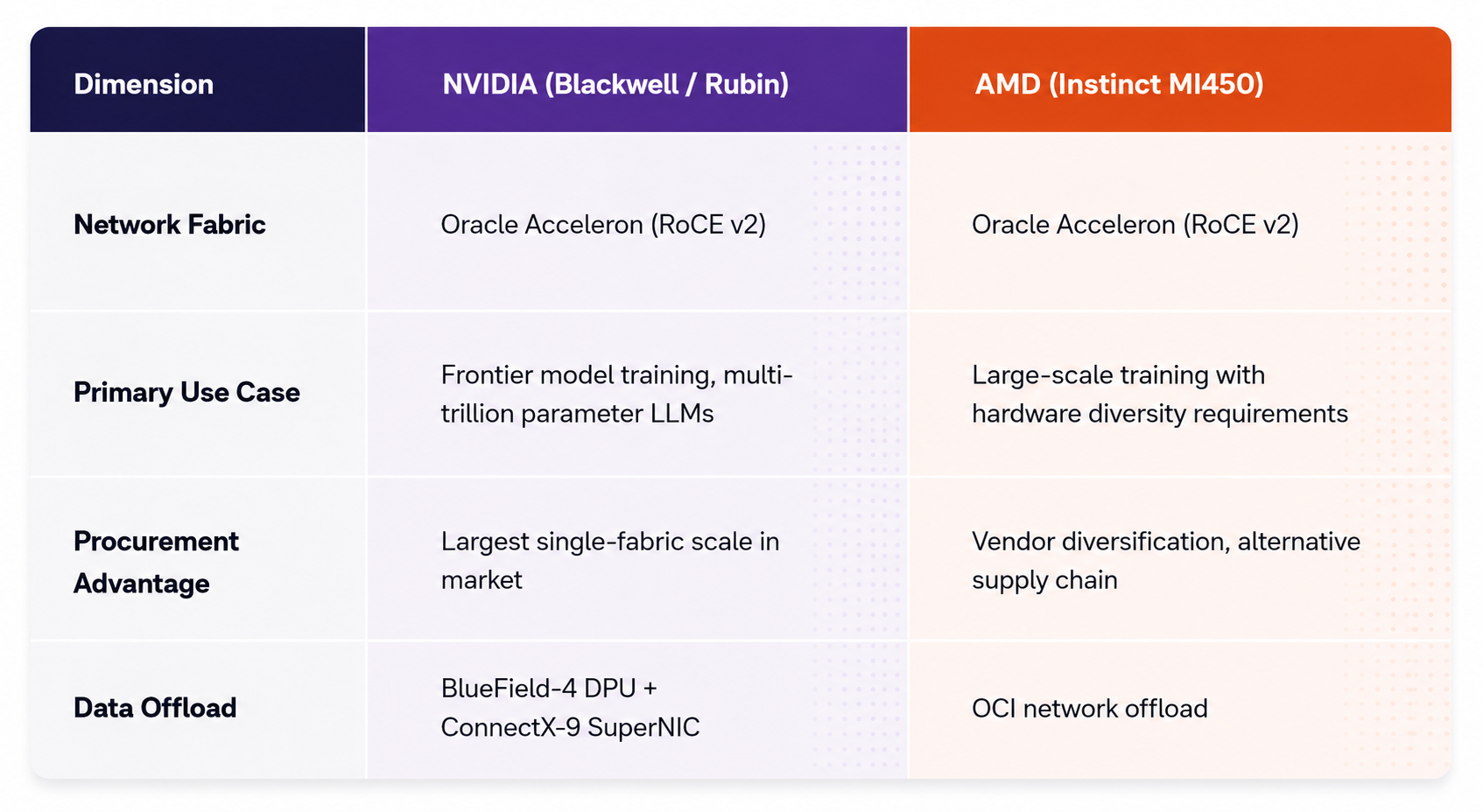
The AMD option deserves particular attention for enterprises managing GPU procurement risk. NVIDIA supply constraints have been a recurring challenge throughout 2024-2026, and organizations that can architect their training pipelines to run on either vendor’s hardware gain significant procurement flexibility. OCI’s Acceleron fabric operates identically under both GPU families, which means the network-level optimizations, including DC-QCN, RDMA, congestion control, apply regardless of which silicon is in the node.

The AI Training Journey from Data to Production on OCI
An AI training workflow on OCI follows five stages: data staging on OCI Object Storage, cluster provisioning on bare-metal GPU instances, distributed training execution across the Acceleron fabric, checkpoint management and fault recovery, and model export for inference deployment. OCI’s bare-metal instances ensure no hypervisor overhead during training, and Acceleron’s congestion control maintains throughput stability across multi-week training runs.
Running a generative AI training job on OCI is not the same as spinning up a single GPU instance and running a script. At supercluster scale, the workflow involves coordinated infrastructure operations that must work reliably for weeks at a time.
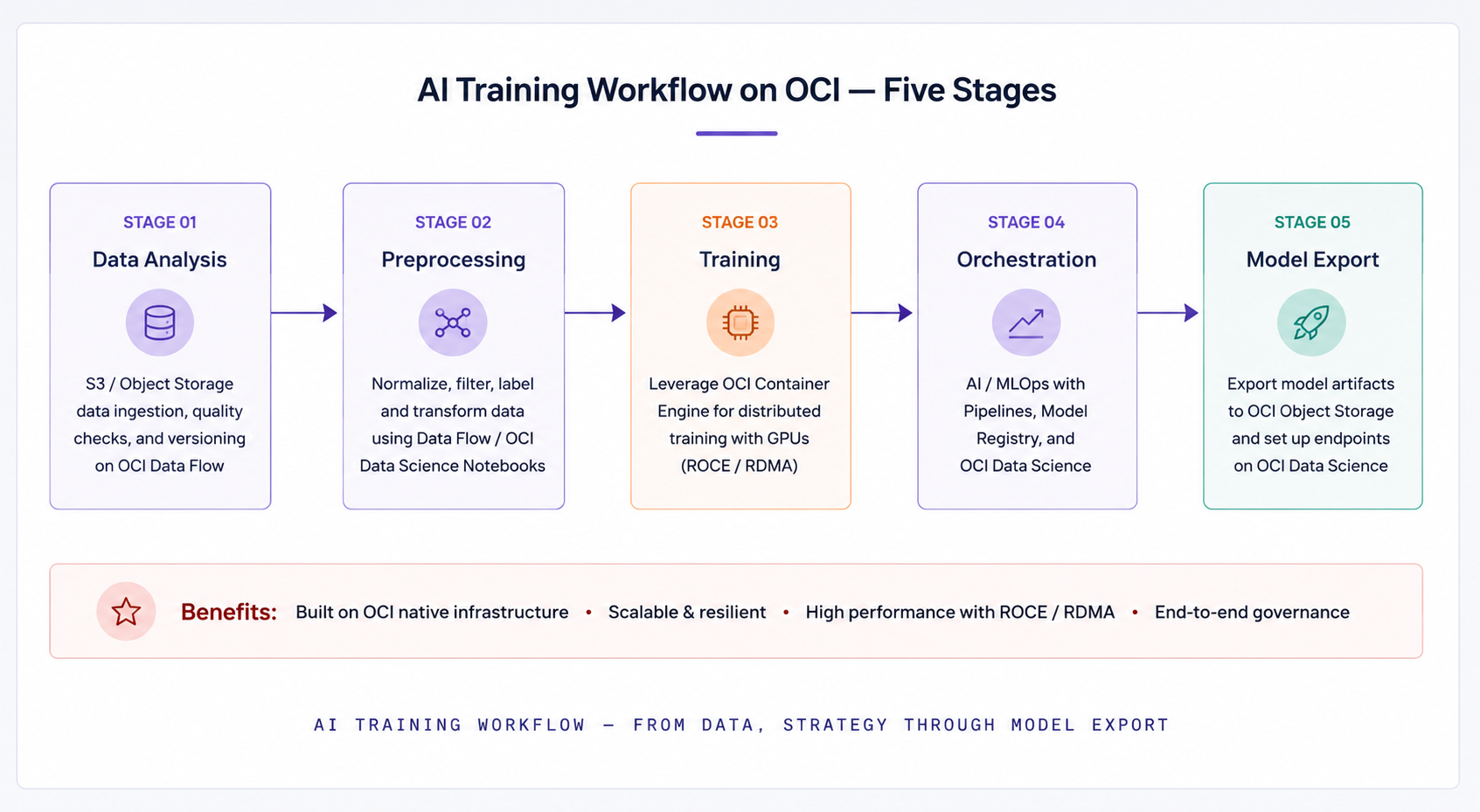
The checkpointing stage deserves emphasis. In a multi-week training run across thousands of GPUs, hardware failures are not exceptional events, they are statistical certainties. OCI’s checkpoint infrastructure periodically saves the full training state (model weights, optimizer state, data loader position) to high-throughput Object Storage. When a node fails, the system recovers from the last checkpoint rather than restarting from scratch. The cost difference between a well-implemented checkpoint recovery and a full restart can exceed hundreds of thousands of dollars on a large training run.
Knowing When OCI Superclusters Deliver Value
OCI superclusters are designed for distributed training of large generative AI models (typically 10 billion+ parameters) where the training job requires hundreds or thousands of GPUs operating simultaneously over days or weeks. They are not cost-effective for single-GPU inference, small-scale fine-tuning (under 50 GPUs), or batch prediction workloads where latency tolerance is high. For smaller AI workloads, OCI’s standard GPU instances or the Always Free tier are more appropriate starting points.
Not every AI workload needs a supercluster. An effective Oracle cloud migration strategy begins by identifying which AI workloads genuinely benefit from distributed GPU infrastructure and which are better served by standard GPU instances.
Superclusters deliver their value when the workload is genuinely distributed, when the model is too large to fit on a single GPU’s memory and must be partitioned across nodes (model parallelism), or when the training dataset is so large that each GPU processes a different shard simultaneously (data parallelism).
In both cases, the GPUs need to communicate constantly, and the network becomes the determining factor in overall training throughput. This is where Acceleron’s sub-10 microsecond latency and DC-QCN congestion control justify their engineering complexity.
For fine-tuning a pre-trained model on a modest dataset, or running inference on a deployed model, the network demands are fundamentally different. A single bare-metal GPU instance or a small cluster of 4-8 GPUs is typically sufficient, and OCI provides these as standard compute shapes without requiring a supercluster allocation.
Enterprises exploring AI for the first time can start with OCI’s Always Free tier (which includes general compute) or a single A100/H100 instance to validate their pipeline before scaling to supercluster capacity.
The decision framework is straightforward: if your training job requires fewer than 50 GPUs and runs for hours rather than weeks, start with standard OCI GPU instances. If it requires hundreds or thousands of GPUs running continuously, the supercluster is where the economics and performance both favor OCI over every other cloud platform.
Looking to accelerate enterprise AI on Oracle Cloud? Explore AppsTek’s Oracle Services, AI Services, Oracle Fusion Cloud, Cloud Engineering, and Data Engineering capabilities to build secure, scalable, and production-ready AI solutions aligned with business goals. Connect with our experts today.
Frequently Asked Questions About Oracle Cloud AI Infrastructure
Standard cloud networking routes GPU traffic through the host CPU's network stack, adding latency at every hop. Oracle Acceleron uses RoCE v2 for direct GPU-to-GPU RDMA that bypasses the CPU entirely, and DC-QCN congestion control that manages individual flows rather than pausing entire ports, delivering sub-10 microsecond latency at 2.1 Eb/s aggregate throughput.
BlueField-4 DPUs handle all network control, storage I/O, and security processing independently from the GPU node's compute hardware. This ensures 100% of GPU cycles are available for AI model computation, no cycles are consumed by infrastructure management operations.
DC-QCN (Data Center Quantized Congestion Notification) is a congestion control protocol that operates per-flow rather than per-port. When congestion is detected, it marks specific flows with ECN flags instead of triggering PFC pauses that block all traffic. This prevents the cascading network stalls that derail distributed AI training on conventional Ethernet fabrics.
Yes. OCI offers up to 50,000 AMD Instinct MI450 Series GPUs alongside its NVIDIA Blackwell/Rubin clusters. Both GPU families connect through the same Oracle Acceleron fabric with identical RoCE v2 and DC-QCN capabilities, giving enterprises hardware diversity and GPU procurement flexibility.
OCI's training infrastructure supports periodic checkpoint saves to high-throughput Object Storage. When a node fails, the system recovers from the last checkpoint rather than restarting the entire training job, minimizing lost computation and cost. At supercluster scale, hardware failures are statistically expected, making checkpoint recovery a critical infrastructure capability.
Typically not. Superclusters are optimized for large-scale distributed training of models with 10 billion+ parameters. For fine-tuning pre-trained models or running inference, OCI's standard bare-metal GPU instances (single or small cluster) provide the right balance of performance and cost without the overhead of a full supercluster allocation.

About The Author
Rahul Sudeep, Senior Director of Marketing at AppsTek Corp, is a results-driven, AI-first B2B marketing leader with 15 years of experience scaling global enterprise SaaS companies. His expertise, honed at IIM-K, spans architecting high-impact go-to-market strategies, driving new market identification and positioning, and embedding Generative AI, LLMs, and predictive analytics into the core marketing function. Rahul unifies Technology, Sales, and Support teams around a single strategic hub, while also managing key Partner and Investor Relations. He leverages AI-driven insights to craft powerful brand narratives and hyper-personalized demand generation campaigns that drive measurable revenue growth and deepen customer engagement.