
Table of Contents
What Is the Oracle AI Data Platform?
Why Does Enterprise AI Underperform Without Unified Data?
What Does Pragmatic Enterprise AI Actually Require?
How Does Zero-Copy Integration Eliminate the ETL Tax?
How Does the Oracle AI Data Platform Architecture Apply Business Meaning?
How Does Agentic Orchestration Embed Intelligence in the Flow of Work?
What Business Outcomes Does the Platform Deliver?



Every quarter an AI initiative spends grounded in a pilot is a quarter a competitor spends pulling ahead. The blocker is rarely budget, talent, or model choice. It is a data foundation that cannot give AI the context to act.
That gap is where most enterprise AI programs come undone. Boards approve the spend, vendors demonstrate compelling prototypes, and momentum builds. The wall appears later, when organizations try to move AI from proof-of-concept into production. The model misreads the business, returns answers that sound right and prove wrong, and carries operational risk into processes that cannot absorb it. Trust erodes fast, adoption slows, and the initiative loses steam before it returns a dollar.
The cause sits in data architecture rather than model quality. The Oracle AI Data Platform was built to close exactly this gap, and the organizations getting AI into production are the ones that treated the foundation as the strategy.
What Is the Oracle AI Data Platform?
The Oracle AI Data Platform is a unified data and intelligence foundation that connects live enterprise data, applies shared business meaning through a semantic layer, and governs every AI inference and automated action. It grounds models in the organization’s own context, which makes AI outputs accurate, traceable, and safe to operationalize.
The platform rests on three working parts. It delivers live, governed access to data across the enterprise. It applies a semantic layer that turns raw records into shared business meaning. It enforces governance so each inference stays auditable and policy-aligned.
Why Does Enterprise AI Underperform Without Unified Data?
Every large organization carries years of operational history across scattered systems. ERP platforms, HR suites, customer databases, IoT feeds, legacy warehouses, and cloud-native applications each hold a slice of the same story. These systems rarely share a language, and they almost never share a governance layer.
Drop an AI model into that environment and it meets what practitioners call the context deficit. The model holds broad general intelligence, yet it knows nothing about the specific customers, products, workflows, and policies that define daily operations.
What does the context deficit look like in practice?
- A model cannot tell a high-value account apart from a routine inquiry.
- A model cannot recognize that a single SKU carries a regulatory constraint.
- A model cannot factor in a cost-center exception approved last quarter.
“Powerful foundation models trained on the world’s knowledge still need to understand a specific business. Without that grounding, enterprise AI becomes an expensive hallucination engine.”
The deficit turns structural as AI shifts from question-and-answer interfaces toward autonomous, multi-step agentic AI. Agents running complex workflows need persistent memory. They need to recall what happened in step three before they decide on step seven. A fragmented foundation forces them to operate with amnesia, which undermines the business-critical processes they were meant to strengthen.
What Does Pragmatic Enterprise AI Actually Require?
The industry has debated architectures for years. The sharper question is simpler. What does enterprise AI need to earn trust?
It needs live, accurate data drawn from across the enterprise without the latency and risk of constant extraction pipelines. It needs a semantic layer that converts raw data into shared business meaning, so a reference to “customer” maps to a precise organizational definition. It needs governance controls that keep every inference and automated action traceable, policy-aligned, and auditable.
This is the operational specification behind the AI Data Platform, and it reflects the architecture that separates AI deployments that scale from deployments that stall.
How Does Zero-Copy Integration Eliminate the ETL Tax?
Traditional data architectures lean on extract, transform, and load pipelines to shuttle data between systems. Every hop adds latency, opens room for data drift, and widens the compliance surface that governance teams must manage. AI workloads depend on recency and accuracy, so this approach breaks down quickly.
The Oracle AI Data Platform removes the bottleneck through zero-copy, zero-ETL integration. Data teams connect directly to live, distributed sources and query or model against them natively. No duplication occurs. No stale copy lingers in an intermediate layer. The data that powers AI inference stays the same governed data that powers the business.
The Autonomous Database anchors this architecture, enabling in-database machine learning and high-performance vector search. Inference and analytics run where the data lives rather than where it has been copied. The difference matters for any organization operating Oracle Cloud Application Services at scale, because AI capabilities embed directly inside existing operational systems instead of bolting on as a separate layer.
How Does the Oracle AI Data Platform Architecture Apply Business Meaning?
Data without meaning stays infrastructure. Meaning without data stays speculation. The governed combination makes AI trustworthy at enterprise scale, and it sits at the heart of the Oracle AI Data Platform architecture.
The semantic and governance engine establishes shared business meaning across models, analytics, and AI agents. It defines what “customer” means in context, what a “high-risk transaction” looks like under a given risk policy, and what an “eligible employee” is under a specific benefits program. These definitions live in a governed semantic layer that adapts as the business evolves, rather than in brittle code that breaks when rules change.
The consequences land immediately. Complex Oracle Redwood implementations can surface contextually accurate information to end users without constant model retraining. Finance teams and compliance officers gain full lineage on every AI output, so the path from source data to recommendation stays visible and auditable.
What this looks like in practice
A procurement AI that knows which supplier relationships carry preferred-vendor status. An HR assistant that understands role-based policy variations across geographies. A customer analytics model that treats accounts by contractual tier rather than spend alone. Semantic enrichment separates AI that is contextually intelligent from AI that is merely statistically fluent.
How Does Agentic Orchestration Embed Intelligence in the Flow of Work?
The most consequential shift in enterprise AI right now is architectural rather than model-driven. AI is moving from a tool that gets queried to a participant that acts.
Agentic AI systems run multi-step workflows on their own. They detect a condition, analyze context, choose a course of action, escalate when needed, and close the loop without a human triggering each step. The platform supplies the infrastructure for this at enterprise scale, with monitoring and safety controls embedded throughout so automation operates inside policy boundaries.
IT operations offer a concrete example. Operations teams face alert fatigue because fragmented monitoring tools fire hundreds of signals without the business context to rank them. An agentic workflow built on the AI data platform Oracle foundation enriches each event with business context automatically: affected services, at-risk SLAs, and customer commitments in jeopardy. It coordinates detection, root-cause analysis, and remediation across multiple systems at once. Ticket creation, approval routing, and cross-team notifications happen automatically. Mean Time to Resolution drops because the work arrives intelligently pre-processed, not because engineers move faster.
Organizations with complex operational environments gain the most. In industrial manufacturing, agentic coordination across production systems, supply-chain signals, and maintenance records marks a step-change in operational intelligence.
What Business Outcomes Does the Platform Deliver?
Human Resources: From Static Policies to Dynamic Guidance
HR teams carry a heavy knowledge-management burden. Employees ask the same questions about benefits, leave, compliance, and performance thousands of times a year, and answers shift by role, geography, and employment type. Traditional chatbots oversimplify or collapse when policy complexity runs high.
The platform enables a governed retrieval-augmented generation (RAG) architecture that pulls role-appropriate policy information from authoritative sources and generates clear, accurate guidance. Every response cites its source. Access controls keep employees seeing only information relevant to their context. Grounding responses in governed enterprise content minimizes hallucinations.
The platform also moves beyond reactive Q&A into proactive workforce intelligence. Unifying Human Capital Management data, performance trends, and external signals lets machine learning models surface early indicators of disengagement and attrition risk. Semantic models interpret organizational structures, role definitions, and skill taxonomies correctly, so predictions reflect how the business actually works rather than how a raw export appears.
Customer Experience: Turning Signal Noise into Competitive Intelligence
Customer sentiment data sits structurally fragmented. It lives in support transcripts, survey responses, social mentions, product telemetry, and NPS scores, each in a separate system with a separate schema. CX leaders end up with plenty of data and very little actionable intelligence.
The Oracle AI Data Platform unifies structured and unstructured data into a governed lakehouse with automated enrichment and classification. Vector search and large language model summarization surface emerging trends as a continuous signal rather than a weekly report. Automated alerts route insights to the right teams, so customer experience, support, and product organizations work from one intelligence layer instead of reconciling conflicting views of the same customer.
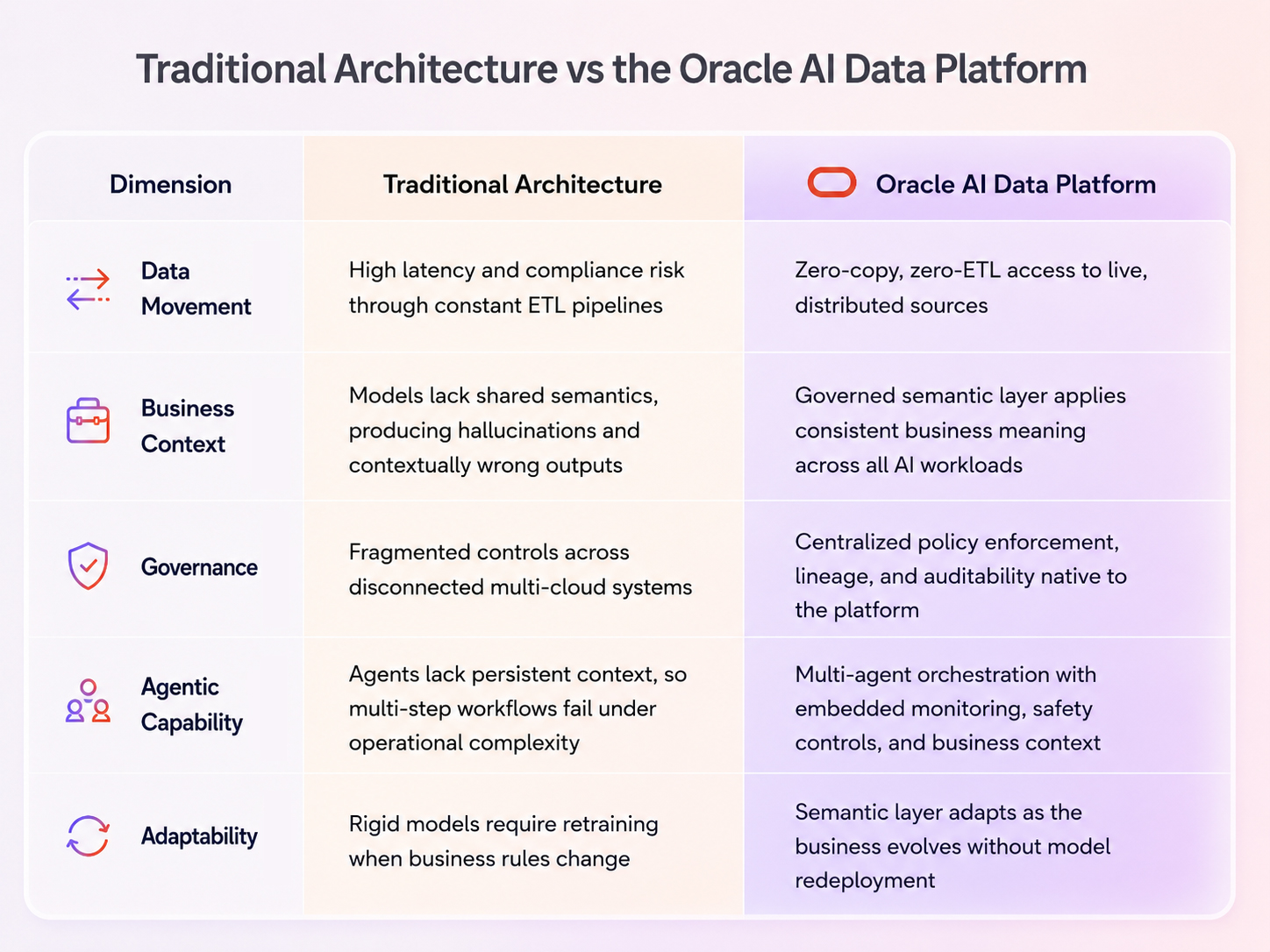
Traditional Architecture vs the Oracle AI Data Platform
How Do Organizations Move From Architecture to Execution?
Understanding why a unified AI data platform matters stays straightforward. Executing the shift from a fragmented legacy environment to an intelligent, agentic digital core proves considerably harder.
The work demands deep familiarity with the Oracle ecosystem, specifically the intersection of OCI infrastructure, Fusion Applications, Autonomous Database, and the governance and semantic layers that bind them. It demands the discipline to map AI capabilities to specific business KPIs rather than deploying technology for its own sake. It demands a delivery model that operates inside the governance, security, and compliance constraints of a real enterprise.
Organizations already running Oracle Managed Services hold a head start, because the operational foundation of monitoring, governance, and continuous optimization already exists. The platform layers intelligence on top of that base rather than demanding a parallel infrastructure buildout.
The enterprises that lead the next decade will be the ones that built the right foundation to make AI trustworthy, contextual, and operationally embedded. The Oracle AI Data Platform is that foundation. The real question is execution speed, not whether to build it.
Ready to Build Your AI Data Foundation?
AppsTek Corp architects and executes Oracle AI transformations that deliver measurable business outcomes. Connect with our team to discuss where your organization stands today and what pragmatic AI looks like in your environment: hello@appstekcorp.com.
Frequently Asked Questions
The Oracle AI Data Platform is a unified foundation that connects live enterprise data, applies a governed semantic layer, and enforces governance across every AI inference. It grounds models in business context so outputs stay accurate, traceable, and production-ready.
The architecture supplies persistent memory, a shared semantic layer, and embedded safety controls. Agents retain context across multi-step workflows, enrich each event with business meaning, and act within policy boundaries, which makes autonomous workflows reliable at scale.
The platform replaces latency-heavy ETL pipelines with zero-copy, zero-ETL access to live sources. Inference runs where data lives through the Autonomous Database, governance stays centralized, and the semantic layer adapts as business rules change without model retraining.
The platform closes the context deficit that causes most production AI to fail. Accurate, governed, contextually grounded outputs build trust, accelerate adoption, and embed intelligence into HR, customer experience, and operations, which turns AI investment into measurable business value.

About The Author
Rahul Sudeep, Senior Director of Marketing at AppsTek Corp, is a results-driven, AI-first B2B marketing leader with 15 years of experience scaling global enterprise SaaS companies. His expertise, honed at IIM-K, spans architecting high-impact go-to-market strategies, driving new market identification and positioning, and embedding Generative AI, LLMs, and predictive analytics into the core marketing function. Rahul unifies Technology, Sales, and Support teams around a single strategic hub, while also managing key Partner and Investor Relations. He leverages AI-driven insights to craft powerful brand narratives and hyper-personalized demand generation campaigns that drive measurable revenue growth and deepen customer engagement.