Table of Contents


KEY TAKEAWAYS
- In AppsTek AI Services, 12 of the 25 steps on a loan file belong to AI agents and 13 belong to people. Eight of those 13 are checkpoints where a person must decide or approve.
- The rule is simple: agents prepare, rules decide, people approve.
- Agents never approve or deny a loan, never accuse a borrower of fraud, never order a paid service without approval and never override the rules engine.
- You can start with one agent on one loan product and decide on day 30 whether to scale.
Ask a COO what concerns them about AI agents in mortgage operations, and the answer is rarely the technology itself. It is accountability. If an agent handles a loan file and something goes wrong, who takes responsibility?
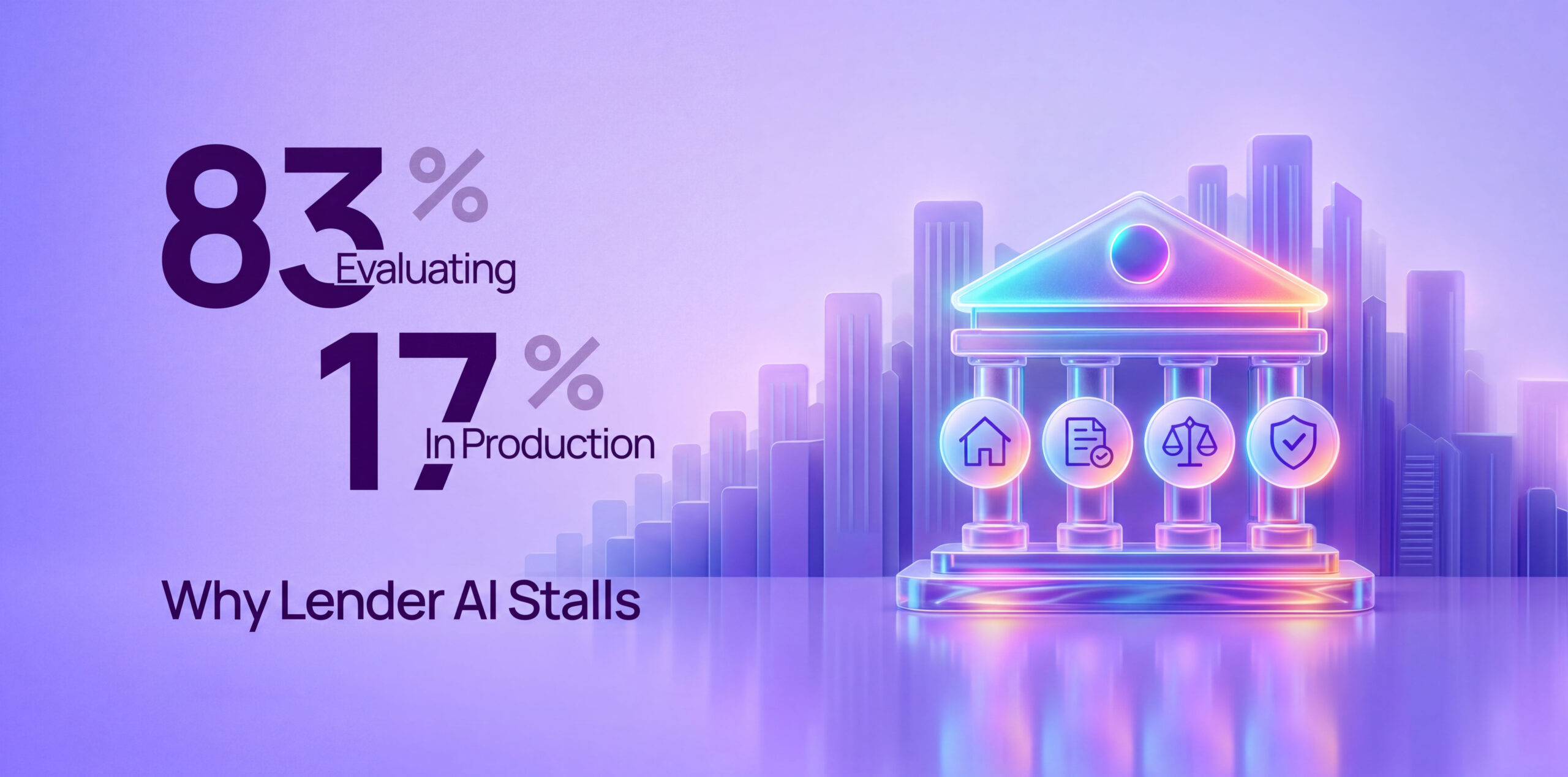
It is a valid concern, and the 2026 data reflects it. In a Mortgage Collaborative survey, 83% of lenders said they were evaluating AI tools, yet only 17% had AI in live production. A quarter identified a lack of trust in AI outputs as the primary barrier to adoption. Meanwhile, 86% cited lower production costs as their top operational priority. The message is clear: lenders are looking for greater efficiency, but they need confidence that control and accountability remain intact.
The way forward is to build accountability into the process itself. Every consequential decision needs a clearly assigned human owner, while every action taken by an AI agent must be supported by traceable evidence. This is how AppsTek AI Services approaches all 25 steps of the mortgage loan lifecycle.
What is the rule for dividing work between AI agents and people?
Agents prepare, rules decide, people approve.
AI agents handle the work of reading, extracting, following up, checking and drafting. A rules engine and automated calculators apply consistent logic to every validation, returning the same pass, fail or numerical result each time. Human oversight remains central to decisions involving judgment or liability, including credit decisions, fraud holds, exceptions, compliance remediation and funding release. Every action carries a traceable record of the rule applied or source used.
Across the 25 steps, 12 are handled by agents and 13 remain with people. Of the 13 human-led steps, eight serve as decision or approval checkpoints, while the remaining five involve borrower and loan officer activities.
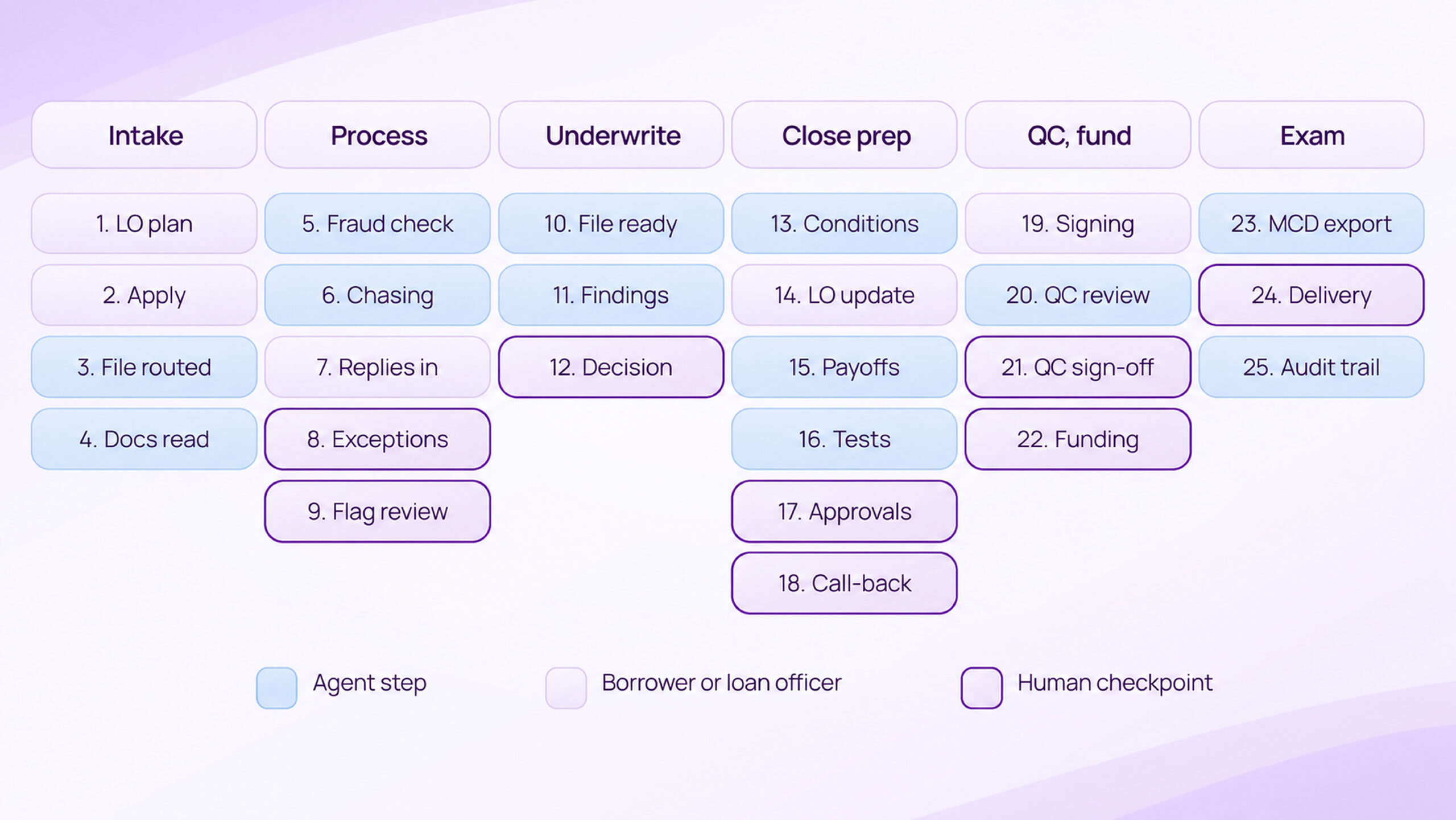
What does a 25-step AI-agent mortgage workflow look like?
The diagram shows all 25 steps in six phases. Teal steps belong to an agent, gray steps to a person, and lavender steps with a dark outline are the eight checkpoints. The text below walks through each phase.
Phase 1: Intake (steps 1 to 4)
The loan officer establishes the loan plan, while the borrower completes the application and uploads the required documents. The orchestrator then creates the loan file, routes incoming documents and tracks their status, triggering the relevant agents (step 3). Next, the document intelligence agent classifies each upload, extracts key fields with confidence scores and validates them against the application data (step 4). Since both stages follow defined workflows and validation rules, they proceed autonomously without requiring human intervention.
Phase 2: Process (steps 5 to 9)
The fraud and identity agent examines documents, identity records and source data, generating a risk score with supporting reasons (step 5). The processing agent then creates a prioritized task list, requests outstanding documents and manages scheduled follow-ups (step 6). When borrowers respond, their submissions automatically pass through document intelligence for classification and extraction (step 7).
Two human checkpoints govern this stage. At step 8, a processor reviews and resolves exceptions that agents cannot clear, such as disputed information or fields with low confidence scores. At step 9, the risk team assesses high-risk fraud flags and decides whether to clear the case, request additional evidence or place it on hold.
This is where the operational value becomes clear. Processors focus their attention on cases that require judgment, rather than manually reviewing every loan file.
Phase 3: Underwrite (steps 10 to 12)
Once all outstanding items are received and holds are resolved, the processing agent assembles the loan file and runs it through a readiness checklist (step 10). The underwriting copilot then standardizes the data, retrieves the relevant lending guidelines, runs income, asset and ratio calculations, and documents its findings with citations to the applicable rules (step 11). The underwriter reviews the completed assessment, addresses any exceptions and makes the final credit decision (step 12).
The distinction is deliberate: the copilot prepares the evidence and supports the assessment, while the authority to approve or decline a loan remains entirely with the underwriter.
Phase 4: Close prep (steps 13 to 18)
The processing agent gathers and matches evidence against approved underwriting conditions, updating the LOS as requirements are met (13). The loan officer keeps the borrower informed (14). The fraud agent validates payoff letters and wire instructions against title data (15). A rules engine checks fee tolerances, disclosures and timelines, while the compliance agent compiles the supporting evidence (16). Compliance staff review exceptions and approve corrective actions (17). The closer prepares the closing package and verifies any payoff or wire changes through a callback to a known number (18).
Phase 5: QC and fund (steps 19 to 22)
The borrower signs the closing documents (19). The QC agent then reviews every loan file for data integrity, documentation gaps and guideline compliance, ranks defects by severity and generates a prioritized cure list (20). QC analysts validate the findings and provide sign-off (21). Funding proceeds only after the closer receives a clean-to-fund confirmation (22).
Late-stage defects can carry significant costs. ACES Quality Management reported a critical defect rate of 1.71% in Q1 2026, with legal, regulatory and compliance issues accounting for 26.02% of critical defects, their highest share in five years.
Phase 6: Exam (steps 23 to 25)
For loans in scope, the compliance agent maps data to MISMO Mortgage Compliance Dataset (MCD) v2.0, validates it against MISMO wrapper files and generates single-loan or bulk exports (23). The risk team reviews the output and submits it to the examiner or investor (24). Finally, the orchestrator archives the complete audit trail and feeds outcomes into Agentic Managed Services for continuous tuning (25).
Since each state regulator sets its own MCD submission timeline, lenders need the ability to generate compliant datasets on demand.
Which steps does a person decide?
There are eight human checkpoints, each tied to a decision involving judgment, liability or financial exposure. At every checkpoint, the reviewer receives a prepared evidence package with the context needed to make an informed decision.
| Step | Who decides | What they decide | What the agent has prepared |
|---|---|---|---|
| 8 | Processor | How to resolve an exception | The exception, the evidence and a suggested fix |
| 9 | Risk team | Clear, ask for evidence or hold | Risk score with reasons and linked entities |
| 12 | Underwriter | The credit decision and conditions | Calculations and cited findings |
| 17 | Compliance staff | Which exceptions and fixes to approve | Test results with evidence for each rule |
| 18 | Closer | Whether a payoff or wire change is real | The change, flagged against title data |
| 21 | QC analyst | Whether defects are cured | A ranked cure list with evidence |
| 22 | Closer | Whether to fund | The clean-to-fund signal and the audit trail |
| 24 | Risk team | What goes to the examiner or investor | A validated MCD file and test results |
The reviewer works from a complete evidence package rather than spending time gathering and assembling information. That is what separates an agent that supports human decisions from one that obscures how the work gets done.
What do AI agents never do on a loan file?
Four actions remain exclusively under human control. Agents cannot approve or decline loans, make fraud accusations against borrowers, order paid services without approval or override the rules engine. These boundaries are enforced through built-in approval gates that pause execution until an assigned person authorizes the action, rather than relying on policy alone.
What does a COO see when agents work the file?
With every action logged, lenders can answer the examiner’s question, “Why was this loan handled this way?” using the audit trail within the loan file. Performance is measured through four key metrics: touches per loan, exception rate, file-ready turnaround time and cure items per loan. A rising exception rate can also signal an upstream issue, such as inaccurate data fields or rules that need revisiting.
How do you start with AI agents in mortgage operations?
There is no need to deploy all 25 steps at once. Start with one loan product and a focused agent workflow, typically document intelligence paired with processing, where automation can reduce manual effort with minimal decision risk. Run the workflow in shadow mode for a week, allowing reviewers to compare agent outputs against their own work. Then measure performance against the baseline established in week one. This is the starting point for the 30-day pilot offered through AppsTek AI Services starts with.
Frequently asked questions
They read and classify documents, extract and cross-check data, chase missing items, check identity and fraud signals, calculate and cite guideline rules, test compliance, review every file before funding and prepare exam data. In the 25-step workflow agents own 12 steps, and every decision goes to a person.
Eight steps: resolving exceptions (step 8), reviewing high-risk fraud flags (9), the credit decision (12), approving compliance fixes (17), the payoff and wire call-back (18), QC sign-off (21), funding (22) and delivering exam data (24).
No. In AppsTek AI Services the underwriting copilot prepares calculations and cited findings, and the underwriter makes every credit decision. Agents also never accuse a borrower of fraud, order a paid service without approval or override the rules engine.
Log every action with its evidence, require a citation on every finding, let a rules engine return pass or fail on compliance tests, pin model, prompt and rule versions, and gate decisions behind named approvals. Compliance staff review the results, so an examiner can see how each loan was handled.
A first pilot takes 30 days. Pick one loan product and one agent, often document intelligence with the processing agent. Set a baseline in week one, run in shadow mode so reviewers compare the agent with their own work, and decide on day 30 whether to scale, adjust or stop against that baseline.

About The Author
Rahul Sudeep, Senior Director of Marketing at AppsTek Corp, is a results-driven, AI-first B2B marketing leader with 15 years of experience scaling global enterprise SaaS companies. His expertise, honed at IIM-K, spans architecting high-impact go-to-market strategies, driving new market identification and positioning, and embedding Generative AI, LLMs, and predictive analytics into the core marketing function. Rahul unifies Technology, Sales, and Support teams around a single strategic hub, while also managing key Partner and Investor Relations. He leverages AI-driven insights to craft powerful brand narratives and hyper-personalized demand generation campaigns that drive measurable revenue growth and deepen customer engagement.