
Table of Contents
What is agentic AI in contract lifecycle management?
AI-powered CLM vs agentic AI in contract lifecycle management: What is the difference?
How does agentic AI in contract lifecycle management actually work?
What makes our Agentic CLM different from generic AI contract platforms?
Generic CLM vs Agentic CLM at a glance
Which AI agents power the AppsTek Corp Agentic CLM?



AI in contract management has moved through two distinct waves. The first wave, usually marketed as AI-powered CLM, bolted machine learning onto existing workflow tools to extract data, flag clauses, and route documents. Useful, but still reactive.
The second wave is arriving now: agentic AI in contract lifecycle management, where specialized AI agents read, reason, draft, and act across the entire contract lifecycle without waiting for a human to press the next button.
The distinction matters because it decides whether a CLM platform alerts the legal team to work or does the work itself. This article breaks down the difference between AI-powered CLM and agentic AI in contract lifecycle management, the unique advantages of a purpose-built Agentic CLM, and the seven specialized agents that power it.
What is AI-powered CLM?
AI-powered CLM refers to traditional contract lifecycle management platforms that have layered AI features on top of a workflow engine. Typically, these systems use machine learning for:
- OCR and metadata extraction from uploaded contracts
- Clause identification against predefined libraries
- Risk-scoring against standard templates
- Alerts for renewal dates, missing fields, or expired terms
- Search and reporting across the contract repository
The underlying engine, though, is still rules-based. A human configures the triggers, and the system executes the same logic on every run. When something genuinely changes, such as a new regulation, an off-template clause, or a unique counterparty risk, the platform surfaces an alert and waits for a person to act.
AI-powered CLM accelerates contract management, but the autonomous management of contracts remains out of reach.
What is agentic AI in contract lifecycle management?
Agentic AI in contract lifecycle management replaces static workflow logic with autonomous AI agents that operate against the client’s playbook, on the client’s actual contracts. Each agent perceives context, reasons against the organization’s legal posture, takes action, and learns from the outcome.
Rather than a single monolithic AI feature, an agentic CLM platform deploys multiple specialized agents that collaborate as one system, drafting contracts, reviewing third-party paper, redlining clauses, tracking obligations, managing renewals, monitoring compliance, and answering portfolio-level questions in plain English.
Here is the practical difference when a renewal approaches:
- AI-powered CLM: identifies the upcoming renewal, surfaces relevant information, and alerts the appropriate stakeholders so they can decide the next steps.
- Agentic CLM: reviews the contract, evaluates renewal terms against current policies and performance data, prepares a renewal draft, coordinates approvals, and advances the process before human review is required.
The distinction is not whether AI is present. Both approaches use AI. The difference lies in how much work the system can independently perform. AI-powered CLM assists users throughout the contract lifecycle, while agentic CLM enables AI agents to execute and coordinate work across that lifecycle.
AI-powered CLM vs agentic AI in contract lifecycle management: What is the difference?
| Dimension | AI-Powered CLM | Agentic AI in CLM |
|---|---|---|
| Core logic | Rules and triggers configured in advance | Contextual reasoning over the contract estate |
| Behavior | Reactive; surfaces alerts, waits for humans | Proactive; drafts, redlines, escalates autonomously |
| Output | Same result every run | Improves with every contract processed |
| AI training | Generic contract data | Client's own contracts and legal playbook |
| Role of legal team | Reviews everything the system flags | Reviews exceptions; sets policy that agents enforce |
| Lifecycle coverage | Stages instrumented individually | One coordinated system across all stages |
How does agentic AI in contract lifecycle management actually work?
When a third-party contract arrives, multiple agents coordinate in sequence and in parallel:
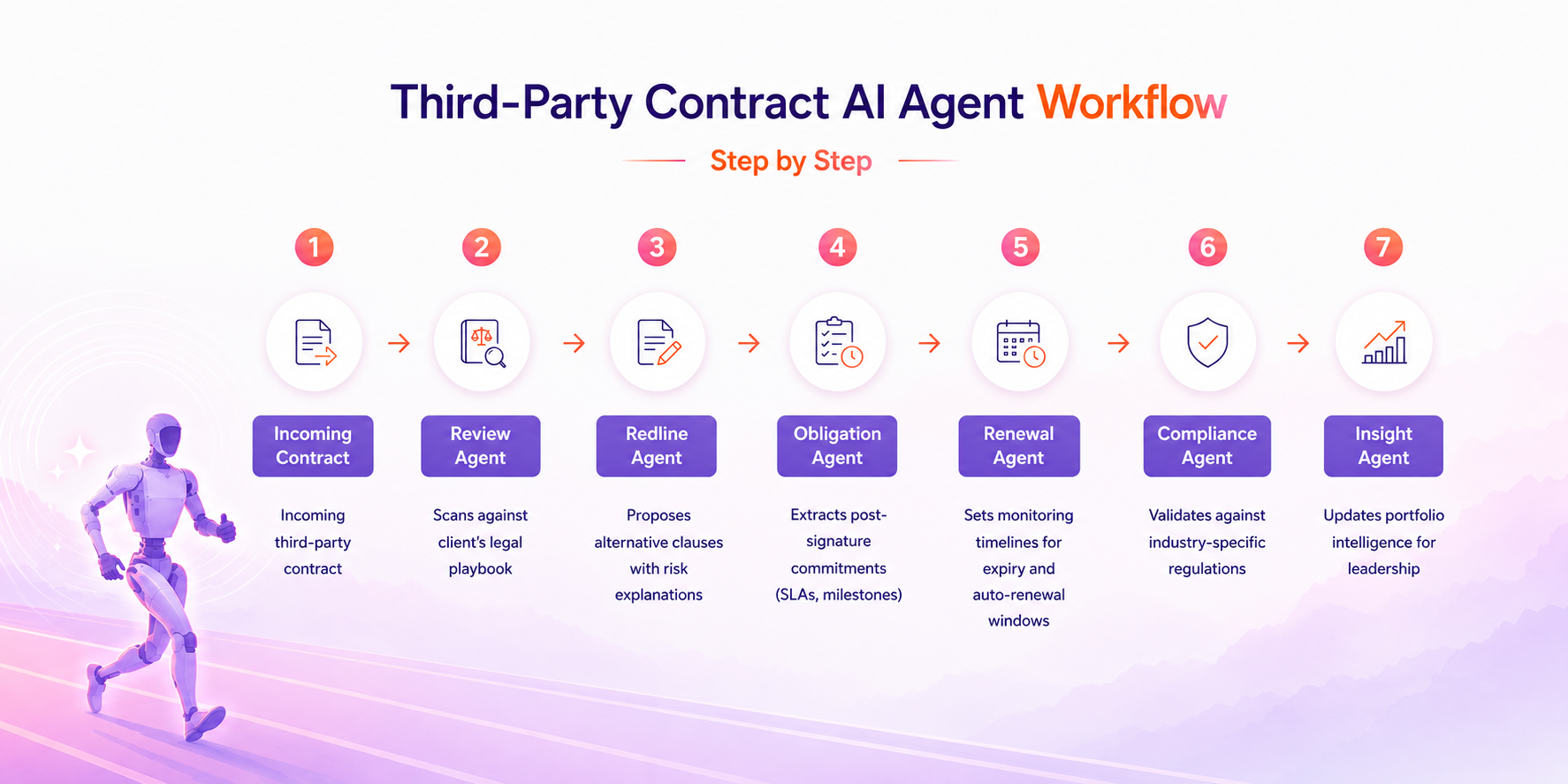
No single agent owns the contract end to end. The agents function as a coordinated system, sharing context and handing off cleanly. This is the architectural property that separates true agentic AI in contract lifecycle management from “AI features” stitched onto a legacy workflow.
What makes our Agentic CLM different from generic AI contract platforms?
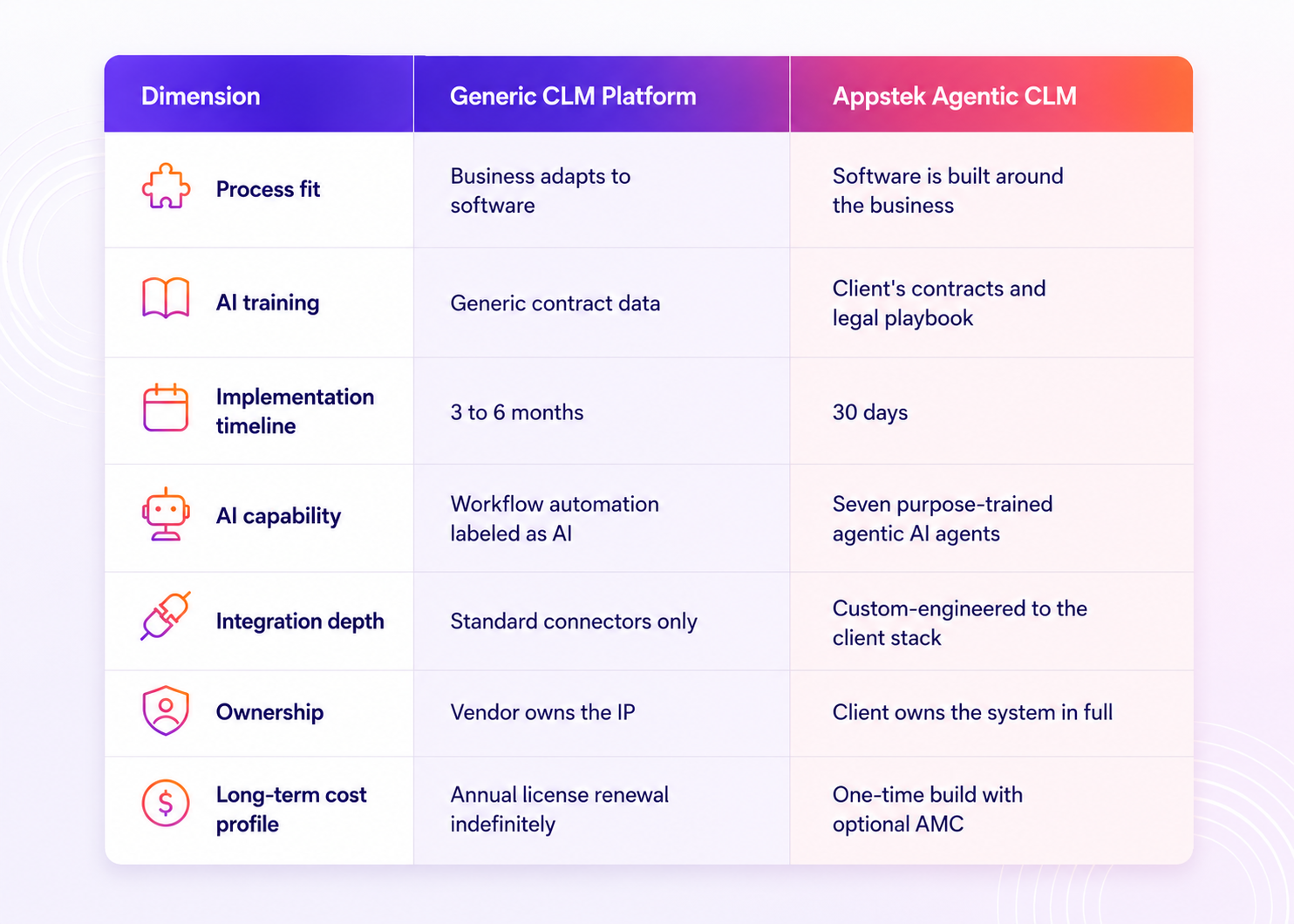
Many platforms in the market are configurable rather than bespoke; customers adapt their processes to fit the tool. Our Agentic CLM inverts that approach, with four advantages:
- Custom-engineered to the business: The platform is built entirely around the organization’s existing contracts, processes, and legal posture, rather than forcing the team to conform to a generic workflow.
- True agentic AI rather than workflow automation in disguise: Seven purpose-trained AI agents execute real tasks across the contract lifecycle, instead of one generic AI feature bolted onto rule-based logic.
- A 30-day deployment commitment: Kickoff to production go-live runs in 30 days, compared with the 3 to 6 months typical of legacy CLM implementations.
- Complete ownership at handover: Full IP retention with zero permanent vendor lock-in, replacing perpetual license renewals with a one-time build and an optional maintenance partnership.
Generic CLM vs Agentic CLM at a glance
Which AI agents power the AppsTek Corp Agentic CLM?
Seven specialized agents cover every stage of the contract lifecycle. They function as a coordinated system rather than as separate tools the team has to stitch together.
- Draft Agent: Generates contract first drafts from conversational prompts using the client’s approved templates and clause language.
Outcome: ~90% reduction in drafting time.
- Review Agent: Scans incoming third-party contracts against the client’s playbook, scoring risk and flagging deviations.
Outcome: risk identified before negotiation begins.
- Redline Agent: Proposes alternative clause language with plain-English explanations of the risk being mitigated.
Outcome: faster negotiation cycles.
- Obligation Agent: Extracts and tracks every post-signature commitment, including SLAs, milestones, payment schedules, and reporting.
Outcome: zero missed obligations.
- Renewal Agent: Monitors expiry timelines and initiates renewal workflows automatically at configured lead times.
Outcome: zero unintended auto-renewals.
- Compliance Agent: Monitors regulatory requirements relevant to the client’s industry and flags compliance gaps proactively.
Outcome: audit-ready continuously.
- Insight Agent: Answers natural-language portfolio questions across the full contract estate without custom reports or legal-team involvement.
Outcome: instant portfolio intelligence for leadership.
Who should move from AI-powered CLM to agentic CLM?
Agentic AI in contract lifecycle management makes the biggest difference for organizations where contract value is quietly leaking through the cracks of a generic platform. That typically means:
- Mid-market enterprises losing 9 to 15% of contract value annually to missed renewals, untracked obligations, or unbilled milestones.
- Legal and procurement teams stuck in manual third-party review cycles.
- Compliance-heavy industries such as financial services, healthcare, manufacturing, technology, and professional services, where regulatory documentation is scattered across systems.
- Leadership teams lacking a consolidated view of expiring contracts, exposure, or counterparty risk.
The bottom line
AI-powered CLM was a meaningful step forward, but it stopped at automating the workflow around the contract.
Agentic AI in contract lifecycle management completes the picture: autonomous agents that draft, reason, act, and learn across every stage of the lifecycle, trained on the client’s contracts and integrated into the client’s stack.
Ready to see what agentic AI in contract lifecycle management looks like when it is built around an organization’s own playbook? AppsTek’s Agentic CLM deploys in 30 days, hands over full IP ownership, and puts seven specialized agents to work on day one. Get in touch with the team to scope the deployment.
Frequently Asked Questions
AI-powered CLM uses artificial intelligence to automate contract-related tasks such as drafting, data extraction, review, search, and risk analysis. It helps contract teams reduce manual effort, accelerate turnaround times, and improve contract visibility.
AI supports contract creation, review, negotiation, approval, obligation tracking, renewals, and reporting. It helps teams process contracts faster and identify important information more efficiently.
Yes. AI can identify non-standard clauses, policy deviations, missing terms, and potential compliance risks by analyzing contracts against predefined rules, playbooks, and regulatory requirements.
AI can be embedded within CLM platforms or integrated through APIs. It works alongside existing contract repositories, workflows, CRM systems, ERP applications, and document management tools.
AI improves contract management by reducing manual work, accelerating contract cycles, increasing review accuracy, strengthening risk oversight, and providing better visibility across the contract portfolio.

About The Author
Myrlysa I. H. Kharkongor is Senior Content Marketer at AppsTek Corp, driving content strategy for the company’s digital engineering services to enhance brand presence and credibility. With experience in media, publishing, and technology, she applies a structured, insight-driven approach to storytelling. She distills AppsTek’s cloud, data, AI, and application capabilities into clear, accessible communications that support positioning and grow the brand’s digital footprint.