Table of Contents
Sovereign AI Architecture Goes Beyond Infrastructure
Data Residency Is Only the Starting Point
The Sovereign AI Enterprise Stack
2. Data and Enterprise Knowledge
4. Applications, Integrations and AI Agents
5. Security, Governance and Observability
Sovereignty Should Follow the Workload
Architecture for Choice, Not Isolation
Building a Sovereignty Baseline



Artificial intelligence is moving deeper into enterprise operations, and the architecture supporting it is becoming increasingly distributed. A single AI workload may depend on enterprise data stored in one environment, a foundation model hosted elsewhere, a vector database containing proprietary knowledge, APIs connecting business systems, and AI agents capable of making decisions or initiating actions.
That distributed model changes the boundaries of control.
Digital sovereignty has traditionally focused on where data is stored, which jurisdiction governs it, and who controls the underlying infrastructure. Those considerations remain important, but they no longer cover the full AI lifecycle. Prompts, embeddings, retrieved context, model inference, AI-generated outputs, agent memory, application integrations, and operational logs can all move through different services and providers before an AI task is completed.
Sovereign AI architecture extends control across this entire enterprise AI stack. It brings infrastructure, data, models, applications, agents, security, and agentic AI governance into the same architectural conversation.
The objective is not to isolate every workload or build every component internally. A practical sovereign AI architecture provides enough control to determine where AI runs, how information moves, which models and providers participate, what AI systems are permitted to do, and how those decisions can be governed over time.
Sovereign AI Architecture Goes Beyond Infrastructure
Sovereign AI architecture is the design of an AI environment around defined requirements for control, jurisdiction, resilience, security, and operational autonomy.
The level of sovereignty required can vary substantially between workloads. An AI assistant working with public marketing information has a different risk profile from a system processing patient records, financial information, government data, or operational information from critical infrastructure.
Sovereignty therefore operates more effectively as a continuum than as a binary designation. Some workloads may only require local data residency and standard enterprise security controls. Others may require stronger restrictions across infrastructure, models, encryption, administrative access, and even physical isolation.
Research across nearly 2,000 organizations suggests that sovereignty measures may be necessary for only about one-third of AI initiatives, with the degree of localization varying even within those workloads.
The architecture needs to support those differences without creating a separate AI environment for every use case.
Sovereign AI is not about making every AI workload local. It is about applying the right level of control to the right workload while retaining the flexibility to change providers, models, and infrastructure as requirements evolve.
Data Residency Is Only the Starting Point
Data sovereignty and AI data residency remain foundational, particularly in regulated industries. The complexity begins once enterprise information enters an AI workflow.
A typical Retrieval-Augmented Generation application illustrates the issue. Source documents may remain within an approved region, while retrieved information is sent to an external model endpoint for inference. Embeddings may be generated through another service and stored in a separate vector database. Conversation history, monitoring information, or model logs may be retained in additional environments.
The source data can remain compliant at rest while other parts of the AI workload move outside the intended control boundary.
Generative and agentic AI also introduce new information assets that sit alongside traditional enterprise records:
- Prompts and system instructions
- Training and fine-tuning datasets
- Embeddings and vector stores
- Retrieved context
- Model inputs and outputs
- Conversation history
- Agent memory
- Evaluation data
- Operational and audit logs
Each asset can contain, reproduce, or encode sensitive enterprise information. Sovereign AI architecture must account for where these assets are processed, how long they are retained, who can access them, and whether they cross jurisdictional or organizational boundaries.
The sovereignty boundary therefore follows the information through the AI lifecycle rather than ending at the database.
The Sovereign AI Enterprise Stack
Enterprise AI sovereignty can be viewed across five connected architectural layers.
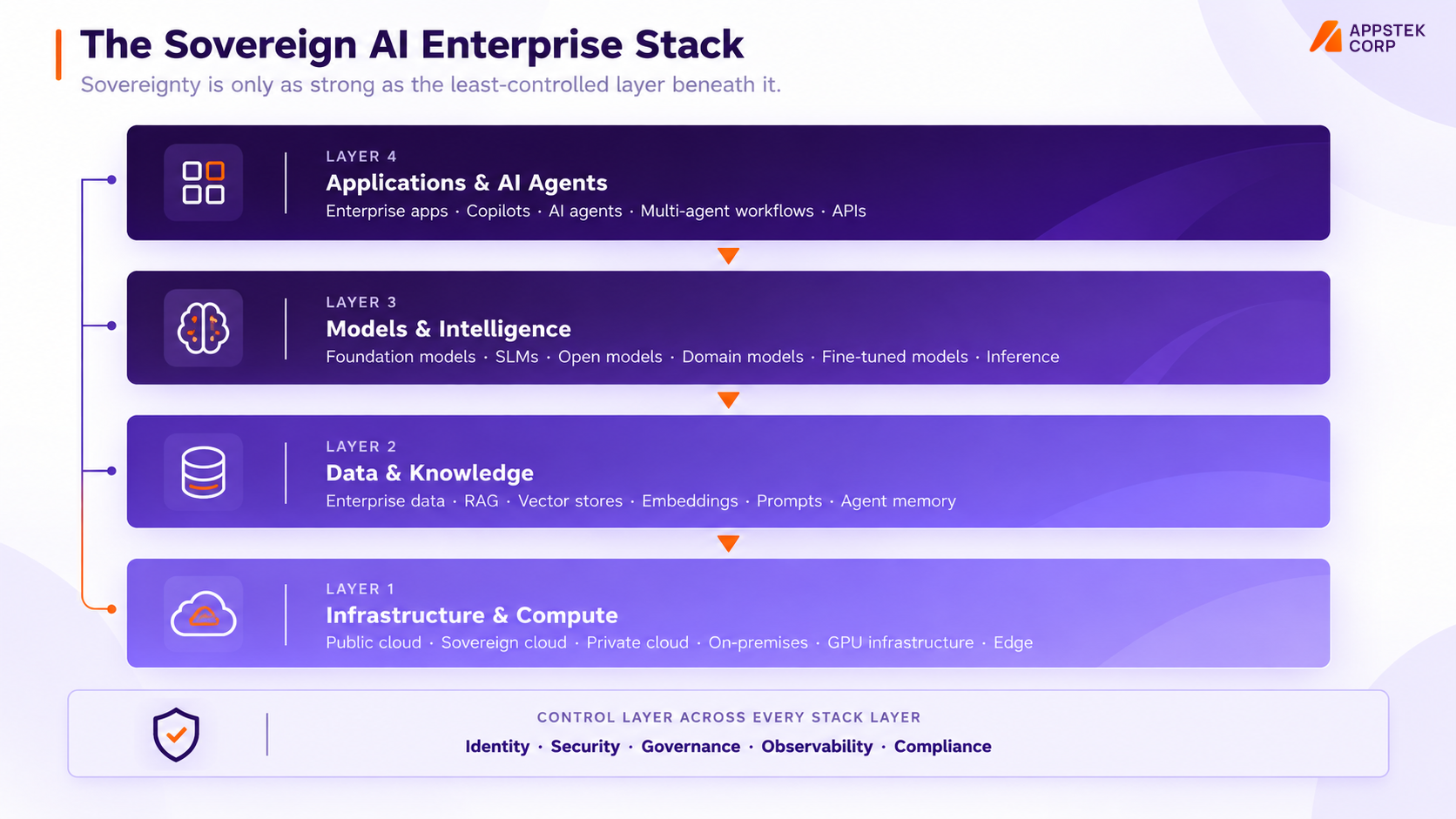
The strength of a sovereign AI stack depends less on any single layer than on how consistently control is maintained across all of them.
1. Infrastructure and Compute
Infrastructure establishes where AI workloads physically and operationally run. The available environment can include public cloud, sovereign cloud, private cloud, regional data centers, on-premises infrastructure, dedicated GPU capacity, and edge computing.
The architectural decision extends beyond cloud or on-premises deployment. It includes questions around infrastructure ownership, administrative control, jurisdiction, encryption, operational responsibility, and provider dependency.
For every critical workload, enterprises need visibility into:
- Where compute is physically located
- Who operates the infrastructure
- Who holds privileged administrative access
- Which legal jurisdiction applies
- How encryption and key ownership are managed
- Which external services remain dependencies
- Whether the workload can be moved if requirements change
Different workloads can then be placed in environments that reflect their actual sensitivity and business criticality.
A global infrastructure environment may provide the scale and innovation required for many AI workloads. Highly sensitive workloads may require local processing, dedicated infrastructure, stronger operational controls, or isolation. Sovereign AI infrastructure increasingly needs to support both ends of that spectrum.
Hybrid and multi-cloud AI architectures consequently play an important role. They allow organizations to combine global capability with stronger local control where it is required, rather than forcing every workload into a single sovereign AI infrastructure model.
2. Data and Enterprise Knowledge
AI expands the enterprise data boundary.
Traditional governance focuses heavily on databases, documents, data warehouses, and data lakes. Generative AI adds retrieval repositories, embeddings, vector stores, prompts, model outputs, and persistent memory. Agentic AI expands it further as information begins moving between AI systems, APIs, and enterprise applications.
A sovereign data architecture requires control over both the source information and the additional knowledge assets created as AI processes that information.
Access control is particularly important. Connecting an AI application to ERP, CRM, HR, finance, engineering, or operational systems should not create a new route around established permissions. Information that is restricted in a source application must remain restricted when accessed through an AI interface.
Identity-aware retrieval, encryption, retention policies, auditability, and policy enforcement therefore become fundamental parts of enterprise AI architecture.
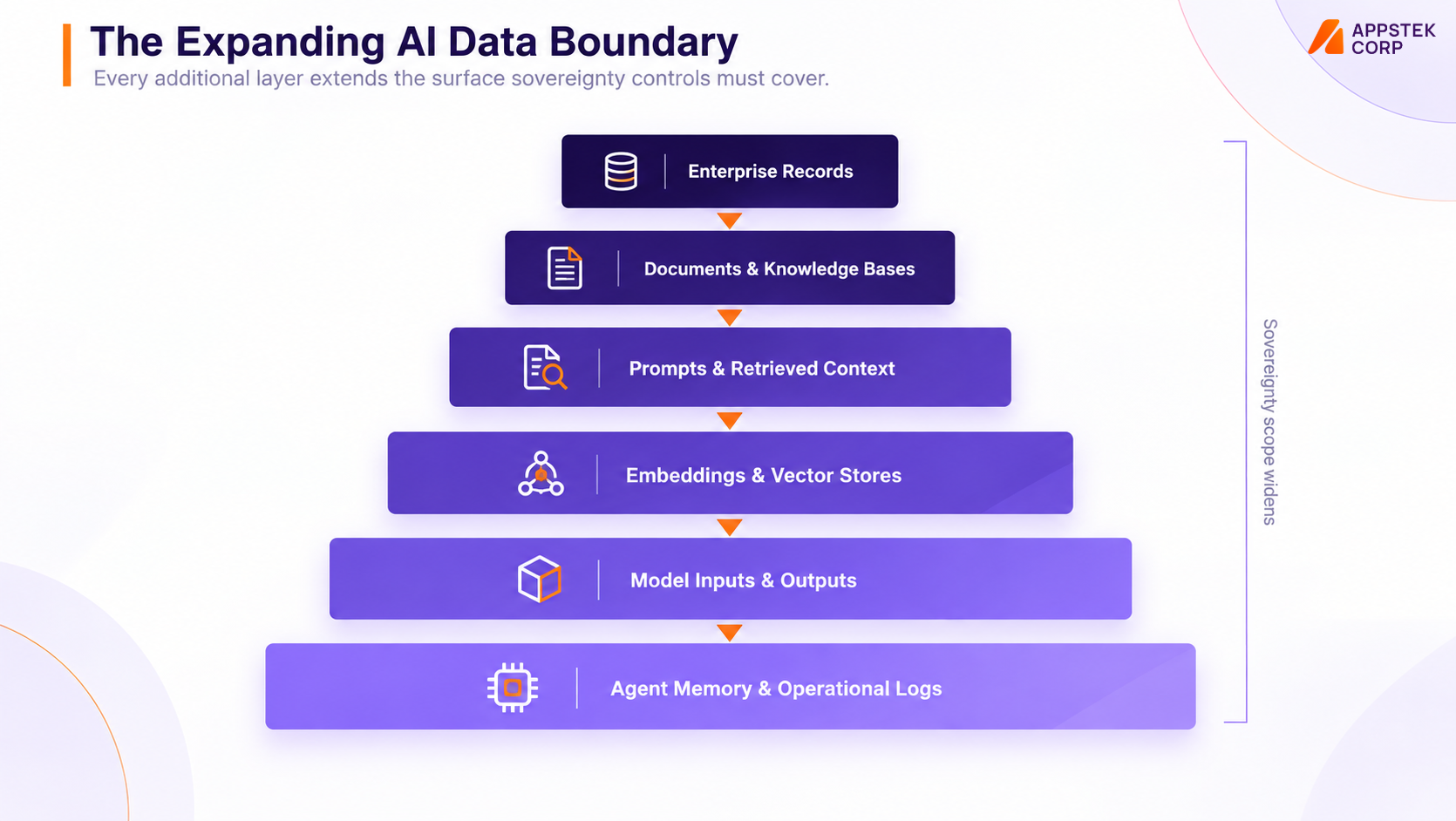
Every additional layer extends the surface that sovereignty controls need to cover.
3. Models and Intelligence
Model sovereignty is emerging as one of the most important gaps in enterprise AI architecture.
Few enterprises are likely to standardize on a single model. Production environments increasingly combine proprietary foundation models, open models, small language models, domain-specific models, and internally fine-tuned models. The choice may change according to accuracy, privacy, cost, latency, industry context, or regulatory requirements.
A multi-model environment creates additional questions around control. Where does inference take place? How are prompts and outputs handled? Can information be retained by the model provider? How are model versions and updates managed? Can one model be replaced by another without redesigning the entire application? Can the organization trace which model generated a specific output?
Model provenance becomes particularly important when AI contributes to regulated, sensitive, or business-critical decisions. Governance needs to extend beyond approving a model for use and into understanding how that model behaves once it becomes part of a production workflow.
The gap between data sovereignty and model sovereignty is already significant. A global 2025 survey found that 60% of organizations had applied sovereignty or residency requirements to data and 46% to infrastructure. That figure dropped to 32% for applications and only 22% for AI models.
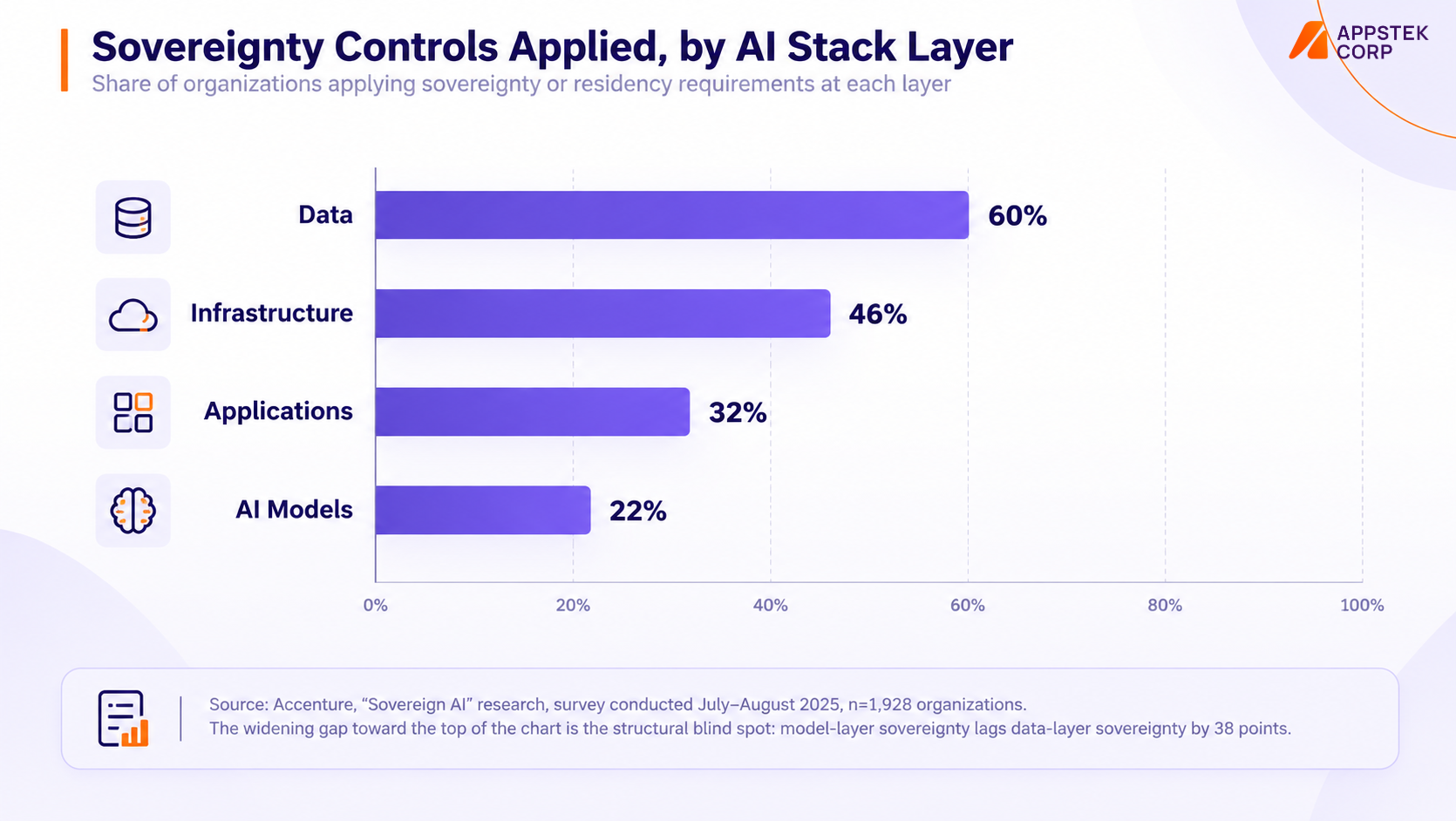
The decline higher in the stack creates a structural blind spot. Protecting enterprise data has limited value if the model processing that information operates outside the intended control framework.
4. Applications, Integrations and AI Agents
Agentic AI introduces a more consequential dimension of sovereignty because AI systems are beginning to move beyond generating information.
An AI agent can retrieve enterprise data, select a model, invoke an API, interact with another application, communicate with another agent, and initiate an action. The architecture is no longer governing only information access. It is governing execution, which is why agentic AI governance is emerging as a distinct architectural requirement rather than an extension of existing AI policy.
An accounts payable agent, for example, could retrieve an invoice, match it against a purchase order, inspect supplier information, identify an exception, and initiate the appropriate workflow. That activity may cross multiple applications, identity boundaries, APIs, models, and infrastructure environments.
Each interaction needs a defined control boundary. Agentic AI governance can include:
- Agent identity
- User delegation and impersonation controls
- Data access permissions
- Approved model access
- Tool and API permissions
- Application-level authorization
- Transaction and execution limits
- Human approval requirements
- Agent-to-agent communication policies
- Complete logging and traceability
The complexity increases further in multi-agent environments. One agent may delegate a task to another, exchange context with a specialized model, retrieve information from an external system, and return the result to an orchestration layer.
Modern sovereign AI architecture therefore has to support multi-cloud, multi-model, and multi-agent environments in which individual services may carry different sovereignty requirements.
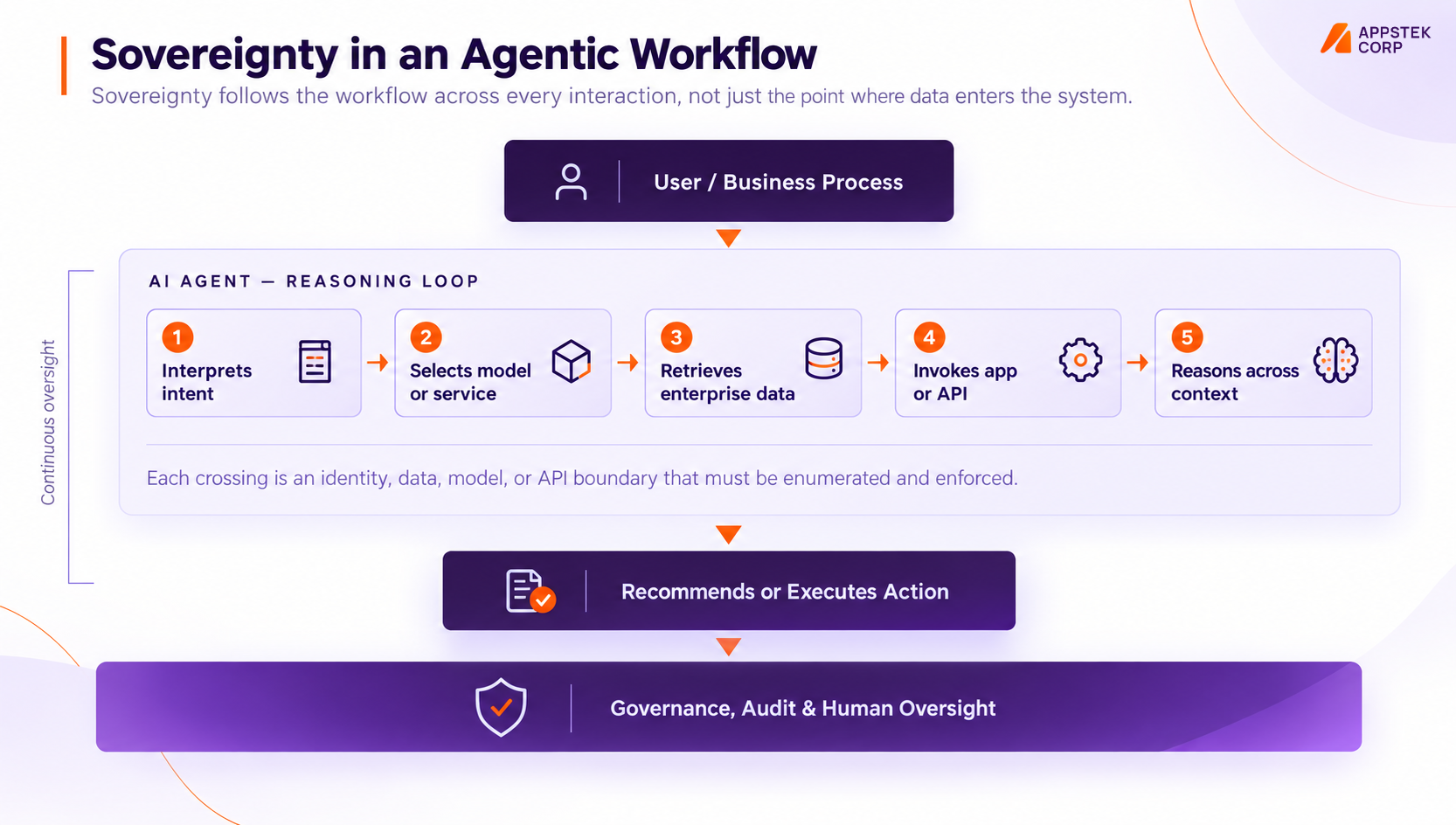
Sovereignty follows the workflow across every interaction rather than stopping at the point where data enters the AI system.
5. Security, Governance and Observability
Security and governance form the control layer across the sovereign AI stack.
As enterprise AI becomes more distributed, organizations need the ability to reconstruct an AI interaction across infrastructure, models, data, applications, and agents. Auditability must provide visibility into who initiated an activity, which information was accessed, which model processed it, where inference occurred, which systems or tools were invoked, and what actions followed.
A sovereign AI control layer can include:
- Identity and access management
- Role-based permissions
- Encryption and enterprise key management
- Data movement policies
- Model access and approval policies
- Agent identity and permissions
- API and tool controls
- AI guardrails
- Model monitoring
- Agent observability
- Audit trails
- Compliance controls
- Policy enforcement
The dynamic nature of AI makes static governance increasingly inadequate. Models change, providers introduce new capabilities, agents gain access to additional tools, regulations evolve, and workloads move between environments.
Sovereignty needs to operate as a continuous capability that can detect changes in dependencies and apply controls as the architecture evolves. Research on sovereign AI architecture similarly emphasizes dynamic governance across hardware, data, cloud, compute, models, and applications rather than treating sovereignty as a one-time compliance exercise.
Sovereignty Should Follow the Workload
A single sovereignty model across an entire enterprise is unlikely to be practical.
Workloads differ in data sensitivity, business criticality, regulatory exposure, provider dependency, and the level of autonomy granted to AI. Applying the highest level of control everywhere can increase complexity and limit access to useful capabilities. Applying insufficient controls to sensitive workloads creates security, regulatory, and operational exposure.
A workload-driven architecture provides a more practical model.
| Workload profile | Illustrative example | Sovereignty posture |
|---|---|---|
| Lower sensitivity | AI assistant using approved public content | Standard enterprise security and governance |
| Moderate sensitivity | Internal knowledge assistant accessing confidential documents | Strong data, identity, model and audit controls |
| Higher sensitivity | AI processing regulated or business-critical information | Extensive controls across infrastructure, data, models, applications and operations |
The appropriate level should be determined through several factors.
Data sensitivity: The type of information accessed, processed, generated, or retained.
Regulatory exposure: Applicable industry requirements, jurisdictional rules, and data residency obligations.
Business criticality: The operational or financial impact of an incorrect output, outage, or loss of access.
Provider dependency: The extent to which the workload relies on individual infrastructure, model, or application providers.
Model exposure: Where inference occurs and how prompts, context, and outputs are processed.
Agent authority: Whether the AI only provides information or can modify records, initiate transactions, or execute business processes.
Operational control: The ability to monitor, audit, modify, suspend, or migrate the workload.
These factors establish the sovereignty requirement before infrastructure or model choices are made.
Architecture for Choice, Not Isolation
Sovereign AI does not require complete technological self-sufficiency.
Few organizations can build every component of the AI stack internally, and doing so could restrict access to advances in models, infrastructure, compute, and specialized services. Sovereignty is more sustainable when the architecture preserves the ability to choose among those capabilities without creating uncontrolled dependency.
Portability and interoperability therefore become strategic design principles.
Applications should avoid unnecessary dependence on a single model where alternatives are practical. Data should remain portable across approved environments. Governance policies should follow workloads across infrastructure boundaries. Open interfaces can reduce the cost of changing providers, while centralized observability can maintain visibility across a distributed AI estate.
A mature sovereign AI architecture can combine global and local infrastructure, different model families, and multiple providers while applying stronger controls to workloads that require them. The underlying goal is interoperability on terms the enterprise can govern rather than isolation from the wider AI ecosystem.
The result is controlled flexibility: access to innovation without surrendering the ability to change direction.
Building a Sovereignty Baseline
Architecture decisions become more effective once existing AI dependencies are visible.
Many enterprise AI environments develop incrementally. Individual teams adopt models, vector databases, cloud services, APIs, and development tools to solve specific problems. As pilots become production systems, those components can form a complex network of dependencies that is difficult to assess at an enterprise level.
A sovereignty assessment creates a baseline across the complete AI stack.
A Practical Sovereignty Assessment
- Classify AI workloads: Group workloads according to data sensitivity, business criticality, regulatory exposure, and level of AI autonomy.
- Map the architecture: Document the infrastructure, data sources, models, vector stores, applications, APIs, and agents supporting each workload.
- Trace data and context movement: Identify where prompts, embeddings, retrieved information, inference requests, outputs, and logs are processed or retained.
- Identify provider dependencies: Map the external services required to operate each workload and assess the effect of a provider change, outage, regulatory shift, or access restriction.
- Define sovereignty requirements: Determine which controls are appropriate for each workload rather than imposing one architecture across the enterprise.
- Build for portability: Use model choice, open interfaces, portable data architectures, and flexible workload placement where they materially reduce dependency.
- Establish continuous governance: Monitor changes across infrastructure, models, data, agents, providers, and regulation so that controls remain aligned with the operating environment.
A use-case-level sovereignty audit followed by an assessment of infrastructure, data residency, and provider dependencies is increasingly being recommended as the starting point for identifying gaps across the AI stack.
Sovereignty Is Moving Up the Enterprise AI Stack
AI sovereignty began with familiar concerns around infrastructure and data. Generative AI expanded the boundary to models, prompts, embeddings, and enterprise knowledge. Agentic AI governance now extends it into applications, tools, integrations, decisions, and actions.
The enterprise AI stack is consequently becoming the new sovereignty boundary.
Control over where data resides remains essential, but it is no longer sufficient on its own. Mature sovereign AI architecture requires visibility into where intelligence runs, which models participate, how information moves between services, what AI agents are authorized to access, and how decisions and actions can be traced.
The goal is not ownership of every component. It is an enterprise architecture capable of retaining meaningful control, choice, accountability, and resilience across the components that matter most.
As AI becomes more deeply embedded into enterprise operations, sovereignty will increasingly be defined not by how much of the AI stack an organization owns, but by how effectively it can govern the stack it depends on.
AppsTek Corp helps enterprises build AI architectures where sovereignty is designed into the stack, enabling greater control across data, models, agents, applications, and integrations without limiting the flexibility needed to scale AI. Contact Appstek Corp to explore how your organization can strengthen AI sovereignty while building an architecture ready for what comes next.

About The Author
Wanpherlin M. Shangpliang is a Marketing Manager at AppsTek Corp, driving strategic marketing initiatives across digital, content, and brand communications. She focuses on positioning AppsTek’s AI offerings and comprehensive digital engineering services while supporting market outreach across key industries. With expertise in campaign management, content strategy, and audience engagement, Wanpherlin builds effective marketing programs that drive measurable growth and strengthen AppsTek’s overall presence.