

When artificial intelligence moved from clever chatbots to multi-agent autonomous systems, technology leaders were promised an era of hyper-efficiency. Yet across Fortune 500 boardrooms, a frustrating reality took hold: the context barrier.
Frontier large language models (LLMs) understand vast amounts of world knowledge, but they know remarkably little about your business. When an enterprise asks an AI agent, “Should we give this customer a 15% discount?”, the LLM stumbles. Is “customer” the global parent account or the local subsidiary? Which regional governance policy applies? Does this order meet margin constraints?
In single pilot programs, engineers bridge this gap manually, stuffing custom prompts with context and hard-coding rules. But as companies deploy hundreds of specialized agents across finance, HR, supply chain and clinical care, this brute-force approach crumbles. Context gets rebuilt repeatedly, analytics diverge, and governance becomes impossible.
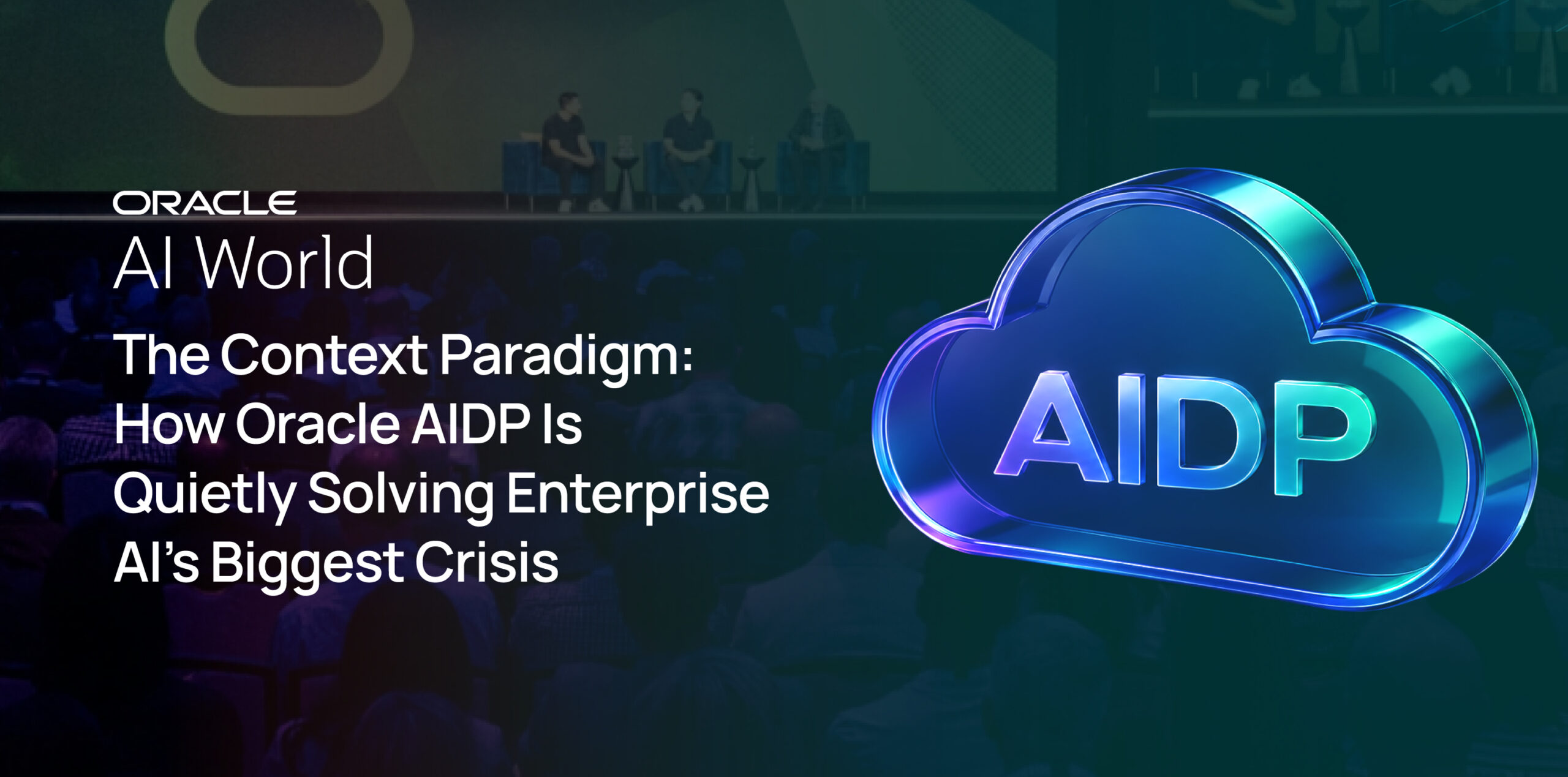
At Oracle AI World 2026, Oracle presented its answer to this crisis: the Oracle AI Data Platform (AIDP), a unified system designed to give AI agents native, real-time enterprise context without copying data, moving pipelines, or burning millions on custom code.
1. Grounding AI in business context: data, ontologies and reasoning
The core premise of AIDP is simple: don’t move your data. Organizations have already spent decades building business context inside systems like Fusion, NetSuite, E-Business Suite, Oracle Analytics and custom SQL databases. AIDP acts as a semantic fabric over this entire data estate, built on three layers.
L1
Enterprise Data Estate
Fusion, NetSuite, EBS, Lakehouse, third-party databases
L2
Business Ontology Layer
Auto-discovered entities, relationships, and policies
L3
Semantic Reasoning Engine
Runtime harness, progressive disclosure, execution
The AI-discovered business ontology
Rather than requiring central data stewards to manually map schemas for years, AIDP uses AI to scan database schemas, API documentation, semantic models and unstructured governance files such as standard operating procedures and policy guidelines.
In a demonstration, the platform took the disparate systems of a fictional fast-food chain, including E-Business Suite records, point-of-sale data and retail analytics models, and generated a single connected enterprise ontology. The result goes beyond cataloging data: it is a well-connected understanding of the business and how all its elements relate to one another.
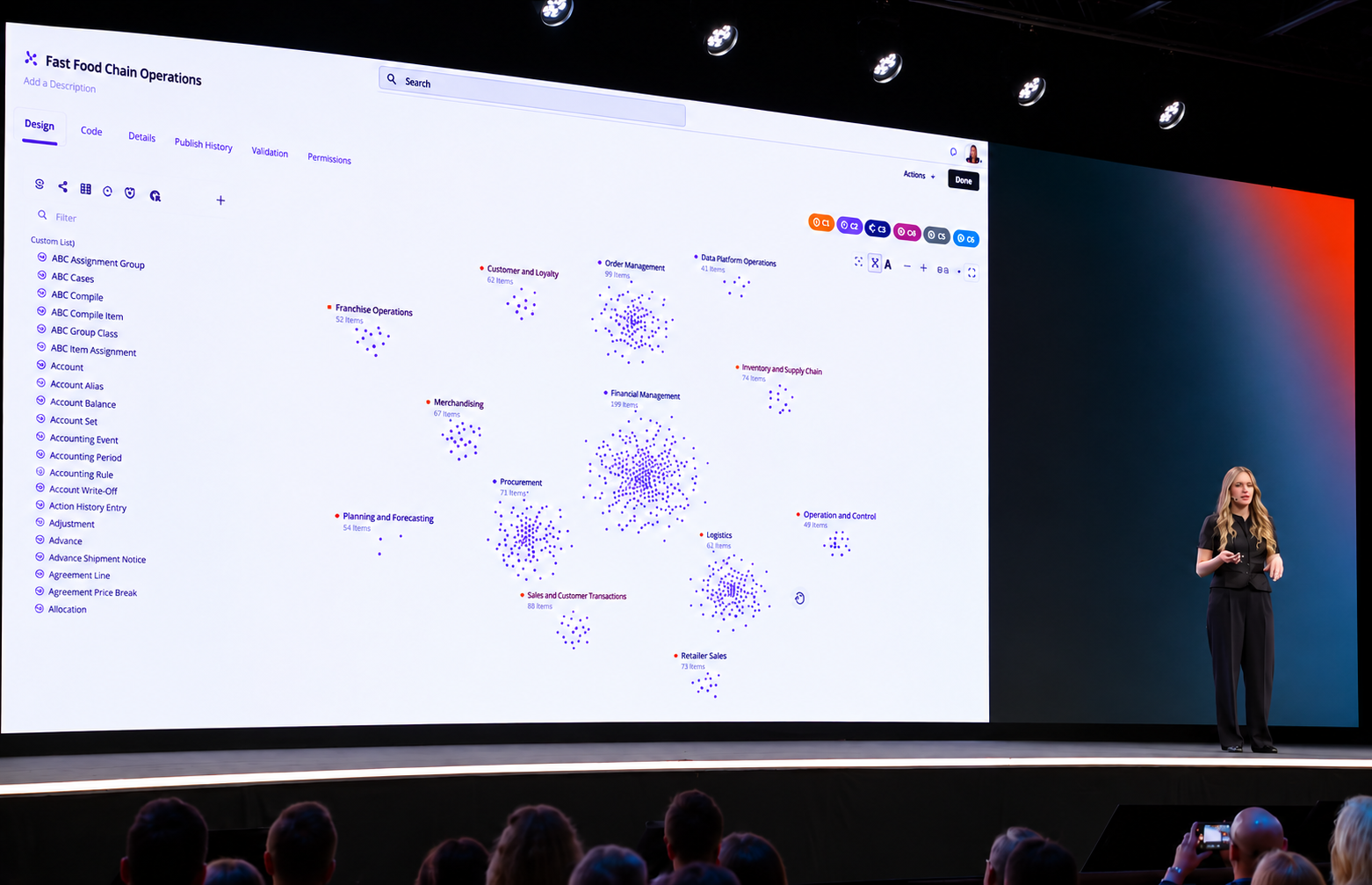
- The concept: “Lot”, a batch of ingredients, is defined once and shared by every agent.
- The connections: It links to recall notices, items, stock on hand and material status.
- The actions: It lists what the business may do to a lot, such as create, update or disable it.
In a food safety scenario, for instance, AIDP doesn’t just link table columns. It links an Item concept to a Lot concept and binds them directly to operational policies like “Place Lot on Hold”, a workflow that requires proof of an official recall notice before it can be triggered.
Progressive disclosure via semantic reasoning
Dumping a 100,000-node ontology into an LLM’s context window wastes tokens, increases latency and degrades accuracy. AIDP solves this with its Semantic Reasoning Engine. Acting as a runtime harness, it interprets an agent’s intent, navigates the ontology on the fly and generates a precise execution plan.
Instead of overwhelming the LLM, the reasoning engine runs federated queries across operational systems, performs local simulations, or uses domain-specific machine learning classifiers to return clean, actionable context.
2. Developer and analyst experiences: meeting teams where they work
Enterprise platforms fail when they force developers and analysts into rigid, proprietary tools. AIDP takes a flexible approach.
| Persona | Preferred tooling | AIDP integration layer |
|---|---|---|
| Software developers | VS Code, Cursor, Claude, Codex | AIDP plugin, visual agent builder, MCP and A2A protocols |
| Business analysts | Oracle Analytics Cloud, Fusion Data Intelligence | Deep Insight Agents, zero-code prompt templates |
| Employees | ChatGPT, Agent Hub, enterprise apps | Universal AI Registry, autonomous workflow orchestration |
An autonomous recall agent, built in Codex
Oracle showed a developer creating an emergency supplier recall agent using Codex with the AIDP plugin. With a single prompt asking for an agent that monitors recall messages, traces inventory across locations using the AIDP operations ontology and issues holds, Codex inspected the enterprise data catalog and automatically registered the agent.
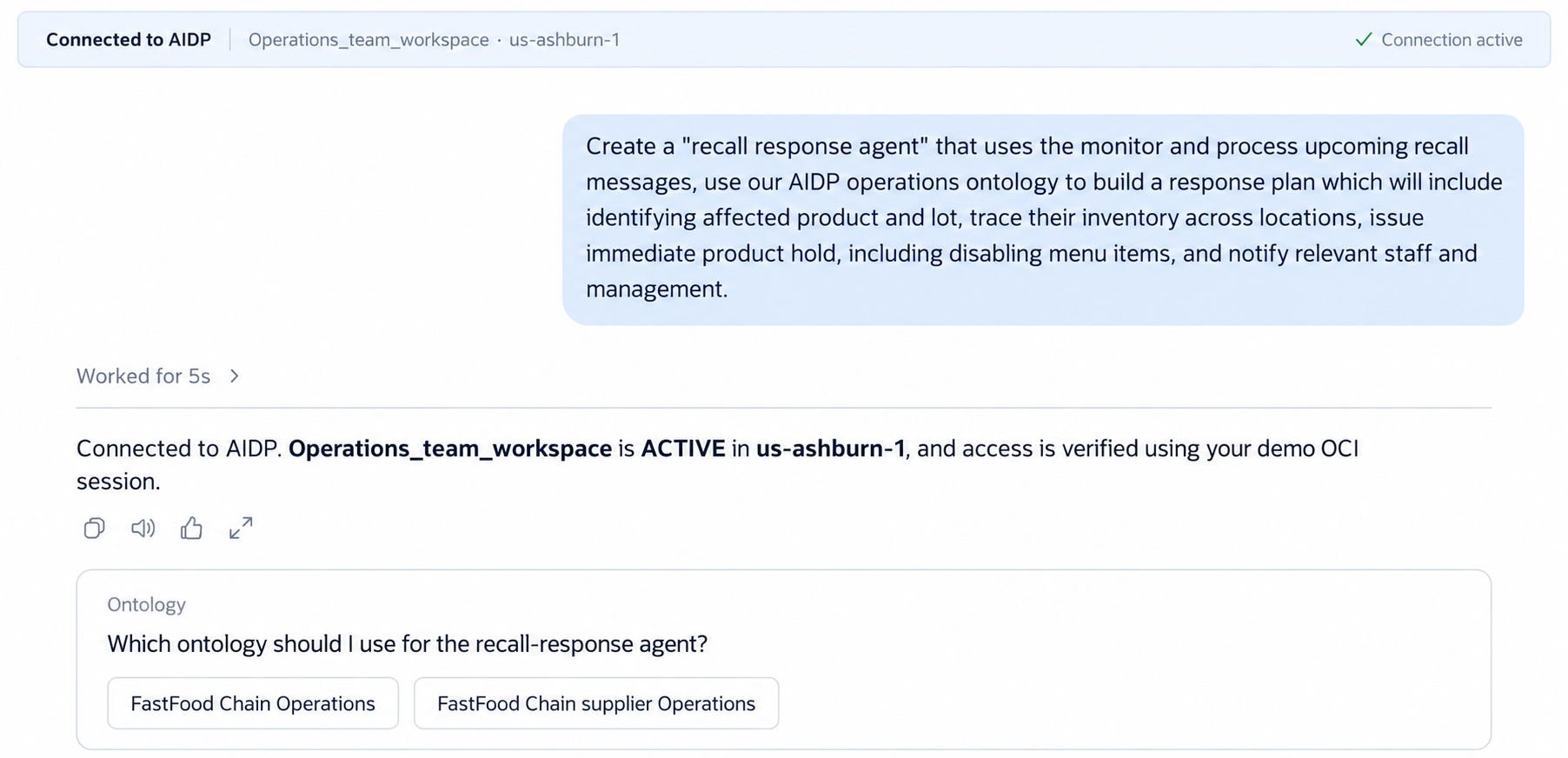
When tested in ChatGPT with a simulated lettuce recall from a supplier, the agent:
- Navigated the lot-tracing ontology to find the affected restaurant branches.
- Built a step-by-step remediation plan following internal policy.
- Paused to request explicit human approval before issuing quarantine orders.
The same context, without code: Deep Insight Agents
The recall agent shows what developers can build on the ontology. Analysts get that same grounded context with no code at all. Because AIDP already knows how a sales opportunity relates to an expense report, an agent can answer questions that once required stitching CX and ERP data together by hand.
In a Fusion Data Intelligence walkthrough, an analyst asked a single question: do travel and meal expenses influence deal win rates? A Deep Insight Agent joined CX pipeline records with ERP expense ledgers, pulled in external Consumer Price Index data to normalize spend, and returned a clear answer:
3. Multi-agent orchestration and enterprise governance
As organizations move from isolated chatbots to networks of autonomous agents, two critical questions emerge: how do agents talk to each other, and how do IT teams control them?
Cross-system coordination with Agent Hub
AIDP introduces Agent Hub, a native interface running inside the customer’s tenancy that translates user intent across different agents. When a project manager asks whether supply disruptions will affect a new data center launch:
- Agent Hub calls a Disruption Assessment Agent in E-Business Suite, which spots delayed power distribution cabinets.
- Context passes automatically to a Recovery Planning Agent, which finds 12 available cabinets in Phoenix and calculates the cost of transferring them to Dallas.
- A Transfer Request Agent prepares the operational transfer order for final approval.
The governance fleet and validation sandbox
Governance cannot be an afterthought. Oracle presented a dedicated AI governance framework that follows every agent from monitoring to certification.
| 1. Fleet overview | 2. Lineage | 3. Validation sandbox | 4. Certification studio |
|---|---|---|---|
| Health, latency and cost | Models and tool calls | Adversarial testing | Policy compliance score |
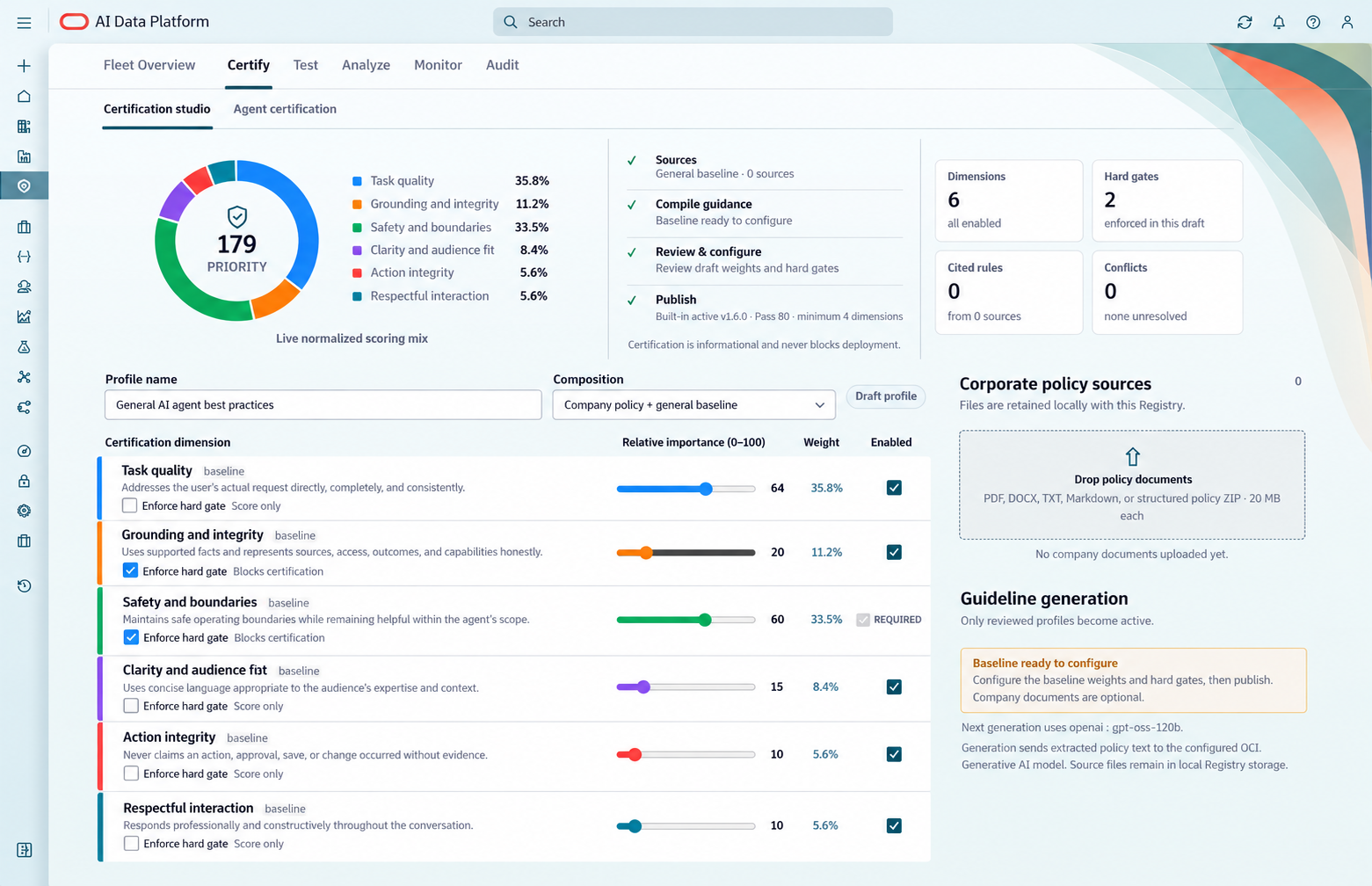
Through the Fleet Overview, administrators can inspect every agent’s latency, token costs, usage drift and underlying source code lineage. In the Validation Sandbox, IT teams run automated adversarial safety tests, such as jailbreak attempts and policy violations. Administrators can drag and drop compliance PDFs into the Certification Studio to automatically generate enforcement benchmarks, ensuring uncertified agents never reach production.
4. Real-world impact: University College Dublin
The practical value of AIDP is already showing at University College Dublin (UCD). Its Clinical Research Centre manages more than 100 clinical trials across a network of hospitals and faced a classic context challenge: matching eligible patients to recruiting trials without a centralized national register.
Using AIDP’s ontology engine paired with domain-specific classifier models, UCD:
- Mapped more than 250 operational subtasks across 14 workflows.
- Matched complex patient profiles to trial criteria using explainable clinical reasoning rather than simple keyword matching.
- Dramatically reduced the administrative burden of manually building and maintaining medical taxonomies.
Building ontologies rapidly with AI inside the data platform is a real game-changer.
The verdict: context is the strategic advantage
As frontier LLMs become commoditized, an organization’s competitive edge won’t come from the raw intelligence of its AI models. It will come from the fidelity of its enterprise context.
Oracle’s AI Data Platform tackles the enterprise AI adoption barrier head-on. By uniting data estates, automating ontology discovery, enabling multi-agent orchestration and enforcing strict, evidence-backed governance, AIDP turns passive corporate data archives into active operational intelligence.
Conclusion
The next phase of enterprise AI will depend on how effectively organizations connect intelligence with the realities of their business. At AppsTek Corp, we help enterprises bridge this gap by bringing together data, applications, cloud and AI engineering to turn emerging Oracle capabilities into meaningful business outcomes. As autonomous systems reshape enterprise operations, the focus remains on building a connected, intelligent and governed digital core that is ready for what comes next.
Connect with AppsTek’s Oracle experts to explore how enterprise AI can translate into measurable business value.

About The Author
Manisha Jadhav, Presales Executive at AppsTek Corp, specializes in solution consulting, business analytics, and enterprise technology solutions. With an MBA in Business Analytics from Symbiosis, she brings expertise in technical presales, business process optimization, and stakeholder engagement. She focuses on bridging business challenges with scalable technology solutions that improve operational efficiency, data visibility, and business outcomes.