
Table of Contents
How Agentic AI Governance Differs From Traditional AI Governance
How Sovereign AI Applies to Autonomous AI Agents
Managing AI Agent Identity and Access
Controlling AI Agent Permissions Across Enterprise Systems
Governing Model Access for AI Agents
Managing Multi-Agent AI Systems
Human Oversight for Autonomous AI Agents
Monitoring and Auditing AI Agent Activity
Building Governance Controls for Agentic AI
Managing AI Agents Across Their Lifecycle
The AI Agent Governance Lifecycle
Building a Sovereign Architecture for Agentic AI



Enterprise AI is moving beyond systems designed primarily to generate answers. Agentic AI introduces systems that can interpret goals, retrieve information, choose tools, interact with enterprise applications, coordinate with other agents, and take actions across business workflows with varying degrees of autonomy.
As those capabilities expand, enterprise control needs to expand with them. An AI assistant summarizing a document can largely be governed through controls around data, models, and user access. An autonomous agent may operate across several systems during a single task, retrieving business information, invoking APIs, selecting models, updating applications, delegating work to other agents, and triggering subsequent steps in a workflow.
Sovereign AI therefore takes on a broader meaning in an agentic environment. Control over infrastructure, data, and models remains essential, but autonomy introduces additional considerations around identity, permissions, execution authority, accountability, and oversight.
The central issue is no longer only where enterprise data resides or where an AI model runs. Enterprises also need to determine who an agent represents, which information it can access, which models and tools it can use, what actions it can perform, and how those actions can be governed and traced.
As AI agents become embedded in core business processes, maintaining control over autonomous action becomes an increasingly important part of enterprise AI sovereignty.
How Agentic AI Governance Differs From Traditional AI Governance
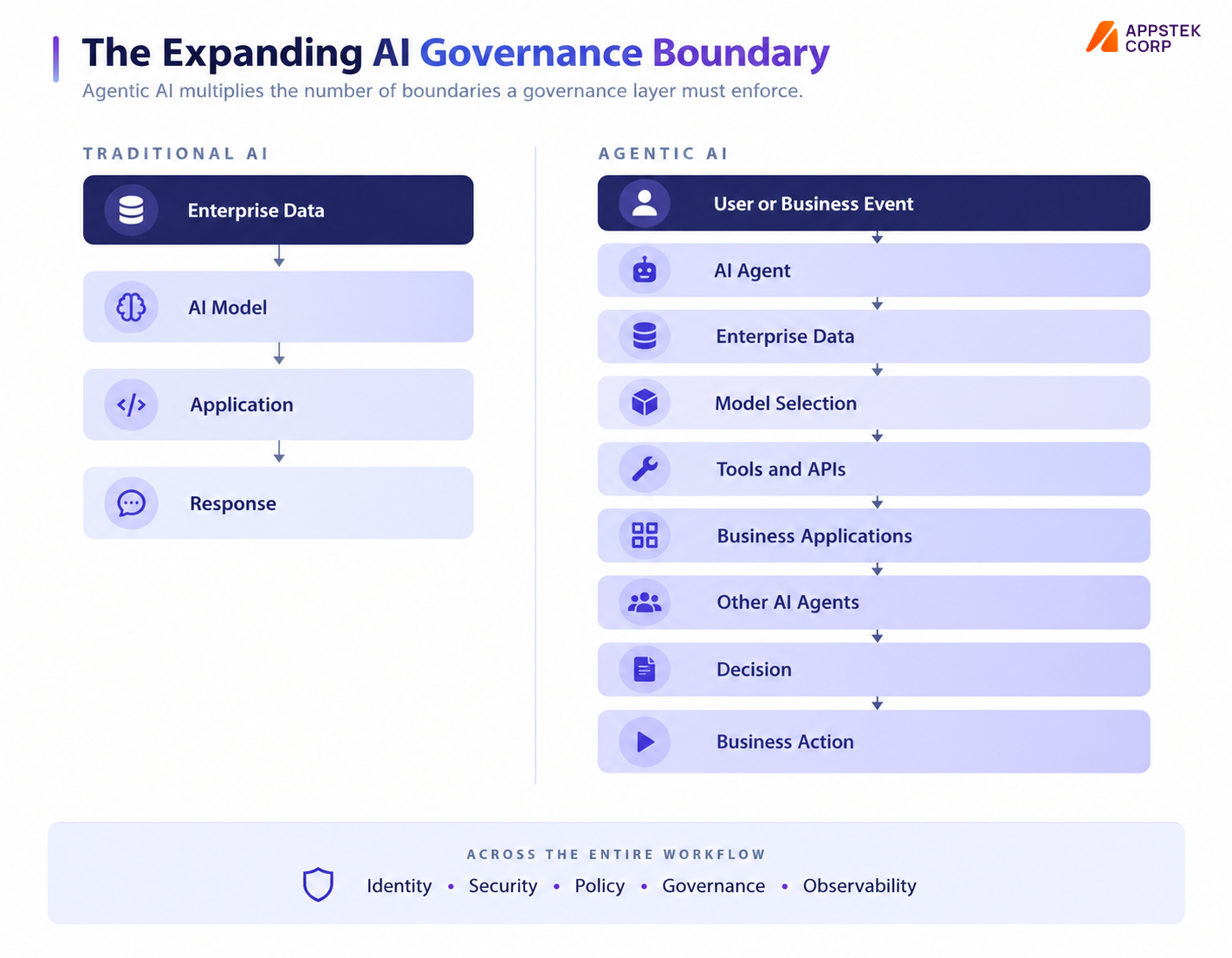
Traditional enterprise AI governance has largely focused on the relationship between data, models, applications, and users. Organizations establish policies around which datasets can be used, which models are approved, where information can be processed, and who can access an AI-enabled application.
Agentic AI introduces decision-making within the workflow itself. Instead of following a predefined sequence for every task, an agent can determine which information it needs, which system to query, which tool to invoke, whether another step is required, and which action should follow.
A procurement agent investigating a supplier issue could retrieve supplier information, review purchase orders, analyze delivery records, identify quality incidents, compare contractual terms, and initiate an approval workflow. Completing that task may involve several databases, enterprise applications, APIs, models, and identity systems.
Agentic AI governance therefore needs to operate across the complete workflow rather than being confined to individual applications or models. Research into sovereign AI architecture increasingly points toward multi-cloud, multi-model, and multi-agent environments where governance needs to preserve accountability, security, and resilience across interconnected systems.
Agentic AI expands governance from controlling what AI can access to controlling what AI can access, decide, and do.
How Sovereign AI Applies to Autonomous AI Agents
AI sovereignty has often been associated with infrastructure location, data residency, administrative control, and jurisdiction. Autonomous agents extend the sovereignty boundary because information and decisions can move through several environments before a business task is completed.
An agent may retrieve information from an internal enterprise application, pass selected context to an approved AI model, call another service for specialized processing, and send instructions to another agent before producing an outcome. The source data may remain within an approved environment even while portions of the workload move across different infrastructure, model, and application boundaries.
A sovereign agentic architecture needs to maintain control throughout that process. Enterprises may need policies governing:
- Where enterprise information can be processed
- Which AI models are approved for specific workloads
- Which applications an agent can access
- Which APIs and tools an agent can invoke
- What actions an agent is authorized to execute
- Which agents can communicate with one another
- When human authorization is required
- How decisions and actions are monitored
- How permissions and authority can be revoked
Not every AI agent requires the same level of control. Sovereignty requirements should reflect the sensitivity of the information involved, the business criticality of the process, applicable regulation, and the authority granted to the agent.
An internal knowledge agent working with approved corporate information carries a different risk profile from an agent processing financial transactions, patient information, government records, or critical infrastructure data. Research on sovereign AI similarly positions sovereignty as a continuum in which different workloads require different levels of localization and oversight.
Agent sovereignty is therefore defined by the information, systems, and authority involved in the workload rather than by the presence of an AI agent alone.
Managing AI Agent Identity and Access
Identity is fundamental to controlling autonomous AI inside the enterprise.
Human employees operate through defined identities that determine which applications they can access, which information they can view, and which transactions they are permitted to perform. Production AI agents require comparable identity and authorization controls.
A defined agent identity connects an autonomous system to its organizational purpose, owner, permissions, tools, and policies. Shared credentials or broadly privileged service accounts make attribution considerably more difficult, particularly when several agents interact with the same enterprise applications.
An enterprise identity model for AI agents can establish:
- Who owns and manages the agent
- Which organizational role the agent represents
- Which users or processes can invoke it
- Which applications and datasets it can access
- Which AI models it can use
- Which APIs and tools it can call
- Which business actions it can execute
- Whether it can delegate tasks to other agents
- How credentials are issued, rotated, and revoked
- How activities are attributed in audit records
Delegated authority requires equal attention. An agent acting on behalf of a finance analyst should not automatically gain access to information or transactions unavailable to that analyst. System-level agents may require additional privileges, but those privileges should remain limited to the function the agent is expected to perform.
A strong AI agent identity framework links autonomy to accountability by ensuring that every significant action can be associated with a known agent operating under defined authority.
Controlling AI Agent Permissions Across Enterprise Systems
Agentic AI derives much of its value from the ability to work across multiple systems. Broad connectivity, however, should not translate into broad authority.
Least-privilege access provides a practical foundation for governing enterprise AI agents. An agent should receive access only to the information, systems, and actions required for its approved purpose.
A procurement agent, for example, may need supplier records, purchase orders, contract information, and quality data while having no legitimate reason to access payroll or employee information. A customer service agent may require access to account history while needing additional authorization before modifying contractual terms or issuing a significant refund.
Permissions also need to distinguish between different types of agent activity.
| AI agent capability | Authority level |
|---|---|
| Retrieve information | Read |
| Analyze information | Analyze |
| Recommend an action | Recommend |
| Prepare a transaction or change | Prepare |
| Modify an enterprise record | Execute |
| Complete a high-impact transaction | Restricted execution |
The distinction between retrieving information and executing an action becomes increasingly important as agents gain autonomy. An agent identifying a payment exception carries a very different level of operational risk from an agent authorized to release the payment.
Granular permissions allow enterprises to automate routine activities while reserving stronger controls for actions with greater financial, regulatory, security, or operational consequences.
Governing Model Access for AI Agents
Enterprise agents are increasingly likely to operate across multiple AI models rather than relying on a single foundation model.
A general-purpose model may support reasoning, a specialized model may process documents, another may perform code analysis, and a smaller private model may handle sensitive enterprise information. Agent orchestration can also select models dynamically according to the requirements of a task.
Model access therefore becomes an important part of agentic AI governance.
Enterprise information should not be routed automatically to any model that happens to be available. Approved model selection can depend on data classification, workload sensitivity, inference location, jurisdiction, model security, provider terms, performance requirements, and regulatory obligations.
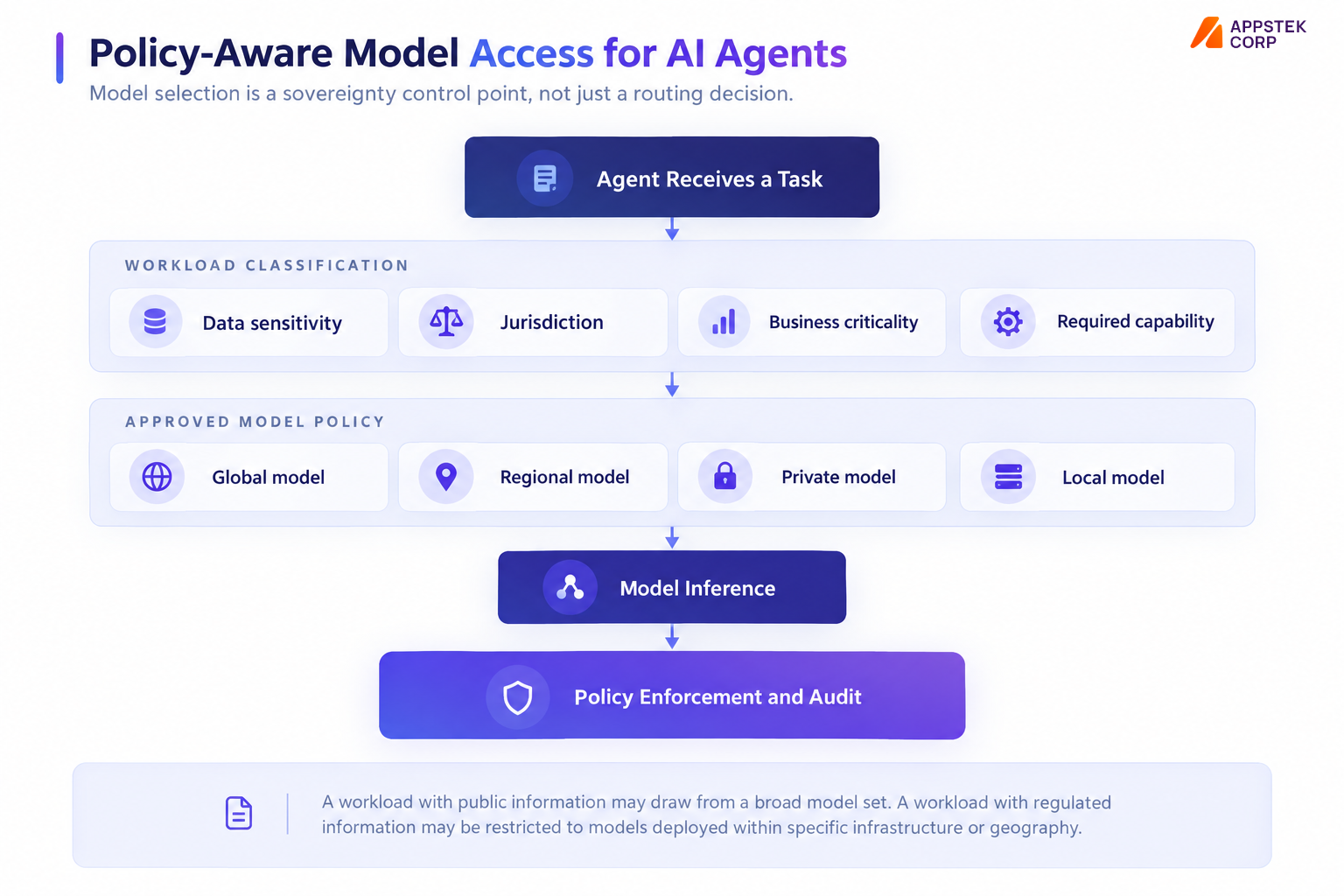
A workload containing public information may allow the agent to use a broader range of approved models. A workflow involving regulated or highly sensitive information may restrict processing to models operating within specific infrastructure or geographic boundaries.
Model governance also needs to account for change. Model versions evolve, providers modify services, deployment locations change, and new models are introduced into enterprise environments. An agent that satisfied sovereignty requirements when originally deployed may need reassessment when an underlying model dependency changes.
Policy-aware model routing allows enterprises to retain access to a diverse AI ecosystem while ensuring that model choice remains within established governance boundaries.
Managing Multi-Agent AI Systems
Multi-agent AI architectures introduce additional governance requirements because tasks and information can move between autonomous systems.
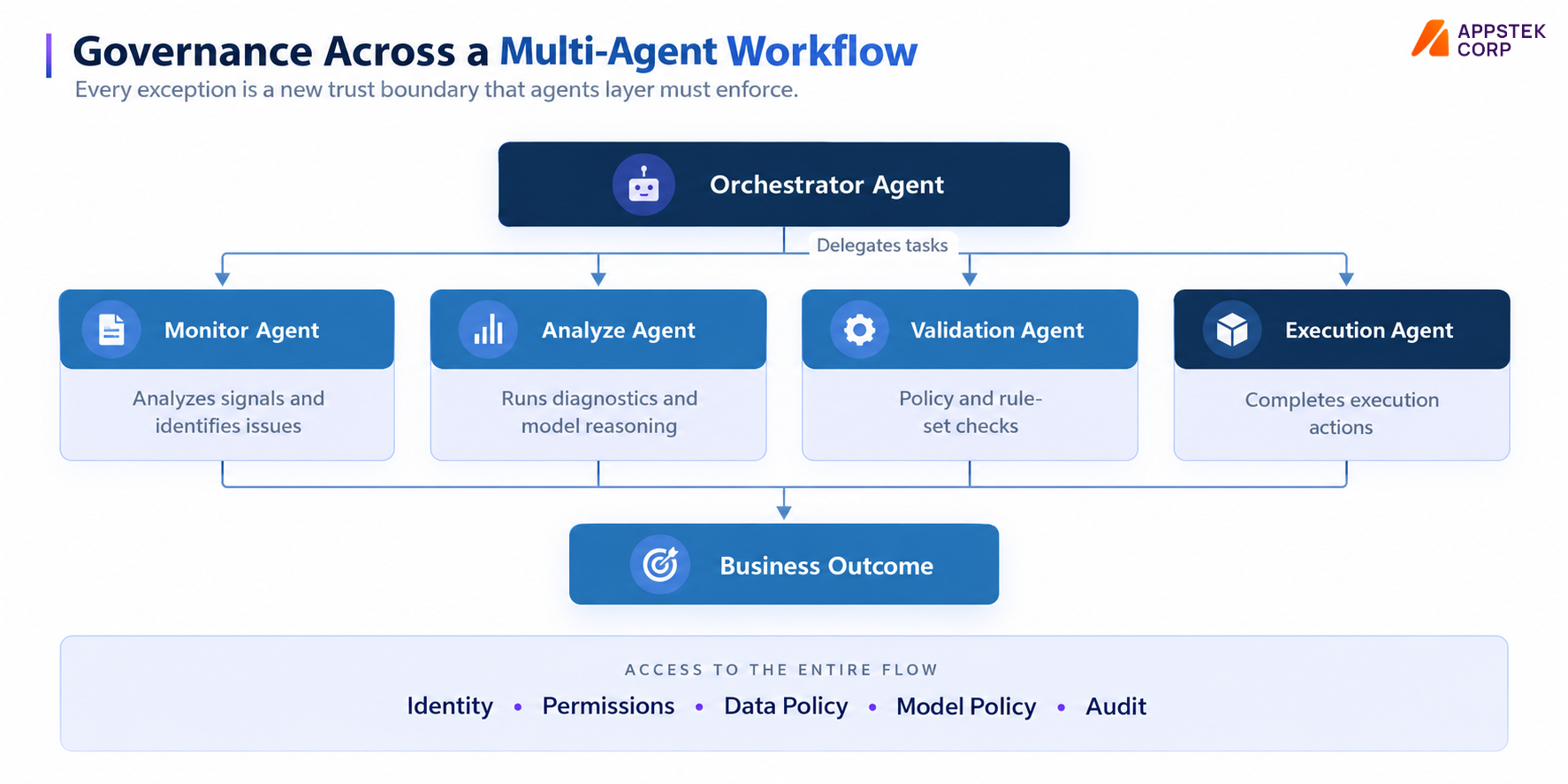
A primary agent may delegate work to several specialized agents. One could retrieve information, another perform analysis, another validate the result, and a separate execution agent could carry out an approved action. Context, instructions, and intermediate outputs may move between agents throughout the workflow.
Every delegation can introduce a different identity, model, permission set, application environment, or infrastructure dependency. Sensitive information passed between agents can also travel beyond the boundary originally established for the initiating agent.
Effective multi-agent AI governance therefore requires visibility into both authority and information flow. Key considerations include:
- Which agents are permitted to communicate
- What information can be exchanged between agents
- Whether permissions can be delegated
- How delegated authority is limited
- How long delegated permissions remain valid
- Which agent owns the final decision
- Which agent performs the final action
- Where shared context and memory are stored
- How the complete chain of agent activity can be reconstructed
Multi-agent AI environments are particularly relevant to sovereign AI because different agents may operate across different models, clouds, applications, or jurisdictions. Governance needs to remain consistent even when the workflow itself is distributed.
Human Oversight for Autonomous AI Agents
Greater autonomy in multi-agent AI does not eliminate the need for human oversight, but effective oversight does not require a person to approve every action.
Human involvement can be aligned with the risk and consequence of the task. Routine, low-risk, and reversible actions may operate with greater autonomy, while transactions involving financial impact, regulated decisions, sensitive information, or irreversible changes may require additional validation or explicit authorization.
A tiered autonomy model provides one way to establish those boundaries.
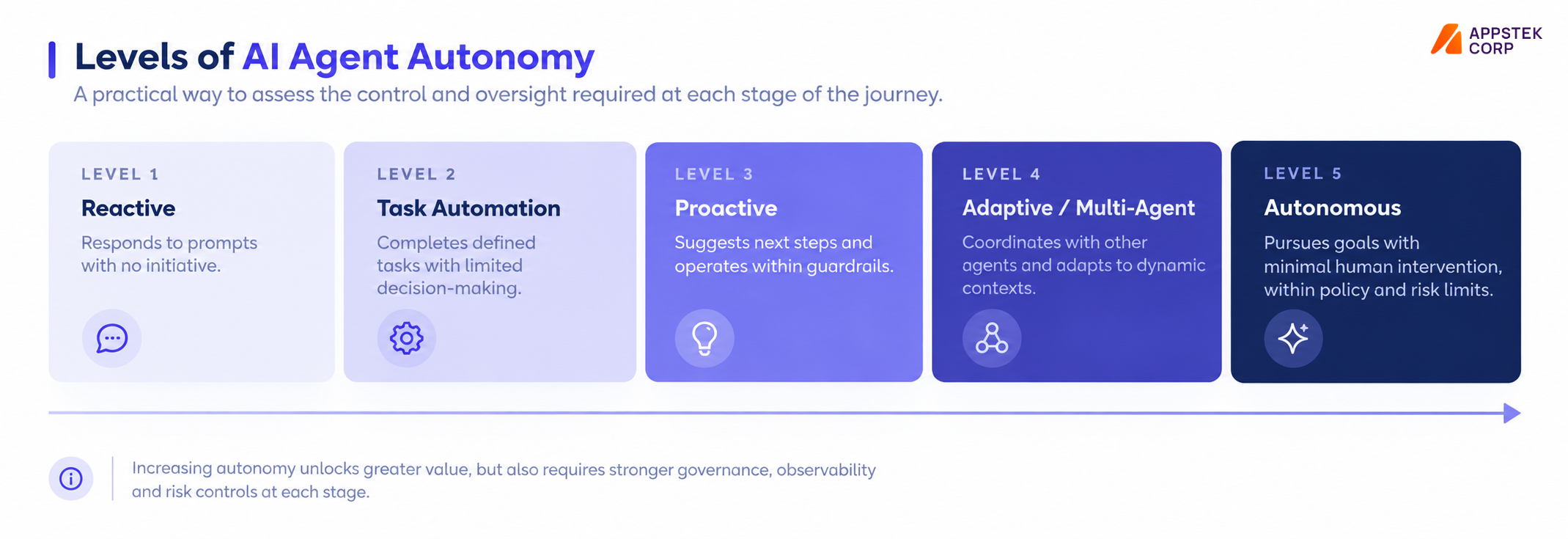
The same agent can operate at different levels depending on the circumstances. A finance agent could automatically reconcile routine transactions that meet defined criteria while escalating high-value payments or unusual exceptions for approval. An IT operations agent could resolve standard service issues autonomously while requiring authorization for changes affecting critical infrastructure.
Risk-based human oversight allows organizations to preserve the operational value of autonomous agents while maintaining control over decisions with greater consequences.
Monitoring and Auditing AI Agent Activity
AI agent governance depends on visibility into how autonomous systems behave in production.
Agentic workflows may involve several reasoning steps, data sources, models, tools, APIs, and other agents before producing an outcome. Conventional application logs can capture individual events without necessarily explaining how the complete decision or action occurred.
AI agent observability needs to provide a connected view across the workflow. A comprehensive audit trail may capture:
- The user or process that initiated the task
- The agent responsible for the workflow
- The policies and instructions applied
- The data sources accessed
- The information retrieved
- The AI models used
- The tools and APIs invoked
- Other agents involved in the task
- Decisions or recommendations generated
- Business actions executed
- Human approvals received
- The final workflow outcome
End-to-end traceability supports security, regulatory compliance, operational monitoring, incident investigation, and accountability. It becomes particularly important when a single workflow spans several external services or cloud environments, where individual platforms may contain only fragments of the overall activity.
Sovereign AI governance increasingly requires visibility across infrastructure, data, applications, and models rather than independent monitoring of each layer. Agent observability extends that principle into autonomous workflows.
Building Governance Controls for Agentic AI
Managing enterprise AI governance independently within every agent becomes difficult as adoption scales. Consistent controls are easier to maintain when identity, access, model policies, data movement, human oversight, and AI agent observability operate through a shared governance framework.
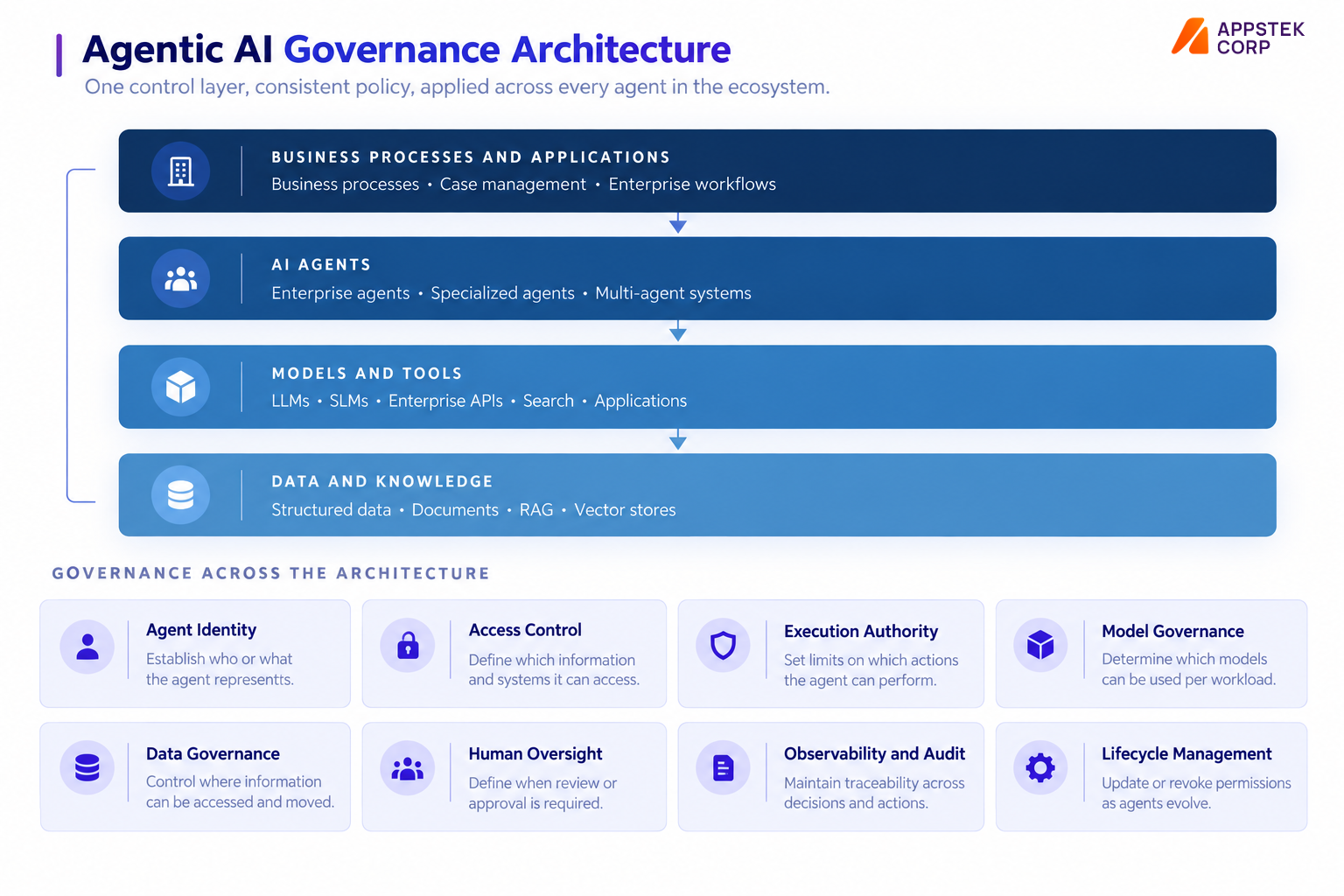
A shared agentic AI governance layer allows agents to retain the flexibility required for autonomous decision-making while keeping their operations within enterprise policy.
The need for dynamic controls increases as agentic environments evolve. New models, tools, integrations, regulations, and business processes can alter the risk profile of an agent without changing its original purpose. Governance therefore needs to adapt alongside the systems it controls.
Managing AI Agents Across Their Lifecycle
AI agent governance begins before production deployment and continues until the agent is retired.
An agent’s operational profile can change significantly over time. Additional applications may be connected, tools introduced, model dependencies replaced, permissions expanded, or workflows redesigned. Without lifecycle-based enterprise AI governance, an agent initially approved for a narrow function can gradually acquire broader access and authority.
A structured lifecycle can include:
The AI Agent Governance Lifecycle
- Design and registration: Define the purpose, owner, identity, required information, system access, and intended autonomy.
- Risk classification: Assess data sensitivity, business criticality, regulatory exposure, and the consequence of agent actions.
- Policy assignment: Establish approved models, infrastructure, tools, permissions, and oversight requirements.
- Testing and validation: Evaluate behavior, security controls, failure modes, tool usage, and permission boundaries.
- Production deployment: Issue approved credentials and provide access appropriate to the agent’s role.
- Continuous monitoring: Track model usage, tool calls, actions, exceptions, and outcomes.
- Change governance: Reassess the agent when material changes occur across models, tools, permissions, or workflows.
- Revocation and retirement: Remove credentials, system access, integrations, and persistent memory when an agent is no longer required.
Lifecycle governance keeps enterprise control aligned with the agent’s actual capabilities rather than relying solely on the conditions under which it was originally approved.
Building a Sovereign Architecture for Agentic AI
A sovereign architecture for agentic AI combines autonomous capability with enforceable controls across infrastructure, data, models, applications, and actions.
Strong AI agent observability, not complete ownership of every component, is what makes this practical for most enterprises. The stronger architectural objective is maintaining sufficient visibility and control to determine which external and internal capabilities can participate in a workload and under what conditions.
Several questions provide a practical starting point for enterprise agent governance:
Seven Questions for a Sovereign Agentic Architecture
- Who owns the AI agent? Every production agent needs a clear organizational owner responsible for its purpose, access, and ongoing governance.
- What information can the agent access? Permissions should reflect the data required for the agent’s function and existing enterprise access policies.
- What can the agent do? Retrieving information, recommending an action, modifying a record, and executing a transaction represent different levels of authority.
- Which models and tools can the agent use? Approved services should be determined according to the workload’s sovereignty, security, and regulatory requirements.
- Where can data and context move? Policies should control which providers, infrastructure environments, models, and jurisdictions can process different information classifications.
- When is human oversight required? Approval requirements should reflect the consequence and reversibility of an action.
- Can the agent’s activity be traced and its authority revoked? Enterprises need the ability to investigate significant actions and withdraw access whenever requirements change.
These controls establish the boundaries within which autonomous AI can operate across enterprise environments.
Keeping Autonomous AI Under Enterprise Control
Agentic AI expands the enterprise sovereignty conversation beyond control over data, infrastructure, and models. Autonomous systems introduce a new layer of operational authority as AI begins interacting directly with enterprise applications and business processes.
The sovereignty boundary increasingly follows the agent wherever it operates.
As agents gain access to more data, applications, models, tools, and other agents, governance needs to provide equivalent visibility into their identities, permissions, decisions, and actions. Greater autonomy can still be achieved without creating unrestricted authority.
A sovereign agentic architecture preserves enterprise control over who an agent represents, what it can access, which models it can use, what actions it can perform, where information can move, when human intervention is required, and how its activity can be audited.
The growth of agentic AI will make autonomy an increasingly important enterprise capability. The organizations best positioned to scale it will be those able to increase what their agents can do without losing control over how they do it.
Building that balance requires an architecture designed for both autonomy and control. Appstek Corp helps enterprises navigate the shift toward sovereign, governed agentic AI, with the technologies and expertise needed to deploy intelligent systems while keeping enterprise authority firmly in hand. Contact Appstek Corp to explore how your organization can build a secure and scalable foundation for agentic AI.

About The Author
Wanpherlin M. Shangpliang is a Marketing Manager at AppsTek Corp, driving strategic marketing initiatives across digital, content, and brand communications. She focuses on positioning AppsTek’s AI offerings and comprehensive digital engineering services while supporting market outreach across key industries. With expertise in campaign management, content strategy, and audience engagement, Wanpherlin builds effective marketing programs that drive measurable growth and strengthen AppsTek’s overall presence.