
Table of Contents
The shift from Ai4 2025 to Ai4 2026
- The deployment audit gap is real
- Disagreement at the top demands grounded data
- Even the disagreements pointed toward openness
- Governance, not capability, is becoming the bottleneck



Three days at Ai4 reinforced a pattern that is becoming difficult to ignore: enterprise AI capability is moving faster than the governance infrastructure designed to control it.
I went into Ai4 2026 with a working hypothesis.
At AppsTek, we have spent the past year making a simple argument: the enterprises that win with AI will not necessarily be the ones that deploy fastest. They will be the ones that understand their business, workflows, data, and desired outcomes before they deploy anything at all.
Pilots are a short-term exercise. Outcomes are what matter over the long term.
That principle has shaped how we approach AI engagements with clients, starting with the business problem rather than the model.
I spent all three days at The Venetian in Las Vegas, from the Tuesday morning keynotes through the Thursday afternoon closing sessions, testing that hypothesis against what the broader industry was actually experiencing, not just what we believed internally.
More than 12,000 attendees from 100 countries came to Ai4 this year, up 50 percent from the 8,000 who attended the year before, alongside 470 exhibitors and roughly 1,000 speakers.
What surprised me was not the scale. It was how consistently the conversations on stage and across the conference floor reinforced what we have been telling our clients.
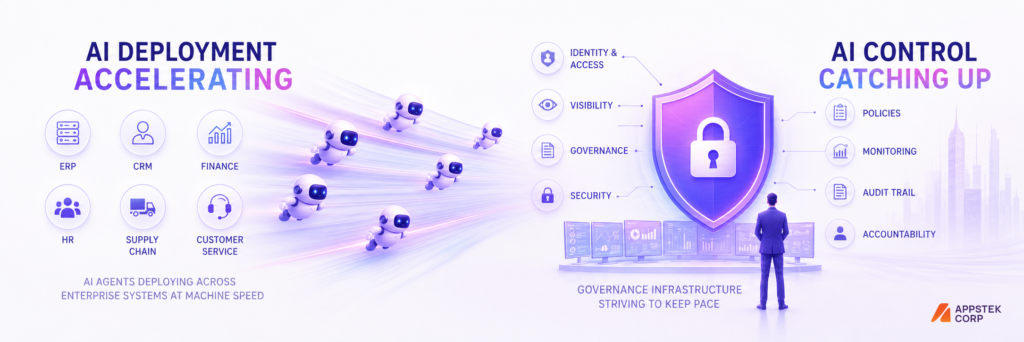
The industry is no longer asking whether AI agents can work. It is starting to confront what happens when they work faster than enterprises can govern them.
The shift from Ai4 2025 to Ai4 2026
Having followed last year’s conference closely, one of the most revealing things was how much the agenda itself had changed.
Last year, the dominant question was essentially: Can enterprises move agentic AI from promise to production?
This year, the conversation had moved significantly further down the maturity curve. Sessions increasingly focused on:
- production deployment
- governance
- identity
- security
- accountability
- operational failures
- what happens when AI systems begin operating at scale
That is not a small change. It suggests that the market has moved beyond debating whether the technology works and is beginning to treat AI as enterprise infrastructure that must be managed responsibly.
That is precisely the maturity curve we have been trying to position our clients ahead of. Here are the four observations that stood out most.
1. The deployment audit gap is real
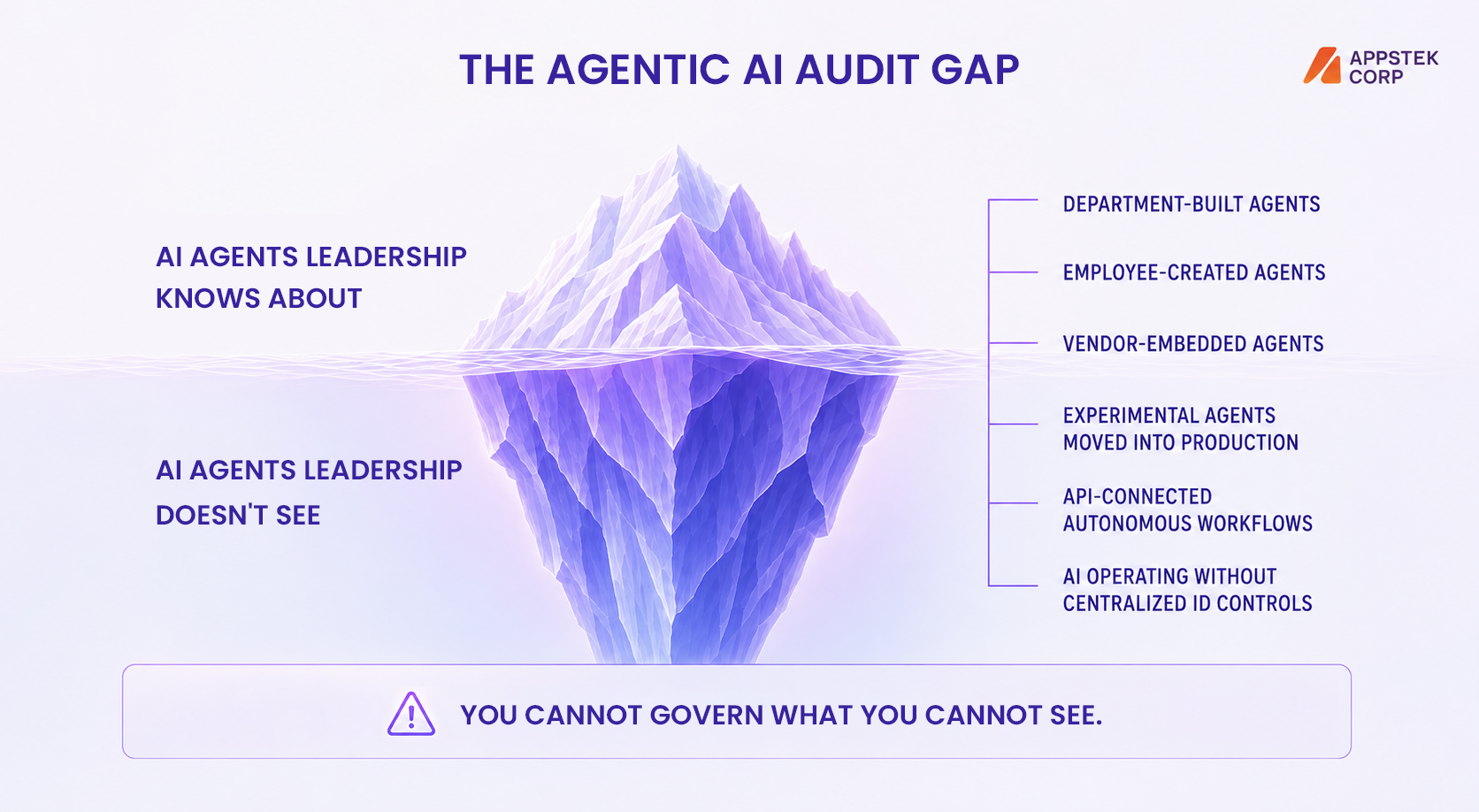
During one session on enterprise AI audits, a manufacturing organization revealed that it was running ten times more AI agents in production than its own leadership knew existed.
The room became noticeably quiet. There was no dramatic reaction, but I saw several people around me write that number down. Some wrote it twice. That told me the point had landed.
Cisco’s Jeetu Patel approached the same problem from another angle during his conversation with CNN’s Matt Egan. His argument was that the identity and access infrastructure required to govern AI agents operating at machine speed is still being built, even as enterprises continue deploying those agents faster than many organizations are actually counting them.
What struck me during the session was how matter-of-fact the discussion was. Nobody presented this as an existential crisis. It was discussed as what it really is: a governance and engineering problem that enterprises now need to solve.
Another data point reinforced the issue. Ninety-six percent of CEOs believe employees are already using generative AI without formal authorization, while 42 percent estimate that at least half of their workforce is doing so.
Shadow AI is therefore evolving. It is no longer only an employee quietly opening an unauthorized AI application on a laptop. It increasingly means AI agents operating across enterprise systems at machine speed without sufficiently mature identity, governance, visibility, or accountability frameworks around them.
If an organization has not audited its agentic estate, that should be one of the first priorities before the next deployment wave.
For enterprises operating Oracle, SAP, NetSuite, or similar environments while adding agentic layers on top, this sounded remarkably similar to conversations we have already been having with clients. What Ai4 confirmed for me was that this is not an isolated problem affecting a handful of organizations. It is becoming an industry-wide pattern, and a fixable one once organizations know where to look.
2. Disagreement at the top demands grounded data
One of the rarest moments of the conference was watching Geoffrey Hinton, Fei-Fei Li, and Andrew Ng share a stage together, live. The room filled long before the session began. By the time they walked out, people were standing along the back wall.
Bringing three of the most influential figures in modern AI onto one stage is unusual enough. But that was not what made the session memorable. What made it valuable was that they disagreed.
They disagreed on regulation. They disagreed on open versus closed models. And they disagreed particularly sharply on jobs.
Hinton was direct about the workers he believes are most exposed, arguing that workers with lower levels of education could face a difficult problem because many of the roles they might otherwise be retrained for could eventually also be performed by AI.
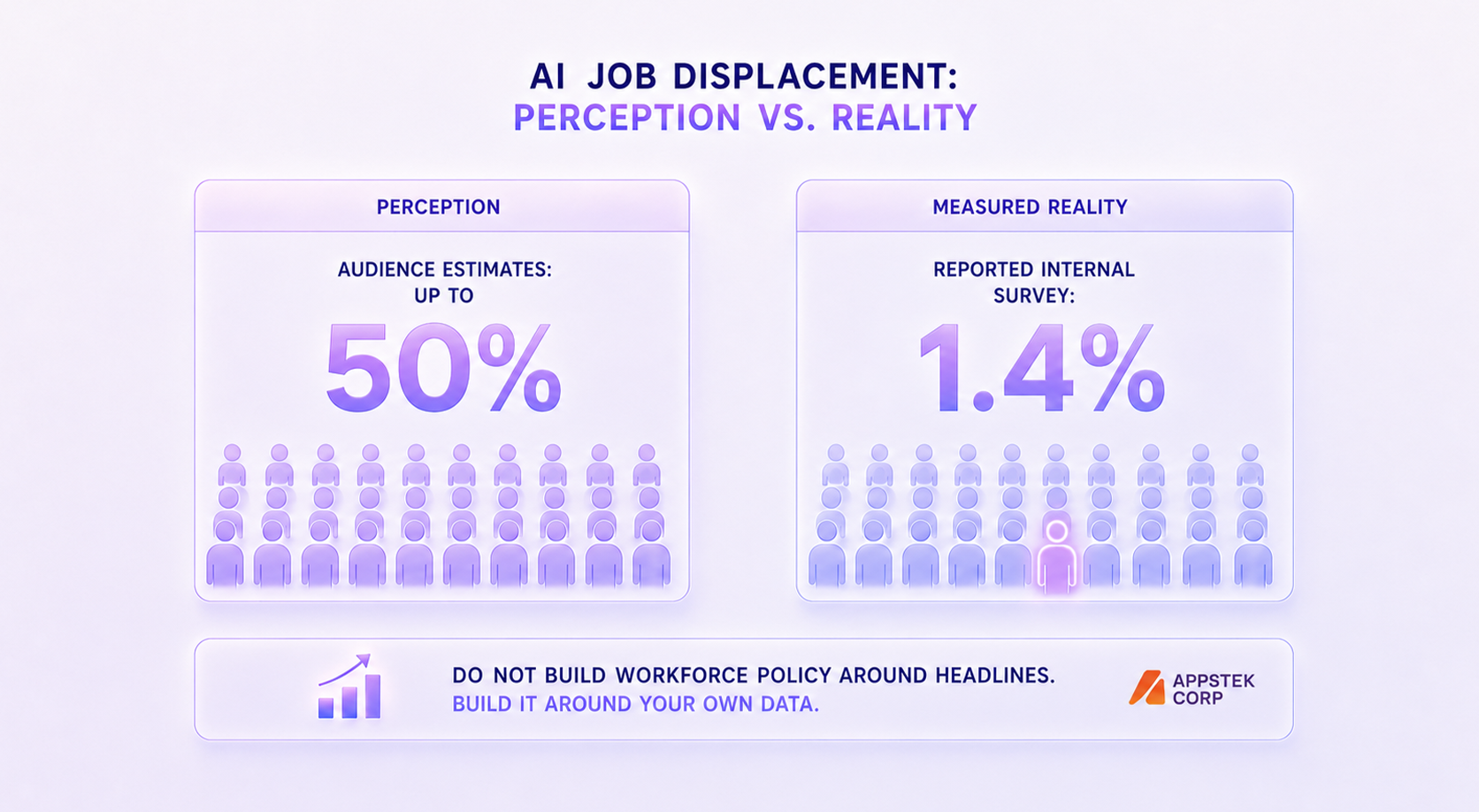
Ng challenged the room from a very different perspective. He asked the audience to estimate the actual displacement rate identified in an internal company survey. People guessed 50 percent. Twenty percent. Ten percent. The actual number was 1.4 percent.
Sitting there listening to the exchange, I found myself agreeing with both of them, but across different time horizons. Hinton’s argument about long-term exposure deserves serious attention, particularly for administrative, repetitive, and call-center-oriented work. Ng’s argument is equally important: the perception of AI-driven job displacement has consistently moved faster than the measurable displacement itself.
The most valuable part was watching highly credible experts examine the same technology and still reach different conclusions about its trajectory. They did it with genuine disagreement, but also genuine respect.
For enterprise leaders, there is an important lesson in that. If some of the people who understand AI better than almost anyone else cannot agree on the displacement timeline, workforce decisions should not be based on headlines, fear, or optimism alone. They should be based on internal evidence.
Measure which tasks are being automated. Measure which roles are changing. Measure productivity improvements. Measure redeployment. Measure actual displacement. The disagreement should be treated as an invitation to keep measuring, not as a reason to freeze.
3. Even the disagreements pointed toward openness
There was another nuance from that conversation that did not receive as much attention in the coverage afterward. Despite their disagreements, all three ultimately made arguments supporting a future where AI development remains open rather than becoming concentrated entirely within a handful of major laboratories.
Even Hinton acknowledged that his earlier resistance to open weights had effectively lost the argument.
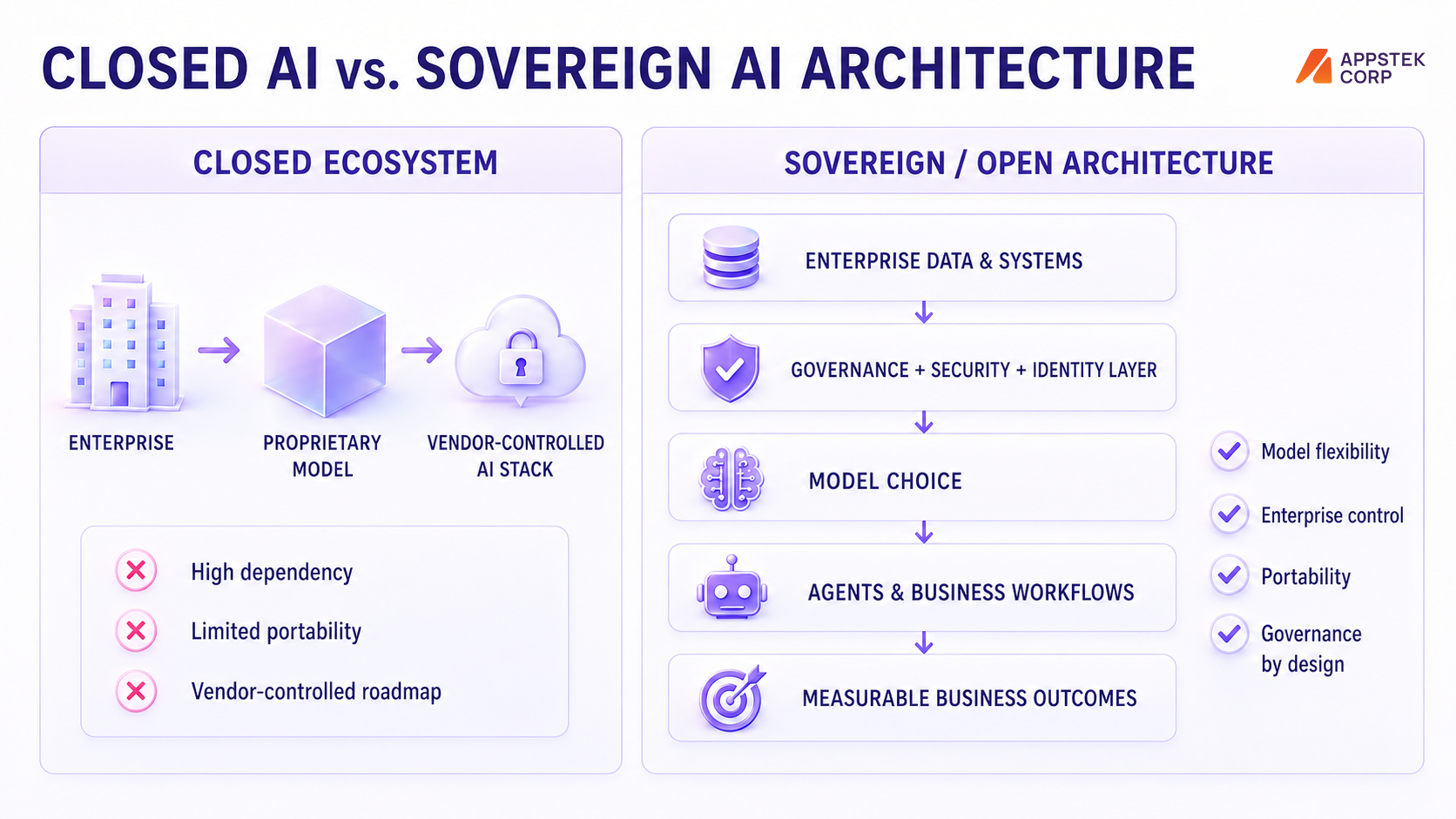
For enterprise buyers, this matters more than it might appear. The open-versus-closed debate is not merely philosophical. It connects directly to practical enterprise questions: Who owns the architecture? How portable are the workloads? How easily can models be changed? Where does enterprise data live? How much control does the organization retain? What happens when a vendor’s technology, pricing, or strategic direction changes?
In other words, the conversation is also about vendor lock-in, sovereignty, portability, and control over the enterprise AI estate.
That aligns closely with the architecture philosophy behind our own approach: enterprises should have the ability to retain control over their AI architecture rather than becoming permanently dependent on a single closed ecosystem.
4. Governance, not capability, is becoming the bottleneck
Several numbers surrounding the market reinforce the same conclusion.
Search interest in the phrase “AI bubble” increased more than 1,581 percent year over year as of July 2026. Gartner projects that more than 40 percent of agentic AI projects will be cancelled by the end of 2027, driven by factors including escalating costs, unclear business value, and inadequate governance. And despite the volume of announcements around agentic AI, only 17 percent of organizations have fully deployed AI agents.
None of this surprised me, and it should not surprise enterprise leaders either.
The market does not need another proof of concept that performs beautifully in a controlled demonstration but collapses when exposed to real operational complexity, real enterprise data, real security requirements, real governance, and real accountability.
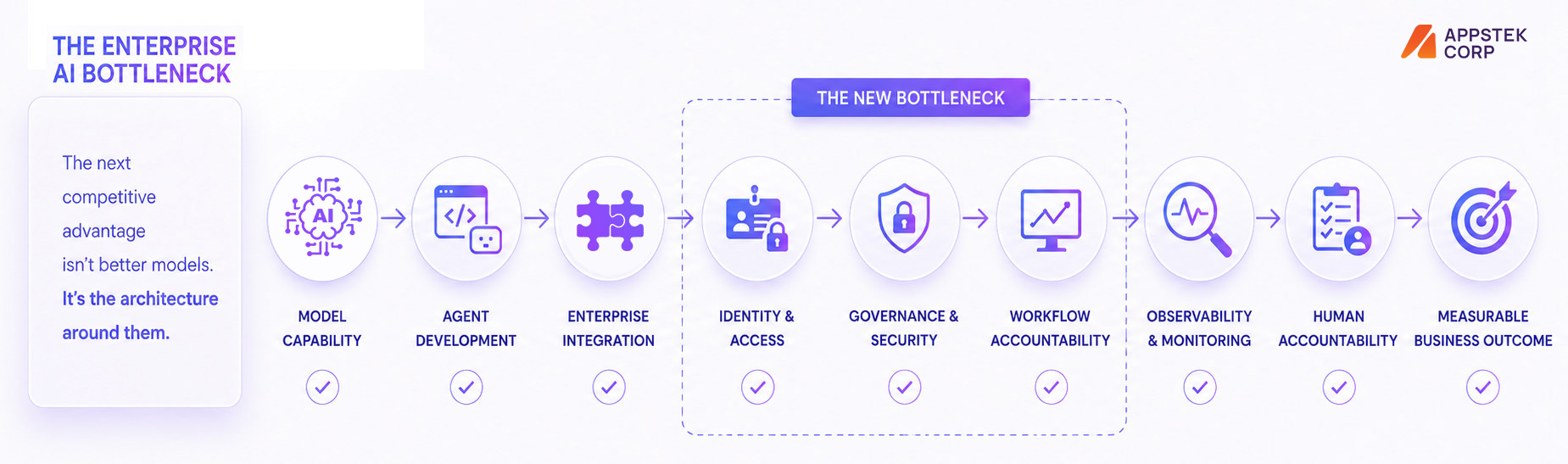
The next major constraint on enterprise AI is unlikely to be access to a more capable model. It will be the architecture surrounding the model: identity, permissions, security, governance, observability, workflow design, data access, human accountability, and business outcomes.
These are what determine whether AI moves from an interesting experiment to reliable enterprise infrastructure.
What this means for enterprise leaders
After three days of watching these discussions play out in person, there are three things I would take directly into enterprise planning conversations this quarter.
1. Audit the AI estate before expanding it
If your organization cannot answer exactly how many AI agents are operating, what systems they can access, who owns them, and what permissions they have, the priority should not be deploying the next fifty agents. The priority should be understanding the ones already running.
The gap between believed deployment and actual deployment appears to be larger than many leadership teams realize. Closing that gap early is a relatively straightforward governance win.
2. Treat workforce impact as a measurement problem before making it a policy problem
The debate around AI and employment is going to remain loud. Internal data can make it much more useful.
- Which tasks are disappearing?
- Which tasks are accelerating?
- Which roles are changing?
- Where are employees becoming more productive?
- Where is retraining working?
- Where is actual displacement occurring?
Better measurement tends to make this conversation more grounded rather than more alarming.
3. Expect governance to constrain the roadmap before model capability does
The technology is moving faster than the infrastructure designed to control it. That gap was, for me, the real headline of Ai4 2026. Not another model announcement. Not another impressive demonstration. Not another prediction about AGI. Control.
- Who can deploy AI?
- What can an agent access?
- Which decisions can it make?
- How is its activity monitored?
- Who is accountable when something goes wrong?
- How easily can the organization change models or vendors?
- How does every deployment connect back to a measurable business outcome?
Those questions are becoming more important than asking which model topped the latest benchmark.
Where this leaves us
This is exactly the gap we built our Sovereign AI Platform to address.
AI should never become a black box bolted onto enterprise systems after the fact. It needs to be audited, governed, secured, observable, and aligned with the business workflow from day one. And it should be designed around a measurable outcome rather than a demonstration.
That is why we do not begin an engagement by asking which model we should use. We start by understanding the business, the workflow, the process, the systems, the data constraints, the governance requirements, the people responsible for the outcome, and, most importantly, what measurable result the client is actually accountable for delivering.
Only then does the technology decision make sense.
Three days at Ai4 did more than confirm a hypothesis for me. It revealed a pattern emerging across an entire industry.
The next phase of enterprise AI will not be won by the organizations that simply deploy the most agents or deploy them the fastest. It will be won by the organizations that understand their businesses well enough to control, govern, and continuously measure what those agents are doing.
That is the difference between deploying AI and building an enterprise that can actually operate with it.
What is the biggest governance gap your organization is seeing with AI agents right now?

About The Author
Sanjoy Roy is the CEO of AppsTek Corp, bringing more than 22 years of executive leadership experience across enterprise technology, digital transformation, and global delivery. He has partnered with Fortune 500 organizations on large-scale modernization, operating model transformation, and technology-led growth, with a growing focus on AI-led innovation.