
Table of Contents
Oracle’s Latest Announcement Is Bigger Than an AI Builder
What Are Fusion Agentic Applications?
Oracle AI Agent Studio Moves Beyond Low-Code Development
Why Oracle Introduced the AI Studio Skill
Why Native Execution Matters More Than AI Models
What This Means for Oracle Development Teams
Preparing Oracle Fusion for Agentic Applications



Oracle's Latest Announcement Is Bigger Than an AI Builder
Every major enterprise software vendor is investing heavily in AI. New copilots, assistants, and automation capabilities are arriving with nearly every release. Yet despite the pace of innovation, enterprise AI continues to encounter the same obstacle when organizations move beyond pilots.
The challenge rarely lies in building an AI model. It lies in allowing AI to execute business processes safely within the systems that run finance, procurement, supply chain, HR, and customer operations.
Enterprise applications have spent decades evolving into trusted systems of record. Identity, security, approval workflows, audit trails, compliance policies, and business rules already exist within these platforms. AI, meanwhile, has largely been introduced as an external capability that connects to enterprise applications through APIs, integrations, or orchestration frameworks. Every additional layer increases complexity, introduces governance challenges, and extends the journey from prototype to production.
Oracle’s latest announcement represents an important shift in that approach. Rather than introducing another AI feature, Oracle has expanded Oracle AI Agent Studio for Fusion Applications with an AI-native builder experience and introduced Fusion Agentic Applications, a new application model where coordinated teams of AI agents operate directly within Oracle Fusion Cloud Applications.
The announcement signals a broader direction for enterprise software. AI is becoming part of the application architecture itself rather than another capability layered alongside it. For Oracle customers, that distinction deserves attention.
What Are Fusion Agentic Applications?
Oracle describes Fusion Agentic Applications as outcome-driven enterprise applications powered by teams of specialized AI agents that collaborate to complete business processes. Instead of supporting a user through a single task, these applications coordinate multiple activities, evaluate business context, apply enterprise policies, and execute work through Oracle Fusion business objects and workflows.
That represents an important evolution from earlier generations of enterprise AI.
Predictive AI identifies patterns and forecasts outcomes. Generative AI creates content and assists users with decision-making. Agentic applications extend that progression by coordinating actions across multiple systems and processes while operating within established governance controls. The emphasis shifts from assisting work to advancing work.
Consider a collections process. Traditional collections teams review outstanding invoices, evaluate customer history, determine risk, decide on the appropriate action, and follow through with multiple operational steps. Several people, systems, and approvals often contribute to a single outcome.
Fusion Agentic Applications are designed to coordinate much of that workflow. Specialized AI agents can analyze customer information, review payment history, recommend the next course of action, initiate approved processes, and escalate exceptions requiring human judgment. Business users continue to make strategic decisions while routine operational work moves forward within defined enterprise guardrails.
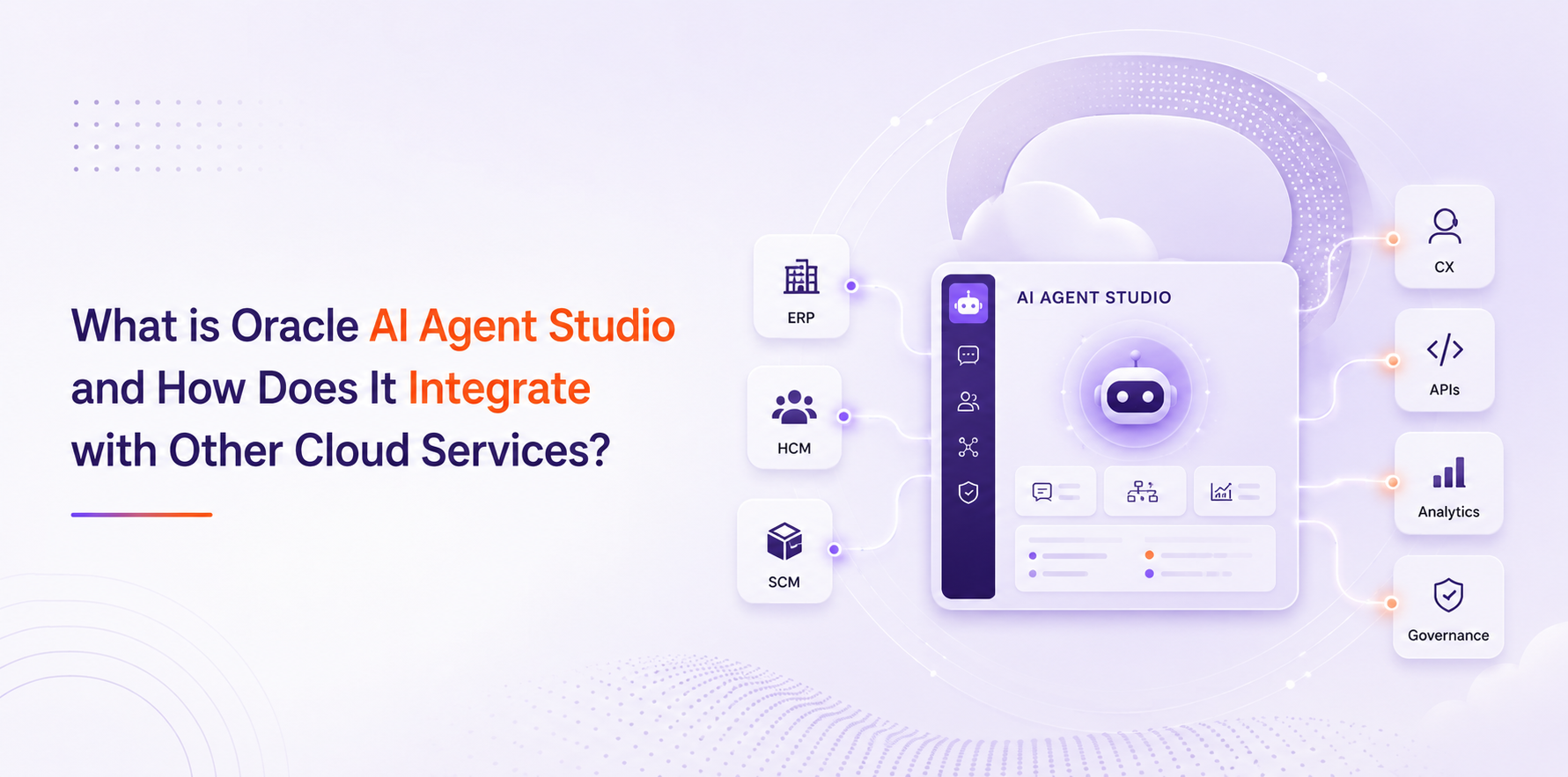
The same approach extends across Oracle Fusion Cloud ERP, HCM, SCM, and CX, where business outcomes frequently depend on coordinating information across multiple functions rather than completing isolated tasks.
Oracle’s objective is clear. Enterprise applications should become active participants in business operations instead of systems that simply wait for user instructions.
Why This Announcement Matters
Technology announcements often focus on features. Enterprise leaders evaluate operating models.
That is what makes Oracle’s July announcement particularly relevant.
Many organizations have already invested in AI assistants, document intelligence, and workflow automation. Those initiatives frequently deliver measurable productivity improvements. Scaling AI across enterprise operations introduces a different set of questions.
- How should AI inherit enterprise permissions?
- Where should governance reside?
- How are AI decisions audited?
- Who owns lifecycle management?
- How do organizations maintain consistency across finance, HR, procurement, and supply chain?
These questions sit beyond the AI model itself. They belong to the enterprise platform.
Oracle’s latest investment suggests that enterprise AI is entering a new phase where governance, execution, and application architecture receive as much attention as intelligence itself. Rather than asking organizations to assemble multiple technologies into a production-ready platform, Oracle is moving those capabilities closer to the core application environment.
For Oracle Fusion customers, the conversation becomes less about adopting another AI feature and more about preparing the enterprise platform for a different style of application delivery.
What's Coming Next
Oracle’s announcement introduces two related capabilities that deserve individual attention. The first is the expansion of Oracle AI Agent Studio for Fusion Applications, including the new AI-native builder experience that supports both business users and professional developers.
The second is the introduction of Fusion Agentic Applications as a new application model built around coordinated AI execution rather than individual automation tasks. Understanding how those two capabilities work together explains why Oracle’s latest release represents more than a product enhancement. It reflects a broader change in how enterprise applications are likely to be built, extended, and governed over the coming years.
Oracle AI Agent Studio Moves Beyond Low-Code Development
Oracle AI Agent Studio has always been positioned as the environment for creating and managing AI agents within Oracle Fusion. The July 2026 announcement expands that vision considerably by introducing an AI-native builder experience that supports business users, professional developers, and implementation partners within the same platform.
That shift is significant because enterprise AI development rarely belongs to a single audience. Business users understand the process. Developers understand the architecture. Enterprise architects establish governance. Platform teams manage deployment. Security teams oversee access and compliance. Every successful AI initiative depends on these groups working together.
Oracle’s latest enhancements acknowledge that reality. Business users can assemble agentic applications through a natural language interface, lowering the barrier to experimentation. Development teams can extend those applications through the newly introduced AI Studio Skill using familiar engineering tools, including Visual Studio Code, Git-based workflows, command-line interfaces, and AI coding assistants such as Codex, Claude Code, and Gemini.
Rather than creating separate experiences for business users and developers, Oracle is bringing them into a shared delivery model where every application ultimately becomes a native Oracle Fusion runtime artifact. That architectural decision matters far more than the interface itself.
Applications inherit Oracle Fusion’s existing identity model, security framework, workflow engine, approval hierarchies, and audit capabilities. Instead of reconstructing governance after development, governance becomes part of the application from the beginning.
For organizations already standardizing on Oracle Fusion, that significantly reduces the effort required to move AI initiatives into production.
Why Oracle Introduced the AI Studio Skill
The introduction of the AI Studio Skill may prove to be one of the most consequential elements of Oracle’s announcement, even though it received less attention than the AI-native builder.
For several years, enterprise AI development has followed two distinct paths. Business users have increasingly relied on low-code platforms to automate routine work. Engineering teams, meanwhile, have continued building custom applications through source control, testing frameworks, continuous integration pipelines, and structured release management. Those worlds have rarely intersected effectively.
Oracle is attempting to bridge that divide. The AI Studio Skill allows developers to work within familiar engineering environments while generating Oracle Fusion artifacts using AI-assisted development. Instead of learning an entirely new development model, engineering teams can extend Fusion applications through workflows that already support enterprise software delivery.
That approach reflects a broader industry shift. Agentic applications are beginning to resemble production software rather than workflow configurations. They require version control, repeatable deployments, testing strategies, reusable templates, and lifecycle management that extend well beyond prompt engineering.
Oracle’s investment suggests that enterprise AI is becoming another discipline within software engineering rather than a standalone capability managed through isolated automation tools.
Why Native Execution Matters More Than AI Models
Much of the discussion around enterprise AI continues to focus on models.
Which large language model performs best?
Which reasoning model produces the highest accuracy?
Which vendor offers the most capable AI assistant?
Those questions matter.
They rarely determine whether an enterprise AI initiative reaches production. The greater challenge lies in operational execution.
Every enterprise application already manages identity, role-based permissions, approval hierarchies, audit logging, compliance controls, business rules, and operational governance. When AI operates outside that environment, organizations must recreate much of that foundation before autonomous execution becomes acceptable for production workloads.
That reconstruction often becomes the longest phase of an AI implementation.
Oracle’s approach changes that sequence.
Fusion Agentic Applications execute within Oracle Fusion Cloud Applications rather than around them. Security policies, approvals, business objects, and governance already exist within the runtime, allowing AI to operate within established enterprise controls instead of introducing another layer that must be secured and managed separately.
The practical outcome is straightforward. Organizations spend less time integrating governance into AI applications and more time identifying where AI can create measurable operational value.
For regulated industries such as financial services, healthcare, manufacturing, utilities, and the public sector, that distinction becomes particularly important because governance is often the deciding factor between a successful pilot and a production deployment.
What This Means for Oracle Development Teams
Oracle’s latest announcement also changes expectations for Oracle developers. Historically, extending Oracle Fusion applications meant building integrations, configuring workflows, developing extensions, or exposing APIs that connected enterprise processes across systems.
Agentic applications introduce another architectural layer. Developers are increasingly responsible for designing how AI agents interact with business objects, workflows, enterprise policies, and external services while maintaining the reliability expected of production enterprise software.
That requires a broader engineering mindset. AI capabilities need version control, deployment pipelines, testing strategies, monitoring, observability, and operational governance in the same way as every other application component.
The AI Studio Skill reflects this evolution by supporting development practices that engineering teams already trust instead of introducing an entirely separate delivery model.
For Oracle customers, this creates an opportunity to extend existing software engineering practices into enterprise AI rather than building isolated AI programs that operate independently of established application delivery processes.
Preparing Oracle Fusion for Agentic Applications
Oracle’s AI-native builder makes it easier to create Fusion Agentic Applications. Deploying them successfully, however, depends on far more than development tools.
Enterprise AI succeeds when the underlying platform is prepared to support autonomous execution.
Organizations evaluating Fusion Agentic Applications should begin with readiness rather than implementation. Identifying where AI can create value is only part of the equation. Equally important is determining whether the surrounding enterprise architecture can support AI operating within production environments.
Several areas deserve early attention.
Business process suitability
Agentic applications perform best where business rules are well defined, transaction volumes are significant, and outcomes can be measured consistently. Finance, procurement, supply chain, customer service, and human capital management often provide strong starting points because these functions already operate through structured workflows and established approval models.
Organizations should focus on processes where AI can reduce operational effort while preserving business oversight, rather than attempting to automate every workflow simultaneously.
Data readiness
Enterprise AI is only as reliable as the information it operates on.
Incomplete master data, inconsistent business definitions, fragmented integrations, and duplicate records reduce confidence in autonomous decision-making. Before introducing agentic applications, organizations should assess whether enterprise data can support consistent, repeatable execution across business functions.
For many Oracle Fusion customers, data quality will influence outcomes more than model selection.
Governance and security
Agentic applications introduce a different level of responsibility than AI assistants. These applications interact with enterprise transactions, business policies, and approval frameworks. Governance therefore extends beyond model governance to include identity management, role-based access, segregation of duties, auditability, and operational accountability.
Organizations that establish governance patterns early will be better positioned to expand AI adoption across multiple business domains.
Platform engineering
Enterprise AI is becoming another workload that requires engineering discipline. Version control, deployment automation, observability, testing strategies, release management, and operational monitoring remain essential as organizations introduce AI into production environments.
Oracle’s latest announcement reflects that direction by supporting developer workflows alongside business-user experiences rather than treating AI as a separate implementation effort.
The Bigger Picture
Oracle’s July 2026 announcement represents more than another milestone in enterprise AI.
It reflects a broader shift in how enterprise applications are expected to evolve.
The first generation of enterprise AI focused on helping people work more efficiently. The next generation focuses on enabling enterprise applications to participate more actively in business execution.
That evolution changes how organizations should think about AI investments.
Success will depend less on selecting individual AI capabilities and more on building an operating model that supports governance, engineering, security, data quality, and continuous delivery as AI becomes embedded across enterprise platforms.
For Oracle Fusion customers, the conversation is gradually moving beyond “Where can AI help?” toward a more strategic question.
How should enterprise applications evolve when AI becomes part of the platform itself?
Oracle’s latest announcement provides one answer.
The organizations that realize the greatest value will be those that treat Fusion Agentic Applications as part of a broader modernization strategy rather than another isolated technology initiative.
From Capability to Enterprise Adoption
Every major enterprise software provider is investing in AI. The differentiator is no longer the presence of AI capabilities but the ability to operationalize them at enterprise scale.
Oracle’s latest investment in Fusion Agentic Applications and Oracle AI Agent Studio reflects an important step in that direction. By bringing application development, governance, enterprise workflows, and AI execution closer together, Oracle is laying the foundation for a more integrated approach to enterprise AI.
Organizations evaluating these capabilities should approach them as part of a broader enterprise architecture strategy rather than a standalone AI initiative.
Preparing data, strengthening governance, modernizing integration architecture, and establishing repeatable engineering practices will have a greater impact on long-term success than any individual feature introduced in a product release.
AppsTek helps organizations modernize Oracle environments through architecture-led transformation, Oracle Fusion implementation, Oracle Integration Cloud, platform engineering, managed services, and enterprise AI delivery. As organizations evaluate Fusion Agentic Applications, success will depend on aligning technology, governance, and business outcomes within a delivery model that can support AI in production.
Frequently Asked Questions
Fusion Agentic Applications are Oracle's new application model introduced in July 2026. They combine teams of specialized AI agents that reason, coordinate, and execute business processes within Oracle Fusion Cloud Applications while inheriting the platform's existing security, governance, workflow, and audit capabilities.
AI assistants primarily respond to user prompts by generating information or recommendations. Fusion Agentic Applications are designed to execute business processes across multiple steps, coordinating AI agents, enterprise workflows, and business rules while escalating only those decisions that require human judgment.
Oracle AI Agent Studio for Fusion Applications is Oracle's development environment for creating, extending, testing, and managing AI agents and Fusion Agentic Applications. Oracle's July 2026 update introduced an AI-native builder experience that supports both natural language application development and professional development workflows through the AI Studio Skill.
Yes. Oracle's AI Studio Skill supports familiar engineering workflows, including Visual Studio Code, standard command-line interfaces, Git-based development, and AI coding assistants such as Codex, Claude Code, and Gemini, enabling developers to build and extend Fusion Agentic Applications using established software engineering practices.
Oracle has announced that Oracle AI Agent Studio, including the AI-native builder experience and AI Studio Skill, is available at no additional cost for Oracle Fusion Applications customers. Organizations should review current Oracle licensing documentation or consult their Oracle representative for environment-specific guidance.

About The Author
Myrlysa I. H. Kharkongor is Senior Content Marketer at AppsTek Corp, driving content strategy for the company’s digital engineering services to enhance brand presence and credibility. With experience in media, publishing, and technology, she applies a structured, insight-driven approach to storytelling. She distills AppsTek’s cloud, data, AI, and application capabilities into clear, accessible communications that support positioning and grow the brand’s digital footprint.