



The Agentic AI Moment Is Here, but Are Enterprises Ready?
How It Works, Why It’s Critical, and What Happens Without It
The enterprise AI conversation has fundamentally shifted. Organizations are no longer debating whether to adopt AI; the question now is how to operationalize autonomy at scale. AI agents can reason across tasks, access enterprise systems through APIs, make decisions based on business rules, and hand off work to other agents or humans when conditions demand it. The technology is real. The potential is enormous.
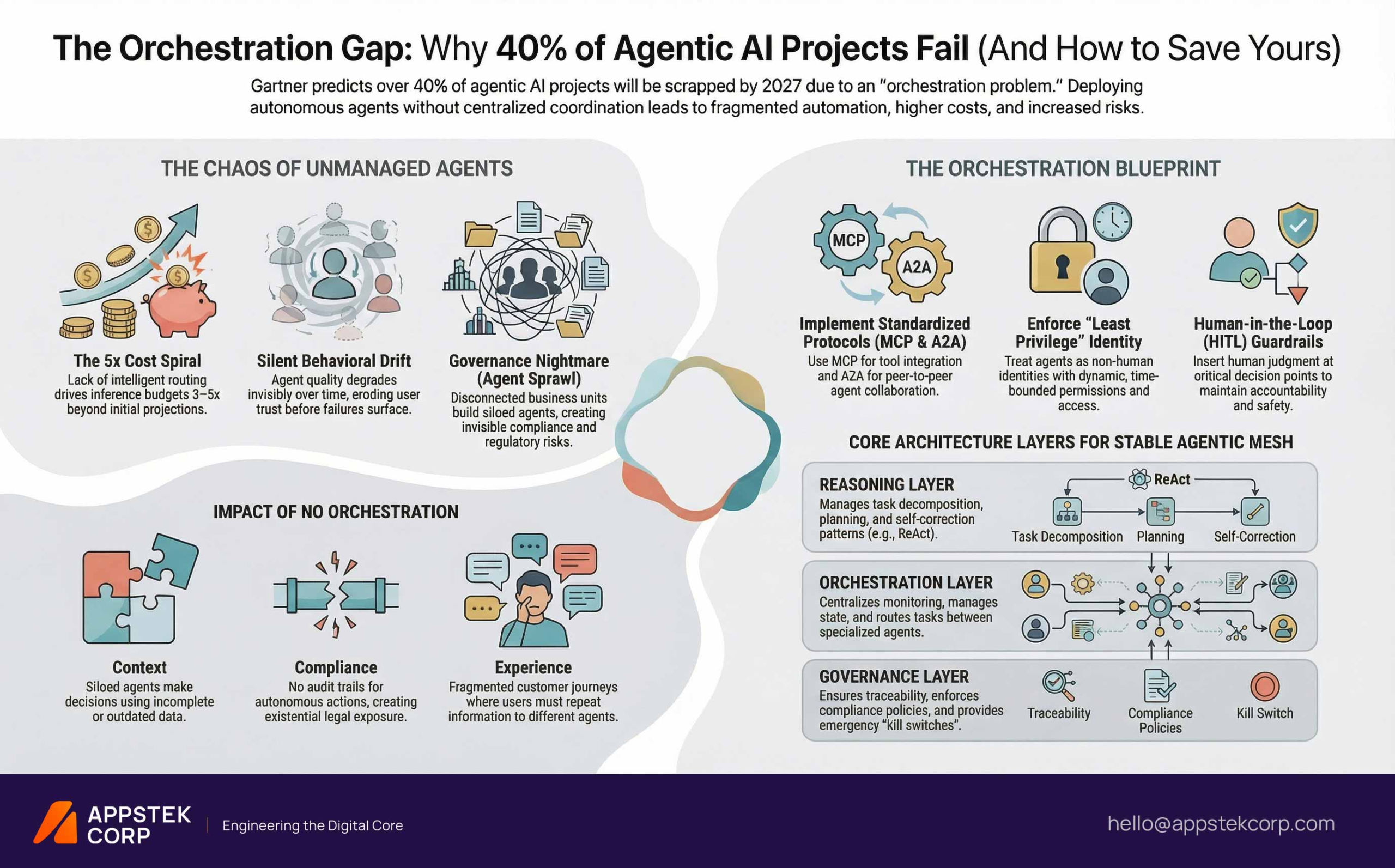
But here is an uncomfortable truth: most enterprises are deploying agents without the connective tissue that makes them effective. According to Gartner, more than 40% of agentic AI projects will be cancelled by the end of 2027, driven by escalating costs, unclear business value, and inadequate risk controls. The models are not the problem. The agentic AI orchestration layer is what is missing.
That figure becomes even more striking in context. Gartner found that only about 130 of the thousands of vendors claiming agentic capabilities actually deliver genuine agentic functionality. The rest are engaged in what the firm calls “agent washing,” rebranding existing chatbots and RPA tools without substantive upgrades.
For enterprises investing heavily in this space, the stakes of getting orchestration right could not be higher.
What follows is a comprehensive guide to understanding agentic AI orchestration: what it is, how it works, why it is the single most critical factor in agentic AI success, and what happens when enterprises try to scale without it.
How Does Agentic AI Orchestration Work?
From Single Agents to Coordinated Systems
Think of agentic AI orchestration as air traffic control for autonomous systems. Just as air traffic control coordinates hundreds of aircraft each with its own destination, speed, and constraints an orchestration layer coordinates multiple AI agents working across different enterprise systems, data sources, and workflows.
A single AI agent is capable enough on its own. It can process a customer inquiry, pull data from a CRM, or classify a document. But enterprise workflows do not exist in isolation. A mortgage origination, a supply chain adjustment, or a fraud investigation involves dozens of systems, multiple decision points, and handoffs between AI and human judgment.
When 79% of organizations report some level of AI agent adoption yet only 11% have actually moved those agents into production, the gap points squarely at missing orchestration infrastructure. Orchestration is the bridge between promising experiments and reliable enterprise operations.
What Is the Function of the AI Agent Orchestrator?
An AI agent orchestrator serves as the central nervous system of a multi-agent deployment. Rather than allowing individual agents to operate independently and hoping for coherent outcomes, the orchestrator imposes structure, sequence, and governance across every agent interaction. Five core functions define what the orchestration layer must deliver.
1. Goal Decomposition & Task Planning
The orchestrator receives a high-level business objective “Process this insurance claim” or “Onboard this new vendor” and breaks it into executable subtasks. Each subtask is assigned to the most appropriate agent based on capability, cost, and latency requirements.
2. Agent Routing & Coordination
Different agents specialize in different domains: one handles document extraction, another runs compliance checks, a third interfaces with legacy ERP systems. The orchestrator routes tasks to the right agent, manages dependencies between them, and ensures they communicate context to one another seamlessly.
3. Memory & Context Management
Unlike stateless API calls, agentic workflows require persistent context. The orchestration layer maintains shared memory across agents so that Agent B knows what Agent A already discovered. Without this, agents duplicate work, lose critical context, or make contradictory decisions.
4. Governance & Guardrails
The orchestrator enforces business rules, compliance policies, and escalation protocols. It determines which agents can access which data, when a human needs to be brought into the loop, and what actions require approval before execution. This is especially critical in regulated industries like healthcare and financial services sector.
5. Monitoring, Auditability & Feedback Loops
Every decision, tool call, and handoff is logged. The orchestrator provides telemetry dashboards for operations teams, audit trails for compliance, and feedback loops that allow agents to improve over time based on outcomes.
AI Agent Orchestration Patterns
How to orchestrate AI agents effectively depends on workflow complexity, and enterprises typically adopt one of several ai agent orchestration patterns depending on the nature of their operations.
Sequential pipelines work well for linear processes like document processing chains, where each step must complete before the next begins. Hierarchical orchestration uses a supervisory agent that delegates to specialist agents and synthesizes their outputs, offering tighter control over complex decision trees.
Dynamic swarms allow agents to self-organize based on expertise, which proves particularly useful for complex problem-solving scenarios where the optimal workflow is not known in advance.
Each pattern carries meaningful trade-offs in cost, latency, and control. A detailed exploration of these architectural decisions, including patterns like ReAct, Plan-and-Execute, and multi-agent supervisor models, is available in AppsTek Corp’s technical deep dive on design patterns for agentic AI and multi-agent systems.
The Technology Stack
Modern orchestration relies on a layered architecture. At the foundation, API connectors and middleware ensure enterprise systems, from Salesforce and SAP to Oracle and Snowflake can communicate.
Above that, protocols like Model Context Protocol (MCP) and Agent-to-Agent (A2A) standardize how agents discover and invoke tools. The orchestration platform sits on top, managing workflows, state, and governance. Leading frameworks in this space include LangGraph, AutoGen, Semantic Kernel, and enterprise-native platforms like IBM watsonx Orchestrate.
Why Is Orchestration Critical for Agentic AI Success?
The Difference Between a Pilot and a Production System
Between 2023 and 2025, enterprises experimented heavily with generative AI pilots: chatbots, code assistants, internal copilots. Most of them worked in controlled environments. Very few of them scaled. The missing ingredient was not a better model. It was the orchestration infrastructure that turns a clever demo into a reliable, governed, enterprise-grade system.
Boards now demand measurable ROI. CFOs scrutinize inference costs. CISOs demand traceability. Operations leaders expect resilience. Orchestration is what enables all of these simultaneously.
Five Reasons Orchestration Is Non-Negotiable
1. Scale Requires Coordination, Not Just More Agents
Low-code platforms make it easy to spin up AI agents quickly. As adoption scales, lack of coordination leads to agent sprawl and fragmented automation. Orchestration brings structure, enabling agents to work together, use the right models, and operate consistently.
2. Enterprise Workflows Demand Cross-System Intelligence
Modern enterprise processes often span 40–60 system touchpoints. Requests that once moved across multiple systems and teams can be handled end to end when agents are coordinated effectively. An orchestration layer routes tasks, aggregates data, drives decisions, and brings in human input when needed.
3. Governance and Compliance Are Not Optional
In regulated industries, every AI-driven decision must be traceable. Orchestration embeds governance into workflows by enforcing access controls, logging decisions, and keeping agents within defined boundaries. Without it, organizations risk audit failures, compliance gaps, and reputational damage.
4. Cost Optimization Depends on Intelligent Routing
Many tasks can be handled by smaller, cost-efficient models. Orchestration routes work accordingly, reserving advanced models for complex reasoning. This approach can cut inference costs by 50–70% without compromising output quality.
5. Human-AI Collaboration Needs a Framework
The most successful agentic implementations do not remove humans from the loop. They operate across a spectrum of autonomy, where some tasks run independently, others are monitored, and high-stakes decisions require direct human involvement. Orchestration defines and enforces how each task is handled across that spectrum.
The Business Impact
Organizations with well-orchestrated agentic AI report 30–50% faster process cycles, improved accuracy, and higher employee satisfaction as repetitive task-switching is reduced. The orchestration layer is what turns technical capability into measurable business outcomes.
What Happens When Agentic AI Lacks Orchestration?
The Predictable Failure Modes
When enterprises deploy agents without orchestration, the failures are not dramatic explosions. They are slow, quiet, and expensive. Research and real-world deployments consistently reveal a predictable set of failure modes that share a single common root cause: the absence of an agentic AI orchestration layer.
- Agent Sprawl and Fragmentation: Without a coordination layer, different teams deploy agents independently across different frameworks, languages, and infrastructure. The result is a patchwork of disconnected automation that is impossible to govern, expensive to maintain, and delivers diminishing returns as complexity grows.
- Silent Drift and Degradation: Agentic AI systems do not fail suddenly they drift. As models are updated, data patterns shift, and prompts are refined, agent behavior evolves incrementally. Without orchestration-level monitoring, this drift goes undetected until it causes a major incident. Output quality degrades, decisions become inconsistent, and trust erodes all beneath the surface of normal-looking KPIs.
- Context Loss Across Handoffs: When agents operate in silos, they lose context at every handoff. A fraud detection agent flags a transaction without knowing the customer filed a travel notice in another system. A customer service agent re-asks questions that a previous agent already resolved. Each context loss creates friction, errors, and customer frustration.
- Governance Gaps and Compliance Exposure: A non-auditable agent provides no proof that its actions complied with regulations. When a black-box agent denies a credit application, approves a claim, or makes a trading decision, there’s no way to explain why. This creates legal liability, audit failures, and regulatory exposure that can be existential for the business.
- Cost Overruns from Unmanaged Inference: Without intelligent routing, every task goes to the most capable (and most expensive) model. Recursive agent calls multiply costs unpredictably. Organizations have reported inference bills 3–5x higher than projected when orchestration and cost controls are absent.
How to Troubleshoot AI Agent Orchestration
When orchestration problems surface, whether through performance degradation, inconsistent outputs, or compliance gaps, a structured diagnostic approach is essential. Effective troubleshooting begins with the observability layer: reviewing telemetry data across agent interactions to identify where context is being lost, where latency is spiking, or where agents are making redundant calls.
From there, the focus shifts to governance validation (ensuring agents are operating within their defined guardrails), memory integrity checks (confirming shared context is propagating correctly between agents), and cost analysis (identifying unmanaged inference patterns that are driving up expenses).
Organizations that build these diagnostic capabilities into their orchestration infrastructure from the outset are far better positioned to scale without encountering the cascading failures that plague unmonitored deployments.
The Real Cost of “Wait and See”
Gartner’s projection that 40%+ of agentic AI projects will be cancelled by 2027 is not about technology failing. It is about organizations that skipped the orchestration layer discovering too late that agents without coordination create more problems than they solve.
The organizations that invested early in orchestration infrastructure are the ones moving from pilot to production, while others are still troubleshooting their experiments.
The Path Forward: Orchestration-First Agentic AI
The enterprises that will succeed with agentic AI are not the ones building the most agents. They are the ones building the best orchestration. This means treating orchestration as core infrastructure not an afterthought. It means starting with well-defined workflows, clear governance, and a progressive autonomy model before scaling agent deployments.
For C-suite leaders, the strategic imperative is clear: the orchestration layer is where competitive advantage lives. It’s what separates organizations that achieve real ROI from those stuck in perpetual pilot mode.
Ready to Build an Orchestration Strategy?
AppsTek Corp helps enterprises design and implement agentic AI orchestration frameworks that are production-ready from day one. With 18+ years of enterprise technology experience, 200+ engagements, and deep expertise across Oracle, SAP, Snowflake, Microsoft, and NVIDIA ecosystems, the firm brings the architectural thinking and integration depth that agentic AI demands.
Start with a complimentary 8-week Proof of Concept, a structured engagement where the AppsTek team assesses existing workflows, identifies high-impact orchestration opportunities, and delivers a working prototype tailored to the enterprise environment.
Contact AppsTek Corp to schedule a conversation with the Agentic AI practice leads: appstekcorp.com/contact-us
Frequently Asked Questions
AI agent orchestration coordinates multiple agents as a unified system. It decomposes goals, routes tasks, maintains shared context, enforces governance, and monitors execution. It turns isolated agents into scalable enterprise automation.
An AI agent orchestrator manages task decomposition, routing, context sharing, governance, and monitoring. It ensures agents collaborate effectively, follow policies, and deliver consistent, traceable outcomes across workflows.
Agentic AI orchestration uses patterns like sequential, hierarchical, or dynamic workflows. It requires system integration, agent communication protocols, and a control layer to manage state, governance, and cost across agents.
Troubleshooting agentic AI orchestration starts with telemetry to find latency or context loss. Then validate guardrails, check memory flow, review model routing costs, and monitor feedback loops to prevent drift and workflow failures.

About The Author
Rahul Sudeep, Senior Director of Marketing at AppsTek Corp, is a results-driven, AI-first B2B marketing leader with 15 years of experience scaling global enterprise SaaS companies. His expertise, honed at IIM-K, spans architecting high-impact go-to-market strategies, driving new market identification and positioning, and embedding Generative AI, LLMs, and predictive analytics into the core marketing function. Rahul unifies Technology, Sales, and Support teams around a single strategic hub, while also managing key Partner and Investor Relations. He leverages AI-driven insights to craft powerful brand narratives and hyper-personalized demand generation campaigns that drive measurable revenue growth and deepen customer engagement.