



Enterprise search has failed the same promise for three decades. Every generation of the technology claimed to help employees find what they need, and every generation left a meaningful share of the workforce searching multiple systems, asking colleagues, or simply redoing work that already existed somewhere in the organization. Generative AI has changed the economics of that problem, but not by making search better on its own. It changed the problem by giving enterprises a way to combine search with reasoning, and now, with autonomous action.
This guide covers the three technologies enterprises are being asked to evaluate together for the first time: enterprise search, retrieval-augmented generation, and agentic AI. Understood separately, each is well documented. Understood together, as a single evolving stack, they explain why so many organizations are rearchitecting how employees and AI systems find and use enterprise knowledge.
Why Enterprise Search Still Fails
The scale of the problem is well documented in current industry research. According to Gartner’s Market Guide for Enterprise AI Search, published in September 2025, 34 percent of employees struggle to find the information they need to do their jobs. Roughly 49 percent of workers now primarily rely on AI tools such as Copilot or Gemini for data discovery rather than traditional search interfaces, yet 36 percent of those AI tool users still report difficulty accessing relevant information despite that assistance.
Gartner forecasts that by 2028, 60 percent of organizations will deploy more than six enterprise AI search platforms across the business, and 60 percent of enterprise applications will have embedded AI search capabilities, up from roughly 20 percent today. The underlying shift Gartner describes is a move from information retrieval, returning a list of documents, toward information synthesis, returning a grounded, contextual answer.
Gartner also notes that no single approach dominates the category. Enterprises are pursuing search as a unified platform indexing content across many sources, in-application search embedded directly inside specific tools, and federated search that queries separate indexes without centralizing them, often combining more than one approach rather than standardizing on a single model.
That shift is exactly what retrieval-augmented generation was built to enable, and exactly what agentic AI is now extending further.
The Evolution of Enterprise Search
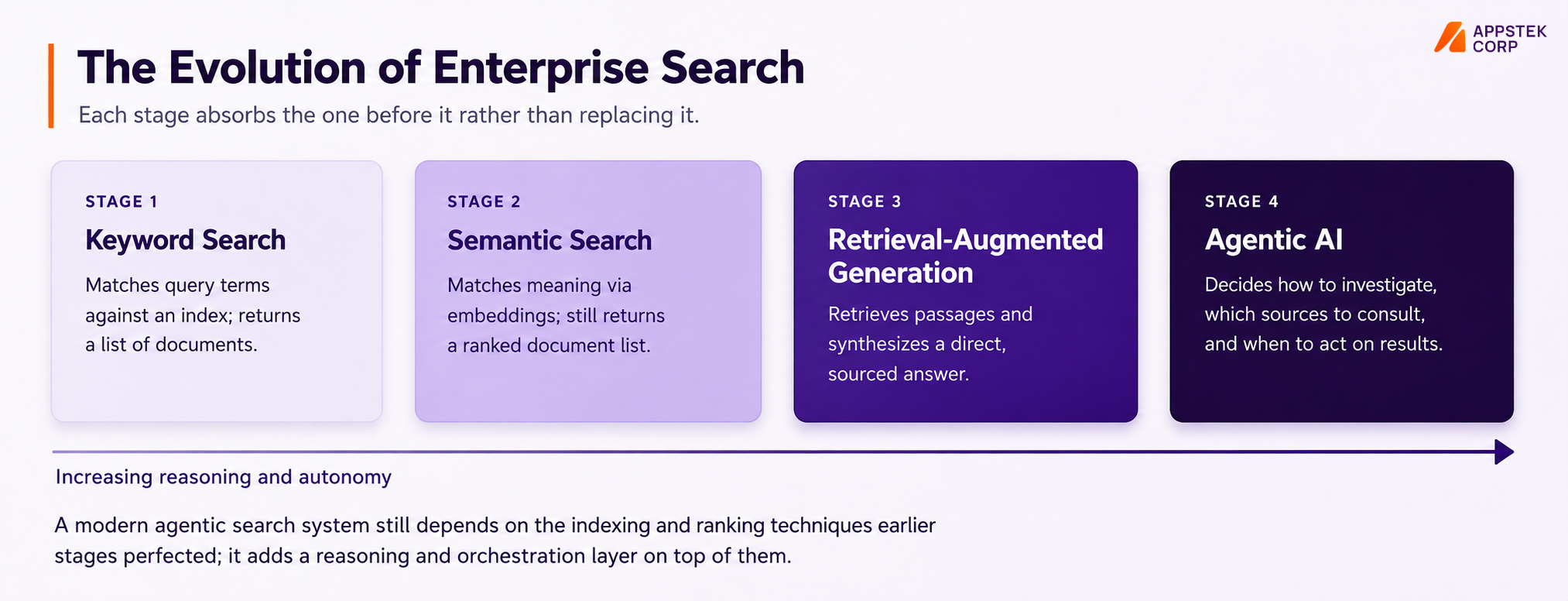
Keyword search matched query terms against an index and left interpretation entirely to the user. Semantic search introduced embeddings, allowing systems to match meaning rather than exact terms, but still returned a ranked list of documents rather than an answer. Retrieval-augmented generation changed the output itself: instead of a list, the system retrieves relevant passages and uses a language model to synthesize them into a direct, sourced answer. Agentic AI represents the current stage, where the system does not just answer a question but decides how to investigate it, which sources to consult, when to retrieve again, and in some deployments, what action to take once it has an answer.
Each stage did not replace the one before it so much as absorb it. A modern agentic search system still depends on the indexing and ranking techniques keyword and semantic search perfected; it simply adds a reasoning and orchestration layer on top.
How RAG Actually Works
Retrieval-augmented generation grounds a language model’s response in retrieved enterprise content rather than relying solely on what the model learned during training. The architecture has become fairly standardized across production deployments, even as specific implementation choices vary.
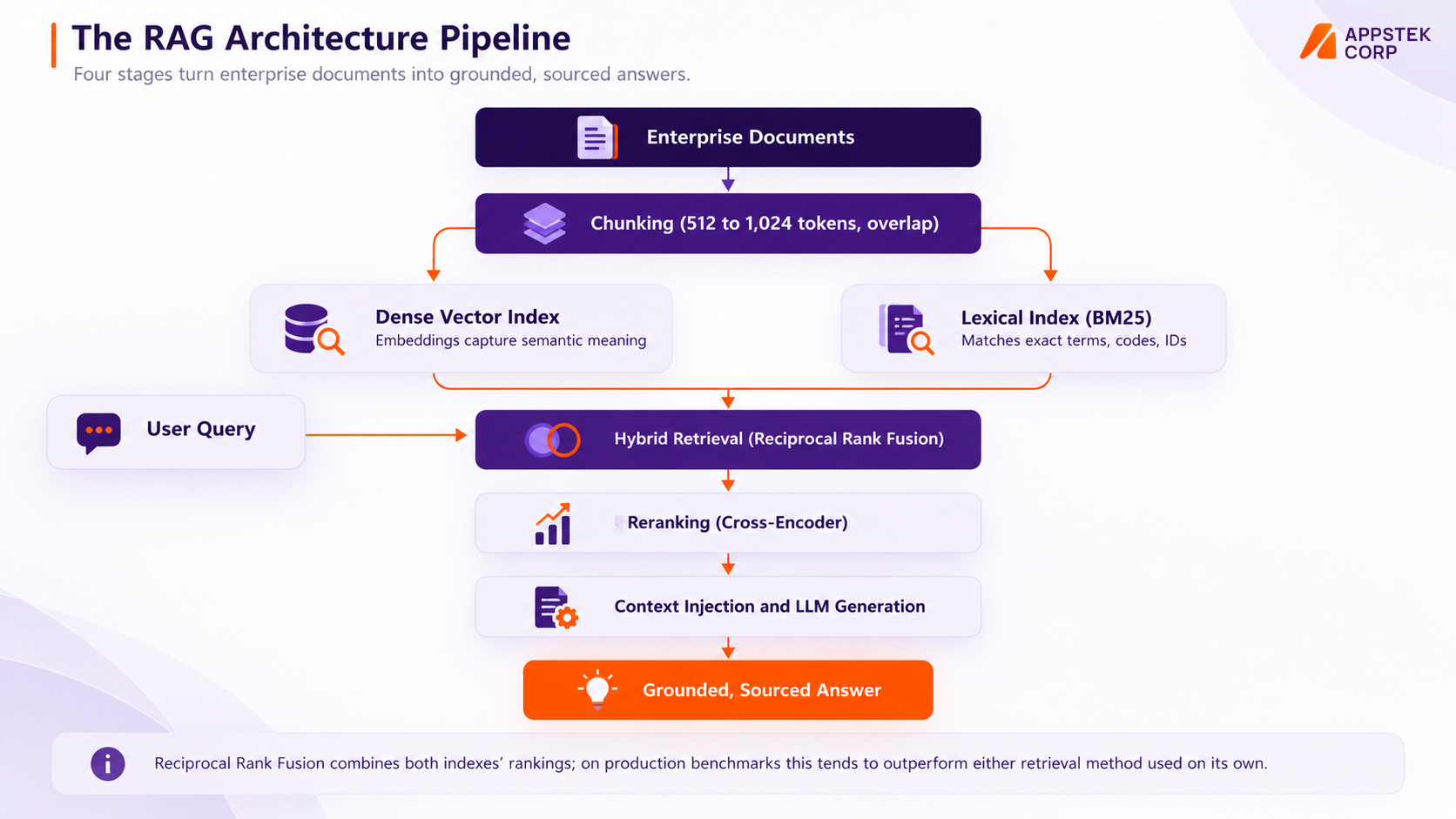
Documents are first split into chunks, commonly in the range of 512 to 1,024 tokens with some overlap between adjacent chunks, so that retrieval can return focused passages rather than entire documents. Each chunk is converted into a dense vector embedding using a model such as OpenAI’s text-embedding-3-large, Voyage AI’s embedding models, BGE-M3, or Cohere’s Embed family, which captures the chunk’s semantic meaning as a point in vector space.
Production systems typically maintain two indexes in parallel rather than relying on embeddings alone: a lexical index, commonly BM25, that matches exact terms, codes, and identifiers well, and a dense vector index that matches conceptual meaning. A technique called Reciprocal Rank Fusion combines the ranked results from both indexes into a single ranking, which in practice tends to outperform either retrieval method used alone, particularly on enterprise content that mixes structured identifiers with unstructured prose.
The initial retrieval pass typically returns more candidates than the system ultimately needs. A reranking step, using a cross-encoder model that reads the query and each candidate passage together rather than comparing precomputed vectors, reorders those candidates by relevance before the final set is passed to the language model. Only after chunking, retrieval, fusion, and reranking does the system inject the selected passages into the model’s prompt and generate a grounded answer.
| Component | Purpose | Common options |
|---|---|---|
| Chunking | Split documents into retrievable units | 512 to 1,024 tokens with overlap between adjacent chunks |
| Embedding model | Capture semantic meaning as a vector | OpenAI text-embedding-3-large, Voyage-3, BGE-M3, Cohere Embed v4 |
| Lexical index | Match exact terms, codes, and identifiers | BM25 |
| Fusion | Combine dense and lexical rankings into one | Reciprocal Rank Fusion |
| Reranker | Reorder top candidates by true relevance | Cohere Rerank v3, Voyage Rerank-2, BGE-Reranker-v2 |
This pipeline is what makes RAG dependable enough for enterprise use, and it is also what agentic AI builds directly on top of.
From RAG to Agentic RAG
Standard RAG follows a fixed, linear sequence: embed the query, retrieve, rerank, generate. It runs the same sequence regardless of how simple or complex the question is, and it retrieves exactly once.
Agentic RAG replaces that fixed sequence with a reasoning loop, in which a language model acts as an orchestrator deciding what to retrieve, from where, and whether the results are good enough to answer with.
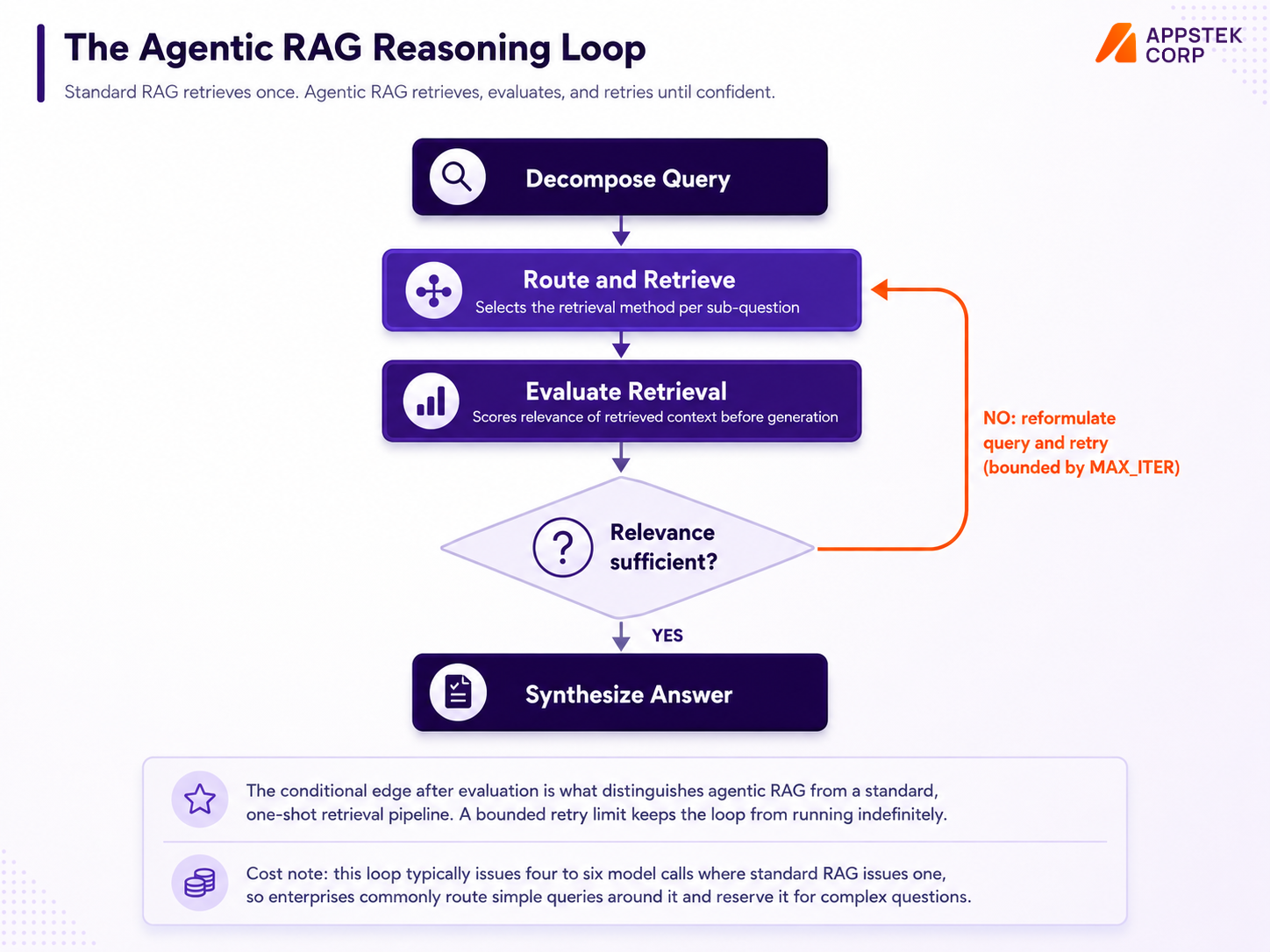
Four capabilities distinguish agentic RAG from the standard pipeline. Query decomposition breaks a complex question into smaller sub-questions before retrieval begins, so that a question spanning multiple topics or systems can be answered by retrieving each part independently rather than forcing one retrieval pass to cover everything. Dynamic tool routing selects the appropriate retrieval method per sub-question, semantic search for conceptual questions, a lexical or SQL query for structured data and identifiers, or a web search when the answer depends on external, current information. Self-evaluation scores the relevance of retrieved context before generation; if the score falls short, the system reformulates the query and retries rather than generating an answer from weak evidence, an approach closely related to what the Self-RAG research describes as critique-guided retrieval. Multi-agent collaboration applies to the most complex tasks, where specialized sub-agents handle different domains or data sources while a coordinating agent decomposes the original query and synthesizes the sub-agents’ results into a final answer.
| Pattern | How it works | Typical use |
|---|---|---|
| Router Agent | Single-step classification routes the query to the right source | ~200 to 400ms overhead; simple lookups |
| ReAct | Interleaves reasoning and tool calls across multiple model calls | Moderate; multi-step questions |
| Plan-and-Execute | Plans the full retrieval sequence upfront, then executes it | Moderate to high; well-defined multi-part tasks |
| Multi-Agent Retrieval | Domain-specialized agents retrieve in parallel; a coordinator synthesizes | 5 to 15 seconds; complex, cross-domain questions |
| Self-RAG | Inline critique tokens evaluate retrieval necessity and answer faithfulness | Variable; quality-sensitive answers |
These patterns are not equally expensive. A simple router agent adds a few hundred milliseconds of classification overhead before sending a query to the right source. A multi-agent retrieval pattern, by contrast, can introduce five to fifteen seconds of latency and typically issues four to six language model calls where a standard RAG pipeline would issue one, increasing inference cost by a factor of roughly three to five at scale. Enterprises deploying agentic RAG in production commonly mitigate this by routing simple queries directly to standard RAG, reserving the full agentic loop for questions that genuinely require it, using smaller models for orchestration steps rather than the primary generation step, and caching decomposition results for recurring query patterns.
Where Governance Fits
An agentic search system is, functionally, an AI agent with read access to a large share of the enterprise’s knowledge, and in some deployments, write access to take action on what it finds. The identity, permission, and audit principles AppsTek has covered elsewhere in this series apply directly here. A search agent needs a defined owner, a permission boundary that mirrors the access the requesting employee already has rather than a broader service-level credential, and an audit trail connecting every retrieved passage and generated answer back to its source.
The model and infrastructure choices behind the search stack raise the same sovereignty questions covered in AppsTek’s guide to sovereign LLMs. A retrieval system that indexes an enterprise’s most sensitive internal documents, then routes queries through a language model, inherits every data residency, licensing, and jurisdictional consideration that applies to the model layer generally. Choosing where that model runs is not a separate decision from choosing how search works; it is part of the same decision.
Questions to Ask Before Deploying Agentic Search
- What is the actual retrieval quality without any agentic layer? Evaluating the retrieval foundation on its own establishes a baseline before adding orchestration complexity on top of it.
- Which queries genuinely need multi-step reasoning, versus a single retrieval pass? Routing simple queries around the agentic loop controls the latency and cost it otherwise adds.
- Does the agent respect the same access boundaries as the person asking? A search agent should inherit the requesting employee’s existing permissions rather than a broader service-level credential.
- What is the acceptable latency and cost ceiling per query? Agentic patterns can issue several times as many model calls as standard RAG; that multiplier needs a budget before rollout.
- How will retrieval failures be distinguished from reasoning failures? Evaluating retrieval and generation separately makes it possible to tell which stage produced a wrong answer.
- Where does the underlying model run, and what data sovereignty requirements apply? The model and infrastructure behind the search stack inherit the same residency, licensing, and jurisdictional questions as any other enterprise LLM deployment.
The Vendor Landscape
Enterprise search and agentic RAG capability is being built and sold across several overlapping categories rather than a single product type.
| Category | What it does | Examples |
|---|---|---|
| Enterprise search platforms | Unified indexing and search across many enterprise sources | Glean, Coveo, Elastic |
| Productivity suite AI | AI search embedded inside an existing productivity suite | Microsoft Copilot, Google Gemini |
| Cloud search services | Managed search and RAG infrastructure from a cloud provider | Google Vertex AI Search, Amazon Q Business |
| Open-source / self-built | Custom RAG stacks built on open orchestration frameworks | LangChain, LlamaIndex, Haystack |
Capabilities, pricing, and positioning across these categories change frequently, and a platform’s marketing claims about its own agentic capabilities should be verified against a hands-on evaluation rather than taken at face value. The right category, and the right vendor within it, depends on which systems already hold the enterprise’s knowledge and how much of the orchestration layer the organization wants to own directly versus buy as a managed capability.
Building Toward Agentic Search
Enterprises rarely move from keyword search to a full agentic RAG deployment in a single step, nor should they. The organizations getting the most reliable results are treating this as a staged build: establishing a solid retrieval foundation first, indexing and connecting the right sources, choosing embedding and reranking models suited to their content, and only then introducing the reasoning and orchestration layer that makes search agentic.
Skipping the foundation to move straight to agentic capability tends to produce a system that reasons confidently over incomplete or poorly ranked evidence, which is a harder failure to diagnose than a search system that simply returns nothing.
Measurement should follow the same staged approach. Retrieval quality can be evaluated on its own, independent of the language model, using standard information retrieval metrics before an agentic layer is added on top. Enterprises that skip this step and evaluate only the final generated answer often cannot tell whether a wrong answer came from a retrieval failure, a ranking failure, or a reasoning failure, which makes the system considerably harder to improve once it is in production.
The technology to make enterprise search finally live up to its original promise now exists. Getting there still depends on the same disciplined groundwork enterprise search has always required, applied underneath a genuinely new layer of capability. Connect With Appstek Corp Experts to Build a Strong Foundation for Agentic AI Enterprise Search

About The Author
Wanpherlin M. Shangpliang is a Marketing Manager at AppsTek Corp, driving strategic marketing initiatives across digital, content, and brand communications. She focuses on positioning AppsTek’s AI offerings and comprehensive digital engineering services while supporting market outreach across key industries. With expertise in campaign management, content strategy, and audience engagement, Wanpherlin builds effective marketing programs that drive measurable growth and strengthen AppsTek’s overall presence.