
Table of Contents
What is Sovereign AI, and Why Does It Matter Now
The Four Pillars of Sovereign AI Architecture
What are the Different Sovereign AI Deployment Models?
Data Residency vs Data Sovereignty
How to Build a Sovereign AI Governance Framework?
Why Every Sovereign AI Architecture Needs an AI Gateway
How to Build Vendor Portability into Sovereign AI
Common Pitfalls to Avoid When Undertaking a Sovereign AI Initiative



Enterprises that hand their AI stack to a single vendor aren’t just outsourcing infrastructure. They’re outsourcing control. The models, the data pipelines, the inference endpoints, the governance controls: if another entity owns or operates any of these, the enterprise is exposed to price hikes, policy changes, regulatory penalties. geopolitical disruption, and competitive erosion that is not flagged in a quarterly review until the damage is already baked into the business.
The AI stack that powers an enterprise’s business decisions should never be someone else’s leverage over it.
Sovereign AI addresses this exposure head on. It is the practice of building, deploying, and governing AI systems within an organization’s own infrastructure, data perimeter, and legal jurisdiction. The defining characteristic is control, over where data resides, which models run on which workloads, who accesses the system, now every decision gets audited, and all of it, under one roof, under one set of rules.
This guide breaks down sovereign AI architectures, deployment models, data residency strategies, governance frameworks, and vendor portability mechanisms. It also lays out a phased implementation roadmap for enterprises that are done renting their AI future and ready to own it.
What is Sovereign AI, and Why Does It Matter Now
Sovereign AI is the ability to retain control over the entire AI stack, including data, models, infrastructure, security, and governance, within organizational and regulatory boundaries. Every major technology provider defines it slightly differently, but the core principle holds regardless of who’s talking.
NVIDIA frames it as building AI using an organization’s own infrastructure, data, workforce, and business networks. Cisco describes it as control over the entire intelligence supply chain. HPE emphasizes governance across data, infrastructure, models, and operations. Cloudera frames it around data, infrastructure, model, and operational sovereignty. Strip away the branding, and every one of these definitions lands on the same point: the organization, rather than a vendor or a foreign jurisdiction, holds authority over how AI is built, deployed, secured, and governed.
The urgency around Sovereign AI is growing. New regulations such as the EU AI Act, GDPR, and emerging data residency requirements are raising expectations for AI governance and accountability. At the same time, enterprises are reducing dependence on a single cloud or model provider to improve resilience, portability, and long-term control.
The market reflects this shift. Global investment in Sovereign AI infrastructure is accelerating as governments and enterprises invest in domestic AI capabilities, sovereign cloud platforms, and trusted AI ecosystems. Gartner forecasts worldwide sovereign cloud IaaS spending will reach $80 billion in 2026, while sovereign AI investment is expected to continue growing over the rest of the decade.
For organizations operating in highly regulated industries, Sovereign AI has become a foundational architecture for building secure, compliant, and resilient AI systems.
The Four Pillars of Sovereign AI Architecture
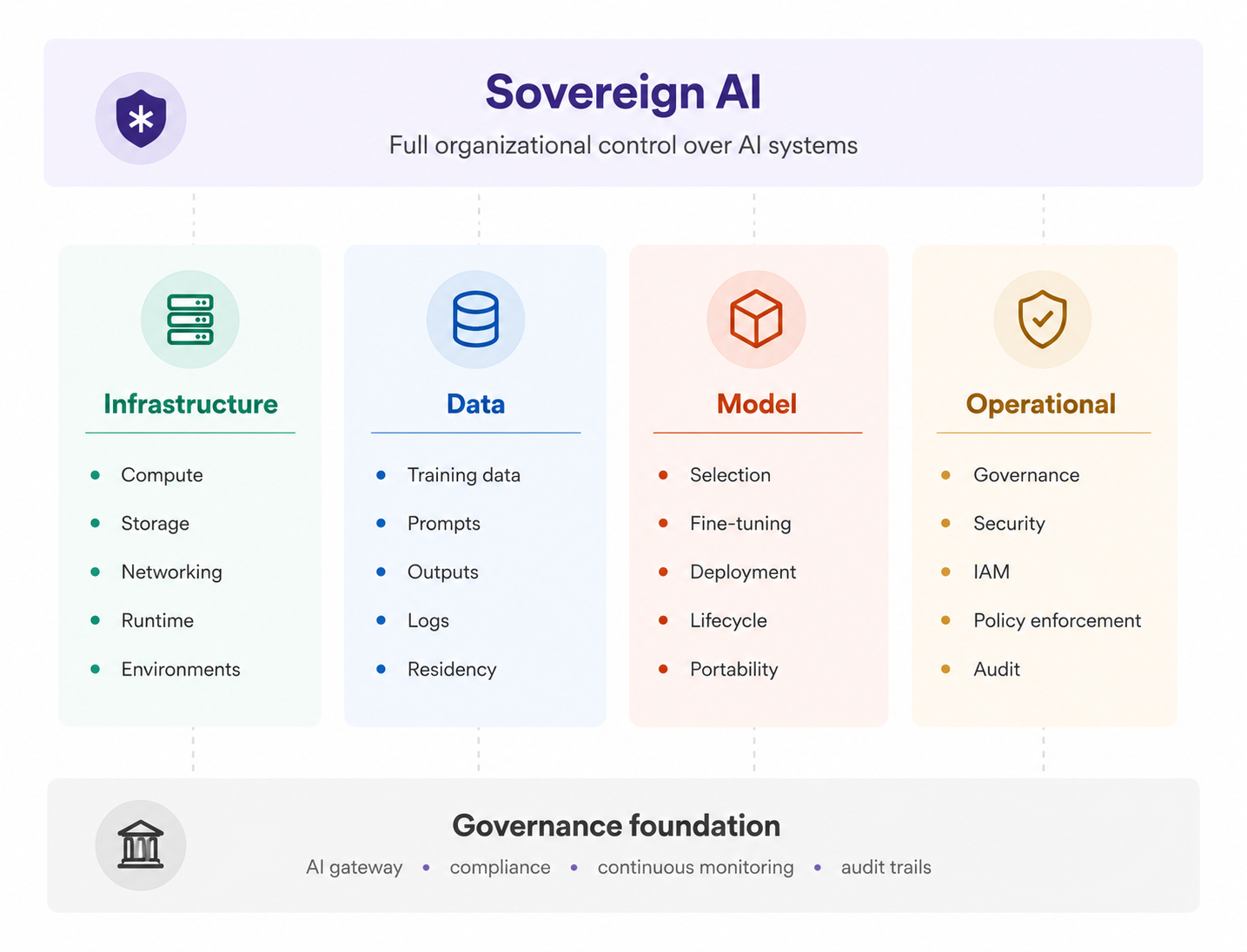
Although the labels change depending on the vendor, the substance remains the same. Any enterprise building a sovereign AI strategy that skips even one of these is leaving a gap that regulators, competitors, or vendors will eventually exploit.
Infrastructure Sovereignty
Infrastructure sovereignty is control over the compute, storage, networking, and runtime environments that power AI workloads.
Data Sovereignty
Data sovereignty is control over where AI data is stored, processed, accessed, and governed throughout its lifecycle, including training data, prompts, outputs, and logs.
Model Sovereignty
Model sovereignty is control over model selection, fine-tuning, deployment, lifecycle management, and the ability to replace models without disrupting applications.
Operational Sovereignty
Operational sovereignty is control over AI governance, security, identity and access management, policy enforcement, monitoring, auditability, and compliance across the AI lifecycle.
What are the Different Sovereign AI Deployment Models?
The deployment model shapes how much control an enterprise has over its AI systems. Each approach offers a different balance of sovereignty, flexibility, scalability, and operational responsibility.
| Deployment Model | Sovereignty Level | Best For | Trade-offs |
|---|---|---|---|
| On-Premises / Air-Gapped | Highest | Defense, intelligence, critical infrastructure | Highest capex; limited scalability; requires in-house expertise |
| Private Cloud | High | Regulated enterprises with existing data center capacity | Significant infrastructure investment; operational complexity |
| Sovereign Cloud | High (with verification) | Healthcare, finance, government agencies | Must verify operator nationality, key management, and admin boundaries |
| Hybrid (Sovereign + Public) | Medium-High | Enterprises balancing sensitive and general workloads | Requires robust workload classification and data flow controls |
| Virtual Private Cloud (VPC) | Medium | Organizations beginning the sovereignty journey | Shared physical infrastructure; sovereignty depends on provider controls |
The hybrid deployment model is the preferred approach for many enterprises, keeping sensitive workloads in sovereign or private environments while using the public cloud for lower-risk AI workloads.
Data Residency vs Data Sovereignty
These terms are frequently conflated, and the gap between them is widening as enforcement deadlines approach.
Data residency means data is stored within a specific geographic region. Data sovereignty means the organization retains legal and operational control over that data, including who can access it from abroad and under which legal authority.
For instance, an AI workload running in an EU data center owned by a US-headquartered cloud provider may still be subject to the US CLOUD Act. For this reason, organizations should evaluate provider ownership, administrative access, encryption key management, and cross-border data transfers alongside residency requirements. The European Data Protection Board (EDPB) also identifies on-premises inference as the strongest safeguard for processing sensitive data with LLMs.
Practical Recommendations for Data Sovereignty:
- Enforce automated data residency policies to ensure training data, prompts, model outputs, and logs remain within approved jurisdictions.
- Protect sensitive data with customer-managed encryption keys (CMKs) before it leaves internal systems or enters external AI services.
- Restrict vendors from using enterprise data for model training, fine-tuning, or service improvement through clear contractual and technical controls.
- Keep compliance and audit logs within regional boundaries while providing centralized visibility without moving data across jurisdictions.
- Regularly audit provider sovereignty controls, including administrative access, encryption key ownership, infrastructure operations, and applicable legal jurisdictions.
How to Build a Sovereign AI Governance Framework?
AI Sovereignty depends on governance that is built into the architecture rather than managed through policy documents alone. It defines how AI systems are secured, monitored, audited, and managed throughout their lifecycle.
Effective governance spans three organizational layers:
- Enterprise Leadership establishes the Sovereign AI strategy, defines risk tolerance, and sets policies for governance, compliance, and vendor dependency.
- Enterprise Architecture translates those policies into technical standards, reference architectures, and governance controls, including identity management, data governance, auditability, model risk management, and vendor portability.
- Operations and Engineering implement and continuously enforce those controls through security policies, monitoring, compliance reporting, and operational governance.
Why Every Sovereign AI Architecture Needs an AI Gateway
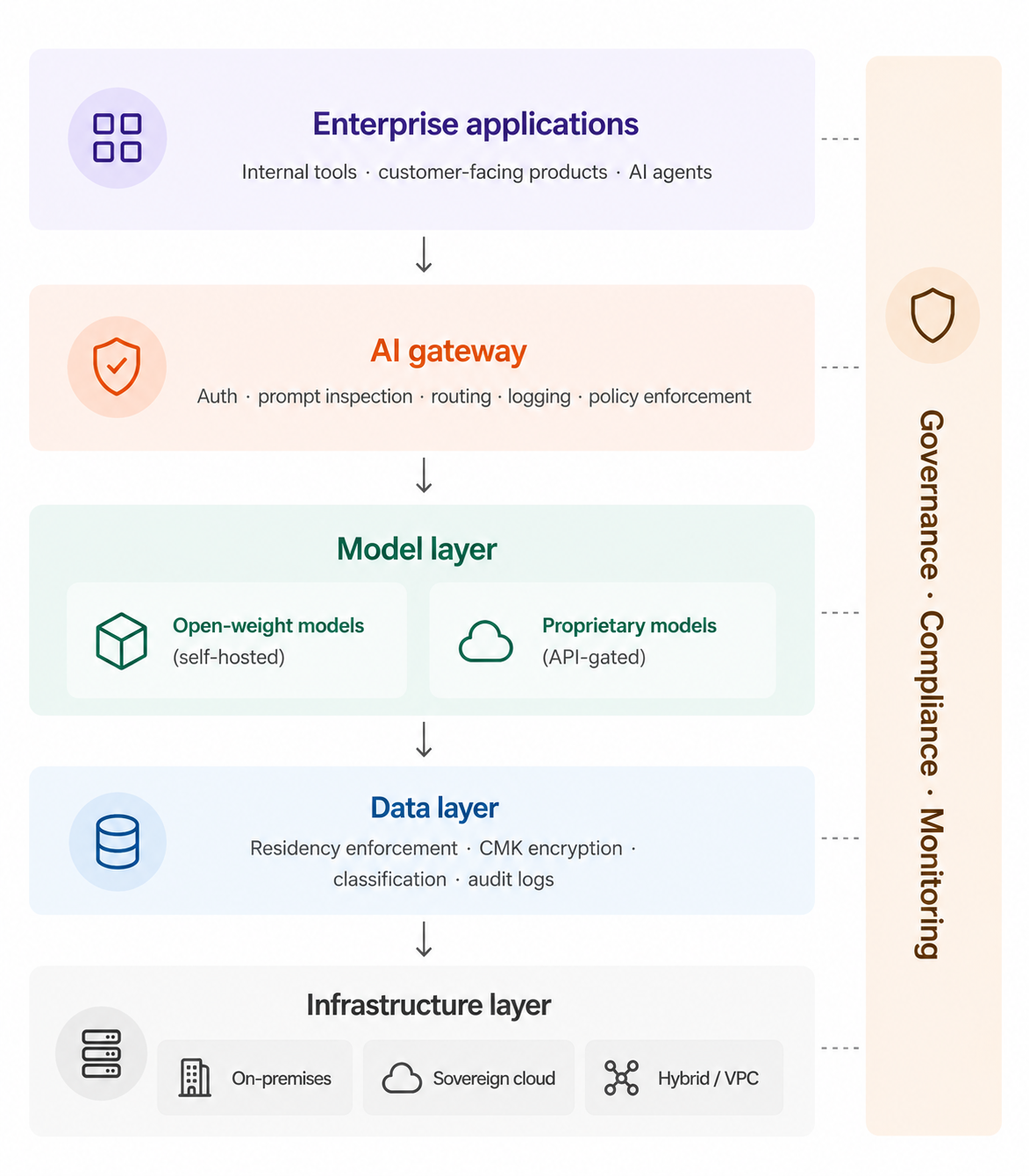
An AI gateway is the central control layer between users, applications, AI agents, and language models. It ensures every interaction follows the organization’s security, governance, and compliance policies.
A well-designed AI gateway should:
- Authenticate and authorize every request before it reaches a model.
- Inspect prompts for policy violations, sensitive data, prompt injection, and other security risks.
- Route requests to the appropriate model based on workload sensitivity, data residency, and regulatory requirements.
- Log every interaction to support auditing and compliance.
- Enforce organization-wide usage policies, rate limits, and cost controls.
Without an AI gateway, applying consistent governance, security, and compliance controls across multiple models and providers becomes significantly more difficult.
How to Build Vendor Portability into Sovereign AI
Vendor lock-in is one of the biggest barriers to Sovereign AI. Applications built around provider-specific models, APIs, or services become increasingly difficult and expensive to move as AI adoption grows.
A portability-first architecture should include:
| Component | Purpose |
|---|---|
| Model abstraction layer | Decouples applications from provider-specific APIs through a common interface. |
| Open-weight models | Provides self-hosted alternatives for critical workloads. |
| Data residency controls | Applies consistent jurisdiction and processing policies across environments. |
| Confidential inference | Protects sensitive workloads regardless of where they run. |
| Governance as code | Enforces policies consistently across providers and deployments. |
The simplest way to measure portability is to ask: Can a critical AI workload move to another provider or on-premises infrastructure without rebuilding the application? If the answer is no, the architecture has a sovereignty gap.
Phased Implementation Roadmap
Achieving AI Sovereignty is an incremental process. Rather than replacing the entire AI stack, enterprises should build sovereignty into existing AI environments in stages.
Phase 1: Assess the Current Environment
Inventory all AI applications, model providers, data flows, infrastructure dependencies, and regulatory obligations across the organization. Identify where sovereignty gaps exist and prioritize workloads based on business impact and compliance risk. This assessment becomes the foundation for everything that follows, and organizations that skip it consistently end up paying for expensive redesigns later.
Key deliverables: Complete AI deployment inventory, regulatory obligation mapping, gap analysis report, risk-prioritized workload list.
Phase 2: Establish Governance and Gateway Foundation
Deploy an AI gateway as the central control plane for all model interactions. Implement authentication, prompt inspection, logging, and routing capabilities. Define and codify governance policies as machine-readable rules that the gateway enforces in real time. Establish the audit trail architecture and classify AI models based on security and regulatory requirements.
Key deliverables: Production AI gateway, codified governance policies, centralized audit logging, initial model catalog with risk classifications.
Phase 3: Strengthen Data and Model Sovereignty
Implement automated data residency enforcement across storage and compute layers. Deploy customer-managed encryption key infrastructure. Build the model abstraction layer and deploy open-weight fallback models for critical workloads within sovereign infrastructure. Validate portability by running a test migration of at least one critical workload between providers or deployment environments.
Key deliverables: Automated data residency enforcement, CMK infrastructure, model abstraction layer, deployed open-weight models, validated migration playbook.
Phase 4: Scale and Continuously Improve
Expand sovereign AI controls across business units. Deploy continuous compliance monitoring that validates sovereignty controls against regulatory requirements in real time. Establish a recurring sovereignty audit cycle. Train engineering teams on privacy-by-design methodologies and threat models specific to sovereign architectures, including cross-region token leakage, metadata exposure, and supply chain risks. Keep reviewing the architecture against evolving regulatory and business requirements as both will shift.
Key deliverables: Organization-wide sovereign AI deployment, continuous compliance monitoring, sovereignty audit framework, trained cross-functional teams.
Common Pitfalls to Avoid When Undertaking a Sovereign AI Initiative
Even well-planned Sovereign AI initiatives can create unnecessary risk when key architectural decisions are overlooked.
- Treating sovereignty as a contractual exercise. Governance should be enforced through architecture and technical controls. When protection lives only in the master service agreement, it changes whenever the contract changes, and it offers zero defense against technical access that the contract failed to anticipate.
- Neglecting governance for agentic AI. As autonomous agents take actions, access tools, and make decisions on the organization’s behalf, permission enforcement at the application layer becomes a critical vulnerability. Sovereign AI architectures need to extend governance to every action an agent can perform, and this is a requirement that many current implementations overlook entirely.
- Underestimating the talent gap. Finding professionals who understand both advanced AI systems and international data law remains a real challenge across every market. Budget for cross-training existing teams alongside infrastructure investment, and prepare customer-facing teams to handle regulator inquiries confidently without escalating every question up the chain.
- Deferring portability decisions. The longer an AI stack runs on a single provider’s proprietary APIs and services, the more expensive and disruptive a migration becomes. Design the model abstraction layer and open-weight fallback strategy early, before lock-in compounds into a strategic constraint that limits every decision that follows.
Building a Future-Ready Sovereign AI Architecture
Sovereign AI ensures enterprises retain control over the systems, data, models, and governance that power their AI operations. As regulations tighten and AI becomes embedded across core business functions, that control shifts from being a technical preference to being a business requirement.
The enterprises that succeed with AI over the next decade will be the ones with the strongest operational foundations, where every AI system is built with governance, resilience, and long-term control at its core. Whether modernizing existing AI initiatives or building new capabilities, sovereign AI architectures provide the foundation for scaling with confidence.
Enterprises looking to build or modernize their AI infrastructure with sovereignty at the core can explore how AppsTek Corp helps organizations design, deploy, and govern AI systems within their own controlled environments