
Table of Contents
What Makes the Traditional Financial Close and Consolidation Process So Difficult to Fix?
How Does Oracle EPM Cloud Modernize Financial Close and Consolidation?
What Role Does AI-Driven Consolidation Play in the Modern Close?
How Does Oracle EPM Address Compliance, Cost, and Industry Recognition?
What Steps Should Finance Leaders Take to Modernize the Close?



Every quarter, the same pattern repeats. Reconciliations pile up, spreadsheets multiply, and finance teams push toward a deadline they know will be tight. Even after years of ERP investments and process improvement initiatives, the financial close and consolidation process can still feel like a fire drill.
In many organizations, a “broken close” refers to a financial close process that remains slow, manual, and heavily dependent on spreadsheets despite significant ERP investment. The underlying issue is not simply technology, but the fragmented structure of the close process itself.
Many organizations still manage financial consolidation and close across disconnected tools, siloed data, and manual workflows that were never designed to scale. For teams running legacy Hyperion environments, that gap tends to grow wider over time.
Now the landscape is starting to shift. The combination of Oracle EPM Cloud and the AI revolution in finance is doing more than improving the financial close and reporting process. It is gradually reshaping how EPM finance operates at a structural level.
What Makes the Traditional Financial Close and Consolidation Process So Difficult to Fix?

The standard financial close and consolidation workflow sounds simple on paper: collect data from your entities, eliminate intercompany transactions, convert currencies, and produce consolidated statements. In practice, every step depends on the one before it. One delay, one mismatched entry, and the whole timeline starts slipping.
| Problem Area | Root Cause | Business Impact |
|---|---|---|
| Data Collection | Manual gathering across multiple ERPs | Delays from Day 1 |
| Intercompany Matching | Unresolved mismatches between entities | Hours of manual investigation |
| Journal Entries | Late or inaccurate manual postings | Reconciliation failures |
| Reporting | Version control and formatting gaps | Missed filing deadlines |
| Compliance | Fragmented audit trails | Increased regulatory exposure |
A useful analogy is that many organizations have invested in a high-performance engine in the form of their ERP, yet continue to operate with the equivalent of a paper map. The processing capability is in place, but the orchestration required to fully utilize it is still missing.
How Does Oracle EPM Cloud Modernize Financial Close and Consolidation?

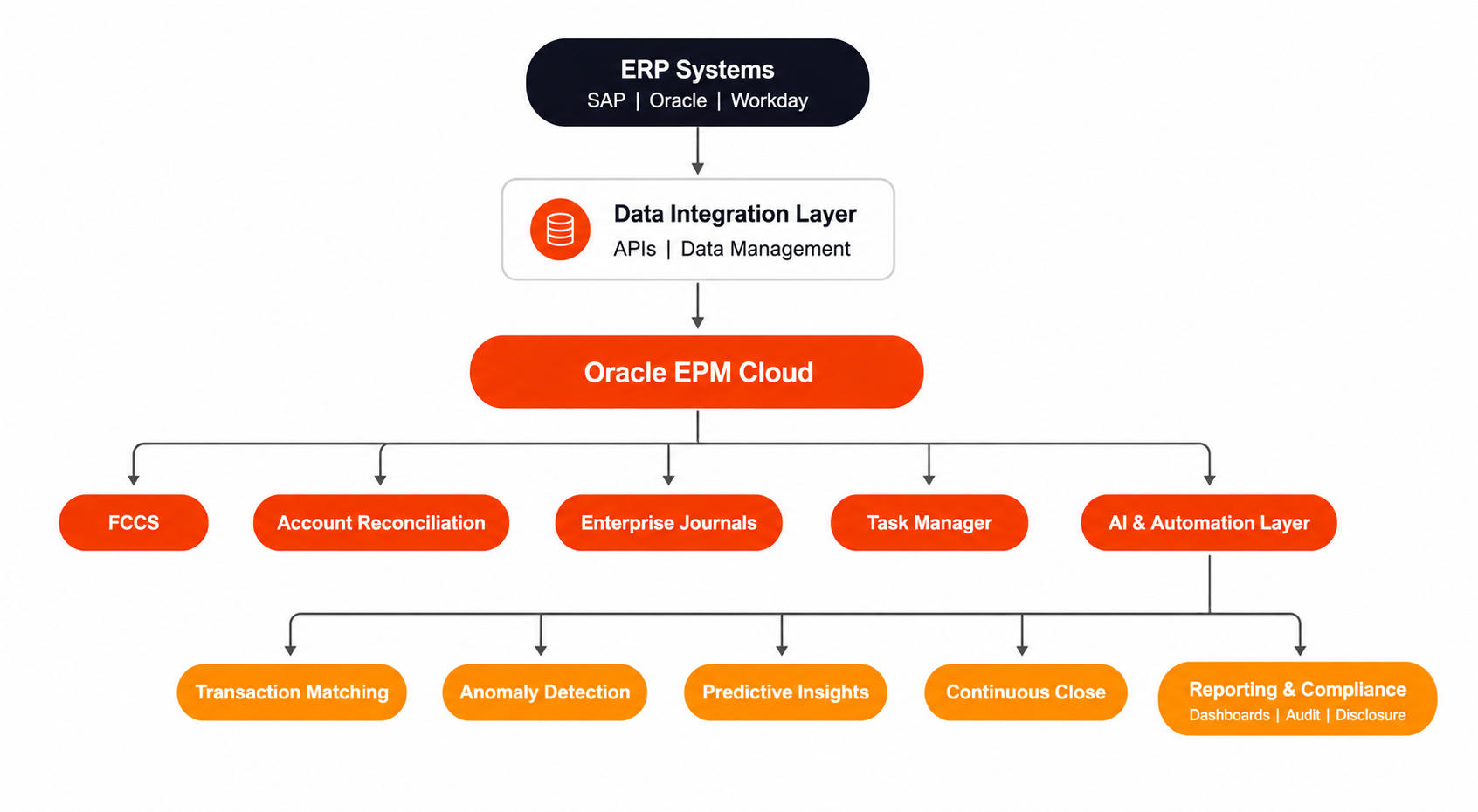
Oracle EPM Cloud approaches financial close and consolidation as a single connected workflow rather than a series of separate tasks. Oracle EPM Cloud integrates machine learning capabilities into areas such as transaction matching, anomaly detection, and financial insight generation, augmenting the traditional rule-based consolidation process.
What Core Capabilities Define Modern EPM Finance?
- Financial Consolidation and Close (FCCS): Multi-entity consolidation, intercompany eliminations, currency translation, and ownership management within a single cloud-native environment.
- Automated Reconciliation: The reconciliation agent uses learning algorithms to automate high-volume transaction matching. In many cases, organizations automate close to 90% of reconciliations without custom development, saving significant time and millions in annual costs.
- Task Manager: Orchestrates the close calendar with dependencies, real-time status tracking, and exception alerts.
- Enterprise Journals: Centralizes journal creation, approval workflows, and posting. The platform auto-generates entries for discrepancies, reducing manual intervention.
How Does This Compress the Close Timeline?
With a modern EPM Cloud platform, millions of transactions can be matched in minutes. Integrated with financial consolidation and period-end reconciliations, this capability compresses processes that traditionally take 10 to 12 days into under a week.
| Close Phase | Traditional | With Oracle EPM |
|---|---|---|
| Data Collection | Day 1 to 3 | Day 1 (automated) |
| Intercompany Elimination | Day 2 to 5 | Day 1 to 2 (AI-assisted) |
| Consolidation | Day 4 to 7 | Day 2 to 3 |
| Review and Reporting | Day 6 to 10 | Day 3 to 5 |
| Audit and Sign-off | Day 8 to 12+ | Day 4 to 6 |
What Role Does AI-Driven Consolidation Play in the Modern Close?

While on the one hand, Oracle EPM fixes the structural problems, AI adoption in finance takes it further by making every stage of the close smarter over time. As we explored in our analysis of Oracle AI agents in finance operations, these are not bolt-on tools. They are embedded capabilities with native access to data, operating within a unified security and control framework.
AI-driven consolidation in Oracle EPM Cloud typically improves performance across five key areas:
- Anomaly Detection: Pattern-based identification of exceptions, with auto-resolution for routine discrepancies.
- Predictive Matching: Learning algorithms that improve account combination predictions over time, enabling the 90% automation benchmark.
- Intelligent Journals: AI pre-populates recurring entries based on historical patterns, reducing manual creation.
- Natural Language Queries: Finance leaders query consolidation data conversationally instead of building ad hoc reports.
- Continuous Close: Routine matching and validation occur throughout the period, eliminating the month-end bottleneck.
The impact of AI in finance goes beyond automation. It allows skilled finance professionals to spend less time on manual work and more time on analysis, judgment, and strategic decision-making. Check how CFOs can bridge the intelligence gap with Oracle EPM and AI.
| Stage | Without AI | With AI-Driven EPM |
|---|---|---|
| Data Ingestion | Manual uploads | Automated with smart validation |
| Matching | Rule-based, manual exceptions | AI-flagged, auto-resolved |
| Consolidation | Sequential, entity by entity | Parallel with predictive checks |
| Review | Static reports | Dynamic dashboards, NL queries |
| Sign-off | Email-based approvals | Workflow-driven, full audit trail |
How Does Oracle EPM Cloud Address Compliance, Cost, and Industry Recognition?

A faster close means nothing if accuracy or audit readiness suffers Oracle Cloud EPM includes detailed audit trails, configurable compliance dashboards, and built-in variance analysis. In one case, a manufacturing organization reduced internal control deficiencies by 80 percent after moving to Oracle Cloud EPM.
On cost, Oracle Cloud EPM consolidates close and reconciliation functions into a single platform with enterprise-scale transaction matching capabilities, flexible reporting, and embedded AI at no additional charge. Legacy systems frequently layer fees for transaction volumes, environments, and add-on tools.
Organizations that migrate consistently report a lower total cost of ownership. For enterprises evaluating the transition path, it helps to carefully assess the key decision points involved in upgrading or migrating to Oracle EPM Cloud.
What Steps Should Finance Leaders Take to Modernize the Close?

A full overhaul does not need to happen immediately, but establishing a clear starting point is essential. The following roadmap outlines a practical path for adopting AI within the financial close and consolidation cycle.
- Audit the current process. Map every step, handoff, and tool. Identify where delays and manual risk concentrate.
- Consolidate the toolset. If your financial consolidation and close process spans more than three disconnected systems, begin planning migration to a unified EPM finance platform.
- Pilot AI selectively. Deploy AI-driven consolidation on your highest-volume reconciliations first, then scale based on results.
- Budget for enablement. AI adoption in finance only delivers ROI when teams are trained to use the tools effectively.
- Secure ongoing support. A structured managed services model ensures your Oracle environment stays optimized post-implementation. Explore how ongoing Oracle managed services can support long-term success.
The Close Does Not Have to Stay Broken

For too long, the financial close and consolidation process has been treated as something to endure rather than optimize. Oracle EPM finance changes that equation: a unified platform for close and consolidation that replaces fragmented tools with integrated workflows. Adopting AI in finance adds intelligence on top, and Oracle’s data confirms the results: 50% faster close times, 90% reconciliation automation, and 55% more time on strategic work.
The organizations that move on this now will not just close faster. They will close with greater accuracy, lower risk, and sharper insight. The close has already changed, the question is whether your team is ready to change with it.
For organizations ready to begin this journey, AppsTek Corp’s Oracle EPM finance consulting services provide full lifecycle support, from advisory and migration planning through implementation, optimization, and managed services. Contact us today.

About The Author
Myrlysa I. H. Kharkongor is Senior Content Marketer at AppsTek Corp, driving content strategy for the company’s digital engineering services to enhance brand presence and credibility. With experience in media, publishing, and technology, she applies a structured, insight-driven approach to storytelling. She distills AppsTek’s cloud, data, AI, and application capabilities into clear, accessible communications that support positioning and grow the brand’s digital footprint.