
Table of Contents
Modern finance organizations face a critical scalability challenge. While ERP systems have successfully digitized financial data, the workflows surrounding that data remain labor-intensive. This operational friction, where analysts spend the majority of their time on reconciliation rather than analysis, is the primary barrier to strategic agility.
The market is responding decisively. Recent FP&A research shows that AI adoption in finance surged from 6% to 47% in 2025, signaling a shift toward autonomous operations. However, true enterprise value requires more than isolated automation scripts; it demands intelligent orchestration within the core system of record.
Oracle’s AI Agents represent this integration of autonomous execution into the financial core. By embedding agentic capabilities directly within Fusion Cloud ERP, Oracle enables finance teams to delegate complex, end-to-end processes, from invoice resolution to anomaly detection, ensuring that operational efficiency scales alongside business growth.
What Are Oracle AI Agents and Why Do They Matter for Finance?

Think of AI agents as the next generation beyond automation. Traditional automation follows rigid rules: if invoice matches purchase order, then approve. It breaks when anything unexpected happens.
Oracle AI agents for finance work differently. They reason through problems, adapt to new situations, and coordinate complex workflows across multiple systems.
Here’s the progression:
| AI Generation | What It Does | Finance Example |
|---|---|---|
| Predictive AI | Forecasts based on patterns | Cash flow predictions, anomaly detection |
| Generative AI | Creates content, answers questions | Report summaries, natural language queries |
| Agentic AI | Takes autonomous action | End-to-end invoice processing, payment optimization |
Oracle has moved through all three stages. They now have over 100 generative AI capabilities embedded in Fusion Applications.
But agentic AI represents the breakthrough. These agents are designed to transform fragmented, complex, and labor-intensive processes into operations that run more continuously, intelligently, and with far less manual intervention.
How Oracle AI Agents Transform Finance Operations?

Oracle built five specialized agents for core finance functions. Each handles specific workflows. Together, they transform how finance operates.
Document IO Agents: The Entry Point
Every finance process starts with data getting into the system. These agents solve that problem.
What Document IO Agents handle:
- Invoices arriving via email, EDI, or PDF
- Multiple languages and formats
- Continuous learning from new document types
Document IO agents do not rely on fixed templates. When introduced to a new invoice format, they can learn from it and adjust, enabling them to handle variation without repeated reconfiguration. The result is a shift from step by step, manually sequenced processing to finance operations that move more continuously and with far less delay.
Payables Agents: From Invoice to Payment
Payables agents manage the entire accounts payable cycle: receives invoice, matches to purchase orders, applies tax rules and fraud checks, routes for approval, and queues for optimal payment.
This AI-enabled operating model increases straight-through processing across the payables cycle while reducing manual intervention and minimizing error exposure. Activities like invoice handling, which previously took days of matching, validation, and approval, can now progress from receipt to payment-ready in minutes when the necessary data and controls are present.
Ledger Agent: Continuous Financial Visibility
Month-end close is often a race against the clock, defined by manual handoffs and frantic error-checking. The Ledger Agent replaces this reactive cycle with continuous visibility.
Instead of waiting until day 30 to find problems, the agent monitors transactions daily, investigating variances and drafting adjustments automatically. The result is a faster, more accurate close where your team spends less time fixing data and more time analyzing it.
Payments Agent: Working Capital Optimization
The Payments Agent shifts accounts payable from a processing function to a working capital engine. It automatically calculates the trade-off between early payment discounts, rebates, and cash preservation, executing the transaction only when it maximizes your working capital.
It ensures that “paying on time” also means “paying intelligently,” securing margins and liquidity without adding headcount.
Planning Agent: Strategic FP&A Support
The Planning agent handles analytical mechanics so teams can focus on strategy. It provides real-time variance analysis, predictive insights, rapid scenario modeling, and intelligent visualization.
It also enables real time trend and variance analysis through natural language interactions, allowing finance teams to explore performance drivers and anomalies more intuitively and without relying solely on traditional reporting interfaces.
Why Oracle AI Agents Outperform Generic AI Tools

Oracle’s approach has distinct advantages.
Built Into the Platform
These agents are built directly into Oracle Fusion Cloud ERP and EPM rather than layered on as add-ons. As a result, they operate with native access to data, avoid the complexity of additional integrations, and function within a unified security and control framework while coordinating seamlessly across workflows.
Approaches that rely on external AI tools often face greater challenges in achieving this level of cohesion.
Multi-Agent Orchestration
Agents work as teams. The Oracle AI Agent Studio coordinates them through full cycles:
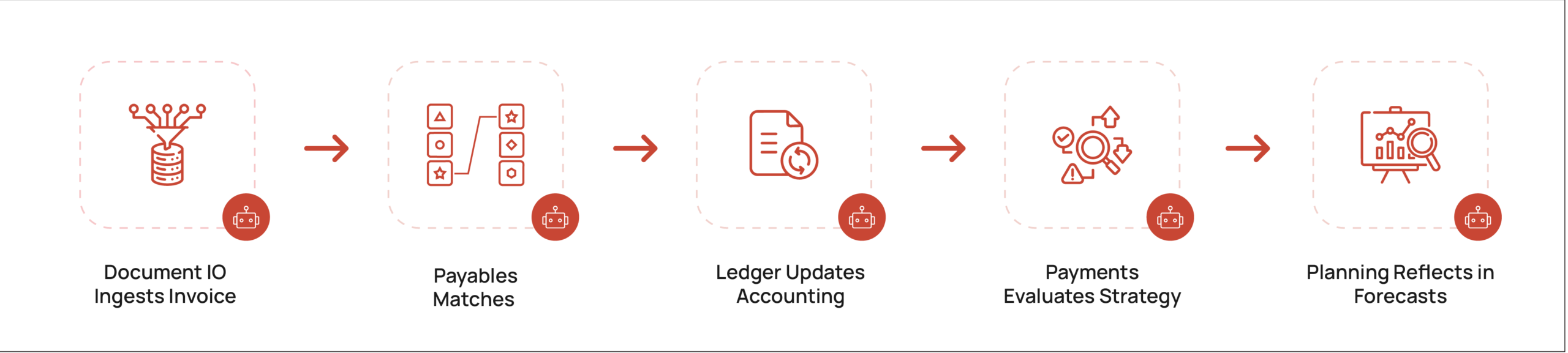
This agent coordination happens automatically through Oracle AI Agent Studio, which orchestrates handoffs, manages data flow, and ensures each agent has the context it needs from upstream processes
Continuous Learning
Traditional AI models often depend on periodic retraining and configuration updates to remain effective. In contrast, these agents are designed to adapt as they operate, refining their performance over time and improving data accuracy with minimal additional setup or intervention.
What Results Can Finance Teams Expect?

Real-world adoption shows how quickly AI in finance is moving from concept to operational impact. The Choctaw Nation of Oklahoma provides concrete evidence. As one of the largest tribal nations with 250,000 members, they run complex operations across education, healthcare, and housing.
Industry reporting indicates that the nation has adopted more than 40 generative AI capabilities, resulting in more streamlined invoice processing, fewer manual errors, and measurable improvements in operational efficiency.
Planned expansions include predictive cash forecasting and automated narrative reporting.
| Benefit Category | Typical Impact |
|---|---|
| Time Savings | Invoice processing: hours → minutes; Month-end close: weeks → days |
| Accuracy | Near-perfect data extraction; elimination of manual entry errors |
| Working Capital | Captured discounts, rebates, optimized payment timing |
| Decision Speed | Real-time insights vs. periodic reports |
| Compliance | Automated controls, complete audit trails |
| Scalability | Handle volume growth without headcount increases |
How Should Finance Leaders Approach Implementation?

Sustainable progress in this area does not happen by chance. It requires deliberate planning, clear priorities, and a structured approach to execution. In practice, a phased model tends to be most effective, with four distinct stages that help organizations move from initial exploration to scaled, measurable impact.
| Phase | Duration | Key Activities |
|---|---|---|
| Assess | 4–6 weeks | Identify pain points, evaluate data quality, prioritize processes |
| Prepare | 6–8 weeks | Clean data, establish governance, train teams, configure systems |
| Pilot | 8–12 weeks | Start with one process, run parallel operations, refine based on feedback |
| Scale | Ongoing | Expand to full organization, add processes, develop custom agents |
The pilot phase is often the most critical. Rather than attempting broad deployment from the outset, organizations benefit from starting with a focused, small scale implementation that allows teams to learn, refine processes, and build confidence. Those early insights create a stronger foundation for expanding adoption in a deliberate and systematic way.
What About Custom Requirements?

Every organization has unique needs. Oracle addresses this through AI Agent Studio.
This platform lets finance teams:
- Customize pre-built agents
- Create new agents for specific workflows
- Integrate with legacy systems
- Adapt to industry-specific regulations
The Oracle Fusion Applications AI Agent Marketplace extends this further. The ecosystem approach means you’re not limited to Oracle’s roadmap. Custom capabilities develop as needs emerge.
From One-Time Projects to Ongoing Evolution

Iterative finance transformations built around point solutions are reaching their limits. Traditionally, transformation has followed a recurring cycle: diagnose, design, implement, stabilize, wait for the next wave, then start over.
AI agents enable continuous evolution instead. Agents learn constantly, new capabilities deploy incrementally, and transformation becomes ongoing rather than episodic. Organizations on this path gain compounding advantages that competitors struggle to match.
AppsTek Corp specializes in Oracle Cloud implementations with deep expertise in Oracle Fusion Cloud Applications, Oracle EPM, and AI solution deployment.
We help organizations assess readiness, design implementation roadmaps, execute phased deployments, and optimize configurations for your specific business needs.
Ready to explore how AI agents can transform your finance function? Schedule a consultation with our specialists or explore our Oracle Cloud services to learn how we can help you develop a customized implementation roadmap.

About The Author
Myrlysa I. H. Kharkongor is Senior Content Marketer at AppsTek Corp, driving content strategy for the company’s digital engineering services to enhance brand presence and credibility. With experience in media, publishing, and technology, she applies a structured, insight-driven approach to storytelling. She distills AppsTek’s cloud, data, AI, and application capabilities into clear, accessible communications that support positioning and grow the brand’s digital footprint.