



As fraud schemes grow more intelligent and adaptive, the limits of rule-based defense are becoming impossible to ignore. Bad actors now move faster than static controls can respond.
In response, banking is undergoing a structural shift toward autonomous defense. Agentic AI risk management is emerging as the foundational capability for protecting assets and sustaining trust in a digital-first economy.
This analysis explores how autonomous agents are reshaping financial security. It moves beyond simple automation to intelligent and decision-making entities capable of countering threats in real time.
The Rising Tide of Financial Complexity
Fraud attempts are not just becoming more frequent. They are becoming structurally more complex. Recent industry data reveals that high-quality fraud attacks increased by 180% between 2024 and 2025. These are not simple phishing emails but multi-layered schemes often orchestrated by AI-driven tools.
The financial impact is staggering. In 2025 alone consumers lost billions to fraud. For banks the operational burden is equally heavy. False positives, legitimate transactions flagged as fraudulent, drain resources and frustrate customers. The industry has reached a tipping point where human analysts cannot scale fast enough to meet the volume of alerts.
This environment necessitates a move toward agentic AI in fraud prevention. Unlike passive software that waits for human input AI agents possess the agency to observe and reason and act. They monitor transactions continuously and identify subtle patterns invisible to the human eye and execute mitigation strategies instantly.
Defining The Agentic Difference
Standard automation follows a linear logic. Agentic AI operates differently. It functions as a dynamic worker capable of pursuing goals autonomously. In the context of banking these agents act as digital risk officers.
Core Capabilities of Risk Agents
- Autonomous Decision Making: Agents can freeze accounts or flag transactions without waiting for manual approval based on confidence scores.
- Continuous Learning: The system updates its threat models in real-time as it encounters new fraud vectors.
- Multi-Modal Analysis: Agents analyze structured data such as transaction logs and unstructured data like emails or voice logs simultaneously.
The market reflects this urgency. The global market for agentic AI in fraud detection was valued at approximately $5.2 billion in 2024 and is projected to surge to $109.9 billion by 2032 growing at a Compound Annual Growth Rate (CAGR) of 46.3%. This explosive growth signals that ai agents for fraud detection are transitioning from experimental pilots to core banking infrastructure.
The Agentic Defense Loop
Understanding how these agents operate requires visualizing the decision loop. The following process flow illustrates how an AI agent handles a suspicious transaction compared to a traditional system.
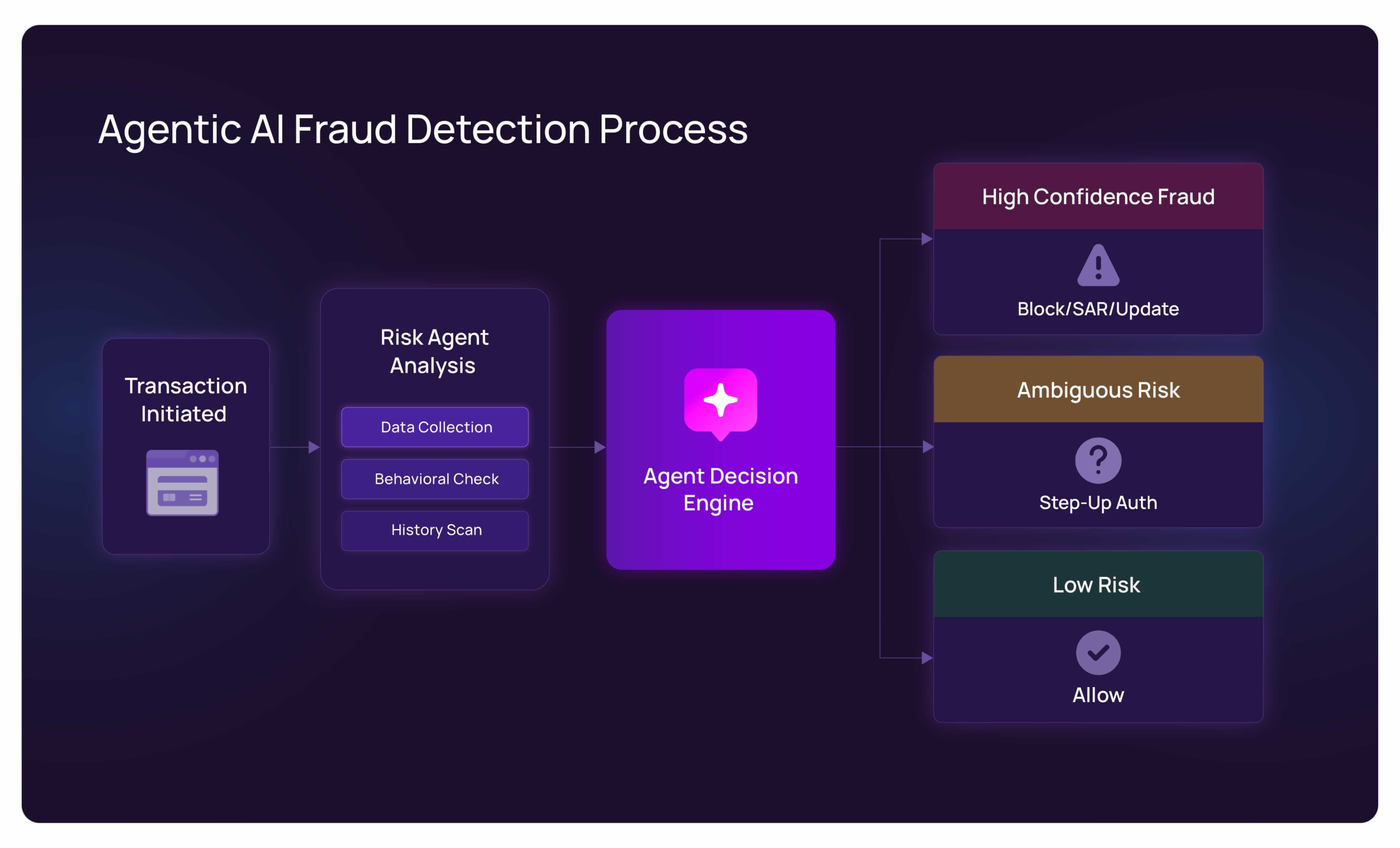
In the agentic workflow the “Human Review Queue” is largely bypassed for clear-cut cases. This speed is vital.
Strategic Implementation Areas
Banks are deploying these agents across several critical domains.
Anti Money Laundering (AML)
Money laundering involves complex networks of transfers designed to obscure the source of funds. Human analysts often struggle to see the full web of connections. AI agents excel here. They can trace funds across borders and institutions instantly.
The benefits of AI in preventing financial crime are most visible in AML where agents can draft Suspicious Activity Reports (SARs) automatically.
Transaction Monitoring
Real-time monitoring is the frontline of defense. Agents analyze user behavior to establish a baseline of “normal” activity. When a deviation occurs, such as a login from an unusual location combined with a high-value transfer, the agent intervenes.
Such as proactive stance is crucial. An instance of this is seen in the case of Mastercard, which in 2024 had deployed a RAG-enabled voice detection system that achieved a 300% boost in fraud detection rates.
KYC and Onboarding
The “Know Your Customer” (KYC) process is often a friction point. Agents streamline this by verifying documents and checking watchlists in seconds. They can also detect synthetic identities, such as fake personas created by combining real and fabricated information, which are becoming a primary tool for fraudsters.
The Operational Impact
Adopting agentic AI risk management delivers measurable operational gains.
- Efficiency: Automated investigations reduce manual workloads by 30-50%. This allows human analysts to focus on high-level strategy rather than routine alert clearing.
- Accuracy: AI agents reduce false positive rates by up to 80%. This reduction directly improves customer satisfaction as legitimate users face fewer blocked transactions.
- Speed: Response times drop from hours or days to milliseconds. In a digital economy this speed is the difference between preventing a loss and attempting to recover one.
The ROI of AI Defense
| Metric | Traditional System | Agentic AI System | Improvement |
|---|---|---|---|
| False Positive Rate | High (often >90%) | Low (<20%) | ~80% Reduction |
| Detection Rate | Baseline | +25–30% | Significant Boost |
| Investigation Time | Hours/Days | Seconds/Minutes | Near Real-Time |
| OpEx Reduction | N/A | 30–50% | Major Savings |
Overcoming Implementation Challenges
Deploying ai agents for fraud detection requires careful planning. Institutions must address data privacy and model explainability and regulatory compliance.
Data Silos
Agents need access to data from across the organization to function effectively. Banks must break down silos between credit card and loan and deposit departments to create a unified data lake.
Explainability
Regulators require banks to explain why a decision was made. “Black box” AI models are unacceptable. Institutions are adopting “Glass Box” approaches where the agent provides a rationale for every action such as “Blocked due to velocity of transfers exceeding 30-day average by 500%.”
The Human Agent Team
The goal is not to replace human analysts but to augment them. Agents handle the volume while humans handle the nuance. This collaborative model ensures that ethical considerations and complex judgment calls remain under human oversight.
Future Trajectory
The trajectory is clear. By 2025 the fraud detection agent segment alone accounted for 33.8% of the revenue share in the financial services market. As these systems mature they will move from reactive defense to predictive immunity. Agents will simulate attacks against their own systems to find vulnerabilities before criminals do.
Financial institutions that hesitate to adopt agentic AI in fraud prevention risk falling behind. The sophistication of attacks will only increase. The only viable defense is a system that learns and adapts faster than the attackers.
Conclusion
Risk management in banking has entered a new era. The integration of agentic AI risk management provides the necessary tools to combat modern financial crime.
By leveraging autonomous agents banks can secure their operations and protect their customers and drive operational efficiency. The data is compelling and the technology is proven and the necessity is absolute. The future of banking security is agentic.
At Appstek Corp we specialize in deploying Agentic AI solutions tailored for the financial sector. Our multi-agent orchestration frameworks are designed to handle complex workflows from mortgage underwriting to real-time fraud detection ensuring enterprises remain resilient against evolving threats.
By replacing brittle rule-based systems with adaptive AI agents we help banks achieve scalable automation and deeper foresight. Contact us today to learn how our Agentic AI services can transform your risk management operations.
Frequently Asked Questions (FAQs)
AI agents monitor transactions in real time, scoring each event against behavioral baselines and network-level risk signals simultaneously, typically a process that takes milliseconds versus hours in manual review queues. Because agents learn from confirmed fraud patterns continuously, accuracy improves over time rather than degrading as fraudsters adapt to static rule sets.
Agentic AI enforces compliance by embedding regulatory controls directly into automated workflows, including screening transactions against current sanctions lists, applying jurisdiction-specific AML thresholds, and generating audit-ready decision logs at every step. Policy updates propagate to agents without manual rework, reducing the lag between regulatory change and operational implementation.
Yes. Agents connect to core banking platforms through REST APIs and event-driven integrations, consuming transaction streams and customer data in real time without requiring changes to the underlying system.
Yes. Each agent action, including data retrieved, rules applied, risk score assigned, decision reached, is logged to an immutable audit trail with timestamps and reasoning context. Investigators and regulators can replay the full decision sequence for any flagged case, satisfying explainability requirements without manual reconstruction.

About The Author
Myrlysa I. H. Kharkongor is Senior Content Marketer at AppsTek Corp, driving content strategy for the company’s digital engineering services to enhance brand presence and credibility. With experience in media, publishing, and technology, she applies a structured, insight-driven approach to storytelling. She distills AppsTek’s cloud, data, AI, and application capabilities into clear, accessible communications that support positioning and grow the brand’s digital footprint.