



The era of the solitary AI chatbot is ending. While virtual assistants have impressed us with their ability to draft emails or answer basic queries, forward-thinking enterprises are hitting a ceiling. They are discovering that no single AI model can excel at everything or handle the sheer complexity of modern business operations that span multiple departments and data systems.
The future belongs to Multi-Agent Orchestration (MAO), a paradigm shift that transforms isolated AI capabilities into a coordinated, intelligent workforce.
What is Multi-Agent Orchestration?
Multi-Agent Orchestration is the coordinated management of multiple specialized AI agents working together as a unified, goal-driven system. Rather than relying on a single, monolithic model to handle every task, MAO employs a network of agents where each possesses distinct capabilities, roles, and domain expertise.
Think of it as a digital symphony. Just as a conductor ensures that the strings, woodwinds, and percussion sections play in harmony to create a complex piece of music, an orchestration layer coordinates specialized agents by assigning tasks, resolving conflicts, and synthesizing results to achieve outcomes no single agent could accomplish alone.
Core Components of an Agentic AI Architecture
- The Orchestrator: A central control layer that breaks down complex goals into subtasks, assigns them to the most capable agents, and monitors progress.
- Specialized Agents: Independent units designed for specific functions, such as a “coding agent,” a “legal compliance agent,” or a “customer service agent”.
- Shared Context: A memory system that preserves institutional knowledge, allowing agents to exchange information and maintain continuity across workflows.
- Governance: Rules and guardrails that ensure agents operate within ethical and operational boundaries.
Why is Multi-Agent Orchestration Important?
As businesses move from experimenting with AI to seeking genuine return on investment (ROI), orchestration becomes the critical differentiator. Without it, companies are left with “AI silos”, fragmented automation tools that cannot communicate or collaborate.
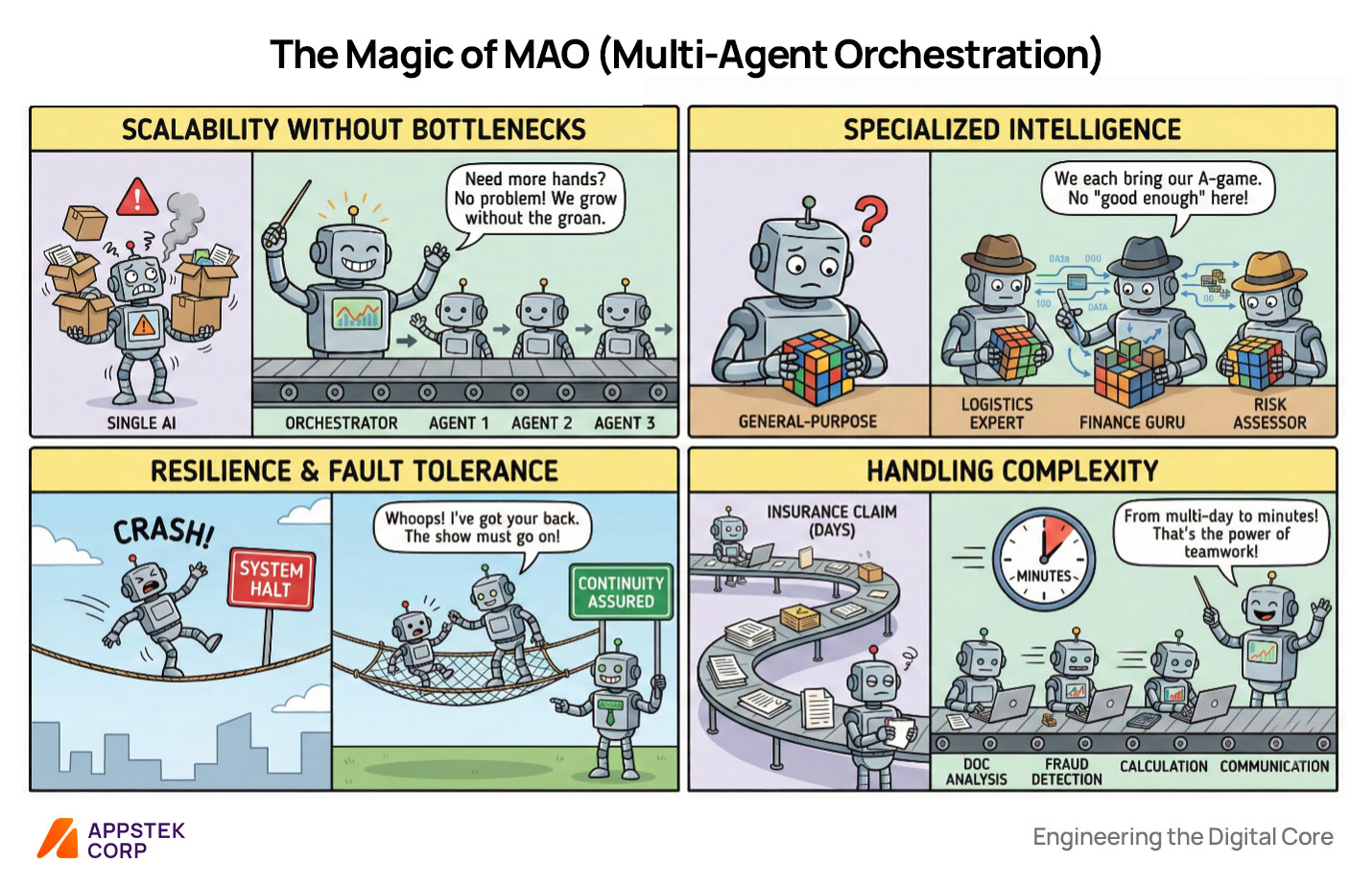
- Scalability Without BottlenecksIn traditional setups, adding more functionality to a single AI model often degrades its performance. Orchestration allows enterprises to scale by adding new, modular agents without breaking existing workflows.
- Specialized IntelligenceA generalist AI might be “good enough” at many things, but business processes requireexpertise. MAO allows organizations to deploy agents that are experts in specific domains (e.g., supply chain logistics or financial risk assessment) and have them collaborate seamlessly.
- Resilience and Fault ToleranceIn a single-agent system, if the model fails, the entire process halts. In an orchestrated network, if one agentencounters an issue, the work can be redistributed to others, ensuring business continuity.
- Handling ComplexityReal-world enterprise tasks,like processing an insurance claim, require document analysis, fraud detection, payment calculation, and customer communication. MAO enables these distinct steps to happen in parallel or sequence, reducing multi-day workflows to mere minutes.
Solving the Challenge with Pragmatic AI
While the promise of autonomous agents is exciting, the reality is that ambition often outruns execution. Many firms struggle to scale because intelligence lives in fragments rather than a cohesive system. This is where the philosophy of Pragmatic AI comes into play.
Pragmatic AI focuses on building for real operations, real constraints, and real outcomes. It shifts the focus from “buzz” to business value, ensuring that AI systems are scalable, predictive, and autonomous.
The Enterprise Framework for Agentic AI Adoption
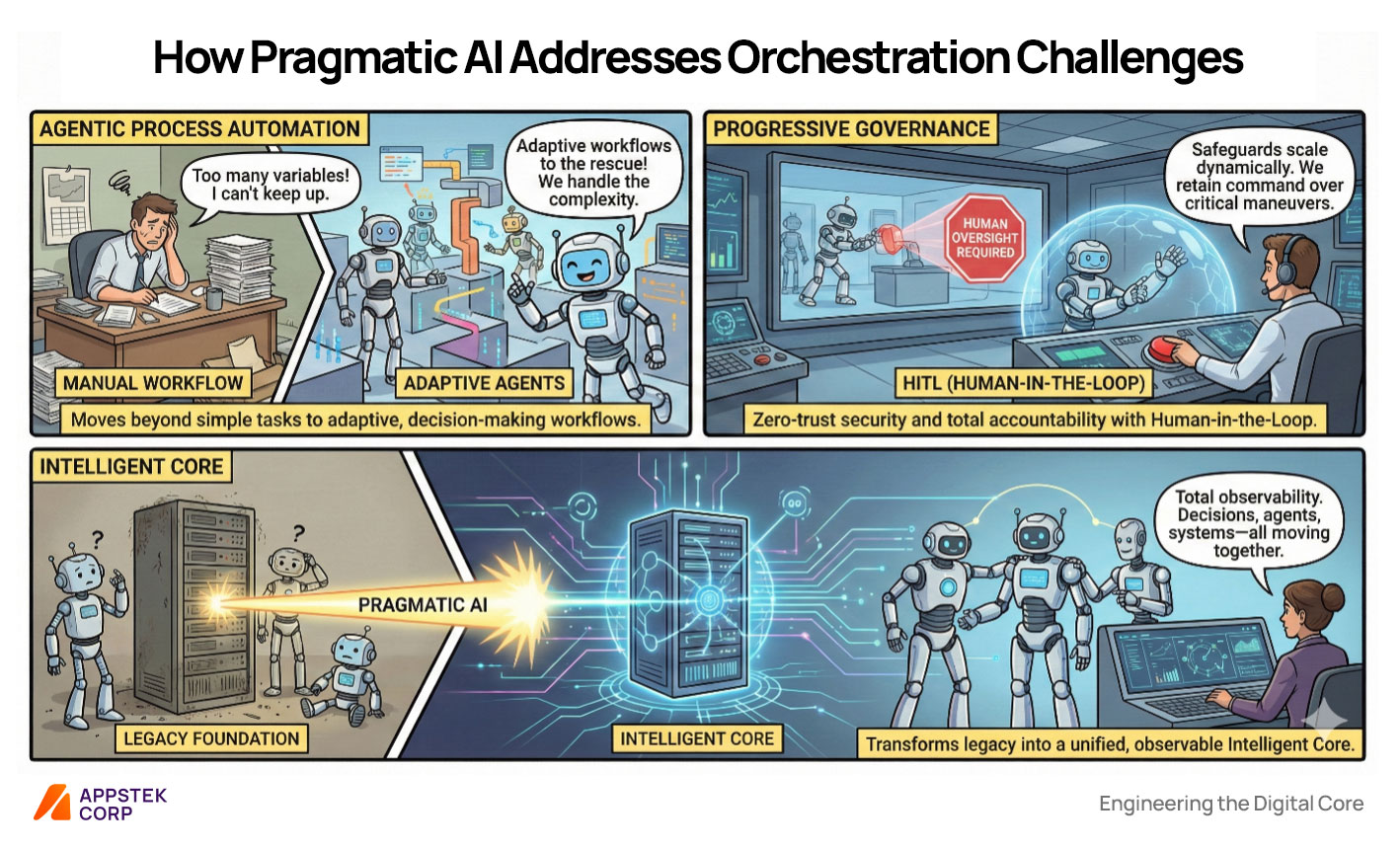
- Agentic Process Automation: It moves beyond simple task automation to adaptive workflows. This allows systems to handle variable, complex processes with decision-making capabilities that are significantly faster than manual coordination.
- Progressive Governance: One of the biggest fears regarding autonomous agents is the loss of control. Pragmatic AI solves this through governance that scales safeguards dynamically. It employs “Human-in-the-Loop” (HITL) protocols where experts retain command over critical maneuvers, ensuring zero-trust security and total accountability.
- Intelligent Core: Instead of treating AI as an add-on, Pragmatic AI seeks to transform a company’s legacy foundation into an “Intelligent Core”. This involves creating a structure where agents, systems, and decisions move together, providing observability so leaders know what the intelligence is doing without having to chase it.
How AppsTek Corp Helps Companies
In an era where many AI initiatives stall at the “proof of concept” stage, AppsTek Corp stands apart by focusing on the Digital Core. They recognize that the bridge between a successful pilot and enterprise-scale ROI is built on structural integrity, not just innovative algorithms.
AppsTek Corp transforms “ambitious AI” into Pragmatic AI through a three-pillared strategy designed for stability, scalability, and measurable impact.
1. Deploying Functional Agentic Solutions
Pragmatic AI moves beyond conversation to execution. AppsTek Corp deploys digital teammates that don’t just “chat”; they reason, collaborate, and act within the enterprise ecosystem.
- Reasoning-Driven Action: Instead of simple automation, these agents break down complex problems and execute real-time tasks. By fetching live data and interacting with external systems, they complete end-to-end workflows autonomously.
- Contextual Customization: Through Agentic Language Model Customization, AppsTek ensures that AI models are not generic. They are fine-tuned to understand specific enterprise contexts and brand identities, ensuring every interaction is intelligent and aligned.
2. Ensuring Operational Resilience & Observability
A pragmatic approach acknowledges that AI is only as good as the infrastructure supporting it. To handle the heavy load of autonomous activity, AppsTek stabilizes the systems behind the intelligence.
- Agentic Engineering: This involves building the technical backbone necessary for seamless human-AI collaboration, orchestrating complex tasks across disparate, legacy, and modern systems.
- Agentic Observability: To maintain trust, AppsTek implements real-time monitoring. This ensures agents remain accountable and transparent, identifying anomalies before they impact the business.
- Continuous Management: Through AI Managed Services, the focus remains on business continuity. This includes ongoing model support, retraining, and infrastructure management to prevent “model drift.”
3. Delivering ROI-First Transformations
At its core, Pragmatic AI is about shifting the focus from technological curiosity to economic necessity. AppsTek Corp eliminates the “uncertainty gap” of experimental AI by implementing disciplined, strategy-led roadmaps that prioritize the bottom line.
The Pragmatic AI Principle: Moving the enterprise from “what is possible” to “what is profitable.” By anchoring every deployment in measurable outcomes, AppsTek ensures that AI isn’t just a line item it’s a value driver.
Pragmatic AI in Action: Industry Success Stories
AppsTek Corp proves that agentic workflows solve real-world bottlenecks, delivering speed and accuracy where it matters most:
- Banking & Financial Services: By deploying Agentic Process Automation, AppsTek redefined the client onboarding experience. What previously took weeks of manual data entry and verification is now completed in minutes, drastically accelerating client acquisition and revenue capture.

- Animal Health: In highly specialized sectors, AppsTek enabled smarter verification and faster care protocols. By reducing manual intervention, they proved that Pragmatic AI can adapt to complex, niche requirements while maintaining high standards of reliability.
Conclusion: Turning AI Ambition into Operational Reality
In the modern enterprise, “good enough” AI is no longer a competitive advantage. To achieve genuine ROI, businesses must solve the fragmentation of AI silos through disciplined orchestration and specialized intelligence.
AppsTek Corp’s focus on the Digital Core ensures that your journey toward autonomy is grounded in structural integrity and measurable outcomes. Whether it’s reducing onboarding from weeks to minutes or cutting operational costs by 28%, the goal of Pragmatic AI remains the same: transforming complex, manual bottlenecks into streamlined, autonomous value drivers. The experiment is over, the era of the autonomous enterprise has arrived.
If your organization is ready to move from isolated AI initiatives to coordinated, enterprise-scale execution, AppsTek Corp provides the architectural discipline, governance frameworks, and operational engineering required to make autonomy practical and sustainable. Reach out to our experts to explore how your AI strategy can translate into stable, measurable operational outcomes.
Frequently Asked Questions (FAQs)
Multi-agent orchestration decomposes complex processes into specialized sub-agents that run in parallel, coordinated by a central orchestrator. Unlike single-agent pilots constrained by one model's context window, orchestrated systems scale throughput proportionally with agent count, enabling order-of-magnitude volume increases without rewriting automation logic.
Organizations report gains across four areas: reduced cycle time from parallel execution, higher straight-through processing rates from improved classification, lower cost-per-transaction as manual touchpoints are eliminated, and reduced error rates from deterministic task routing.
Governance requires four controls: role-based access defining what each agent can invoke, immutable audit logs capturing every agent action and decision, human escalation gates that pause flows when confidence falls below threshold, and policy enforcement layers that validate outputs before downstream propagation.
Yes. A connector agent exposes legacy ERP data through a secure API abstraction while transformation agents normalize it before passing it to AI applications. The orchestration layer handles schema translation between legacy and modern systems, eliminating the need to modify the underlying platform.
A focused deployment covers three phases: four to eight weeks for architecture and piloting, eight to sixteen weeks for expansion with governance and monitoring, then ongoing optimization from production telemetry. Most organizations reach measurable business impact within three to five months.

About The Author
Rahul Sudeep, Senior Director of Marketing at AppsTek Corp, is a results-driven, AI-first B2B marketing leader with 15 years of experience scaling global enterprise SaaS companies. His expertise, honed at IIM-K, spans architecting high-impact go-to-market strategies, driving new market identification and positioning, and embedding Generative AI, LLMs, and predictive analytics into the core marketing function. Rahul unifies Technology, Sales, and Support teams around a single strategic hub, while also managing key Partner and Investor Relations. He leverages AI-driven insights to craft powerful brand narratives and hyper-personalized demand generation campaigns that drive measurable revenue growth and deepen customer engagement.