

Table of Contents
Procurement Transformation as a Systemic Risk for CPOs and CDOs

Despite substantial capital investment in digital transformation over the past decade, the failure rate for procurement modernization initiatives remains critically high. Industry analysis indicates that between 70% and 80% of these projects fail to meet their defined business objectives.
For Chief Procurement Officers (CPOs) and Chief Digital Officers (CDOs), this statistic represents a systemic operational risk. However, the root cause is rarely the underlying technology. Most procurement transformations fail not because the “back-end” logic is wrong, but because the “front-end” creates friction for the user.
Historically, organizations have approached change management in procurement as a communications challenge. Strategies have prioritized didactic training modules and broad-spectrum internal messaging. This premise has proven fundamentally flawed. The Adoption Gap is not a function of inadequate communication; it is a consequence of deficient design architecture.
How One-Size-Fits-All Design Drives Off-System Procurement

Legacy procurement platforms frequently suffer from a “mile wide, inch deep” architectural flaw. These systems are designed as Systems of Record which are rigid data repositories optimized for audit trails and financial governance.
However, they fail as Systems of Engagement which are the actual tools users need to execute their daily tasks. This misalignment creates a “Shadow Process” economy. Since the official system enforces a “one-size-fits-all” uniformity that ignores operational reality, users create their own workflows outside the system. They rely on email chains, spreadsheets, and side-channel negotiations to get work done, only entering data into the ERP at the last possible moment.
The economic consequences of this design failure are severe:
- Information Silos: Disconnected processes between Procurement, AP, and Supply Chain lead to compliance blind spots and late payments.
- Maverick Spend: When compliant purchasing channels present excessive friction, users default to unauthorized channels. Maverick spend typically accounts for 10-15% of total procurement spend, eroding approximately 12-18% of negotiated savings.
- Data Integrity Degradation: Complex user interfaces precipitate poor data quality. Users frequently select default options or input invalid data to bypass mandatory fields, compromising analytics platforms.
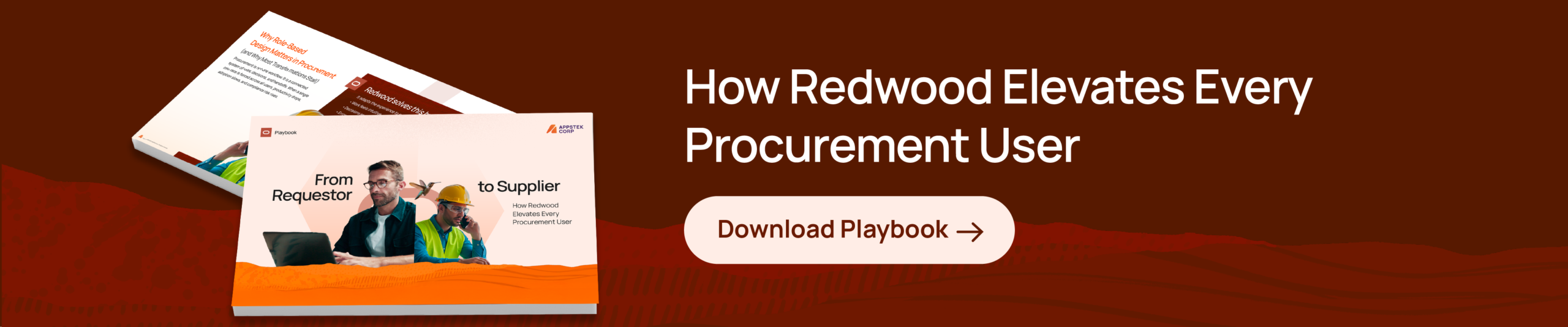
Role-Based Design as an Operating Layer

In legacy architectures, user experience is largely static. Every user is exposed to the same navigation structures, forms, and validation logic, regardless of role, frequency of use, or transaction intent. Complexity is managed through training rather than design.
A role-based operating layer inverts this model. Under Oracle Redwood-aligned architecture:
- Interaction patterns adapt based on user role, location, and authorization context.
- System logic infers defaults rather than requiring manual input.
- Compliance rules are embedded into the transaction flow instead of being documented externally.
This shifts procurement systems from instruction-driven usage to behavior-guided execution, reducing reliance on training and post-transaction remediation.
Responsive Self-Service Procurement
Responsive Self-Service Procurement is best understood not as a feature set, but as an emergent capability of this architectural model.
When engagement is designed around intent rather than process sequence, several outcomes follow naturally:
- Intent-Driven Discovery: Search-first interaction models allow users to express need in business terms, while the system resolves categorization, sourcing rules, and eligibility in the background.
- Context Preservation Across Devices: Responsive interaction models support transaction continuity across desktop and mobile environments without altering business logic or data integrity.
- Minimal Cognitive Load for Casual Users: Interfaces are optimized for infrequent users by reducing visible options to those relevant to the current task, eliminating the need for deep procedural knowledge.
The result is not the elimination of complexity, but its containment within the system, rather than offloading it onto the user.
Upstream Error Prevention Through Embedded Intelligence
One of the most measurable impacts of a role-based engagement layer is the reduction of upstream errors.
In traditional environments, procurement operations teams function as downstream correctors, resolving issues introduced during requisition creation, such as incorrect accounting, incomplete documentation, or policy violations.
A persona-aware operating layer reverses this dynamic:
- Predictive Defaults
Accounting, shipping, and project attributes are inferred from user and organizational context, reducing manual entry and error probability. - Guided Transaction Paths
Complex purchasing scenarios are handled through conditional flows that expose only policy-compliant options at each step. - Contextual Policy Enforcement
Compliance guidance is delivered in-line and in-context, replacing static documentation with real-time decision support.
This architectural approach by Oracle Redwood transforms procurement operations from a corrective function into a preventive one, improving data quality, cycle time, and compliance outcomes simultaneously.
| Dimension | Legacy Procurement Architecture | Redwood-Aligned Engagement Architecture |
|---|---|---|
| Interaction Model | Hierarchical, menu-driven | Search-first, intent-driven |
| User Experience | Uniform across roles | Role- and context-aware |
| Device Model | Desktop-centric, VPN-dependent | Responsive, device-agnostic |
| Data Entry | Manual, error-prone | Predictive defaults and guided inputs |
| Compliance Model | Enforced post-transaction | Embedded at point of action |
| Extensibility | Custom code, IT-dependent | Configuration-led, low-code |
| Training Dependency | High, mandatory | Minimal for casual users |
How Persona Mapping Drives Sustainable Adoption

For executive leadership, the strategic imperative is clear: transition from “Process Mapping” to “Persona Mapping.”
Process Maps represent idealized, linear workflows that often fail to account for operational reality. Persona Maps acknowledge the specific constraints, contexts, and objectives of distinct user groups.
Procurement change management initiatives fail when designed for the Process Map. They succeed when designed for the Persona Map. Moving from “Process Maps” to “Persona Mapping” is the only way to ensure sustained, near-universal adoption.
The Persona Mapping Framework
To bridge the Adoption Gap, transformation strategies must be audited against three core criteria:
- User Intent Analysis: Beyond job title, what is the specific objective of the transaction? (e.g., rapid operational purchase vs. strategic sourcing event).
- Friction Minimization: What is the minimum viable interaction required? Can system logic infer data points to reduce manual input?
- User Value Proposition: How does the system deliver tangible value to the user (speed, visibility) rather than solely to the enterprise (compliance)?
The Redwood design system provides the technical framework to execute this strategy, enabling the deployment of distinct, persona-optimized experiences on a unified data foundation.
Operational Case Study on Persona-Led Design for Field Engineers

Consider the use case of a Field Engineer requiring a replacement component.
Legacy Process Workflow:
- VPN Authentication.
- Navigation to “Create Requisition” module.
- Manual search (high failure rate due to nomenclature variance).
- Manual GL Account selection (high error probability).
- Manual Ship-To address entry.
- Submission and latency.
Oracle Redwood Persona Workflow:
- Mobile application access via tablet.
- QR code scanning of the component.
- Automated identification of part, location, and project code.
- One-click order execution.
The distinction lies in compliance velocity. The legacy process encourages non-compliant behavior (e.g., off-contract purchasing). The Redwood process establishes the compliant path as the path of least resistance.
Conclusion
Forcing user adaptation to rigid software architectures is no longer a viable strategy. Modern enterprise software must adapt to the user.
For CDOs addressing transformation fatigue, this shift offers a viable path to engagement. It requires a move beyond communication campaigns to the delivery of superior interface design that respects stakeholder time and intelligence.
For Procurement Heads, this represents the only viable path to 100% compliance. Compliance cannot be mandated; it must be engineered into the user experience.
The Oracle Redwood interface and Responsive Self Service Procurement are not merely feature sets. They are the architectural bridge across the Adoption Gap, facilitating a shift from process enforcement to user enablement.
Ultimately, the most effective change management strategy is the deployment of a system that inherently facilitates adoption. Check how you can make a business case for procurement modernization with redwood.
To explore more insights on procurement modernization and Oracle Cloud solutions, visit our Oracle success stories and Playbooks.
Ready to close the adoption gap in your organization? Contact our experts at AppsTek Corp today to schedule a consultation and discover how we can engineer a user-centric procurement strategy for your enterprise.